
BuddhistCatholicContemplativeEvangelicalGeneral ChristianHinduJewishLatter-day SaintMuslimNew VisionsProgressive Christian
Beliefs
- Buddhist
- Catholic
- Contemplative
- Evangelical
- General Christian
- Hindu
- Jewish
- Latter-day Saint
- More Voices
- Muslim
- New Visions
- Pagan
- Progressive Christian
Topics
- Religion News
- Food and Religion
- Sports and Religion
- Religious Art
- Religious Music and Entertainment
- Religious Events
- History and Religion
- Style and Religion
- Politics and Religion
- Women in Religion
- Recreation Outdoors and Religion
- Business Finance and Religion
- Careers Workplace and Religion
- Education and Religion
- Family Parenting and Religion
- Health Fitness and Religion
- Home and Religion
- Relationships and Religion
- Technology and Religion
- Travel and Religion
Columnists
- Buddhist Columnists
- Business Finance and Religion Columnists
- Careers Workplace and Religion Columnists
- Catholic Columnists
- Contemplative Columnists
- Education and Religion Columnists
- Evangelists Columnists
- Family Parenting and Religion Columnists
- General Christian Columnists
- Health Fitness and Religion Columnists
- Hindu Columnists
- History and Religion Columnists
- Home and Religion Columnists
- Jewish Columnists
- More Voices Columnists
- Latter Day Columnists
- Muslim Columnists
- New Visions Columnists
- Nonreligious Columnists
- Pagan Columnists
- Politics and Religion Columnists
- Progressive Columnists
- Recreation Outdoors and Religion Columnists
- Relationships and Religion Columnists
- Religion News Columnists
- Religious Art Columnists
- Religious Events Columnists
- Religious Music and Entertainment Columnists
- Sports and Religion Columnists
- Style and Religion Columnists
- Technology and Religion Columnists
- Travel and Religion Columnists
- Women in Religion Columnists
Resource Library
- 2026 Calendar
- Library of World Religions
- The 100 Most Holy Places on Earth
- Patheos Answers
- Podcasts
- Videos
- Faith Leaders Database
- Anglican Episcopalian
- Bahai
- Baptist
- Buddhism
- Christianity
- Confucianism
- Eastern Orthodoxy
- Hinduism
- Holiness and Pentecostal
- ISKCON
- Islam
- Judaism
- Lutheran
- Methodist
- The Church of Jesus Christ of Latter-day Saints
- New Age
- Paganism
- Presbytarian and Reformed
- Protestantism
- Religion Behind the Scenes
- Roman Catholic
- Scientology
- Shia Islam
- Sikhism
- Sufism
- Sunni Islam
- Taoism
- Zen
- See all religions
Research Tools
 Ad-Free & Subscriber Log-In Subscription Support
Ad-Free & Subscriber Log-In Subscription Support
Follow Patheos 

- Trending:
- Forgiveness
- |
- Marriage
- |
- Consciousness
- |
- Death Penalty
- |
- Election
- |
- Halloween

- Home
- Catholic
- Religious Music & Entertainment
- ‘Shōgun’: Japan, Catholicism & the Joys of a Well-Told Tale
‘Shōgun’: Japan, Catholicism & the Joys of a Well-Told Tale
Last updated on: May 5, 2024 at 9:00 am by Kate O'Hare
‘Shōgun’: Japan, Catholicism & the Joys of a Well-Told Tale 2024-05-05T09:00:55-08:00 Kate O'Hare
Patheos Explore the world's faith through different perspectives on religion and spirituality! Patheos has the views of the prevalent religions and spiritualities of the world.
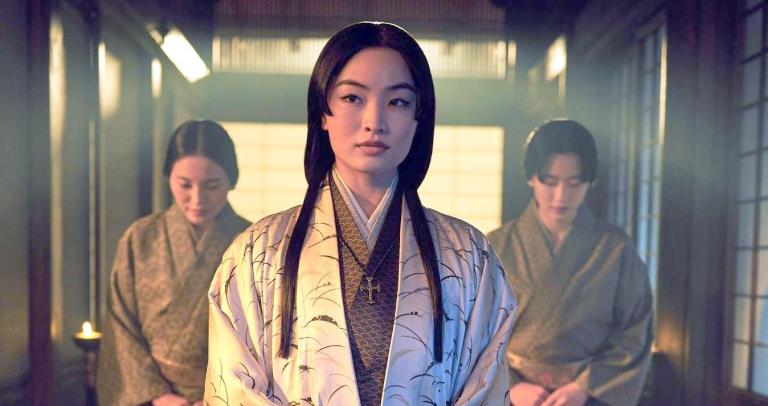
Back in 1980, NBC’s miniseries adaptation of James Clavell’s 1975 historical novel Shōgun landed with a bang. Starring heartthrob Richard Chamberlain as a British privateer in 1600 feudal Japan, it set off a craze for all things Japanese — and for miniseries (building on 1977’s Roots).
I’ll admit to fear and trepidation back in February, when I sat down to watch the new, 10-episode version of Shōgun airing on FX and streaming on Hulu. I needn’t have worried. The 2024 Shōgun is different from the 1980, but in no way worse — and in many ways, better than I expected.
And how does it treat Catholicism? I’ll get to that.
(Mild language warning on the trailer.)
What Is Shōgun About?
As I said up top, the story begins with the arrival of John Blackthorne (Cosmo Jarvis), a British privateer aboard a Dutch sailing vessel that shipwrecks off the coast of Japan in 1600. He’s no explorer. As described by Britannia.com, a privateer is “a pirate with papers.”
The Real Blackthorne
Blackthorne is based on the real-life Brit William Adams, the beginning of whose story closely tracks Blackthorne’s. In the interest of avoiding spoilers, you can read more about him here, and more about the real-life Japanese power struggle here.
At the behest of the government of Britain’s Queen Elizabeth I, Blackthorne’s there to disrupt the established Spanish and Portuguese trade in Asia (which came with Jesuit missionaries). He’s an adamant and very vocal anti-Catholic Protestant, but mostly, his mission is about money.
The Catholic Spanish and Portuguese pioneered trading in China, Japan and surrounding areas, and the Anglican Brits want a piece of it.
As as aside, being an American of Irish ancestry, it’s a real howler to hear an Englishman complaining about how other European countries carve up new lands seeking profit. Heh.
In Japan, Blackthorne finds himself in the middle of a brewing civil war among feudal lords vying for power in the wake of the death of a ruler, whose heir is just a child.
The Real Mariko
His guide is Lady Toda Mariko (Anna Sawai) — surname goes first — an enigmatic, unhappily married noblewoman. A convert to Catholicism, she’s loosely based on Lady Hosokawa Gracia, a Catholic who was embroiled in the real-life political struggle that inspired Clavell’s fiction (but who, in real life, never met Adams).
As the lone survivor of her family, sentenced to death when her father was accused of treachery, Mariko is haunted and melancholy.
Mariko is fluent in Portuguese and English, having been taught by Portuguese Jesuit missionaries. So, her liege lord, Yoshii Toranaga (actor and producer Hiroyuki Sanada) assigns her to translate for Blackthorne, who also speaks Portuguese.
(Mariko’s on-the-fly editing between Blackthorne’s words and what she says he said offers moments of unexpected humor.)
While he is openly and relentlessly hostile to all things Catholic, Blackthorne does warm up to Mariko, and vice versa. But both are at the mercy of forces larger than themselves.
Is Shōgun Historically Accurate?
More or less. Clavell took real Japanese history and fictionalized it.
Some critics of the 1980 miniseries complained that Blackthorne — while based on a real person — was too central to the plot, at the expense of Japanese characters. But, considering the production cast Chamberlain, an established star, that’s no surprise.
Here, while Jarvis does great work in the role, he’s hardly better known to American audiences than the rest of the cast, which includes many Japanese actors who’ve never worked outside of their homeland.
In a nod to modern sensibilities, the American executive-producing team of spouses Justin Marks and Rachel Kondo (who is of Japanese descent) went to great lengths to ensure period accuracy in setting (filming actually took place around Vancouver, Canada), costuming and language.
They also made Blackthorne, rather than the central character, just one of the major figures in the overall power struggle.
And, as might be expected these days, much attention is focused on Mariko. But, unlike a lot of “you go, girl”-ness that we see today, where female characters are overemphasized and portrayed as superior in every way, Mariko’s abilities don’t exceed what we saw in 1980 — and are realistic for the period.
Mariko is also hardly more impressive than Hosokawa Gracia, whose story is told here:
Also, this story takes place less than 20 years before the brutal persecution of Christians began in Japan, as depicted in the Martin Scorsese film Silence, based on the novel by Shūsaku Endō. More on that here.
Being Faithful to the Truth of the Era
Shōgun succeeds where many productions today fail. No character here represents a modern political or social ideology. They’re all humans, caught up in a struggle in a particular place and time. Their actions and attitudes are also appropriate for the place and time — with no one expressing anachronistic contemporary ideas.
Blackthorne does speak negatively about his homeland, especially the city of London, and his hygiene and habits are definitely not equal to Japanese standards. But, then, he’s an ordinary Englishman sojourning among the highest ranks of polite Japanese society.
If one can imagine an ordinary Japanese sailor taken to the palaces, manor homes and cathedrals of Renaissance Europe, he would probably be just as out of place and amazed.
How James Clavell Imagined the Japanese World of Shōgun
Clavell himself (whose daughter Michaela is an executive producer on Shōgun) seems to have had a deep appreciation for Asian culture — perhaps at the expense of respect for his own, at least in Shōgun.
Born in Australia, later an American, and held as a prisoner of the Japanese during World War II, Clavell — a filmmaker, screenwriter and prolific novelist — did have a broad experience of the world.
But that doesn’t mean he always got it right, from a Japanese perspective.
Issues With Clavell’s Novel
A review in the Tokyo Weekender explains the many ways the miniseries versions avoid the pitfalls of Clavell’s novel, from its treatment of the female characters to its depiction of samurai life.
The historical confusion in Shogun is ultimately a problem with the novel, not the miniseries. As an adaptation, the miniseries had to stick with the original, needlessly made-up names while trying to fix as many of the book’s other problems without straying too far from it.
A historian said of Clavell’s book:
Whereas Western man, as symbolised by Blackthorne, is depicted as ridden with shame over sex, obsessed with a fear of death, raised on an unwholesome diet of animal flesh and alcohol, and terrified of bathing, the Japanese are represented as paragons in each particular. They view sex and nudity as wholly ‘natural’, are able to face death with composure and even eagerness, eat only fish (preferably raw), rice, and pickles, and of course are wholly addicted to the pleasures of the hot bath.
It is precisely this rather didactic contrast that gives Shōgun so much of its interest, both for the average reader and for the historian. Clavell is in effect delivering a sermon on the errant ways of the West. More specifically, he is delivering a polemic against the Christian church for instilling in Western man his (in Clavell’s view) distorted attitudes to sex, death, and cleanliness.
This anti-Christian tone runs throughout Shōgun and manifests itself most clearly in the depiction of the European Jesuits. Although no responsible historian would claim that the Jesuits were without their faults as missionaries in Japan, it is hard to find the priests of Shōgun as anything but caricatures.
That’s not the case in the miniseries version of Shōgun.
Catholicism in Shōgun
There’s no doubt that the Jesuit missionaries were entwined with both the Spanish and Portuguese governments, but they weren’t the government itself — which ran the trade routes.
While the priests in Shōgun know where they stand — between the Japanese regime and their own rulers — at least one of them, Mariko’s confessor Father Martin (Tommy Bastow), is portrayed as thoughtful and sincere in his faith.
Catholicism is a world religion. It belongs solely to no one culture nor one group of people. Within the limits of dogma and Sacred Tradition, each culture that embraces it brings its own unique ways of worship.
It was no different for the Catholics of feudal Japan, but there are some things in that culture that stand in opposition to Catholic teaching. As a woman caught between two worlds, Mariko is faced with hard choices. But, still, this is fiction, not history.
Mariko, Sex and Death (SOME SPOILERS)
Both as a Catholic and a highborn, married Japanese woman, if she values her salvation and her very life, Mariko should never have sex outside her marriage — let alone with a “barbarian.” And yet …
Well, we can say that this romance came from Clavell’s novel, and it’s not necessarily consistent with either Mariko’s faith or her situation in Japanese society.
And then there’s the ritual suicide.
In the penultimate episode, Mariko is faced with the prospect of her duty to her liege lord compelling her to commit suicide. I worried how this would be handled, but as it turns out, Shōgun dealt with it in a rather graceful way.
Mariko acknowledges the potential mortal sin and tries to find a way around it. When that falls through, she realizes that her duty will result in her eternal condemnation. So, rather than rationalizing her way around Hell, she accepts it as the cost of doing her duty.
So, does she kill herself? You’ll have to watch to find out, but the solution in the story is elegant.
Should You Watch Shōgun?
I say, absolutely, with the understanding that there is some language, sexual situations, a bit of nudity, and lots of violence, so I’d keep it to mature middle-schoolers and up.
Also, like Netflix’s The Crown, which wove fictionalized stories with real characters, and HBO’s The Gilded Age, which mixed real and fictional characters, Shōgun offers an opportunity to learn about real history. There are plenty of articles, blog posts and videos examining all aspects of the story (like the one on Hosokawa Gracia, embedded above), along with several produced as companions to the show.
By the way, along with the original version of Shōgun, which features copious Japanese dialogue, subtitled in English, Hulu also offers a second version, dubbed in English. As I did with the Korean-language Squid Game, I watched it first in the original, then did a re-watch with the dubbed version — so I could pay attention to the visuals without having to read.
Shōgun and the Future of the Miniseries
Some commentary I’ve heard suggests that, despite the critical and ratings success of Shōgun, that the era of miniseries might be coming to a close. They’re expensive and splashy, but they end after only a relatively few episodes. And in the age of of bingeing, they end very quickly.
Even FX chief Jon Landgraf (widely considered a TV sage) said:
“One of the things consumers really, really want is they want libraries,” Landgraf said. “They want to bond with the show and be able to watch that show consistently and over time. “I have a real worry about what happens to television if television doesn’t create the next generation of shows like that.”
One supposes FX could concoct a sequel or prequel to Shōgun, but, honestly, I hope that doesn’t happen. The mini ends where Clavell’s story ends, and that’s as it should be. But I’d be very interested to see what Marks and Kondo do next.
Unlike high-fantasy shows, which pick and choose elements of history (especially any era with swords), the historical drama — a good one, anyway — has to be entertaining and engrossing, while doing justice to how real people lived in the past.
Shōgun did its duty to both.
All 10 episodes are available On Demand from FX and streaming on Hulu.
Image: Anna Sawai as Lady Mariko in ‘Shōgun’/FX
Don’t miss a thing: Subscribe to all that I write at Authory.com/KateOHare.
Religious Music and Entertainment

About Kate O'Hare
Based in Los Angeles, Kate O'Hare is a veteran entertainment journalist, Social Media Content Manager for Family Theater Productions and a rookie screenwriter. You can read more about the author here.
Previous Post

April 21, 2024
'I Am Iron Man': The Redemption (and Return?) of Tony Stark
Next Post

May 5, 2024 'Billy & Molly: An Otter Love Story': A Warm, Wet Delight
Recent Comments
"I read somewhere that Jesus claims to be present in the hungry, thirsty, homeless, sick……just ..."
‘Adore Him: He Is Here’: On ..."
"My husband was Key Assistant Locations Manager on this film and it was so gratifying ..."
‘Coyote vs. Acme’: Never, Ever Give ..."
"Kate, Alan owes you big time...I mean like a steak dinner or something! I have ..."
‘The Odyssey’: What a (Very) Long, ..."
"It's true: the language was prosaic American English. Yes, some of the characters were shallow ..."
‘The Odyssey’: What a (Very) Long, ..."
Browse Our Archives
Select a Category books breaking news digital media Faith practice food interview jane the virgin media movies music NFL Pope Francis Showbiz 101 social media sports technology television Uncategorized video
Select a Month October 2026 September 2026 August 2026 July 2026 June 2026 May 2026 April 2026 March 2026 February 2026 January 2026 December 2025 November 2025 October 2025 September 2025 August 2025 July 2025 June 2025 May 2025 April 2025 March 2025 February 2025 January 2025 December 2024 November 2024 October 2024 September 2024 August 2024 July 2024 June 2024 May 2024 April 2024 March 2024 February 2024 January 2024 December 2023 November 2023 October 2023 September 2023 August 2023 July 2023 June 2023 May 2023 April 2023 March 2023 February 2023 January 2023 December 2022 November 2022 October 2022 September 2022 August 2022 July 2022 June 2022 May 2022 April 2022 March 2022 February 2022 January 2022 December 2021 November 2021 October 2021 September 2021 August 2021 July 2021 June 2021 May 2021 April 2021 March 2021 February 2021 January 2021 December 2020 November 2020 October 2020 September 2020 August 2020 July 2020 June 2020 May 2020 April 2020 March 2020 February 2020 January 2020 December 2019 November 2019 October 2019 September 2019 August 2019 July 2019 June 2019 May 2019 April 2019 March 2019 February 2019 January 2019 December 2018 November 2018 October 2018 September 2018 August 2018 July 2018 June 2018 May 2018 April 2018 March 2018 February 2018 January 2018 December 2017 November 2017 October 2017 September 2017 August 2017 July 2017 June 2017 May 2017 April 2017 March 2017 February 2017 January 2017 December 2016 November 2016 October 2016 September 2016 August 2016 July 2016 June 2016 May 2016 April 2016 March 2016 February 2016 January 2016 December 2015 November 2015 October 2015 September 2015 August 2015 July 2015 June 2015 May 2015 April 2015 March 2015 February 2015
Follow Us!
TAKE THE
Religious Wisdom Quiz
True or False: Moses entered the Promised Land before he died.
Select your answer to see how you score.
TRUE FALSE
Related posts from Kate O'Hare's Pax Culturati

'The Chosen' S6 Trailer: The Passion Gets Very...

Catholic Mike Ditka: Bear of a Man of...

We Need to Talk About 'Clarkson's Farm'

'Adore Him: He Is Here': On the Red...
TRENDING AT PATHEOS Catholic

Janie Learns the Way of the Cross: A...
Teaching children about Jesus' Passion can be challenging. Many parents and educators...

Looking For Good Catholic Writing - October 2026
He alone extends the heavens, and he walks upon the waves of...

In "Irreplaceable," our book on vocation and technology, Trevor Sutton and I...

I was strolling through the top floor of the brand new Parthenon...

What Does Gêvâh Mean For Kimberley Guifoyle &...
This week, a lot of the news is focused on Kimberly Guilfoyle....

INNER CIRCLE: Profound Mystery (Of Christ In All...
Ephesians 5:31-32 “For this reason, a man will leave his father and...
view all Catholic blogs
What Are Your Thoughts?leave a comment
Ad-Free & Subscriber Log-In Subscription Support
- About Us
- 2026 Calendar
- Videos
- Podcasts
- Library of World Religions
- Faith In Media Tracker
- Advertise With Us
- Write for Us
- Privacy Policy
- Terms of Service
- Do Not Sell My Data
- Contact Us
- Radiant Digital
- Manage Newsletter Subscriptions
- Unsubscribe From Notifications
- Sitemap
Copyright 2008-2026, Patheos. All rights reserved.
Subscription Support Ad-Free & Subscriber Log-In
Follow Patheos