
BuddhistCatholicContemplativeEvangelicalGeneral ChristianHinduJewishLatter-day SaintMuslimNew VisionsProgressive Christian
Beliefs
- Buddhist
- Catholic
- Contemplative
- Evangelical
- General Christian
- Hindu
- Jewish
- Latter-day Saint
- More Voices
- Muslim
- New Visions
- Pagan
- Progressive Christian
Topics
- Religion News
- Food and Religion
- Sports and Religion
- Religious Art
- Religious Music and Entertainment
- Religious Events
- History and Religion
- Style and Religion
- Politics and Religion
- Women in Religion
- Recreation Outdoors and Religion
- Business Finance and Religion
- Careers Workplace and Religion
- Education and Religion
- Family Parenting and Religion
- Health Fitness and Religion
- Home and Religion
- Relationships and Religion
- Technology and Religion
- Travel and Religion
Columnists
- Buddhist Columnists
- Business Finance and Religion Columnists
- Careers Workplace and Religion Columnists
- Catholic Columnists
- Contemplative Columnists
- Education and Religion Columnists
- Evangelists Columnists
- Family Parenting and Religion Columnists
- General Christian Columnists
- Health Fitness and Religion Columnists
- Hindu Columnists
- History and Religion Columnists
- Home and Religion Columnists
- Jewish Columnists
- More Voices Columnists
- Latter Day Columnists
- Muslim Columnists
- New Visions Columnists
- Nonreligious Columnists
- Pagan Columnists
- Politics and Religion Columnists
- Progressive Columnists
- Recreation Outdoors and Religion Columnists
- Relationships and Religion Columnists
- Religion News Columnists
- Religious Art Columnists
- Religious Events Columnists
- Religious Music and Entertainment Columnists
- Sports and Religion Columnists
- Style and Religion Columnists
- Technology and Religion Columnists
- Travel and Religion Columnists
- Women in Religion Columnists
Resource Library
- 2026 Calendar
- Library of World Religions
- The 100 Most Holy Places on Earth
- Patheos Answers
- Podcasts
- Videos
- Faith Leaders Database
- Anglican Episcopalian
- Bahai
- Baptist
- Buddhism
- Christianity
- Confucianism
- Eastern Orthodoxy
- Hinduism
- Holiness and Pentecostal
- ISKCON
- Islam
- Judaism
- Lutheran
- Methodist
- The Church of Jesus Christ of Latter-day Saints
- New Age
- Paganism
- Presbytarian and Reformed
- Protestantism
- Religion Behind the Scenes
- Roman Catholic
- Scientology
- Shia Islam
- Sikhism
- Sufism
- Sunni Islam
- Taoism
- Zen
- See all religions
Research Tools
 Ad-Free & Subscriber Log-In Subscription Support
Follow Patheos 

- Trending:
- Advent
- |
- Forgiveness
- |
- Thanksgiving
- |
- Election
- |
- Seasonal Holidays
- |
- Marriage

- Home
- Catholic
- Religious Music & Entertainment
- PBS’ ‘Benjamin Franklin: A Film by Ken Burns’: A Complex American Life, But Not One Without God
PBS’ ‘Benjamin Franklin: A Film by Ken Burns’: A Complex American Life, But Not One Without God
Last updated on: April 4, 2022 at 8:43 am by Kate O'Hare
PBS’ ‘Benjamin Franklin: A Film by Ken Burns’: A Complex American Life, But Not One Without God 2022-04-04T08:43:40-08:00 Kate O'Hare
Patheos Explore the world's faith through different perspectives on religion and spirituality! Patheos has the views of the prevalent religions and spiritualities of the world.
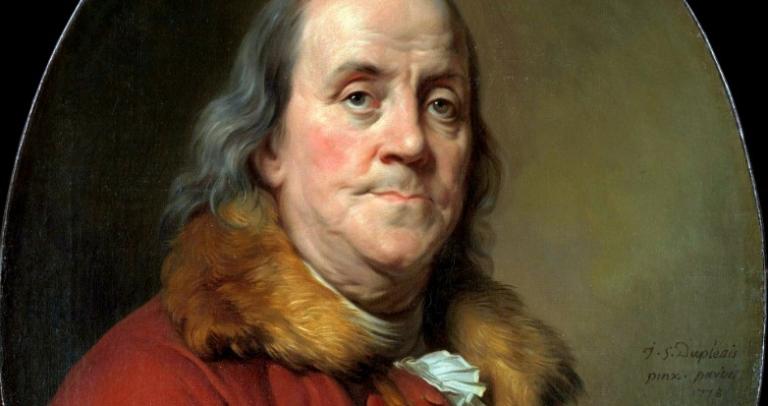
Benjamin Franklin portrait by Joseph Siffred Duplessis, 1778/Credit: Courtesy of The Metropolitan Museum of Art, New York
Premiering Monday and Tuesday, April 4-5 on PBS (check local listings), Benjamin Franklin: A Film By Ken Burns profiles perhaps the most enigmatic of the Founding Fathers — who was also a man of faith, if not the most orthodox sort.
Born the 10th son of a Boston soap maker (he was legitimate, unlike his own son, and that son’s son and grandchildren, making for a strange Franklin family tradition), Franklin ended his formal schooling at age 12.
A self-taught polymath, he went through careers as a printer, writer, editor, businessman, social organizer, inventor, amateur scientist and economic envoy to England before, late in life, he ever got involved in helping to birth the American republic.
Historian Walter Isaacson and Ken Burns Discuss Franklin
At the recent TV Critics Association (virtual) Winter Press Tour, Walter Isaacson, author of The First American: The Life and Times of Benjamin Franklin, addressed the complex nature of Dr. Franklin (whose doctorate was honorary), saying:
The importance of Ben Franklin is that he was able to connect art and science, able to connect the humanities and technology. He cared about everything you could possibly learn about anything, from art to anatomy to math to music to diplomacy.
And his science helped inform the things that he did. By being an expert in Newton, he understood checks and balances and balances of power.
His electricity experiments are the most important scientific achievements of that period, right after Newton. And, so, I do think by being like a Renaissance man, like a Leonardo da Vinci, he’s able to see the patterns in nature.
And he thought of himself as a scientist and an inventor. I think that is engrained not only in him, but into what the foundation of America was about.
Ken Burns picked up the thread, saying:
Yeah, I think Walter’s exactly right. You’ll be happy to know in a couple years we’ll be coming back with a film on Leonardo.
Many of these projects born at a dinner in Washington D.C. many years ago, when we realized we couldn’t divorce the right and the left brain and we couldn’t divorce either of these two, sort of, protean figures who are arguably among the most important human beings, certainly for Franklin in the 18th century.
Whatever History Thinks, Franklin Knew He Wasn’t God
Fellow Founding Father John Adams realized that history would view Franklin as a towering figure, as he said in an April 4, 1790, letter to another Founder, Benjamin Rush:
The Essence of the whole will be that Dr Franklin’s electrical Rod, Smote the Earth and out Spring General Washington. That Franklin electrified him with his Rod—and thence forward these two conducted all the Policy Negotiations Legislation and War.
But what Adams and Franklin — and likely Washington as well — knew is that there was, above them, a Supreme Being.
Benjamin Franklin deals with its subject’s less-than-conventional view of Christianity. Franklin often gets called a Deist, a believer in a clockmaker God who doesn’t interfere in our daily lives. He did refer to himself as a “thorough Deist” in his autobiography, but that’s only part of the story.
Likely closer to the truth is this passage — included in part in the documentary — as described in a post at the Pennsylvania Heritage website:
Ezra Stiles (1727-1795), the Calvinist president of Yale College, was curious about Benjamin Franklin (1706-1790) and his faith. In 1790, he asked the nation’s senior statesman if he would commit his religious beliefs to paper. Franklin agreed.
He was nearing the end of his life – he died six weeks later – and possibly believed this was as good a time as any to summarize the religious creed by which he lived.
“Here is my Creed,” Franklin wrote to Stiles. “I believe in one God, Creator of the Universe. That He governs it by His Providence. That he ought to be worshiped. That the most acceptable Service we render to him, is doing Good to his other Children. That the Soul of Man is immortal, and will be treated with Justice in another Life respecting its Conduct in this …
“As for Jesus of Nazareth … I think the system of Morals and Religion as he left them to us, the best the World ever saw … but I have … some Doubts to his Divinity; though’ it is a Question I do not dogmatism upon, having never studied it, and think it is needless to busy myself with it now, where I expect soon an Opportunity of knowing the Truth with less Trouble.”
The narrative was classic Franklin, witty and to the point. Religion was worthless unless it promoted virtuous behavior. Jesus was the greatest moral teacher who ever lived, but he was not God.
Franklin and Slavery — It’s Complicated
The four-hour Benjamin Franklin film — which, in form and presentation, is classic Ken Burns — leans heavily into Franklin’s inconsistent comments and actions in regard to chattel slavery.
In this, he was hardly alone among the Founding Fathers.
Eventually, Franklin came down on the right side of the issue, but he still had to support the compromises in both the Declaration of Independence and the Constitution that ensured the Southern states would first join and then remain in the union.
Said Isaacson:
The greatest thing they had to do as founders, and the greatest thing we have to do in our lives, is to know when to compromise and when to stand true on principle.
Franklin is a great example of that. He usually gets it right. He knows you can’t make a great democracy without compromise, but there’s times where he says you can’t compromise.
He, and they, got it wrong, especially on the three‑fifths clause, and Franklin knew it, which is why he dedicated the rest of his life after the Constitutional Convention to being an abolitionist, to decrying the notion of slavery, to trying to get rid of it, and, even more so than even Lincoln, believing that Blacks could be well-educated and were just as capable as whites. And, so, he becomes somebody who promotes education as well.
But you have to understand in life when you’ve messed up and been willing to compromise when you should have stayed true to principle, just as you have to understand the times when you’ve messed up and taken a high moral position but screwed things up because you couldn’t compromise.
A Nation Born From Compromise and Original Sin
As a documentary producer, Burns generally steers a middle ground. But, like anyone else in the filmmaking business, he’s affected by the outside culture.
If done ten years ago, Benjamin Franklin might not have delved as deeply into the issue of slavery. But, this is a vital part of the story of the founding of America, and it’s undeniably part of Franklin’s personal and political story.
It’s obvious that Franklin knew that, one day — in this world or the next — he and his fellow Founders would be called to task for their compromises … but they still had to make them.
Perhaps Peter Stone’s book/screenplay for the musical/movie 1776 captured it best:
Dr. Benjamin Franklin: We’ve no choice, John. The slavery clause has got to go.
John Adams: [stunned] Franklin, what are you saying?
Dr. Benjamin Franklin: It’s a luxury we can’t afford.
John Adams: [pause, then] ‘Luxury?’ A half million souls in chains … and Dr. Franklin calls it a ‘luxury!’ Maybe you should have walked out with the South!
Dr. Benjamin Franklin: [dangerous] You forget yourself, sir. I founded the FIRST anti-slavery society on this continent.
John Adams: Oh, don’t wave your credentials at me! Maybe it’s time you had them renewed!
Dr. Benjamin Franklin: [angrily] The issue here is independence! Maybe you have forgotten that fact, but I have not! How DARE you jeopardize our cause, when we’ve come so far? These men, no matter how much we may disagree with them, are not ribbon clerks to be ordered about – they are proud, accomplished men, the cream of their colonies. And whether you like them or not, they and the people they represent will be part of this new nation that YOU hope to create. Now, either learn how to live with them, or pack up and go home!
[pause, then]
Dr. Benjamin Franklin: In any case, stop acting like a Boston fishwife.
While We’re on the Subject of Overlooked Bits of History
Speaking of aspects of the American Revolution that are not widely covered, I recently finished listening to the audiobook of British historian Andrew Roberts’ excellent biography The Last King of America: The Misunderstood Reign of George III.
One of Roberts’ missions in the book, if not the chief one, is to rehabilitate George III’s reputation in the face of the widespread belief (first codified in the Declaration) that he was a tyrant.
History has perhaps judged George III unfairly on this, but one thing that struck me was the huge role that anti-Catholicism played in the Revolution — on both sides of the conflict.
Burns might want to consider including this bit of history in a future film.
Image: Benjamin Franklin portrait by Joseph Siffred Duplessis, 1778/Credit: Courtesy of The Metropolitan Museum of Art, New York
Don’t miss a thing: Subscribe to all that I write at Authory.com/KateOHare

About Kate O'Hare
Based in Los Angeles, Kate O'Hare is an entertainment journalist, Social Media Content Manager for Catholic production company Family Theater Productions and a screenwriter. You can read more about the author here.
Previous Post

March 26, 2022
HBO's 'The Gilded Age': Oh, the Dresses!

Browse Our Archives
Select a Category books breaking news digital media Faith practice food interview jane the virgin media movies music NFL Pope Francis Showbiz 101 social media sports technology television Uncategorized video
Select a Month November 2026 October 2026 September 2026 August 2026 July 2026 June 2026 May 2026 April 2026 March 2026 February 2026 January 2026 December 2025 November 2025 October 2025 September 2025 August 2025 July 2025 June 2025 May 2025 April 2025 March 2025 February 2025 January 2025 December 2024 November 2024 October 2024 September 2024 August 2024 July 2024 June 2024 May 2024 April 2024 March 2024 February 2024 January 2024 December 2023 November 2023 October 2023 September 2023 August 2023 July 2023 June 2023 May 2023 April 2023 March 2023 February 2023 January 2023 December 2022 November 2022 October 2022 September 2022 August 2022 July 2022 June 2022 May 2022 April 2022 March 2022 February 2022 January 2022 December 2021 November 2021 October 2021 September 2021 August 2021 July 2021 June 2021 May 2021 April 2021 March 2021 February 2021 January 2021 December 2020 November 2020 October 2020 September 2020 August 2020 July 2020 June 2020 May 2020 April 2020 March 2020 February 2020 January 2020 December 2019 November 2019 October 2019 September 2019 August 2019 July 2019 June 2019 May 2019 April 2019 March 2019 February 2019 January 2019 December 2018 November 2018 October 2018 September 2018 August 2018 July 2018 June 2018 May 2018 April 2018 March 2018 February 2018 January 2018 December 2017 November 2017 October 2017 September 2017 August 2017 July 2017 June 2017 May 2017 April 2017 March 2017 February 2017 January 2017 December 2016 November 2016 October 2016 September 2016 August 2016 July 2016 June 2016 May 2016 April 2016 March 2016 February 2016 January 2016 December 2015 November 2015 October 2015 September 2015 August 2015 July 2015 June 2015 May 2015 April 2015 March 2015 February 2015
Follow Us!
TAKE THE
Religious Wisdom Quiz
Which letter emphasizes faith without works is dead?
Select your answer to see how you score.
Hebrews 1 Peter James Titus
Related posts from Kate O'Hare's Pax Culturati
'Ebenezer': Johnny Depp in a Dickens That Gets...

'I Play Rocky': A Two-Fisted Tale of Hope...
Casting & Confusion: Austen, 'The Gilded Age' &...
'Sense and Sensibility': OK Austen Adaptation But a...
TRENDING AT PATHEOS Catholic

'Statements of Faith' never get shorter
Nothing demonstrates a conservative commitment to faith and faithfulness like a "statement...

Michele's Reviews - Future Grace by John Piper
In God's Place, at God's Pace, by Future Grace Impatience is...

Bama Gramma's Blackout Christmas: the Power of Light...
Another Christmas Skit: I have an alter ego: Bama Gramma. She shows...

Thanksgiving as a Way of Life: A Christian...
Each year, Thanksgiving brings families and friends together to share meals, stories,...

Two Women Doctors Who Went Against the Current
Women physicians who transformed healthcare for "Indians" “I shall have an advantage...

Reading Culture Through Scripture, Not the Other Way...
A Radix Teleology and Faith Before Seeing: Essentialism “For we also have...
view all Catholic blogs
Ad-Free & Subscriber Log-In Subscription Support
- About Us
- 2026 Calendar
- Videos
- Podcasts
- Library of World Religions
- Faith In Media Tracker
- Advertise With Us
- Write for Us
- Privacy Policy
- Terms of Service
- Do Not Sell My Data
- Contact Us
- Radiant Digital
- Manage Newsletter Subscriptions
- Unsubscribe From Notifications
- Sitemap
Copyright 2008-2026, Patheos, part of the Radiant Digital network of media brands. All rights reserved.
Subscription Support Ad-Free & Subscriber Log-In
Follow Patheos