
BuddhistCatholicContemplativeEvangelicalGeneral ChristianHinduJewishLatter-day SaintMuslimNew VisionsProgressive Christian
Beliefs
- Buddhist
- Catholic
- Contemplative
- Evangelical
- General Christian
- Hindu
- Jewish
- Latter-day Saint
- More Voices
- Muslim
- New Visions
- Pagan
- Progressive Christian
Topics
- Religion News
- Food and Religion
- Sports and Religion
- Religious Art
- Religious Music and Entertainment
- Religious Events
- History and Religion
- Style and Religion
- Politics and Religion
- Women in Religion
- Recreation Outdoors and Religion
- Business Finance and Religion
- Careers Workplace and Religion
- Education and Religion
- Family Parenting and Religion
- Health Fitness and Religion
- Home and Religion
- Relationships and Religion
- Technology and Religion
- Travel and Religion
Columnists
- Buddhist Columnists
- Business Finance and Religion Columnists
- Careers Workplace and Religion Columnists
- Catholic Columnists
- Contemplative Columnists
- Education and Religion Columnists
- Evangelists Columnists
- Family Parenting and Religion Columnists
- General Christian Columnists
- Health Fitness and Religion Columnists
- Hindu Columnists
- History and Religion Columnists
- Home and Religion Columnists
- Jewish Columnists
- More Voices Columnists
- Latter Day Columnists
- Muslim Columnists
- New Visions Columnists
- Nonreligious Columnists
- Pagan Columnists
- Politics and Religion Columnists
- Progressive Columnists
- Recreation Outdoors and Religion Columnists
- Relationships and Religion Columnists
- Religion News Columnists
- Religious Art Columnists
- Religious Events Columnists
- Religious Music and Entertainment Columnists
- Sports and Religion Columnists
- Style and Religion Columnists
- Technology and Religion Columnists
- Travel and Religion Columnists
- Women in Religion Columnists
Resource Library
- 2026 Calendar
- Library of World Religions
- The 100 Most Holy Places on Earth
- Patheos Answers
- Podcasts
- Videos
- Faith Leaders Database
- Anglican Episcopalian
- Bahai
- Baptist
- Buddhism
- Christianity
- Confucianism
- Eastern Orthodoxy
- Hinduism
- Holiness and Pentecostal
- ISKCON
- Islam
- Judaism
- Lutheran
- Methodist
- The Church of Jesus Christ of Latter-day Saints
- New Age
- Paganism
- Presbytarian and Reformed
- Protestantism
- Religion Behind the Scenes
- Roman Catholic
- Scientology
- Shia Islam
- Sikhism
- Sufism
- Sunni Islam
- Taoism
- Zen
- See all religions
Research Tools
 Ad-Free & Subscriber Log-In Subscription Support
Ad-Free & Subscriber Log-In Subscription Support
Follow Patheos 

- Trending:
- Forgiveness
- |
- Marriage
- |
- Consciousness
- |
- Death Penalty
- |
- Election
- |
- Halloween

- Home
- Catholic
- Religious Music & Entertainment
- CNN’s ‘Pope: The Most Powerful Man in History’ Is Eminently Skippable
CNN’s ‘Pope: The Most Powerful Man in History’ Is Eminently Skippable
Last updated on: March 10, 2018 at 10:56 am by Kate O'Hare
CNN’s ‘Pope: The Most Powerful Man in History’ Is Eminently Skippable 2018-03-10T10:56:06-08:00 Kate O'Hare
Patheos Explore the world's faith through different perspectives on religion and spirituality! Patheos has the views of the prevalent religions and spiritualities of the world.
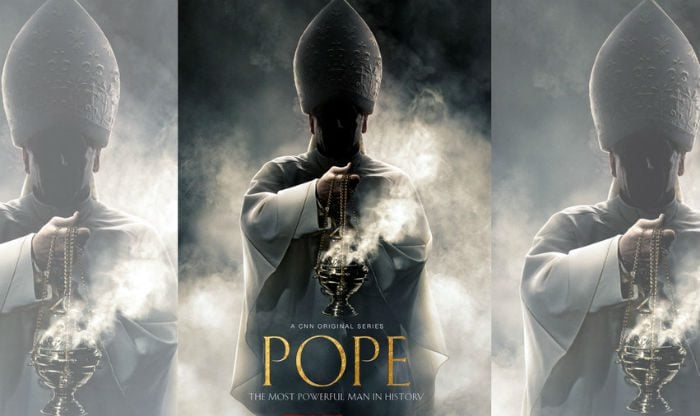 If the story of Catholicism is told poorly, that may be because Catholics are very seldom the ones telling it.
Premiering Sunday, March 11, CNN’s six-part “Pope: The Most Powerful Man in History” — CNN provided episodes 101 and 104 — is the same old, same old. It’s not so much as a documentary or an investigation, but a litany of received secular wisdom about the Church, a lot of it incomplete, cursory or just plain wrong, set to very dramatic music.
Narrated with gravity by Liam Neeson, its purports to be a history of the papacy, but near as I can tell, the Catholic presence in it is relatively minimal. It features lots of scholars of various sorts, some familiar from similar documentaries.
Rather than offering real insights, they generally say fairly bland and obvious things that could be handled in narration. The only Catholics I remember seeing in the episodes provided to me were Irish historian Eamon Duffy, Cardinal Wuerl of Washington, D.C., and Catholic Congressman Jeff Fortenberry (R-Nebraska).
(The press materials say that Bishop Paul Tighe and Vatican journalist John Thavis are also interviewed.)
Otherwise, it commits a similar sin to one I perceived in author Jon Krakauer’s “Under the Banner of Heaven,” his nonfiction book dealing with fundamentalist offshoots of Mormonism. While the polygamist abuses it outlines are verified, in discussing the mainstream Church of Jesus Christ of Latter-Day Saints and its doctrines, it talks mostly to former Mormons and opponents, rather than including some faithful Mormons.
That may be because they wouldn’t talk to him, or it may be the modern assumption that, in discussing religion, one can only trust the voices of secularists and apostates rather than believers. I certainly wouldn’t defend the beliefs of the LDS Church, but I don’t like unfairness, either.
Also notably absent in the episodes I saw was the Church’s role in establishing schools, hospitals and the university; and its care of the poor, lepers, orphans and outcasts, especially when nobody else was doing it (which is much of the last couple of thousand years, until the last 200 or so). Popes had a bit to do with all those, as well.
Throughout the two episodes I saw of “Pope” was a whiff of condescension bordering on anti-Catholicism, a sort of “Oooh, it’s big and fancy and old, but you know, it’s really rubbish under all that frippery.”
Especially in the second episode provided (which was numbered 4), dealing with Martin Luther and the Reformation, one gets the definite feeling that the writers of the narration view Martin Luther as a great hero, and that the Church got its comeuppance, paving the way for a far better version (or versions) of Christianity. Obviously we don’t think so, but the idea that the Reformation may have not been an unreservedly wonderful thing, is never entertained.
As for accuracy, the first episode claims Constantine the Great was a “Christian emperor.” While his mother was Christian, and he did promulgate laws legalizing the practice of Catholicism in the Roman Empire, he was never baptized himself until nearly on his deathbed. He allowed the Church to exist and flourish, but he was far more interested in building his temporal empire than any higher religious purpose.
For that matter, the episode leaps from the death of Peter to Constantine, quickly passing over several centuries and all the Early Church Fathers. It was under their leadership in the first years and decades of the Faith, that the Church established its structure, the Mass and many doctrines. If you read their writings, the Church of today can be quite easily recognized in these early years. Constantine legalized the Church, but he didn’t build it. It was already built before he was born.
The episode’s treatment of the Crusades follows the view of them held since the late 19th-century: that, with brief lip service to the real danger posed to Christians under Muslim conquest — in the Middle East and Europe — that the Church’s forays into the Holy Land were entirely wrong, and that the Kurdish Muslim Saladin was a model of benevolence and tolerance. The truth is way more complicated than that, but the CNN producers showed no inclination to do anything but skim the surface.
In the second episode, the question of the sales of indulgences comes up again, and old myths about them are resurrected to beat the Church over the head. The Renaissance popes got up to all sorts of reprehensible things (as did a whole lot of folks during the Renaissance) — and the experts quoted show the correct attitude of righteous repugnance — but at least on this topic, here’s what Catholic Answers has to say:
Myth 6: A person can buy indulgences.
The Council of Trent instituted severe reforms in the practice of granting indulgences, and, because of prior abuses, “in 1567 Pope Pius V canceled all grants of indulgences involving any fees or other financial transactions” (Catholic Encyclopedia). This act proved the Church’s seriousness about removing abuses from indulgences.
Myth 7: A person used to be able to buy indulgences.
One never could “buy” indulgences. The financial scandal surrounding indulgences, the scandal that gave Martin Luther an excuse for his heterodoxy, involved alms—indulgences in which the giving of alms to some charitable fund or foundation was used as the occasion to grant the indulgence. There was no outright selling of indulgences. The Catholic Encyclopedia states: “[I]t is easy to see how abuses crept in. Among the good works which might be encouraged by being made the condition of an indulgence, almsgiving would naturally hold a conspicuous place. . . . It is well to observe that in these purposes there is nothing essentially evil. To give money to God or to the poor is a praiseworthy act, and, when it is done from right motives, it will surely not go unrewarded.”
But, no one asked them, or anyone like them, probably under the assumption, “Of course, they’re going to say that, they’re Catholic.” Well, by that logic, what do you expect Protestants or secularists to say, since they’re Protestants and secularists?
In short, there’s very little reason to watch “Pope: The Most Powerful Man in History.” It adds nothing new or original to the conversation; it repeats old tropes; and it talks to very few Catholics (but plenty of scholars and non-Catholic Christians). You do get to see the first-century Didache brought out of storage and given a rare showing on TV — with an Orthodox cleric handling it without gloves. Sheesh.
The best thing I can say is to quote Oscar Wilde (another deathbed Catholic convert), who observed, “The only thing worse than being talked about is not being talked about.”
If you still want to devote some hours to Church history, try Bishop Barron’s “Catholicism” and its sequel “The Pivotal Players.” You’ll get better history and better theology.
But, if you’re still game, from CNN:
Pope will stream live for subscribers on March 11 via CNNgo (at CNN.com/go and via CNNgo apps for Apple TV, Roku, Amazon Fire, Samsung Smart TV and Android TV), and on the CNN mobile apps for iOS and Android. Moreover, the series will be available the day after the broadcast premiere on demand via cable/satellite systems, CNNgo platform and CNN mobile apps.
Pope: The Most Powerful Man in History will regularly air Sunday nights at 10 p.m. ET/PT.
Image: Courtesy CNN
Don’t miss a thing: head over to my other home, as Social Media Manager at Family Theater Productions; and check out FTP’s Faith & Family Media Blog, and our YouTube Channel.
Previous Post

March 8, 2018
In Hospital Video, Kevin Smith Thanks Chris Pratt for His Prayers
Next Post

March 12, 2018 'A Wrinkle in Time': WTFrak Was That? And Where Was the Bible?
Browse Our Archives
Select a Category books breaking news digital media Faith practice food interview jane the virgin media movies music NFL Pope Francis Showbiz 101 social media sports technology television Uncategorized video
Select a Month October 2026 September 2026 August 2026 July 2026 June 2026 May 2026 April 2026 March 2026 February 2026 January 2026 December 2025 November 2025 October 2025 September 2025 August 2025 July 2025 June 2025 May 2025 April 2025 March 2025 February 2025 January 2025 December 2024 November 2024 October 2024 September 2024 August 2024 July 2024 June 2024 May 2024 April 2024 March 2024 February 2024 January 2024 December 2023 November 2023 October 2023 September 2023 August 2023 July 2023 June 2023 May 2023 April 2023 March 2023 February 2023 January 2023 December 2022 November 2022 October 2022 September 2022 August 2022 July 2022 June 2022 May 2022 April 2022 March 2022 February 2022 January 2022 December 2021 November 2021 October 2021 September 2021 August 2021 July 2021 June 2021 May 2021 April 2021 March 2021 February 2021 January 2021 December 2020 November 2020 October 2020 September 2020 August 2020 July 2020 June 2020 May 2020 April 2020 March 2020 February 2020 January 2020 December 2019 November 2019 October 2019 September 2019 August 2019 July 2019 June 2019 May 2019 April 2019 March 2019 February 2019 January 2019 December 2018 November 2018 October 2018 September 2018 August 2018 July 2018 June 2018 May 2018 April 2018 March 2018 February 2018 January 2018 December 2017 November 2017 October 2017 September 2017 August 2017 July 2017 June 2017 May 2017 April 2017 March 2017 February 2017 January 2017 December 2016 November 2016 October 2016 September 2016 August 2016 July 2016 June 2016 May 2016 April 2016 March 2016 February 2016 January 2016 December 2015 November 2015 October 2015 September 2015 August 2015 July 2015 June 2015 May 2015 April 2015 March 2015 February 2015
Follow Us!
TAKE THE
Religious Wisdom Quiz
But you, Bethlehem Ephrathah, though you are small, out of you will come a ruler over Israel. What makes this town significant?
Select your answer to see how you score.
The birthplace of the Messiah A place of prophecy A holy city David's hometown
Related posts from Kate O'Hare's Pax Culturati

'The Chosen' S6 Trailer: The Passion Gets Very...

Catholic Mike Ditka: Bear of a Man of...

We Need to Talk About 'Clarkson's Farm'

'Adore Him: He Is Here': On the Red...
TRENDING AT PATHEOS Catholic

A new article, written by Jeff Lindsay and Gale L. Pooley,...

Swimfan: Forgotten Aughts Pleasures
This is a recovery effort. In 2002, My Big Fat Greek Wedding...

Top Three Anti-Catholic Lies About Catholicism
This is my initial transcript for the video, "THE 3 WORST...

Pope Leo Celebrates Mass for Nurses & Docs...
I don't have any idea how he did it, but Pope Leo...

The Sermon on the Mount, Part I: Matthew...
The Sermon on the Mount, Part I (Matthew 4:12-5:12) St. Matthew moves...

What's up from Crossway: Reviewing some of their latest A few weeks...
view all Catholic blogs
Ad-Free & Subscriber Log-In Subscription Support
- About Us
- 2026 Calendar
- Videos
- Podcasts
- Library of World Religions
- Faith In Media Tracker
- Advertise With Us
- Write for Us
- Privacy Policy
- Terms of Service
- Do Not Sell My Data
- Contact Us
- Radiant Digital
- Manage Newsletter Subscriptions
- Unsubscribe From Notifications
- Sitemap
Copyright 2008-2026, Patheos. All rights reserved.
Subscription Support Ad-Free & Subscriber Log-In
Follow Patheos