
BuddhistCatholicContemplativeEvangelicalGeneral ChristianHinduJewishLatter-day SaintMuslimNew VisionsProgressive Christian
Beliefs
- Buddhist
- Catholic
- Contemplative
- Evangelical
- General Christian
- Hindu
- Jewish
- Latter-day Saint
- More Voices
- Muslim
- New Visions
- Pagan
- Progressive Christian
Topics
- Religion News
- Food and Religion
- Sports and Religion
- Religious Art
- Religious Music and Entertainment
- Religious Events
- History and Religion
- Style and Religion
- Politics and Religion
- Women in Religion
- Recreation Outdoors and Religion
- Business Finance and Religion
- Careers Workplace and Religion
- Education and Religion
- Family Parenting and Religion
- Health Fitness and Religion
- Home and Religion
- Relationships and Religion
- Technology and Religion
- Travel and Religion
Columnists
- Buddhist Columnists
- Business Finance and Religion Columnists
- Careers Workplace and Religion Columnists
- Catholic Columnists
- Contemplative Columnists
- Education and Religion Columnists
- Evangelists Columnists
- Family Parenting and Religion Columnists
- General Christian Columnists
- Health Fitness and Religion Columnists
- Hindu Columnists
- History and Religion Columnists
- Home and Religion Columnists
- Jewish Columnists
- More Voices Columnists
- Latter Day Columnists
- Muslim Columnists
- New Visions Columnists
- Nonreligious Columnists
- Pagan Columnists
- Politics and Religion Columnists
- Progressive Columnists
- Recreation Outdoors and Religion Columnists
- Relationships and Religion Columnists
- Religion News Columnists
- Religious Art Columnists
- Religious Events Columnists
- Religious Music and Entertainment Columnists
- Sports and Religion Columnists
- Style and Religion Columnists
- Technology and Religion Columnists
- Travel and Religion Columnists
- Women in Religion Columnists
Resource Library
- 2026 Calendar
- Library of World Religions
- The 100 Most Holy Places on Earth
- Patheos Answers
- Podcasts
- Videos
- Faith Leaders Database
- Anglican Episcopalian
- Bahai
- Baptist
- Buddhism
- Christianity
- Confucianism
- Eastern Orthodoxy
- Hinduism
- Holiness and Pentecostal
- ISKCON
- Islam
- Judaism
- Lutheran
- Methodist
- The Church of Jesus Christ of Latter-day Saints
- New Age
- Paganism
- Presbytarian and Reformed
- Protestantism
- Religion Behind the Scenes
- Roman Catholic
- Scientology
- Shia Islam
- Sikhism
- Sufism
- Sunni Islam
- Taoism
- Zen
- See all religions
Research Tools
 Ad-Free & Subscriber Log-In Subscription Support
Ad-Free & Subscriber Log-In Subscription Support
Follow Patheos 

- Trending:
- Forgiveness
- |
- Marriage
- |
- Consciousness
- |
- Death Penalty
- |
- Election
- |
- Halloween

- Home
- Catholic
- Religious Music & Entertainment
- Who Is God? Depends How You (or Morgan Freeman) Ask the Question
Who Is God? Depends How You (or Morgan Freeman) Ask the Question
Last updated on: April 13, 2016 at 8:56 am by Kate O'Hare
Who Is God? Depends How You (or Morgan Freeman) Ask the Question 2016-04-13T08:56:36-08:00 Kate O'Hare
Patheos Explore the world's faith through different perspectives on religion and spirituality! Patheos has the views of the prevalent religions and spiritualities of the world.
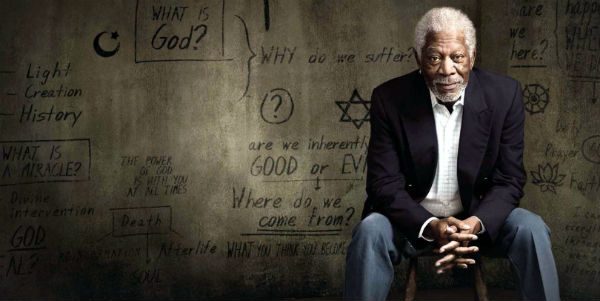 In the next episode of “The Story of God,” airing Sunday, April 17 at 9 p.m. ET/PT, on National Geographic Channel, host Morgan Freeman goes in search of the nature of the Divine.
He makes a warm and charming examination of polytheistic Hinduism and Navajo religion, and a lyrical examination of Islam, including parts of it that originated in its predecessors, Judaism and Christianity, while speaking as if the notions were unique to Islam.
In this episode, the only representation of Christianity is a perfunctory visit to Joel Osteen’s Texas megachurch.
So, if you’re looking for the Catholic sense of divinity, oddly, it’s best expressed in some parts of the segment on Islam, but with Christ as the the Son of God obviously removed from the picture. Also, the idea of the infinite God becoming both fully divine and fully human — the very core of Christianity — is not really discussed, unless you count Osteen’s presentation of Christ as a “friend” (which, of course, He is, but also so much more than just your best buddy and business booster).
National Geographic Channel posed these two questions to bloggers participating in this ongoing look (click here for an earlier installment) at “The Story of God”:
How has the perception of God changed over time?
Monotheism vs Polytheism – does your worldview impact your daily life?
I’m no theologian — just a Catholic revert who’s spent most of my life focused on storytelling, on the screen and on the page. But I have also sojourned among the modern pagans, and studied many mythological systems, along with the writings of Joseph Campbell, who tells us much about how humans have told stories about gods and heroes.
But, see, here’s the thing … humans created those stories, as wonderful and insightful as they are. They are told in a human manner, featuring characters, even the gods, who act in recognizably human ways. The stories resonate deeply, because they reveal much of how people experience the world and relate to each other and to the unknowable.
After returning to the Church, when I dug into the Catechism and the Scriptures, coming at them nearly with fresh eyes, what struck me most was the strangeness of the stories, from Abraham to Christ. In the West, we’ve become so accustomed to the Biblical narratives, they’re so interwoven into the very fabric of our culture and literature — whether you’re a believer or not — that we take them almost for granted. We are like fish who don’t know they’re wet, swimming in a sea of quotes, aphorisms, poetry, characters and ideas born in the Word.
Taken in from the outside, though, they are odd tales indeed. As I read the Passion narrative and the Acts of the Apostles in particular, it became obvious to me that these aren’t the kinds of stories people concoct when they want to start a new religion. People generally make themselves look a lot better and smarter and braver than the Apostles did, if they expect folk to trust and follow them. I was looking at flawed men and women, telling stories that were confusing and confounding and often unflattering, because that’s how it happened, and that’s how it had to be told.
A lot of what makes heresies so appealing is that they correspond more to how we think God should be, in our human way of envisioning Him. They’re seductive and make sense on the surface, but ultimately, “the appalling strangeness of the mercy of God,” as novelist Graham Greene put it, is missing. Because God shouldn’t conform to what we want; we need to conform to what He wants, as best as we can discern it — and that’s seldom the most obvious path in human terms.
The God of the Judeo-Christian world — to paraphrase a talk I heard today from L.A.’s Bishop Robert Barron — is not a creature or being among other creatures and beings. He, if you want to use that pronoun, has no sex and no form (but Jesus Christ was definitely male; make no mistake about that). God needs nothing from us, but wants everything for us. God is not part of existence; He is existence itself, the very energy and fabric and, well, everything, that brought everything into being and holds it all together.
God doesn’t exist outside reality; He IS reality.
In the Christian view, in His wisdom, God saw that this was not enough for us. So, He came down to His people, became one of them for a time, lived among them — not because He needed some kind of a crash course in what it meant to be human, but because we, as creatures of flesh and spirit, needed a God with hands and a face (even if, Shroud of Turin notwithstanding, we don’t know the details of that face).
The idea of being fully God and fully human is a tricky and shocking proposition. It didn’t set well with most of the Jews at the time, or, much later on, with the Muslims. Even between the Catholic and Orthodox lungs of the Church, sorting out the details of how the Trinity of God the Father, God the Son and God the Holy Spirit works has been fraught with difficulty.
But why should we think that thinking about God would be easy? You might as well ask your dog to describe the manufacturing process and nutritional components of his kibble. Although, as Freeman demonstrates in a segment in which science shows that the frontal lobes of believers light up when they contemplate God, we’re still trying to grasp infinity with a blob of wrinkly grey matter stuck inside our heads. This stuff’s hard.
For a polytheist, the idea of divinity is fragmented, existing here and there, in this deity and that, tied to this people or that, on this mountain, in this lake, or up this tree. Christians, too, have their holy places and places where a person may feel the presence of God most powerfully, but if all the church buildings in the world imploded tomorrow, along with all the sacred art, it would be a tragedy for mankind, but it wouldn’t be the end of the Church. She is the Bride of Christ, and all the baptized breathing, eating, sleeping and worshiping within her are the living Body of Christ.
God became Man and walked with us, but was no less the immanent, omniscient God of the Universe for it. He lived, taught, suffered, died and rose again not because He needed to, but because He had compassion for His children, and wanted them to know, in a concrete way, that He understood, that He conquered our bodily death, and that one day, we would hold the hand and touch the face of God.
Image: Courtesy National Geographic Channel
Don’t miss a thing: head over to my other homes at CatholicVote and the Faith & Family Media blog, and like my Facebook page; also like the Patheos Catholic FB page to see what my colleagues have to say.
Previous Post

April 8, 2016
'When Calls the Heart': Daniel Lissing Is 'A Man of Action ... Mostly'
Next Post
April 17, 2016 EWTN's Father Mitch Pacwa Survives a Heart Attack
Browse Our Archives
Select a Category books breaking news digital media Faith practice food interview jane the virgin media movies music NFL Pope Francis Showbiz 101 social media sports technology television Uncategorized video
Select a Month October 2026 September 2026 August 2026 July 2026 June 2026 May 2026 April 2026 March 2026 February 2026 January 2026 December 2025 November 2025 October 2025 September 2025 August 2025 July 2025 June 2025 May 2025 April 2025 March 2025 February 2025 January 2025 December 2024 November 2024 October 2024 September 2024 August 2024 July 2024 June 2024 May 2024 April 2024 March 2024 February 2024 January 2024 December 2023 November 2023 October 2023 September 2023 August 2023 July 2023 June 2023 May 2023 April 2023 March 2023 February 2023 January 2023 December 2022 November 2022 October 2022 September 2022 August 2022 July 2022 June 2022 May 2022 April 2022 March 2022 February 2022 January 2022 December 2021 November 2021 October 2021 September 2021 August 2021 July 2021 June 2021 May 2021 April 2021 March 2021 February 2021 January 2021 December 2020 November 2020 October 2020 September 2020 August 2020 July 2020 June 2020 May 2020 April 2020 March 2020 February 2020 January 2020 December 2019 November 2019 October 2019 September 2019 August 2019 July 2019 June 2019 May 2019 April 2019 March 2019 February 2019 January 2019 December 2018 November 2018 October 2018 September 2018 August 2018 July 2018 June 2018 May 2018 April 2018 March 2018 February 2018 January 2018 December 2017 November 2017 October 2017 September 2017 August 2017 July 2017 June 2017 May 2017 April 2017 March 2017 February 2017 January 2017 December 2016 November 2016 October 2016 September 2016 August 2016 July 2016 June 2016 May 2016 April 2016 March 2016 February 2016 January 2016 December 2015 November 2015 October 2015 September 2015 August 2015 July 2015 June 2015 May 2015 April 2015 March 2015 February 2015
Follow Us!
TAKE THE
Religious Wisdom Quiz
Commanded to go to Nineveh, I fled in the opposite direction on a ship to Tarshish. Who am I?
Select your answer to see how you score.
Elijah Jonah Hosea Jeremiah
Related posts from Kate O'Hare's Pax Culturati

'The Chosen' S6 Trailer: The Passion Gets Very...

We Need to Talk About 'Clarkson's Farm'

'Adore Him: He Is Here': On the Red...

Netflix's 'Narnia: The Magician's Nephew': We Have Thoughts
TRENDING AT PATHEOS Catholic

A new article, written by Jeff Lindsay and Gale L. Pooley,...

Swimfan: Forgotten Aughts Pleasures
This is a recovery effort. In 2002, My Big Fat Greek Wedding...

Top Three Anti-Catholic Lies About Catholicism
This is my initial transcript for the video, "THE 3 WORST...

Pope Leo Celebrates Mass for Nurses & Docs...
I don't have any idea how he did it, but Pope Leo...

The Sermon on the Mount, Part I: Matthew...
The Sermon on the Mount, Part I (Matthew 4:12-5:12) St. Matthew moves...

What's up from Crossway: Reviewing some of their latest A few weeks...
view all Catholic blogs
Ad-Free & Subscriber Log-In Subscription Support
- About Us
- 2026 Calendar
- Videos
- Podcasts
- Library of World Religions
- Faith In Media Tracker
- Advertise With Us
- Write for Us
- Privacy Policy
- Terms of Service
- Do Not Sell My Data
- Contact Us
- Radiant Digital
- Manage Newsletter Subscriptions
- Unsubscribe From Notifications
- Sitemap
Copyright 2008-2026, Patheos. All rights reserved.
Subscription Support Ad-Free & Subscriber Log-In
Follow Patheos