
BuddhistCatholicContemplativeEvangelicalGeneral ChristianHinduJewishLatter-day SaintMuslimNew VisionsProgressive Christian
Beliefs
- Buddhist
- Catholic
- Contemplative
- Evangelical
- General Christian
- Hindu
- Jewish
- Latter-day Saint
- More Voices
- Muslim
- New Visions
- Pagan
- Progressive Christian
Topics
- Religion News
- Food and Religion
- Sports and Religion
- Religious Art
- Religious Music and Entertainment
- Religious Events
- History and Religion
- Style and Religion
- Politics and Religion
- Women in Religion
- Recreation Outdoors and Religion
- Business Finance and Religion
- Careers Workplace and Religion
- Education and Religion
- Family Parenting and Religion
- Health Fitness and Religion
- Home and Religion
- Relationships and Religion
- Technology and Religion
- Travel and Religion
Columnists
- Buddhist Columnists
- Business Finance and Religion Columnists
- Careers Workplace and Religion Columnists
- Catholic Columnists
- Contemplative Columnists
- Education and Religion Columnists
- Evangelists Columnists
- Family Parenting and Religion Columnists
- General Christian Columnists
- Health Fitness and Religion Columnists
- Hindu Columnists
- History and Religion Columnists
- Home and Religion Columnists
- Jewish Columnists
- More Voices Columnists
- Latter Day Columnists
- Muslim Columnists
- New Visions Columnists
- Nonreligious Columnists
- Pagan Columnists
- Politics and Religion Columnists
- Progressive Columnists
- Recreation Outdoors and Religion Columnists
- Relationships and Religion Columnists
- Religion News Columnists
- Religious Art Columnists
- Religious Events Columnists
- Religious Music and Entertainment Columnists
- Sports and Religion Columnists
- Style and Religion Columnists
- Technology and Religion Columnists
- Travel and Religion Columnists
- Women in Religion Columnists
Resource Library
- 2026 Calendar
- Library of World Religions
- The 100 Most Holy Places on Earth
- Patheos Answers
- Podcasts
- Videos
- Faith Leaders Database
- Anglican Episcopalian
- Bahai
- Baptist
- Buddhism
- Christianity
- Confucianism
- Eastern Orthodoxy
- Hinduism
- Holiness and Pentecostal
- ISKCON
- Islam
- Judaism
- Lutheran
- Methodist
- The Church of Jesus Christ of Latter-day Saints
- New Age
- Paganism
- Presbytarian and Reformed
- Protestantism
- Religion Behind the Scenes
- Roman Catholic
- Scientology
- Shia Islam
- Sikhism
- Sufism
- Sunni Islam
- Taoism
- Zen
- See all religions
Research Tools
 Ad-Free & Subscriber Log-In Subscription Support
Ad-Free & Subscriber Log-In Subscription Support
Follow Patheos 

- Trending:
- Forgiveness
- |
- Marriage
- |
- Consciousness
- |
- Death Penalty
- |
- Election
- |
- Halloween

- Home
- Catholic
- Religious Music & Entertainment
- ‘The Story of God: Apocalypse’: Everything Ends, Everything Begins
‘The Story of God: Apocalypse’: Everything Ends, Everything Begins
Last updated on: April 11, 2016 at 2:54 pm by Kate O'Hare
‘The Story of God: Apocalypse’: Everything Ends, Everything Begins 2016-04-11T14:54:50-08:00 Kate O'Hare
Patheos Explore the world's faith through different perspectives on religion and spirituality! Patheos has the views of the prevalent religions and spiritualities of the world.
A few years ago, the popular press had a fascination with predictions made by the ancient Maya — you know, those folks in Mesoamerica who liked to cut out the hearts of human sacrifices — that the world would end on Dec. 21, 2012.
Here’s how it’s explored in “Apocalypse,” the next episode of National Geographic Channel’s “The Story of God,” airing Sunday, April 10, at 9 p.m. ET/PT. It follows host Morgan Freeman on a trip around the world to survey how different religions deal with the Big Questions (click here for an earlier piece I did on the show).
Oh, well. It’s April 6, 2016, as I type this, and the so-called “Mayan apocalypse” went the way of most predictions of this sort, right down the memory hole.
On the other hand, you could say that it happened, only much earlier. Mayan civilization reached its zenith around the 300s A.D., but by the 900s, it had all but vanished. The people remained, but the distinctive world they had created faded into history, leaving behind bones, bits and stone monuments of itself.
Such it has been, with most human civilizations, and such it will likely be with ours, at some point.
Worlds end. New worlds begin. If the apocalypse is the end of the world, we’ve already seen scores of them.
As the famous R.E.M. song notes: “It’s the end of the world as we know it …”
People also end, and with each death goes a unique, irreplaceable view of reality. You might say that every human death is an apocalypse in miniature. It certainly is the end of the world, as he or she knows it, for the person who died.
But, Catholics believe, there is a world beyond the world, lasting into infinity. By virtue of our own choices, we will either spend it gazing upon the Beatific Vision of God (or on our way to that, in Purgatory), or cut off from it forever, in Hell.
One of the most famous notions of the Apocalypse — which comes from an Ancient Greek word for uncovering, as in the lifting of a veil — comes from the last book of the Bible, Revelation, a recounting of visions by the Apostle John during his exile on the island of Patmos.
Says the USCCB:
The Book of Revelation cannot be adequately understood except against the historical background that occasioned its writing. Like Daniel and other apocalypses, it was composed as resistance literature to meet a crisis. The book itself suggests that the crisis was ruthless persecution of the early church by the Roman authorities; the harlot Babylon symbolizes pagan Rome, the city on seven hills (Rev 17:9).
The book is, then, an exhortation and admonition to Christians of the first century to stand firm in the faith and to avoid compromise with paganism, despite the threat of adversity and martyrdom; they are to await patiently the fulfillment of God’s mighty promises. The triumph of God in the world of men and women remains a mystery, to be accepted in faith and longed for in hope. It is a triumph that unfolded in the history of Jesus of Nazareth and continues to unfold in the history of the individual Christian who follows the way of the cross, even, if necessary, to a martyr’s death.
Though the perspective is eschatological—ultimate salvation and victory are said to take place at the end of the present age when Christ will come in glory at the parousia—the book presents the decisive struggle of Christ and his followers against Satan and his cohorts as already over. Christ’s overwhelming defeat of the kingdom of Satan ushered in the everlasting reign of God (Rev 11:15; 12:10). Even the forces of evil unwittingly carry out the divine plan (Rev 17:17), for God is the sovereign Lord of history.
There are those who say, cloaked within Revelation’s rich symbolic language, it describes the fall of Jerusalem in 70 A.D. — certainly the end of the world, as Jews of the area knew it — and the rise of the Roman Emperor Nero, who cruelly persecuted Christians.
But as with many things in the Bible, what was relevant and timely then continues to be so today, as people often fight the same battles over and over, with only the names, places and dates changed.
Due to its extravagant, poetical nature and resonant themes of good and evil, Revelation is a favorite of Hollywood filmmakers. They’re helped by some non-Catholic Christians that have spun out stories around such notions as “The Rapture,” when all the true believers are swept up into Heaven, leaving behind the rest of humanity to deal with terrible tribulations (which we seem to have now anyway).
This murk has spawned any number of doomsday cults and prophets, who wind up looking at the dawn after the last day, and retreating to redo their predictions (if they didn’t do something appallingly foolish, like commit suicide, which is the ultimate self-fulfilling prophecy of death).
As with many things, Catholics have a both/and view of the Apocalypse, echoed in the remainder of that R.E.M. lyric:
It’s the end of the world as we know it, and I feel fine …
The Apocalypse is both inevitable and inspirational.
In a strictly scientific sense, each of us will end, the planet will end, the solar system will end, and the universe will end. It’s only a matter of time.
In a Christian view, Christ will return in His glory, either at the end of all things or at an earlier time of His own choosing. If any of us is around at the moment, it’ll be a heckuva show. But if we keep the Faith, no matter how it all comes out or when, we’ll wind up in a world that never ends.
So, basically, you’ll know the end when it happens, either to just you or to everything. In the meantime, all you can do is … all you can do.
Said Saint Peter, the first Vicar of Christ, and the Rock upon which Christ’s Pilgrim Church is built:
“But do not ignore this one fact, beloved, that with the Lord one day is as a thousand years, and a thousand years as one day. The Lord is not slow about His promise as some count slowness, but is forbearing toward you, not wishing that any should perish, but that all should reach repentance …
Since all these things are thus to be dissolved, what sort of persons ought you to be in lives of holiness and godliness, waiting for and hastening the coming of the day of God, because of which the heavens will be kindled and dissolved, and the elements will melt with fire! But according to His promise, we wait for new heavens and a new earth, in which righteousness dwells.
Therefore, beloved, since you wait for these, be zealous to be found by Him without spot or blemish, and at peace” (2 Pet. 3:8–14).
So, live every day you are given, and believe as if the world will end in a moment, so that you may have life for all eternity.
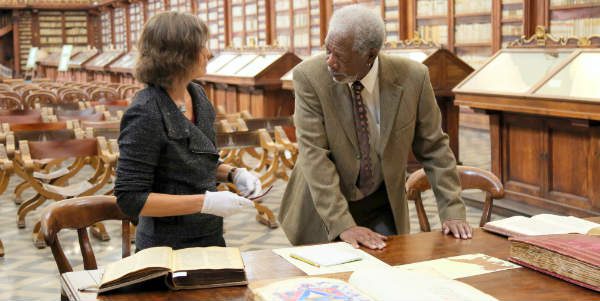
Image: ROME – Host Morgan Freeman examines ancient documents with Cornell University Professor of Ancient Mediterranean Religions Kim Haines-Eitzen at the Biblioteca Casanatense in Rome, Italy. (photo credit: National Geographic Channels/Seth Nejame)
Don’t miss a thing: head over to my other homes at CatholicVote and the Faith & Family Media blog, and like my Facebook page; also like the Patheos Catholic FB page to see what my colleagues have to say.
Next Post

April 8, 2016 'When Calls the Heart': Daniel Lissing Is 'A Man of Action ... Mostly'
Browse Our Archives
Select a Category books breaking news digital media Faith practice food interview jane the virgin media movies music NFL Pope Francis Showbiz 101 social media sports technology television Uncategorized video
Select a Month October 2026 September 2026 August 2026 July 2026 June 2026 May 2026 April 2026 March 2026 February 2026 January 2026 December 2025 November 2025 October 2025 September 2025 August 2025 July 2025 June 2025 May 2025 April 2025 March 2025 February 2025 January 2025 December 2024 November 2024 October 2024 September 2024 August 2024 July 2024 June 2024 May 2024 April 2024 March 2024 February 2024 January 2024 December 2023 November 2023 October 2023 September 2023 August 2023 July 2023 June 2023 May 2023 April 2023 March 2023 February 2023 January 2023 December 2022 November 2022 October 2022 September 2022 August 2022 July 2022 June 2022 May 2022 April 2022 March 2022 February 2022 January 2022 December 2021 November 2021 October 2021 September 2021 August 2021 July 2021 June 2021 May 2021 April 2021 March 2021 February 2021 January 2021 December 2020 November 2020 October 2020 September 2020 August 2020 July 2020 June 2020 May 2020 April 2020 March 2020 February 2020 January 2020 December 2019 November 2019 October 2019 September 2019 August 2019 July 2019 June 2019 May 2019 April 2019 March 2019 February 2019 January 2019 December 2018 November 2018 October 2018 September 2018 August 2018 July 2018 June 2018 May 2018 April 2018 March 2018 February 2018 January 2018 December 2017 November 2017 October 2017 September 2017 August 2017 July 2017 June 2017 May 2017 April 2017 March 2017 February 2017 January 2017 December 2016 November 2016 October 2016 September 2016 August 2016 July 2016 June 2016 May 2016 April 2016 March 2016 February 2016 January 2016 December 2015 November 2015 October 2015 September 2015 August 2015 July 2015 June 2015 May 2015 April 2015 March 2015 February 2015
Follow Us!
TAKE THE
Religious Wisdom Quiz
Who was turned into a pillar of salt?
Select your answer to see how you score.
Lot Lot's wife Ruth Naomi
Related posts from Kate O'Hare's Pax Culturati

'The Chosen' S6 Trailer: The Passion Gets Very...

Catholic Mike Ditka: Bear of a Man of...

We Need to Talk About 'Clarkson's Farm'

'Adore Him: He Is Here': On the Red...
TRENDING AT PATHEOS Catholic

A new article, written by Jeff Lindsay and Gale L. Pooley,...

Swimfan: Forgotten Aughts Pleasures
This is a recovery effort. In 2002, My Big Fat Greek Wedding...

Top Three Anti-Catholic Lies About Catholicism
This is my initial transcript for the video, "THE 3 WORST...

Pope Leo Celebrates Mass for Nurses & Docs...
I don't have any idea how he did it, but Pope Leo...

The Sermon on the Mount, Part I: Matthew...
The Sermon on the Mount, Part I (Matthew 4:12-5:12) St. Matthew moves...

What's up from Crossway: Reviewing some of their latest A few weeks...
view all Catholic blogs
Ad-Free & Subscriber Log-In Subscription Support
- About Us
- 2026 Calendar
- Videos
- Podcasts
- Library of World Religions
- Faith In Media Tracker
- Advertise With Us
- Write for Us
- Privacy Policy
- Terms of Service
- Do Not Sell My Data
- Contact Us
- Radiant Digital
- Manage Newsletter Subscriptions
- Unsubscribe From Notifications
- Sitemap
Copyright 2008-2026, Patheos. All rights reserved.
Subscription Support Ad-Free & Subscriber Log-In
Follow Patheos