
BuddhistCatholicContemplativeEvangelicalGeneral ChristianHinduJewishLatter-day SaintMuslimNew VisionsProgressive Christian
Beliefs
- Buddhist
- Catholic
- Contemplative
- Evangelical
- General Christian
- Hindu
- Jewish
- Latter-day Saint
- More Voices
- Muslim
- New Visions
- Pagan
- Progressive Christian
Topics
- Religion News
- Food and Religion
- Sports and Religion
- Religious Art
- Religious Music and Entertainment
- Religious Events
- History and Religion
- Style and Religion
- Politics and Religion
- Women in Religion
- Recreation Outdoors and Religion
- Business Finance and Religion
- Careers Workplace and Religion
- Education and Religion
- Family Parenting and Religion
- Health Fitness and Religion
- Home and Religion
- Relationships and Religion
- Technology and Religion
- Travel and Religion
Columnists
- Buddhist Columnists
- Business Finance and Religion Columnists
- Careers Workplace and Religion Columnists
- Catholic Columnists
- Contemplative Columnists
- Education and Religion Columnists
- Evangelists Columnists
- Family Parenting and Religion Columnists
- General Christian Columnists
- Health Fitness and Religion Columnists
- Hindu Columnists
- History and Religion Columnists
- Home and Religion Columnists
- Jewish Columnists
- More Voices Columnists
- Latter Day Columnists
- Muslim Columnists
- New Visions Columnists
- Nonreligious Columnists
- Pagan Columnists
- Politics and Religion Columnists
- Progressive Columnists
- Recreation Outdoors and Religion Columnists
- Relationships and Religion Columnists
- Religion News Columnists
- Religious Art Columnists
- Religious Events Columnists
- Religious Music and Entertainment Columnists
- Sports and Religion Columnists
- Style and Religion Columnists
- Technology and Religion Columnists
- Travel and Religion Columnists
- Women in Religion Columnists
Resource Library
- 2026 Calendar
- Library of World Religions
- The 100 Most Holy Places on Earth
- Patheos Answers
- Podcasts
- Videos
- Faith Leaders Database
- Anglican Episcopalian
- Bahai
- Baptist
- Buddhism
- Christianity
- Confucianism
- Eastern Orthodoxy
- Hinduism
- Holiness and Pentecostal
- ISKCON
- Islam
- Judaism
- Lutheran
- Methodist
- The Church of Jesus Christ of Latter-day Saints
- New Age
- Paganism
- Presbytarian and Reformed
- Protestantism
- Religion Behind the Scenes
- Roman Catholic
- Scientology
- Shia Islam
- Sikhism
- Sufism
- Sunni Islam
- Taoism
- Zen
- See all religions
Research Tools
 Ad-Free & Subscriber Log-In Subscription Support
Ad-Free & Subscriber Log-In Subscription Support
Follow Patheos 

- Trending:
- Forgiveness
- |
- Marriage
- |
- Consciousness
- |
- Death Penalty
- |
- Election
- |
- Halloween

- Home
- Catholic
- Religious Music & Entertainment
- Spike’s ‘Tut’: Alexander Siddig Learns to Preach Like an Egyptian
Spike’s ‘Tut’: Alexander Siddig Learns to Preach Like an Egyptian
Last updated on: July 19, 2015 at 8:18 am by Kate O'Hare
Spike’s ‘Tut’: Alexander Siddig Learns to Preach Like an Egyptian 2015-07-19T08:18:48-08:00 Kate O'Hare
Patheos Explore the world's faith through different perspectives on religion and spirituality! Patheos has the views of the prevalent religions and spiritualities of the world.
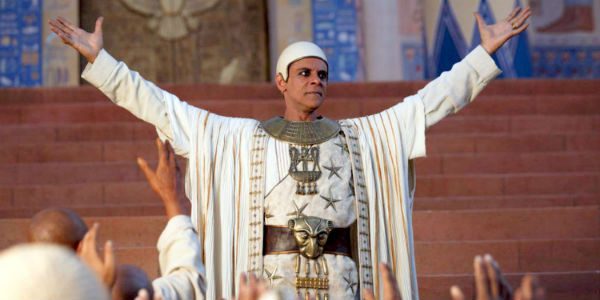
TV isn’t always fussy about ethnic accuracy in casting historical dramas, but sometimes it gets pretty close.
Stranger in a Strange Land
British actor Alexander Siddig, one of the stars of the three-night, six-hour miniseries “Tut,” premiering Sunday, July 19, on cablenet Spike, was born in 1965 to an English mother and Sudanese father not far from the Nile River in Sudan, which is at modern Egypt’s southern border.
But at the age of four, his Muslim grandmother packed him off alone to his mother in England, and he’s glad she did.
“Thank God I didn’t grow up in Sudan,” he said, speaking from a hotel in Hollywood, the morning after a party for “Tut.” “A lot of my family were forced to, and were in prison for years … My grandmother put me on a plane and just prayed to her God that I would be safe.”
Although he became thoroughly assimilated into British culture — he went by Siddig El Fadil (a shortened version of his birth name) until the ’90s, when he switched to Alexander Siddig — Siddig was particularly happy to take on his “Tut” role of Amun, high priest to the famous boy pharaoh. After all, ancient Nubia, a trading partner and rival power to Egypt (there was even a dynasty of Nubian pharaohs) lay in what now is southern Egypt and northern Sudan.
“I was really a part of this world,” said Siddig. “So, it was nice to do something where I felt indigenous. I’m part of this place, which is great.”
Growing a Story From a Seed of History
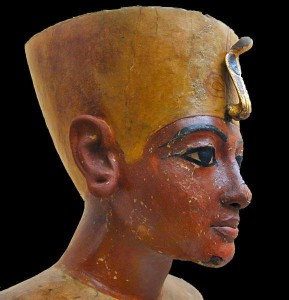 Filmed in Morocco, “Tut” spins a rollicking but almost entirely fictitious story around the short life and reign of Tutankhamun (circa 1332-1323 B.C.). He ascended to the throne at 9 or 10 but only ruled briefly after attaining his majority.
Slight, and with some skeletal abnormalities, he died at the age of 18 or 19, and the exact cause of death remains a topic for debate (“Tut” has its own theory).
While Egyptophiles will appreciate the massive, hand-painted sets — which Siddig said were mostly real, rather than CGI — there might be some eye-rolls at the luxuriant locks sported by Tut and others, especially since Egyptian art usually portrayed the aristocracy with shaved heads and elaborate wigs.
“We had to settle,” said Siddig, “for the fact that you’ve got a bunch of working actors who have to do other stuff.”
(That included Siddig, who was also in the middle of filming HBO’s “Game of Thrones.”)
They also wear an enormous amount of heavy, shiny robes. Again, this stands in contrast to Egyptian art, in which the people didn’t wear much, and what they did wear was mostly linen. But, said Siddig, consultants on “Tut” told him to not always believe what he saw painted on a wall or carved into a pillar.
“The priests did wear a lot of clothes,” he said, “and so did the aristocracy. It was a show of their wealth and ostentation. What ended up on the walls was actually more symbolic than reality.”
We do know that the title character of “Tut” was born Tutankaten during the reign of 18th Dynasty Pharaoh Akhenhaten, who threw aside Egypt’s powerful polytheistic religion in favor of a personal monotheism that made him the sole human intercessor for a sun-disk deity, called the Aten.
There are theories that Akhenaten’s religious upheaval was either inspired by Hebrew Joseph or Moses, or, conversely, inspired the concept of monotheism among Hebrews, but there’s no direct evidence for either notion. But comparisons between Akhenaten’s “Hymn to the Aten” and Psalm 104 are intriguing, if not proof of anything in particular.
What’s certain is that Akhenaten’s belief system didn’t outlive him in Egypt, and by the crowning of Tutankhamun, the original state religion was back in full force. The 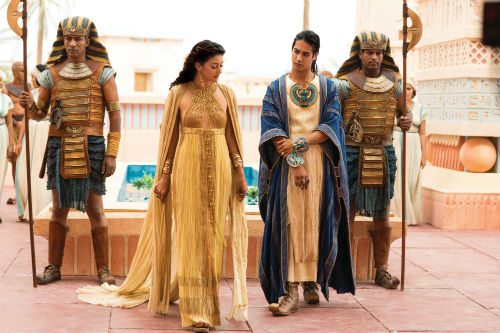 kingdom’s capital was removed from Akhenaten’s desert city of Akhetaten and returned to Thebes, on the banks of the Nile.
On the opposite shore was the Valley of the Kings, where many royals were buried. It was there, in 1922, that Brit Howard Carter would find Tutankhamun’s tomb. Its vast array of treasures and artifacts — contrasted with most other tombs, which had been plundered at one time or another — helped make relatively unimportant King Tut, as he came to be known, one of the most recognizable figures in all of Ancient Egypt.
Blending Fact and Fiction
Playing characters based on history in Tut are Avan Jogia as the boy king, Ben Kingsley as Vizier Ay, and Nonso Anozie (Sampson in History’s “The Bible”) as General Horemheb (both of whom succeeded Tut on the throne, with Horemheb’s reign marking the end of the 18th Dynasty). Also, Sibylla Deen plays Akhenaten’s daughter Ankhe, Tut’s half-sister and wife (real name Ankhesenpaaten, later Ankhesenamun).
Playing characters purely from imagination are Kylie Bunbury as the commoner Suhad; Peter Gadiot as Tut’s longtime friend, Ka; Iddo Golberg as loyal soldier Lagus; and Siddig as High Priest Amun.
When Tut took the throne, he set about restoring the temples and earlier religious practices.
“It was a brave new time,” said Siddig. “Akhenaten tried to do what wound up being the impossible, and change the religious basis of Egypt to a monotheistic culture. The priests, who were suddenly disenfranchised, didn’t take kindly to that. They do a good job of pointing that out in the show.
“That was a really interesting part of it. I know that Akhenaten was an unpopular pharaoh, and Tut, I suppose, tried to get back to the status quo.”

Next Post

July 21, 2015 Father Barron to Be L.A.'s Bishop Barron
Browse Our Archives
Select a Category books breaking news digital media Faith practice food interview jane the virgin media movies music NFL Pope Francis Showbiz 101 social media sports technology television Uncategorized video
Select a Month October 2026 September 2026 August 2026 July 2026 June 2026 May 2026 April 2026 March 2026 February 2026 January 2026 December 2025 November 2025 October 2025 September 2025 August 2025 July 2025 June 2025 May 2025 April 2025 March 2025 February 2025 January 2025 December 2024 November 2024 October 2024 September 2024 August 2024 July 2024 June 2024 May 2024 April 2024 March 2024 February 2024 January 2024 December 2023 November 2023 October 2023 September 2023 August 2023 July 2023 June 2023 May 2023 April 2023 March 2023 February 2023 January 2023 December 2022 November 2022 October 2022 September 2022 August 2022 July 2022 June 2022 May 2022 April 2022 March 2022 February 2022 January 2022 December 2021 November 2021 October 2021 September 2021 August 2021 July 2021 June 2021 May 2021 April 2021 March 2021 February 2021 January 2021 December 2020 November 2020 October 2020 September 2020 August 2020 July 2020 June 2020 May 2020 April 2020 March 2020 February 2020 January 2020 December 2019 November 2019 October 2019 September 2019 August 2019 July 2019 June 2019 May 2019 April 2019 March 2019 February 2019 January 2019 December 2018 November 2018 October 2018 September 2018 August 2018 July 2018 June 2018 May 2018 April 2018 March 2018 February 2018 January 2018 December 2017 November 2017 October 2017 September 2017 August 2017 July 2017 June 2017 May 2017 April 2017 March 2017 February 2017 January 2017 December 2016 November 2016 October 2016 September 2016 August 2016 July 2016 June 2016 May 2016 April 2016 March 2016 February 2016 January 2016 December 2015 November 2015 October 2015 September 2015 August 2015 July 2015 June 2015 May 2015 April 2015 March 2015 February 2015
Follow Us!
TAKE THE
Religious Wisdom Quiz
According to James, what should you do if you lack wisdom?
Select your answer to see how you score.
Fast and pray for seven days Ask God, who gives generously Seek counsel from elders Study the Torah diligently
Related posts from Kate O'Hare's Pax Culturati

'The Chosen' S6 Trailer: The Passion Gets Very...

Catholic Mike Ditka: Bear of a Man of...

We Need to Talk About 'Clarkson's Farm'

'Adore Him: He Is Here': On the Red...
TRENDING AT PATHEOS Catholic

Emotion in Early Christianity by Andrew Crislip
Andrew Crislip’s Emotion in Early Christianity examines an often overlooked dimension of...

16 Spiritual Touchstones for a More Grounded Life
After decades of spiritual study, here are 16 principles I try...

Catholic Evangelization: Sharing Your Faith Every Day
Welcome back to the Graceful Awakening mini-series called, “From Faith to Mission.” ...

The Pillar of the Boatmen: the Ancient Monument...
The Pillar of the Boatmen is a Romano-Gaulish sculpture that dates from...

In one sense walking into Westminster Abbey is like walking down the...

'Super Scam Me' Exposes AI Jon Bon Jovi...
Leslie Pickett believed she was in a relationship with Jon Bon Jovi....
view all Catholic blogs
Ad-Free & Subscriber Log-In Subscription Support
- About Us
- 2026 Calendar
- Videos
- Podcasts
- Library of World Religions
- Faith In Media Tracker
- Advertise With Us
- Write for Us
- Privacy Policy
- Terms of Service
- Do Not Sell My Data
- Contact Us
- Radiant Digital
- Manage Newsletter Subscriptions
- Unsubscribe From Notifications
- Sitemap
Copyright 2008-2026, Patheos. All rights reserved.
Subscription Support Ad-Free & Subscriber Log-In
Follow Patheos