
BuddhistCatholicContemplativeEvangelicalGeneral ChristianHinduJewishLatter-day SaintMuslimNew VisionsProgressive Christian
Beliefs
- Buddhist
- Catholic
- Contemplative
- Evangelical
- General Christian
- Hindu
- Jewish
- Latter-day Saint
- More Voices
- Muslim
- New Visions
- Pagan
- Progressive Christian
Topics
- Religion News
- Food and Religion
- Sports and Religion
- Religious Art
- Religious Music and Entertainment
- Religious Events
- History and Religion
- Style and Religion
- Politics and Religion
- Women in Religion
- Recreation Outdoors and Religion
- Business Finance and Religion
- Careers Workplace and Religion
- Education and Religion
- Family Parenting and Religion
- Health Fitness and Religion
- Home and Religion
- Relationships and Religion
- Technology and Religion
- Travel and Religion
Columnists
- Buddhist Columnists
- Business Finance and Religion Columnists
- Careers Workplace and Religion Columnists
- Catholic Columnists
- Contemplative Columnists
- Education and Religion Columnists
- Evangelists Columnists
- Family Parenting and Religion Columnists
- General Christian Columnists
- Health Fitness and Religion Columnists
- Hindu Columnists
- History and Religion Columnists
- Home and Religion Columnists
- Jewish Columnists
- More Voices Columnists
- Latter Day Columnists
- Muslim Columnists
- New Visions Columnists
- Nonreligious Columnists
- Pagan Columnists
- Politics and Religion Columnists
- Progressive Columnists
- Recreation Outdoors and Religion Columnists
- Relationships and Religion Columnists
- Religion News Columnists
- Religious Art Columnists
- Religious Events Columnists
- Religious Music and Entertainment Columnists
- Sports and Religion Columnists
- Style and Religion Columnists
- Technology and Religion Columnists
- Travel and Religion Columnists
- Women in Religion Columnists
Resource Library
- 2026 Calendar
- Library of World Religions
- The 100 Most Holy Places on Earth
- Patheos Answers
- Podcasts
- Videos
- Faith Leaders Database
- Anglican Episcopalian
- Bahai
- Baptist
- Buddhism
- Christianity
- Confucianism
- Eastern Orthodoxy
- Hinduism
- Holiness and Pentecostal
- ISKCON
- Islam
- Judaism
- Lutheran
- Methodist
- The Church of Jesus Christ of Latter-day Saints
- New Age
- Paganism
- Presbytarian and Reformed
- Protestantism
- Religion Behind the Scenes
- Roman Catholic
- Scientology
- Shia Islam
- Sikhism
- Sufism
- Sunni Islam
- Taoism
- Zen
- See all religions
Research Tools
 Ad-Free & Subscriber Log-In Subscription Support
Ad-Free & Subscriber Log-In Subscription Support
Follow Patheos 

- Trending:
- Forgiveness
- |
- Marriage
- |
- Consciousness
- |
- Death Penalty
- |
- Election
- |
- Halloween

- Home
- Catholic
- Religious Music & Entertainment
- ‘Killing Jesus’ & ‘A.D.’ — Where Was Barabbas?
‘Killing Jesus’ & ‘A.D.’ — Where Was Barabbas?
Last updated on: April 5, 2015 at 10:33 pm by Kate O'Hare
‘Killing Jesus’ & ‘A.D.’ — Where Was Barabbas? 2015-04-05T22:33:04-08:00 Kate O'Hare
Patheos Explore the world's faith through different perspectives on religion and spirituality! Patheos has the views of the prevalent religions and spiritualities of the world.
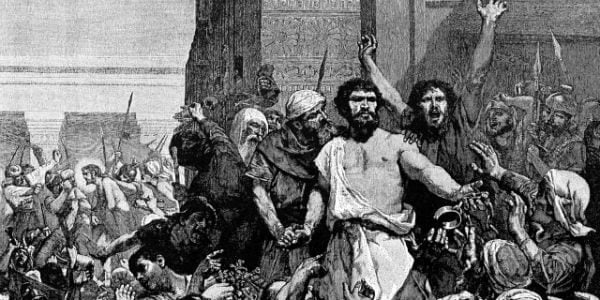
During this Holy Week, we’ve had competing versions of the trial and Crucifixion of Jesus — NatGeo Channel’s “Killing Jesus” (which repeated on Good Friday and on Easter Sunday, April 5, on Fox News Channel), and the Easter premiere of NBC’s 12-part “A.D.’: The Bible Continues.”
As I outlined in my review of “Killing Jesus,” it takes out all the supernatural parts of the story of Christ, supposedly focusing on the sociopolitical forces surrounding Christ’s ministry and death. “A.D.,” produced by spouses Mark Burnett and Roma Downey, who also did History’s “The Bible,” is a sacred retelling of Jesus’ story and the founding of the early Church, miracles and all.
Well, not quite all.
Although the two productions come at the Gospels from different angles, they both have the same person missing — Barabbas.
As described at CatholicCulture.org:
“A notorious prisoner,” Matthew described him (Matthew 27:16-17). John called him “a brigand” (John 18:40-41). Mark and Luke both said that he was in prison as a rioter and murderer (Mark 15:7-15; Luke 23:19-25). When Pilate questioned Jesus at his trial and could find him guilty of nothing, he offered the people the choice of freeing Christ or Barabbas, hoping that the latter’s notorious reputation would induce them to release Christ. But, whipped into fury by their chief priests, they insisted that the guilty man be freed and the innocent die. (Etym. Aramaic bar’ abba, son of the father.)
The omission is especially puzzling in “Killing Jesus,” since the freeing of a prisoner by public acclamation during the Passover was a very political move by Pilate in general, and especially when he applied it to the case of Jesus. With Barabbas in the mix, the responsibility for Jesus’ execution is spread among the Jewish high priests and elders, headed by Caiaphas; the Roman Empire, represented by the regional governor, Pontius Pilate; and the people in the crowd, which was likely heavily weighted in favor of Barabbas’ supporters.
After all, as a post at CatholicMoralTheology.com points out:
Why is it that, when confronted with a choice between that which draws us toward God and that which draws us away from God, we opt for the latter?
Perhaps we fail to recognize the choice for God as such because we expect that choice to look very differently. We construct our divine expectations to fit our own agenda rather than being open to discovering God’s agenda.
For the crowds in Mark’s Gospel, how could Jesus be the Son of the true Father without military might? How could the Messiah be such a simple man, and one so seemingly weak and defenseless in the custody of Pilate? We convince ourselves we are not moving away from God because God is not one of the choices. We rationalize it as an offense to God when the image of human weakness somehow claims identity with divine omnipotence. And yet, it may be our own assumptions that are offended, not God’s.
Then why, in a movie that strips out miracles and divinity in favor of politics, is such a political figure as Barabbas — represented in tradition as a Zealot, who were enemies of Roman rule — excised from the story?
We don’t know. I could speculate that it’s a case of modern political correctness, leaving the blame for Christ’s death among a small number of leaders, rather than spreading it around to the Jewish people gathered in Jerusalem at the time — but that’s just a guess.
When it comes to “A.D.,” though, I went right to the source and asked Burnett about the omission. Here’s his emailed response:
Sure. We originally allows three minutes of flashbacks to reset Crucifixion and to focus on Resurrection.
However, it expanded. I think that there were seven trials, and we really couldn’t include everything.
It was all about brevity and the line, “Truth. What is truth?” We did not want to distract from this.
So much to include. So little time. It’s very hard to make these choices. In the end it’s all about driving the story forward.
Our role is like Mark 4. We tell big parables. Tens of millions at a time on TV and many seek more details in smaller groups (churches).
So, there you go. Barabbas gets cut for time and to keep the story focused in another direction — but there are other Zealot characters, so they’re still represented.
Personally, I think it’s a loss for both productions. The crowd howling for Barabbas over Christ is a pivotal moment in the Passion narrative. Even if some think it’s a little hard to explain to modern sensibilities, it seems to me a very human reaction — when you feel oppressed, the man with the sword looks a lot more attractive than the one preaching love.
Maybe, next year, we should have a new version of the story of Barabbas (but, barring that, you could go back and watch the 2012 REELZ Channel miniseries version, starring Billy Zane).
Image: “Give us Barabbas!”, from “The Bible and its Story Taught by One Thousand Picture Lessons,” 1910. from Wikimedia Commons
Previous Post

April 5, 2015
The Easter Cross in the Sky at Sunrise in California
Next Post
April 6, 2015 10 Reasons Why 'The Ten Commandments' Is Truly Epic
Browse Our Archives
Select a Category books breaking news digital media Faith practice food interview jane the virgin media movies music NFL Pope Francis Showbiz 101 social media sports technology television Uncategorized video
Select a Month October 2026 September 2026 August 2026 July 2026 June 2026 May 2026 April 2026 March 2026 February 2026 January 2026 December 2025 November 2025 October 2025 September 2025 August 2025 July 2025 June 2025 May 2025 April 2025 March 2025 February 2025 January 2025 December 2024 November 2024 October 2024 September 2024 August 2024 July 2024 June 2024 May 2024 April 2024 March 2024 February 2024 January 2024 December 2023 November 2023 October 2023 September 2023 August 2023 July 2023 June 2023 May 2023 April 2023 March 2023 February 2023 January 2023 December 2022 November 2022 October 2022 September 2022 August 2022 July 2022 June 2022 May 2022 April 2022 March 2022 February 2022 January 2022 December 2021 November 2021 October 2021 September 2021 August 2021 July 2021 June 2021 May 2021 April 2021 March 2021 February 2021 January 2021 December 2020 November 2020 October 2020 September 2020 August 2020 July 2020 June 2020 May 2020 April 2020 March 2020 February 2020 January 2020 December 2019 November 2019 October 2019 September 2019 August 2019 July 2019 June 2019 May 2019 April 2019 March 2019 February 2019 January 2019 December 2018 November 2018 October 2018 September 2018 August 2018 July 2018 June 2018 May 2018 April 2018 March 2018 February 2018 January 2018 December 2017 November 2017 October 2017 September 2017 August 2017 July 2017 June 2017 May 2017 April 2017 March 2017 February 2017 January 2017 December 2016 November 2016 October 2016 September 2016 August 2016 July 2016 June 2016 May 2016 April 2016 March 2016 February 2016 January 2016 December 2015 November 2015 October 2015 September 2015 August 2015 July 2015 June 2015 May 2015 April 2015 March 2015 February 2015
Follow Us!
TAKE THE
Religious Wisdom Quiz
According to 3 John, who loves to be first and will not welcome the brothers?
Select your answer to see how you score.
Alexander Diotrephes Demetrius Gaius
Related posts from Kate O'Hare's Pax Culturati

'The Chosen' S6 Trailer: The Passion Gets Very...

We Need to Talk About 'Clarkson's Farm'

'Adore Him: He Is Here': On the Red...

Netflix's 'Narnia: The Magician's Nephew': We Have Thoughts
TRENDING AT PATHEOS Catholic

We are approaching the date of our new American national holiday: October...

Letters on Living the Faith by C.S. Lewis
Most of us met C.S. Lewis as a public intellectual. Mere Christianity....

When Halloween Unmasks Married Hearts
Written by Dr. David K. Ewen from Eternal Truth Bible College Behind...

Aristotle. He’s been called the father of logic, the father of the...

Methodist Central Hall and Westminster Abbey
Situated on the same square is Methodist Central Hall and Westminster Abbey. ...

57th Dove Awards Honor Dolly Parton, Crown New...
On gospel music’s biggest night, the 57th annual GMA Dove Awards honored...
view all Catholic blogs
Ad-Free & Subscriber Log-In Subscription Support
- About Us
- 2026 Calendar
- Videos
- Podcasts
- Library of World Religions
- Faith In Media Tracker
- Advertise With Us
- Write for Us
- Privacy Policy
- Terms of Service
- Do Not Sell My Data
- Contact Us
- Radiant Digital
- Manage Newsletter Subscriptions
- Unsubscribe From Notifications
- Sitemap
Copyright 2008-2026, Patheos. All rights reserved.
Subscription Support Ad-Free & Subscriber Log-In
Follow Patheos