
BuddhistCatholicContemplativeEvangelicalGeneral ChristianHinduJewishLatter-day SaintMuslimNew VisionsProgressive Christian
Beliefs
- Buddhist
- Catholic
- Contemplative
- Evangelical
- General Christian
- Hindu
- Jewish
- Latter-day Saint
- More Voices
- Muslim
- New Visions
- Pagan
- Progressive Christian
Topics
- Religion News
- Food and Religion
- Sports and Religion
- Religious Art
- Religious Music and Entertainment
- Religious Events
- History and Religion
- Style and Religion
- Politics and Religion
- Women in Religion
- Recreation Outdoors and Religion
- Business Finance and Religion
- Careers Workplace and Religion
- Education and Religion
- Family Parenting and Religion
- Health Fitness and Religion
- Home and Religion
- Relationships and Religion
- Technology and Religion
- Travel and Religion
Columnists
- Buddhist Columnists
- Business Finance and Religion Columnists
- Careers Workplace and Religion Columnists
- Catholic Columnists
- Contemplative Columnists
- Education and Religion Columnists
- Evangelists Columnists
- Family Parenting and Religion Columnists
- General Christian Columnists
- Health Fitness and Religion Columnists
- Hindu Columnists
- History and Religion Columnists
- Home and Religion Columnists
- Jewish Columnists
- More Voices Columnists
- Latter Day Columnists
- Muslim Columnists
- New Visions Columnists
- Nonreligious Columnists
- Pagan Columnists
- Politics and Religion Columnists
- Progressive Columnists
- Recreation Outdoors and Religion Columnists
- Relationships and Religion Columnists
- Religion News Columnists
- Religious Art Columnists
- Religious Events Columnists
- Religious Music and Entertainment Columnists
- Sports and Religion Columnists
- Style and Religion Columnists
- Technology and Religion Columnists
- Travel and Religion Columnists
- Women in Religion Columnists
Resource Library
- 2026 Calendar
- Library of World Religions
- The 100 Most Holy Places on Earth
- Patheos Answers
- Podcasts
- Videos
- Faith Leaders Database
- Anglican Episcopalian
- Bahai
- Baptist
- Buddhism
- Christianity
- Confucianism
- Eastern Orthodoxy
- Hinduism
- Holiness and Pentecostal
- ISKCON
- Islam
- Judaism
- Lutheran
- Methodist
- The Church of Jesus Christ of Latter-day Saints
- New Age
- Paganism
- Presbytarian and Reformed
- Protestantism
- Religion Behind the Scenes
- Roman Catholic
- Scientology
- Shia Islam
- Sikhism
- Sufism
- Sunni Islam
- Taoism
- Zen
- See all religions
Research Tools
 Ad-Free & Subscriber Log-In Subscription Support
Ad-Free & Subscriber Log-In Subscription Support
Follow Patheos 

- Trending:
- Forgiveness
- |
- Marriage
- |
- Consciousness
- |
- Death Penalty
- |
- Election
- |
- Halloween
 Karen Spears Zacharias
- Home
- Evangelical
- A Gold Star Daughter’s story
A Gold Star Daughter’s story
Last updated on: May 24, 2013 at 6:14 pm by Karen Spears Zacharias
A Gold Star Daughter’s story 2013-05-24T18:14:01+00:00 Karen Spears Zacharias
Patheos Explore the world's faith through different perspectives on religion and spirituality! Patheos has the views of the prevalent religions and spiritualities of the world.
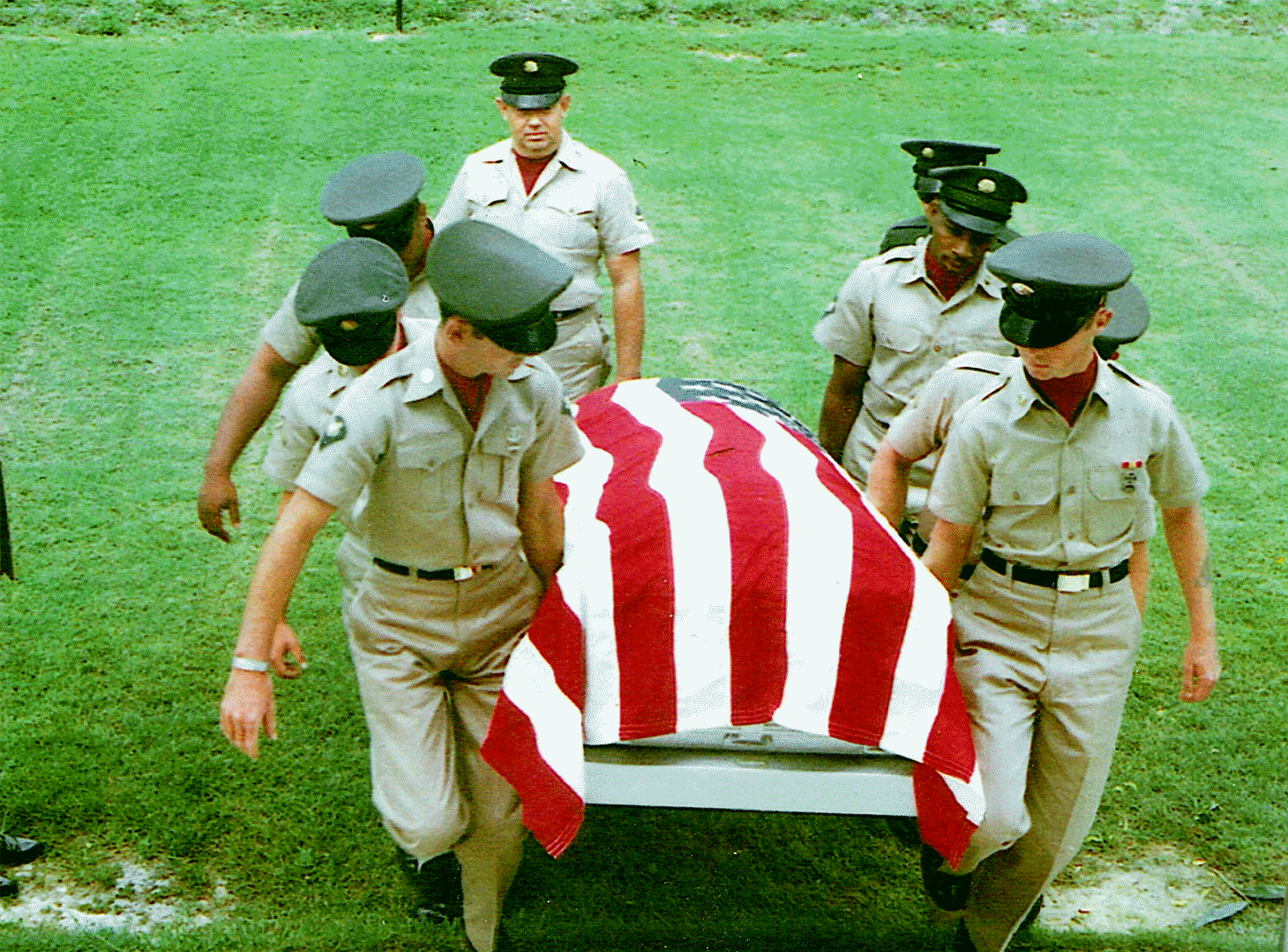
The Man in the Jeep
At first I never even noticed the jeep, what with trying to tie up the bulldog pup. Grandpa Harve was sitting in a mesh lawn chair nearby, his dead arm slung down between his legs. His good hand flicked a cigarette stub.
“Karen, you hold her,” Mama instructed over my shoulder. “Frankie, tie that in a doubleknot.” Daddy’s best buddy, Dale Ferrano, had given us a prize bulldog as a gift that day. We were all gathered outside the trailer house trying to figure out where to keep such a creature in a yard that had no grass or a fence.
We hadn’t lived at Slaughters Trailer Court in Rogersville, Tennessee, very long. It was just a dirt hill with six trailers slapped upside it. One was ours, and one belonged to Uncle Woody, Mama’s oldest brother. I’m sure given the situation Mama would have rather not lived in any place named Slaughters.
Folks often laugh when I tell them I grew up a trailer park victim. But when I drive through places like Slaughters, like Lake Forest or Crystal Valley, or any of the other trailer courts I once called home, I ache for the children who live there. And for the circumstances that led their mamas and daddies to make homes between cinder block foundations and dirt yards.
This was late July 1966. Just like any Southern summer, the days steamed and the nights stewed. I found myself missing the ocean breezes of Oahu, where we had last lived with Daddy. We’d left the island just a month before, shortly after I finished third grade. We had family in Rogersville, where both my parents had grown up.
“I knew the minute I saw that jeep,” Mama told me later. “There aren’t any military bases in East Tennessee.”
I don’t remember having any premonitions myself. I was used to seeing jeeps. We had lived near military bases all my life. Fort Benning. Fort Campbell. Schofield.
“Shelby Spears?” the soldier asked. He was clutching a white envelope. His fingers trembled.
“Yes?” Mama replied. Her whole face went taut as she clenched her jaw. She turned and handed the pup over to Brother Frankie. Little Linda hid behind Mama, rubbing her bare toes in the dirt. “Finish tying him up,” Mama instructed.
Then, pulling down the silver handle of the trailer door, she stepped inside. The soldier followed.
I looked over at Grandpa Harve. His eyes were hidden behind dark sunglasses. A white straw hat shielded his drooping head. Sister Linda followed the soldier. I followed her. Frankie followed me.
For years now, I have tried to remember what happened next. But it’s as if somebody threw me up against a concrete wall so violently that my brain refuses to let any of it come back to me. I suppose the pain was so intense my body just can’t endure it.
I call only bits. Crying. Screaming. Hollering like a dog does when a chain is twisted too tightly about its neck.
Frankie was sitting cross-legged on the blue foam cushion that served as the trailer’s built-in couch. He pounded the wall with his fists. “Those Charlies killed my Daddy!” he screamed. “Those Charlies killed my Daddy!”
Grasping Mama’s hand, Linda buried her face in her thigh.
I was confused. Who was Charlie? Who was this soldier? Why was Mama crying? “What is it?” I asked. “What’s happened?”
“Daddy’s dead!” Frankie yelled back at me, punching the wall again. “They’ve kilt our daddy! I’m gonna kill them Charlies!”
I had never seen Mama cry before.
Not even that December night in Hawaii when Daddy left us.
Sister Linda was six years old and was already asleep when Daddy and Mama asked Frankie and me to come into the living room. “We need to talk,” Daddy said.
He’d never asked us to talk before. Not officially, like he was calling together his troops or something. Mama sat real quiet beside him on the red vinyl couch. Frankie and I sat on the hardwood floor, dressed in our pajamas, ready for bed.
“Frank, Karen,” Daddy said, “I believe you both are old enough now to understand some things.”
I was thankful he recognized my maturity. After turning over a whole can of cooking oil on top of my head earlier that evening while helping Mama in the kitchen, I was feeling a bit insecure about my status as the family’s oldest daughter. I was nine years old.
“You both know who President Johnson is?”
We nodded in unison.
Daddy continued, “There’s a country that needs our help, South Vietnam. President Johnson has asked me to go.”
“Where’s Vietnam?” Frankie asked.
“Whaddya gonna do there?” I asked.
“It’s in Southeast Asia. We’ll be helping protect the country from communism.”
Tears stung. Not because I understood what communism was, or that Daddy would be in any danger. Simply because my daddy would be leaving me.
“Frank, you’re the man of the house now,” Daddy said. “I need you to take care of your mama and sisters.”
“Yes, sir,” Frankie replied, his voice too steady for a boy of just eleven.
“Karen,” Daddy said, looking directly at me, “you need to help Mama take care of Linda. Okay?”
I nodded.
I held my tears until after I hugged Mama and Daddy and climbed into bed. Scrunching myself between the cold wall and the edge of my mattress, I began to cry. A few minutes later Daddy flipped on the light. On the bed next to mine, curled into a ball like a kitten, a sleeping Linda didn’t even twitch. “Karen?”
“Yes, sir?” I said as I wiped my nose on the back of my forearm.
“Are you crying?”
“Yes, sir,” I replied. I tried to shake the shivers from my neck.
“Why are you crying, honey?” Daddy asked.
“I’m scared,” I answered.
“Scared of what?” Daddy walked over and sat down on the edge of my bed.
“That you won’t come home!” I wailed. Like monsoon rains, powerful tears rushed forth.
“Karen,” Daddy said, smoothing matted hair back from my wet cheeks. “I’ll come back. I promise.”
Picking me up, he let me cry into his shoulder. He smelled of Old Spice and sweat. “But I need for you to stop your crying, okay? It upsets Mama.”
“Okay,” I said, sucking back the last sob. I didn’t want to upset anyone.
“G’night, Karen.”
“G’night, Daddy. I love you.”
“I love you too, honey.”
He flipped off the light. Grabbing my pillow, I sought to muffle the crying that grown-ups can control but children never can.
Daddy left early the next day, before the sun tiptoed over the horizon. He kissed me good-bye, but I barely woke in the predawn darkness.
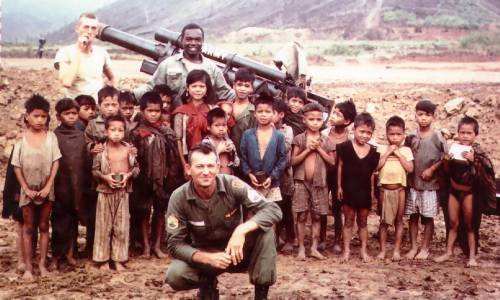
From Vietnam, Daddy sent pictures of barefoot children in tattered clothing. He sent Linda a Vietnamese doll wearing a red satin dress, and me one wearing yellow. Vietnamese colors for happiness and luck. And he wrote letters, promising he’d be home soon.
Daddy did return for a short visit. His orders called it an R&R, a rest-and-recuperation trip. The order is dated May 8, 1966. The papers issue Daddy a leave for Manila in the Philippines, effective May 10. Skip a couple of spaces over from “Philippines,” and in another type and ink are the words “and Hawii.” Later, Daddy swore to Mama he’d gotten ahold of a typewriter and changed his order, just so he could come home to us again. He laughed every time he told Mama about that.
It was pitch-dark outside when Mama locked us inside the house and left to go pick up Daddy. Frankie, Linda, and I sat on the vinyl couch waiting for them to return. I was having a hard time staying awake. Earlier that week Frankie had dared me to stick my hand in a wasp hive in the banana tree out back. I’d done it, trusting, as Frankie claimed, that all the wasps were long gone.
Liar. Liar. Liar. I got stung countless times. My hand swoll up till it looked like a brand-new baseball mitt. The doctor had given me sleeping pills and told Mama that I needed to keep my hand elevated. I’d taken the pills off and on all day long. After a half hour or so, waiting for Daddy, I gave up the struggle and returned to Mama’s bed. I was there, asleep, when I heard Daddy’s playful voice and Linda’s giggles. I was sore that everybody else had been awake to greet Daddy.
“Hey there, Sleepy-head,” he said when I stepped into the room.
“Hey, Daddy,” I replied, climbing onto his right knee. Linda was sitting on his left one.
“Couldn’t wait up for me?” he asked.
“I tried,” I said.
“Let me see that hand,” he said, taking my right hand into his. He studied the swollen hand. “That must’ve hurt.”
I glared at Frankie. “Yes, sir. It did.”
“Guess you won’t be sticking your hand into hives again anytime soon.”
“No, sir. I sure won’t.”
Frankie grinned. Mama and Daddy laughed. Linda snuggled closer to Daddy and giggled some more. I continued to glare at Frankie. I couldn’t see what everybody thought was so funny.
Daddy had changed since he first left us in December. He was thinner. Malaria, he told Mama. I asked her what malaria was.
“A mosquito disease,” she said.
We’d had plenty of mosquitoes in Tennessee. They could leave big welts on a girl’s ankles and belly. But I never knew bites could make a person lose weight. Daddy looked awfully thin to me. Like he hadn’t had a hot biscuit or plate of gravy in a month of Sundays. Even his hair looked thinner. He had a worrisome look in his eyes, too. Like somebody who spent too much time reading and studying and still couldn’t figure out the sum.
I was in the kitchen one afternoon when Daddy told Mama about a little girl he’d seen get blown up by a bomb. That troubled him. It troubled me, too, after I heard about it. Daddy said the girl would come to the camp, and he and the other soldiers gave her C-rations, pennies, gum, or candy, whatever they had. Frankie and I liked to get into Daddy’s C-rations, too. Not because the food tasted good. It was really awful. Most of it smelled and looked like cat food. We just liked the cans because they were painted army green. When we ate from them, we pretended to be soldiers in the jungles, just like Daddy.
Daddy leaned his chair back on two legs as he took a draw from his cigarette. A little bit of the Pet milk he’d poured over his bowl of cobbler earlier had turned the color of peaches.
“The Viet Cong strapped a bomb around her,” Daddy said, recalling the moment he’d seen the little girl explode. Mama stood by the kitchen sink, drying a plate, listening to Daddy. She didn’t say a word. “She was just a little girl, about Linda’s size,” Daddy said. “She was always asking me for pennies, for gum. They strap these kids with bombs and send them into our camps. There’s nothing we can do.”
Daddy took another drag from his cigarette and mashed the end of it into his plate. Mama just kept drying dishes. I studied the sadness on my daddy’s face. He looked defeated. Tired. Plumb worn-out. I walked over and wrapped my arms around his neck from behind. He patted my hands. “Hey there, Sissy,” he said.
“Hey, Daddy,” I replied.
“Wanna go for a ride?” he asked.
“Yes, sir,” I said.
“Run go get Linda,” he instructed. “She can come with us.”
Daddy loved to take Linda and me riding on the moped in between the rows of pineapple fields near our house. He’d found the moped in a ditch one day and brought it home and fixed it up. If something had an engine, Daddy could get it to run. He’d spend hours lying on his back underneath a car, tinkering with its parts. I don’t ever remember any car we ever owned breaking down. But Daddy always found some sort of reason to spend his Saturday afternoons underneath the car’s hood. The only thing he seemed to love more than fixing car engines was driving cars. Fast. He and Mama shared that, too. Their lead-footed ways.
One day, back in 1957, it had gotten him into a mess of trouble and practically killed Granny Ruth. He had her in the passenger seat beside him when he was broadsided on a highway outside Knoxville. Granny Ruth was hurt real bad. She spent weeks lying in the hospital bed. Mama says Granny Ruth never did fully recover from that wreck. She died from a stroke in 1962, shortly before we left for Hawaii.
Mama didn’t like Daddy taking us girls out on the moped. She wouldn’t ride it with him except for a time or two, down to the end of the street. And she wouldn’t watch as we whizzed in and out of the red dirt roads of Wahiawa’s pineapple fields. But Linda and I loved it. We squealed with delight, especially when Daddy revved up the engine.
“Faster, faster!” Linda would scream.
“Yeah, faster, faster!” I’d chime in.
Our hair, hers dark, mine blond, would whip every which way about our heads. Daddy would yell at us, “Hang on tight!”
Linda sat in front between his legs and gripped the bike’s handles. Daddy kept one arm around her. I sat on the back, grasping his waist. Sometimes, when he wanted to go really fast, he’d have one of us wait in the fields while he took the other out. “Safer that way,” he said.
He wouldn’t go far, but he’d go as fast as the bike would take him. It was probably only zero to thirty in five minutes, but Linda and I felt like were going at the speed of light. It was better than a Scrambler ride at the fair. Plus, we got the extra kick of having Daddy all to ourselves.
During that time he was home in May 1966, Daddy took Linda and me for several rides in the pineapple fields. He took Mama fishing along Oahu’s North Shore. And he tossed balls with Frankie in the driveway. He ate hot biscuits and milk gravy that Mama made.
Daddy didn’t talk much of war, or of Vietnam. Other than the story of the little girl, I never heard him mention it again. He cleaned his gear, shined his boots, and grew sadly quiet as it got closer to the time when he had to return. He didn’t make me any more promises. But this time I wasn’t worried about his leaving. He’d come home just like he’d said. I figured he’d be home again soon enough. So on May 20, 1966, I barely woke at all when Daddy came in to kiss me good-bye.
“I love you, Karen.”
“I love you, too, Daddy,” I said. I sat up and gave him a hug. He flipped off the overhead light, and I fell back to sleep, confident that there would be plenty of time for more hugs from Daddy.
In June our family returned to Rogersville in anticipation of that promise. Daddy said he’d be home in time for my tenth birthday on November 12. Perhaps even on Veterans Day.
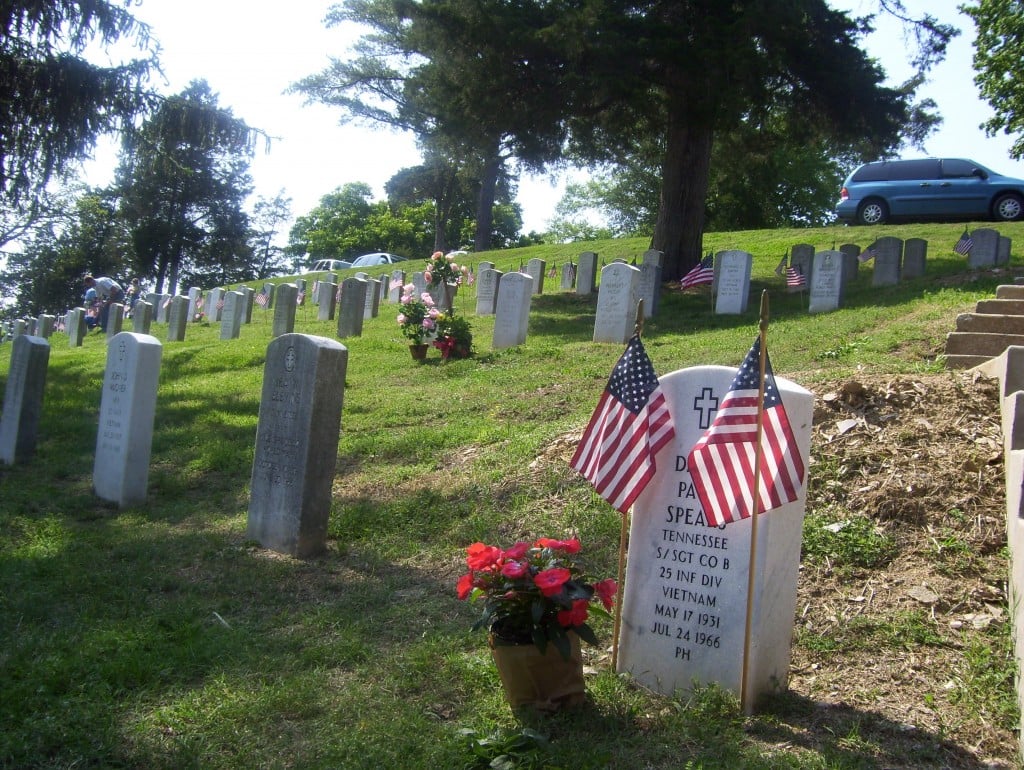
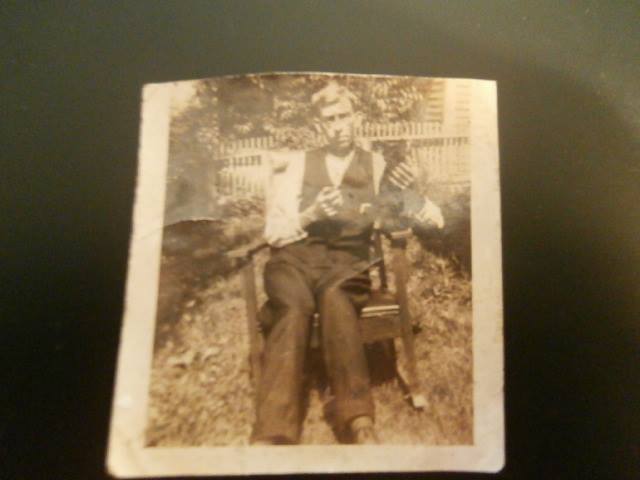
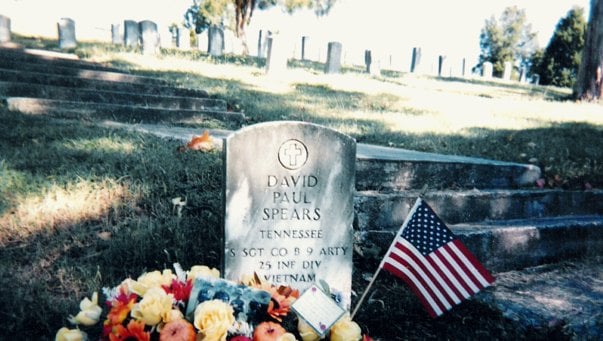
Daddy kept his promise, in a way. He did come back. Via airmail, in a cargo plane full of caskets.
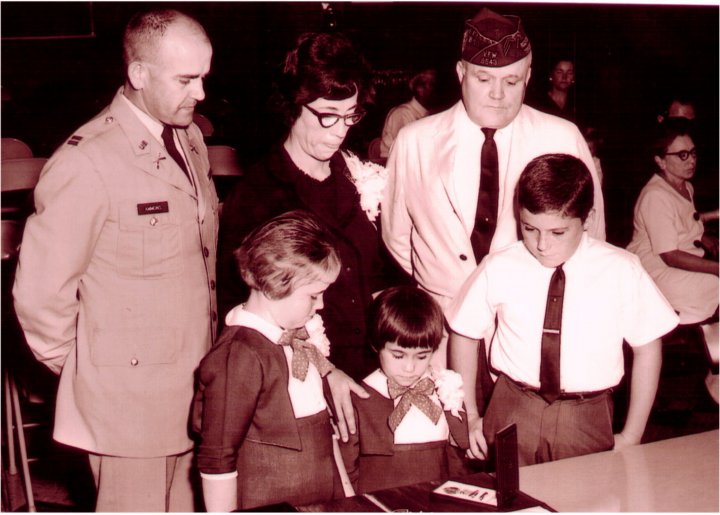
The tears streaming down Mama’s face frightened me.
Grandpa Harve didn’t rise from his lawn chair until the man in the jeep pulled away. And if he ever hugged or comforted his daughter in any way, I never witnessed it. But streams of tears flowed from beneath his dark glasses throughout the rest of the day. Grandpa Harve loved Daddy as much as any of us.
As I tried to sleep that first night, fear blanketed me. Never warm, it at least wrapped me up real tight. I took refuge in fear’s cocoon. Sometimes I still do.
I could hear Mama’s cries through the thin panel boards that seperated our bedrooms. She had cried all day long. Loud, wailing cries. Bitter water. That day I’d seen Mama raise her head and plead with God Almighty himself. She kept asking the same question over and over. “Why me, God? Why me?”
If God ever gave her an answer, I never heard it.
I wasn’t bold enough to ask God why myself. I figured you had to know him well enough to ask such a personal question. Still, I prayed each night. Clasping my throat, I prayed the only prayer I knew: “Our Father, who art in Heaven, hallow’d be thy name. …”
Sometimes I fell asleep before I got to the part about “Forgive us our trespasses, as we forgive those who trespass against us.” But not usually. Getting to sleep is hard when you’re worried about having your head cut off. It was a notion I obsessed over after I overheard some kinfolk discuss whether somebody had tried to cut off Daddy’s head. From that moment on, for years to come, decapitation haunted my slumber. Avoiding dismemberment became my focus early in life.
Prior to Daddy’s death, I had never even thought much about my neck before. The only times I ever noticed I had a neck were when Mama told me there was enough dirt in its creases to grow cotton. But nearly every night hence I fell into a fitful sleep with my hands resting on my throat. I figured being asleep was too much like being dead. No telling what people do to you when you’re dead or asleep.
Once, years later, I slept with a man who didn’t understand my fallow fears. While I lay sleeping, he took a pair of scissors and cut off my panties. When I awoke the next morning and found myself nude from the waist down, I was frantic. I couldn’t figure out where my favorite pair of underwear had disappeared to. Nor could I recall any particular dream that would have enticed me to discard them. My panic came out in a scream.
I know that poor man never understood the violation of cutting a pair of panties off a woman while she slept. And I tried hard to believe that was the only way I was violated. But when one is asleep, one is never sure what is going on.
I fret that being dead renders the same effect. Perhaps it’s different for the dead. Perhaps the dead know what’s going on in a way the sleeping don’t. But can they really offer any help? Or is it just like those dreams where an intruder climbs into your bedroom window and he’s stealthily coming toward you, and you begin to scream for help? Then you wake up and your mouth is open, but there is no sound at all. Just the clock ticking, the refrigerator humming, and dark silence.
I suspect if Daddy really saw how hurt we all were, he would have done something to help us. But he didn’t. I hope it’s because he couldn’t, not because he was so busy rejoicing up in heaven that he didn’t care about the hell he’d left us in.
It’s hard to explain what losing a father does to a family. Daddy’s death is the road marker we kids use to measure our life’s journey. Before his death, ours was a home filled with intimacy and devotion. After his death, it was filled with chaos and destruction.
I thought about our family’s loss decades later while reading an article published in The Oregonian. It was the police account of a young man whose body had surfaced in the Columbia River. Hoping that somebody could help identify the boy, the newspaper ran a photo of the shirt he was wearing. It was a custom-made T-shirt with the picture of a skull on it. Law enforcement officials couldn’t identify the boy because his head was missing.
That shirt was his only legacy. And unless someone recognized it, his headless body would be buried in a grave marked “John Doe.” Whatever thoughts or memories his soul would carry into the afterlife would literally be cut off forever.
I think that’s what losing Daddy did to us. With him gone, we were headless. It was as if somebody came into our home with a machete and in one swift slice decapitated our entire family.
Karen Spears Zacharias is a Gold Star Daughter. This is an excerpt from her memoir AFTER THE FLAG HAS BEEN FOLDED, available for purchase at any local bookstore or by e-book online. This Memorial Day remember the soliders who paid the ultimate sacrifice and their families.
After the Flag has been Folded
Previous Post

May 23, 2013
How she sees the world
Next Post
May 27, 2013 I talk to cabbies
Browse Our Archives
Select a Category child abuse Military ministry pop culture prayer Sports Uncategorized Veterans Day
Select a Month July 2014 June 2014 May 2014 April 2014 March 2014 February 2014 January 2014 December 2013 November 2013 October 2013 September 2013 August 2013 July 2013 June 2013 May 2013 April 2013 March 2013 February 2013 January 2013 December 2012 November 2012 October 2012 September 2012 August 2012 July 2012 June 2012 May 2012 April 2012 March 2012 February 2012 January 2012 December 2011 November 2011 October 2011 September 2011 August 2011 July 2011 June 2011 May 2011 April 2011 March 2011 February 2011 January 2011 December 2010 November 2010 October 2010 September 2010
Follow Us!
TAKE THE
Religious Wisdom Quiz
How was Elijah taken up to Heaven?
Select your answer to see how you score.
After his walk with God Carried by angels After his passing Chariot of fire
Related posts from Karen Spears Zacharias
TRENDING AT PATHEOS Evangelical

The REST of Your Life: A Creative Wrestles...
This week I had a conversation with a good friend from church....

How the author of the world's best hymn...
I've been working with John Newton for a while now. This makes...

Long before this Lectio Divina, Psalm 130 - the song - started...

What About the Trees? Another Living Parable
After I finished writing the last article about falling leaves as a...

Why Classical Education Is a Conversation, Not a...
Come and Read: Joy in Classical Education When I was a little...

Cornell University has received a great deal of negative publicity and intense...
view all Evangelical blogs
Ad-Free & Subscriber Log-In Subscription Support
- About Us
- 2026 Calendar
- Videos
- Podcasts
- Library of World Religions
- Faith In Media Tracker
- Advertise With Us
- Write for Us
- Privacy Policy
- Terms of Service
- Do Not Sell My Data
- Contact Us
- Radiant Digital
- Manage Newsletter Subscriptions
- Unsubscribe From Notifications
- Sitemap
Copyright 2008-2026, Patheos. All rights reserved.
Subscription Support Ad-Free & Subscriber Log-In
Follow Patheos