
BuddhistCatholicContemplativeEvangelicalGeneral ChristianHinduJewishLatter-day SaintMuslimNew VisionsProgressive Christian
Beliefs
- Buddhist
- Catholic
- Contemplative
- Evangelical
- General Christian
- Hindu
- Jewish
- Latter-day Saint
- More Voices
- Muslim
- New Visions
- Pagan
- Progressive Christian
Topics
- Religion News
- Food and Religion
- Sports and Religion
- Religious Art
- Religious Music and Entertainment
- Religious Events
- History and Religion
- Style and Religion
- Politics and Religion
- Women in Religion
- Recreation Outdoors and Religion
- Business Finance and Religion
- Careers Workplace and Religion
- Education and Religion
- Family Parenting and Religion
- Health Fitness and Religion
- Home and Religion
- Relationships and Religion
- Technology and Religion
- Travel and Religion
Columnists
- Buddhist Columnists
- Business Finance and Religion Columnists
- Careers Workplace and Religion Columnists
- Catholic Columnists
- Contemplative Columnists
- Education and Religion Columnists
- Evangelists Columnists
- Family Parenting and Religion Columnists
- General Christian Columnists
- Health Fitness and Religion Columnists
- Hindu Columnists
- History and Religion Columnists
- Home and Religion Columnists
- Jewish Columnists
- More Voices Columnists
- Latter Day Columnists
- Muslim Columnists
- New Visions Columnists
- Nonreligious Columnists
- Pagan Columnists
- Politics and Religion Columnists
- Progressive Columnists
- Recreation Outdoors and Religion Columnists
- Relationships and Religion Columnists
- Religion News Columnists
- Religious Art Columnists
- Religious Events Columnists
- Religious Music and Entertainment Columnists
- Sports and Religion Columnists
- Style and Religion Columnists
- Technology and Religion Columnists
- Travel and Religion Columnists
- Women in Religion Columnists
Resource Library
- 2026 Calendar
- Library of World Religions
- The 100 Most Holy Places on Earth
- Patheos Answers
- Podcasts
- Videos
- Faith Leaders Database
- Anglican Episcopalian
- Bahai
- Baptist
- Buddhism
- Christianity
- Confucianism
- Eastern Orthodoxy
- Hinduism
- Holiness and Pentecostal
- ISKCON
- Islam
- Judaism
- Lutheran
- Methodist
- The Church of Jesus Christ of Latter-day Saints
- New Age
- Paganism
- Presbytarian and Reformed
- Protestantism
- Religion Behind the Scenes
- Roman Catholic
- Scientology
- Shia Islam
- Sikhism
- Sufism
- Sunni Islam
- Taoism
- Zen
- See all religions
Research Tools
 Ad-Free & Subscriber Log-In Subscription Support
Ad-Free & Subscriber Log-In Subscription Support
Follow Patheos 

- Trending:
- Forgiveness
- |
- Marriage
- |
- Consciousness
- |
- Death Penalty
- |
- Election
- |
- Halloween
 Gone Witching
- Home
- Pagan
- Desecration of the Divine: Awareness and Safe Spaces
Desecration of the Divine: Awareness and Safe Spaces
Last updated on: July 19, 2018 at 4:05 am by K. C. Alexander
Desecration of the Divine: Awareness and Safe Spaces 2018-07-19T04:05:13+00:00 K. C. Alexander
Patheos Explore the world's faith through different perspectives on religion and spirituality! Patheos has the views of the prevalent religions and spiritualities of the world.
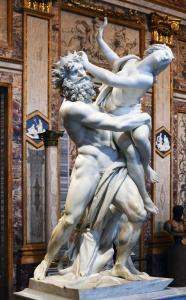
The Rape of Proserpina; Gian Lorenzo Bernini
In the records we have (primarily written by men, either in ages past or here and now), a woman of divine attachment or being is 100% at the mercy of a male. Either because society and strength gives him the right to “claim” her, or because a woman is so steeped in the concept of man as “right” that any other woman that offends him is in the wrong.
This is not any individual’s fault, and it’s not anybody’s burden to blame alone. We are all complicit in this stereotype. Our programming is set; it is how we were raised. And in pagan circles, there are unwilling women imprisoned by the emotional expectation to be embodiment of a goddess.
How disrespectful to that goddess. How disrespectful to that woman! Way to cheapen an experience. Because an unwilling recipient of worship? That’s not blessing. That’s not flattery.
That’s Hera-level fury when someone worships some random woman by comparing them her.
The Choices of a Goddess
Let me 100% clear: there is nothing wrong with choosing to embody and embrace every aspect of a divine goddess. If sexuality and lust and the oneness of being and purity and whatnot are your jam, then rock on with your badass self. You are who you are, nobody else, and your identity is your own.
And once more for the cheap seats:
YOU ARE WHO YOU CHOOSE TO BE.
YOU DESERVE TO BE TREATED HOW YOU CHOOSE TO BE TREATED.
If your path is one where you have chosen to embody or answer the call of a goddess that embraces the concept of divine objectification (as in, “the expression of something abstract in a concrete form”), then that is okay. Hell, you need nobody’s permission! Be that Mary or Aphrodite or Babalon or whatnot. You do you, boo, and may your ecstasy forever strengthen and protect you.
But this choice to be placed on a pedestal and embraced and open to all is an individual choice; that expectation of behavior is not and should not be the default setting for all pagan women—and that is the real issue at stake. Not all of us chose to be remade by the eyes of men; we are who we are, not who you make us out to be.
I, for one, am not your Galatea.
The Absolute, Infallible Truth
(Yeah, I went there. Come at me, bruh. No, really, I’d love to see some thinkpieces about this… and also, ironically enough, from men.)
The issue of women’s bodies and treatment does not spring alone from religion, faith, or practice. This isn’t a pagan issue, it’s not a geek issue, it’s not a STEM issue. It involves these places and more, but that isn’t the root. The root of it all comes from the simplest (and the most difficult to get through!) fact that the only default in social behaviors should be the right of choice.
Sonja Sadovsky from Messages of Pluto answers Scarlet Magdalene’s article with a partial rebuttal, in which she, too, states:
It is completely valid to own one’s “No.” It is not valid to deny or Other women who have found their “Yes.” This is what liberation means, to own one’s choices and tolerate the reality that other rational people will come to different conclusions and act accordingly. To claim that women who consent and enjoy using their bodies as Altars or in any other manner they so desire denies them the agency of choice. (Sonja Sadovsky; Io Babylon!)
This is absolutely right, and it’s important to understand that this is framed from the point of view of the woman who wholeheartedly consent. It is that woman’s clear consent with a “yes” that invites worship.
[Edited to include this, as it is just as important a statement…] She also says:
We are also empowered to call out injustice when we see it, to name it, and to claim it. This is healthy, and so necessary to weed out the charlatans. None of these are perfect systems but they are worth improving. We need to have honest boundaries and honor them. All voices are necessary and can find expression. It starts with inclusion, not exclusion. (Sonja Sadovsky; Io Babylon!)
Yes! Agreed! But the problem I have, the thing that had me really, really chewing on this train of thought for a while is how those two powerful statements got awkwardly framed and ultimately buried by points that seemed to support the very opposite of empowerment for all. The mixed message I received when reading Sadovsky’s article left me feeling incredibly torn.
The Virgin and the Whore: Man’s Favorite Fantasy
In the spirit of absolute transparency, this statement by Sadovsky made me recoil on first read:
What do the Virgin and the Whore have in common? Self-determination. Each uses her body, her vessel as she chooses. Her sexuality is is hers to indulge in or abstain from as she wills. (Sonja Sadovsky; Io Babalon!)

Pygmalian and Galatea (Falconet)
Unpacking why I had such a physical and emotional response took some time. I spent some time talking it over with friends, trying to pinpoint exactly where my recoil came from. I slept on it. Ultimately, I came to realize that there are two aspects to this—to use her own words, there is what is being said and what is being implied.
I think that what is being implied is that there is an active reclamation for Virgin and Whore, in the same way women campaign to actively reclaim “slut” and “cunt” and “bitch”. I think she is saying that those who take on the monikers are now turning it into something far more empowering than what it used to mean.
But I have to guess, because what is being said is what readers have to go by: The Virgin and the Whore have the freedom to use their bodies as they see fit.
This is… it’s just not true. At least, not in a historical context. While a woman who chooses to remain chaste or a woman who chooses to share in physical love (for barter or otherwise) may have been and likely were sacred in cultures from time immemorial, they were not the Virgins or Whores known by this culture for the past two thousand years.
Whatever these women were (goddesses, witches, wise women, sorcerers, mothers, take what you will), their existence has only really been speculated and written about in more recent times. Fertility goddess and warrior goddesses show up in artifacts, but nobody left behind a pamphlet (except Egypt, naturally, and it’s pyramid-sized), but much of what we know is also built on what we, in the latest centuries, have assumed and/or fictionalized.
While the concept of sex and chastity in goddesses that Sadovsky references have been explored by women, those writings are also only about a hundred years old at most. They are reinvisioned, reimagined. Maybe even reclaimed.
But it does not change where the archetypes come from.
The Virgin and the Whore as most commonly known go back thousands of years. They are descriptors, titles and cages that were invented and shaped by men. They represent the sacred and the profane ideals of a woman, the two types of women that embody two sets of morals and demeanors.
The Virgin: She is untouched, pure; an innocent that can be taught, trained, loved, owned and caged by the man who chooses her to be his accessory. She is fresh; a blank canvas to be painted with a man’s colors. She will be the mother of his children one day. She will be his angel, the spotlight that gently shines upon his deeds. She is Mary, who bore and nursed Jesus into the man he became, but then fell out of the Bible because there was nothing left for her to do until her Holy Son was crucified. Then she mourned, as good women are meant to do.
The Whore: She is all that the Virgin isn’t: dark and wicked, seductive, clever, cunning. She seeks power over men and uses her sexuality and her wiles to get it; ultimately to that man’s downfall. (Because the agency of men is what matters here.) She is the woman figure that is meant to hold a man’s basest desires—he can sully and satiate himself in her without ever worrying about staining his beautiful canvas at home. She is Eve at the time of betrayal—who fell from Virgin when she tempted Adam into sin; she is Lilith, who was abandoned and turned out by Adam and God because she was independent and strong-willed. She was not of Adam, could not be owned by Adam, and therefore became Mother of Monsters. The whore who bred with anything to gain power.
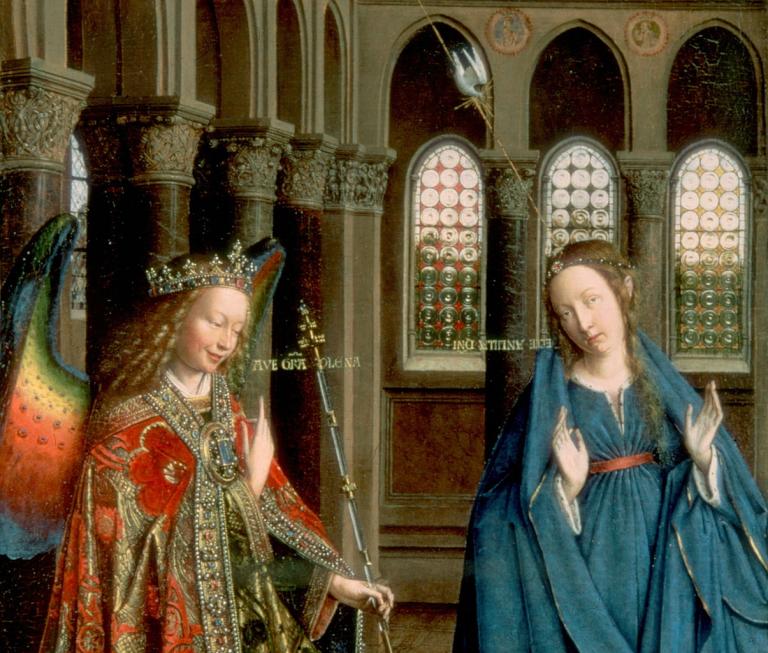
Gabriel: “Mary! Mary! God impregnated you!”
Mary: “Do I even get a choi— oh, forget it.”
(The Annunciation; Jan van Eyck)
These are framed in Biblical standards, but let’s face it: the Christianizing of everything basically led to the widespread manwashing of once colorful pantheons, and gave rise to the eternal duology of the Virgin/Whore. In nearly no cases of historically (and Western culturally) catalogued Virgin and Whore has the woman ever been given the choice. Under pain of retribution, under pain of death, under the yoke of a God’s revocation of agency, the Virgin must be a Virgin and the Whore must be a Whore.
I think that understanding the available history and the widely understood root of an archetype is deeply important—both for the pagan community, and for the welfare of those who join it and want to learn from it. From there, it’s great to learn about where essayists and writers of a hundred years, fifty years, twenty years past took it, but it cannot stop there.
We change. Society changes. What was acceptable then is not meant to be acceptable now; this is how we fester. This is how we die.
Change must be allowed to take hold. Which means we must be willing to not only listen, but to take the time to comprehend somebody else’s existence.

About K. C. Alexander
K. C. Alexander is an SF/F author and very proud of smearing her bloody fingers all over the lines. She writes aggressive transhumanist sci-fi, co-wrote Mass Effect: Andromeda: Nexus Uprising, and may or may not be a witch. Like what she does? Want to see more? Check out her tarot reads and behind the scenes glimpses of her new projects. Every offer goes to support an author hard at work. You can read more about the author here.
Previous Post

July 17, 2018
The Practice of Patience: Where Mud Becomes Lotus
Next Post

August 19, 2018 An Unexpected Education by Accidental Ritual
Browse Our Archives
Select a Category Witchery
Select a Month December 2018 September 2018 August 2018 July 2018 June 2018 May 2018 April 2018 March 2018 February 2018
Follow Us!
TAKE THE
Religious Wisdom Quiz
How many times did Peter deny Jesus?
Select your answer to see how you score.
4 5 2 3
Related posts from Gone Witching

Photo-Op Witch: You Are Welcome Here

Seeking the Liminal: It Starts as a Search...
Saying No to New Year Resolutions
TRENDING AT PATHEOS Pagan

When we talk about Greek religion, we often begin with the dodekatheion—the...

I was recently chatting with someone on Instagram. She asked me what...

While there are many people who share their results, the end of...

On July 23, I saw Christopher Nolan's The Odyssey which is Homer’s...

As I write this two big events have just finished up. One...

Restoring the Watershed of Divine Love
Perhaps cooperation is not something we manufacture through legislation, ideology, or moral...
view all Pagan blogs
Ad-Free & Subscriber Log-In Subscription Support
- About Us
- 2026 Calendar
- Videos
- Podcasts
- Library of World Religions
- Faith In Media Tracker
- Advertise With Us
- Write for Us
- Privacy Policy
- Terms of Service
- Do Not Sell My Data
- Contact Us
- Radiant Digital
- Manage Newsletter Subscriptions
- Unsubscribe From Notifications
- Sitemap
Copyright 2008-2026, Patheos. All rights reserved.
Subscription Support Ad-Free & Subscriber Log-In
Follow Patheos