
BuddhistCatholicContemplativeEvangelicalGeneral ChristianHinduJewishLatter-day SaintMuslimNew VisionsProgressive Christian
Beliefs
- Buddhist
- Catholic
- Contemplative
- Evangelical
- General Christian
- Hindu
- Jewish
- Latter-day Saint
- More Voices
- Muslim
- New Visions
- Pagan
- Progressive Christian
Topics
- Religion News
- Food and Religion
- Sports and Religion
- Religious Art
- Religious Music and Entertainment
- Religious Events
- History and Religion
- Style and Religion
- Politics and Religion
- Women in Religion
- Recreation Outdoors and Religion
- Business Finance and Religion
- Careers Workplace and Religion
- Education and Religion
- Family Parenting and Religion
- Health Fitness and Religion
- Home and Religion
- Relationships and Religion
- Technology and Religion
- Travel and Religion
Columnists
- Buddhist Columnists
- Business Finance and Religion Columnists
- Careers Workplace and Religion Columnists
- Catholic Columnists
- Contemplative Columnists
- Education and Religion Columnists
- Evangelists Columnists
- Family Parenting and Religion Columnists
- General Christian Columnists
- Health Fitness and Religion Columnists
- Hindu Columnists
- History and Religion Columnists
- Home and Religion Columnists
- Jewish Columnists
- More Voices Columnists
- Latter Day Columnists
- Muslim Columnists
- New Visions Columnists
- Nonreligious Columnists
- Pagan Columnists
- Politics and Religion Columnists
- Progressive Columnists
- Recreation Outdoors and Religion Columnists
- Relationships and Religion Columnists
- Religion News Columnists
- Religious Art Columnists
- Religious Events Columnists
- Religious Music and Entertainment Columnists
- Sports and Religion Columnists
- Style and Religion Columnists
- Technology and Religion Columnists
- Travel and Religion Columnists
- Women in Religion Columnists
Resource Library
- 2026 Calendar
- Library of World Religions
- The 100 Most Holy Places on Earth
- Patheos Answers
- Podcasts
- Videos
- Faith Leaders Database
- Anglican Episcopalian
- Bahai
- Baptist
- Buddhism
- Christianity
- Confucianism
- Eastern Orthodoxy
- Hinduism
- Holiness and Pentecostal
- ISKCON
- Islam
- Judaism
- Lutheran
- Methodist
- The Church of Jesus Christ of Latter-day Saints
- New Age
- Paganism
- Presbytarian and Reformed
- Protestantism
- Religion Behind the Scenes
- Roman Catholic
- Scientology
- Shia Islam
- Sikhism
- Sufism
- Sunni Islam
- Taoism
- Zen
- See all religions
Research Tools
 Ad-Free & Subscriber Log-In Subscription Support
Ad-Free & Subscriber Log-In Subscription Support
Follow Patheos 

- Trending:
- Forgiveness
- |
- Marriage
- |
- Consciousness
- |
- Death Penalty
- |
- Election
- |
- Halloween
 Just and Sinner
- Home
- Evangelical
- Who was the Real St. Patrick?
Who was the Real St. Patrick?
Last updated on: June 3, 2014 at 1:33 am by Jordan Cooper
Who was the Real St. Patrick? 2014-06-03T01:33:28-06:00 Jordan Cooper
Patheos Explore the world's faith through different perspectives on religion and spirituality! Patheos has the views of the prevalent religions and spiritualities of the world.
When most people think of St. Patrick’s Day, they think about one of two things. 1. An excuse to drink a lot of beer, or 2. Legends about Patrick driving away snakes from Ireland, and using the shamrock to describe the Trinity.
Well, neither of those two things have anything to do with the actual, historical St. Patrick. But the real story is much better than legend. Patrick was a fifth century Christian, missionary, and bishop. We have three surviving works from his pen including a letter, a hymn, and most importantly his autobiography known as the Confessions of St. Patrick.
In this small autobiography, Patrick tells the remarkable story of how he was called by God to spread the gospel among the Irish. Patrick grew up in England, and as a child was captured as a slave by men from Ireland. Growing up, Patrick was familiar with the Christian faith but was not personally devoted to it. In captivity, Patrick began to think about the Christian faith, and was converted. He had a dream one night, telling him to go to a certain area where he would find a boat. Patrick looked for this boat the next day, found it, and escaped. He eventually made it back to his homeland.
While in Britain, Patrick became a deacon, and eventually a bishop. As a bishop he had a desire to go back to those who had captured him years before and bring them the gospel. He was almost hindered from this task by certain people who challenged Patrick’s validity as a bishop due to some sin that he committed as a boy. (Legalists have been around for a long time!) Eventually this issue was settled, and Patrick was sent to the Irish people. He allowed himself to be captured, and preached the gospel to his captors, and eventually, throughout Ireland. Because of the gospel that Patrick preached, the nation was converted to the Christian faith.
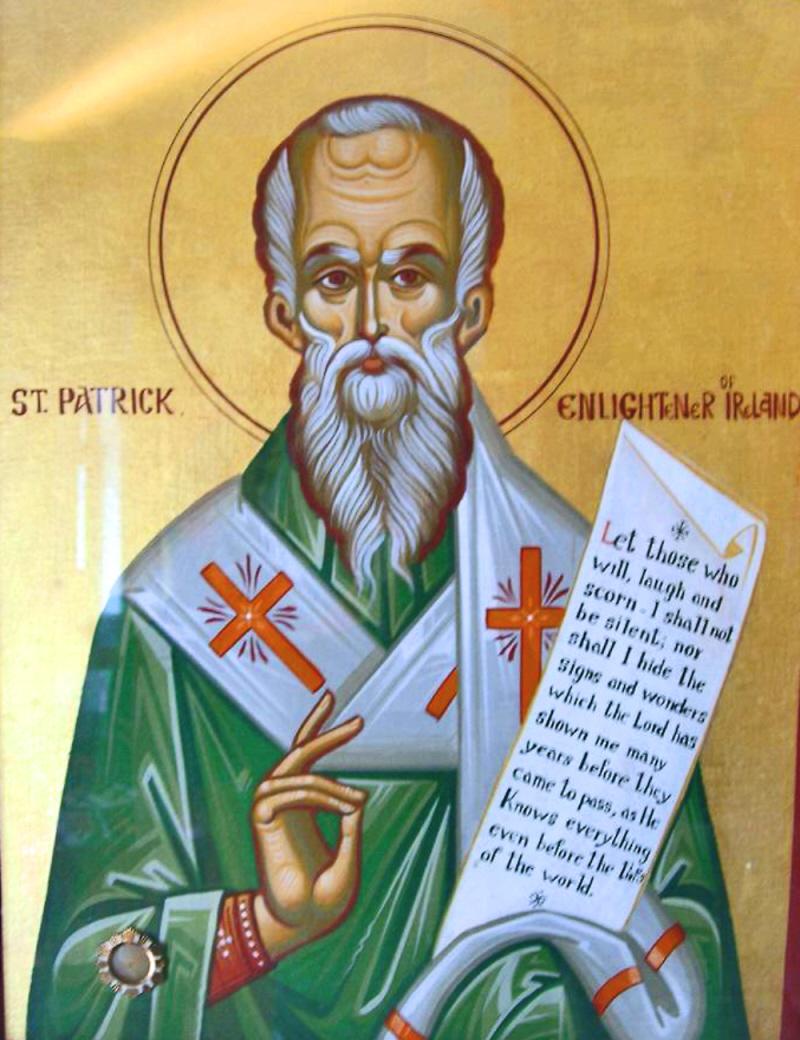
Patrick’s faith is summarized in his own works with a creed. This may be a personal creed, or it may have been used liturgically in the Irish church. Here is the creed:
Because there is no other God
nor ever was nor will be in future days,
other than God who is unbegotten Father,
without beginning,
yet from whom is all beginning
and who holds all things in being
as we have come to learn;
and his Son Jesus Christ
Whom together with his Father
we bear witness, has most surely always existed
even before time began,
Begotten spiritually and present with the Father
in a manner beyond human words;
before all time began.
And through him have all things, seen and unseen,
been made,
then he himself was made man,
and once death had been overcome, he was received
into the heavens with his Father.
“And he has given him full power over every name
in the heavens, on earth
and in the depths beneath
so that every tongue shall confess to him
that Jesus Christ is our Lord and God.”
It is he whom we believe
and we hope he will soon come again,
to be “judge of the living and dead
who will render each man according to his deeds.”
And “he has poured out abundantly his Holy Spirit upon us,”
given as a pledge of our immortality.
Which the Holy Spirit makes us both believers,
obedient “children of God and equal heirs with Christ”:
whom we confess and adore,
one God in the most holy named Trinity.
There are a few things we can learn from St. Patrick, and none of it has to do with bad analogies for the Trinity. First, we see the importance of a Trinitarian confession of faith. It was this Trinitarian confession which constituted the essence of Patrick’s message which was proclaimed to the Irish people. Second, it shows us how God uses preaching to spread the gospel. So often the church is distracted, trying to act like the world to win converts. But Patrick, one man, simply proclaimed the gospel, and the word was efficacious. If we only preach the word, the Spirit will work through it. There is no need to make the gospel “attractive” with some kind of flashy show. The third thing the story of Patrick teaches us is that the office of the Papacy is not of the essence of the church, and was not viewed that way at this time. Since the founding of the Irish church in the 5th century, and about the 9th century, the Irish church had no connection to the Roman Church.
So why not take this St. Patrick’s day to think about the message that Patrick preached? Instead of drinking, think about the glory of the Holy Trinity.
Previous Post

June 3, 2014
St. Ambrose on Law and Gospel
Next Post
June 3, 2014 Alcuin of York
Browse Our Archives
Select a Category American Lutheran Classics Blog Posts Book Review Christian Dogmatics Course Church Resources Curtis Leins Dogmatic Theology Ethics FAQs Historical Theology Just & Sinner Publications Luther Quotations Podcast Sermons The American Lutheran Theological Journal The complete works of Revere Franklin Weidner Theology Proper Uncategorized Videos
Select a Month October 2019 September 2019 July 2019 June 2019 May 2019 April 2019 March 2019 February 2019 January 2019 December 2018 November 2018 October 2018 September 2018 July 2018 June 2018 May 2018 April 2018 March 2018 February 2018 January 2018 December 2017 November 2017 October 2017 September 2017 August 2017 July 2017 June 2017 May 2017 April 2017 March 2017 February 2017 January 2017 December 2016 November 2016 October 2016 September 2016 August 2016 July 2016 June 2016 May 2016 April 2016 March 2016 February 2016 January 2016 December 2015 November 2015 October 2015 September 2015 August 2015 July 2015 June 2015 May 2015 April 2015 March 2015 February 2015 January 2015 December 2014 November 2014 October 2014 September 2014 August 2014 July 2014 June 2014 May 2014
Follow Us!
TAKE THE
Religious Wisdom Quiz
What does "Immanuel" mean, as in Isaiah's prophecy?
Select your answer to see how you score.
Prince of peace God will save God with us God reigns
Related posts from Just and Sinner
Cyril of Alexandria on the Importance of Having...
A Review of Matthew Levering's "The Theology of...

Theonas of Alexandria on the Importance of Holy...
TRENDING AT PATHEOS Evangelical

The REST of Your Life: A Creative Wrestles...
This week I had a conversation with a good friend from church....

How the author of the world's best hymn...
I've been working with John Newton for a while now. This makes...

Long before this Lectio Divina, Psalm 130 - the song - started...

What About the Trees? Another Living Parable
After I finished writing the last article about falling leaves as a...

Why Classical Education Is a Conversation, Not a...
Come and Read: Joy in Classical Education When I was a little...

Cornell University has received a great deal of negative publicity and intense...
view all Evangelical blogs
Ad-Free & Subscriber Log-In Subscription Support
- About Us
- 2026 Calendar
- Videos
- Podcasts
- Library of World Religions
- Faith In Media Tracker
- Advertise With Us
- Write for Us
- Privacy Policy
- Terms of Service
- Do Not Sell My Data
- Contact Us
- Radiant Digital
- Manage Newsletter Subscriptions
- Unsubscribe From Notifications
- Sitemap
Copyright 2008-2026, Patheos. All rights reserved.
Subscription Support Ad-Free & Subscriber Log-In
Follow Patheos