
BuddhistCatholicContemplativeEvangelicalGeneral ChristianHinduJewishLatter-day SaintMuslimNew VisionsProgressive Christian
Beliefs
- Buddhist
- Catholic
- Contemplative
- Evangelical
- General Christian
- Hindu
- Jewish
- Latter-day Saint
- More Voices
- Muslim
- New Visions
- Pagan
- Progressive Christian
Topics
- Religion News
- Food and Religion
- Sports and Religion
- Religious Art
- Religious Music and Entertainment
- Religious Events
- History and Religion
- Style and Religion
- Politics and Religion
- Women in Religion
- Recreation Outdoors and Religion
- Business Finance and Religion
- Careers Workplace and Religion
- Education and Religion
- Family Parenting and Religion
- Health Fitness and Religion
- Home and Religion
- Relationships and Religion
- Technology and Religion
- Travel and Religion
Columnists
- Buddhist Columnists
- Business Finance and Religion Columnists
- Careers Workplace and Religion Columnists
- Catholic Columnists
- Contemplative Columnists
- Education and Religion Columnists
- Evangelists Columnists
- Family Parenting and Religion Columnists
- General Christian Columnists
- Health Fitness and Religion Columnists
- Hindu Columnists
- History and Religion Columnists
- Home and Religion Columnists
- Jewish Columnists
- More Voices Columnists
- Latter Day Columnists
- Muslim Columnists
- New Visions Columnists
- Nonreligious Columnists
- Pagan Columnists
- Politics and Religion Columnists
- Progressive Columnists
- Recreation Outdoors and Religion Columnists
- Relationships and Religion Columnists
- Religion News Columnists
- Religious Art Columnists
- Religious Events Columnists
- Religious Music and Entertainment Columnists
- Sports and Religion Columnists
- Style and Religion Columnists
- Technology and Religion Columnists
- Travel and Religion Columnists
- Women in Religion Columnists
Resource Library
- 2026 Calendar
- Library of World Religions
- The 100 Most Holy Places on Earth
- Patheos Answers
- Podcasts
- Videos
- Faith Leaders Database
- Anglican Episcopalian
- Bahai
- Baptist
- Buddhism
- Christianity
- Confucianism
- Eastern Orthodoxy
- Hinduism
- Holiness and Pentecostal
- ISKCON
- Islam
- Judaism
- Lutheran
- Methodist
- The Church of Jesus Christ of Latter-day Saints
- New Age
- Paganism
- Presbytarian and Reformed
- Protestantism
- Religion Behind the Scenes
- Roman Catholic
- Scientology
- Shia Islam
- Sikhism
- Sufism
- Sunni Islam
- Taoism
- Zen
- See all religions
Research Tools
 Ad-Free & Subscriber Log-In Subscription Support
Ad-Free & Subscriber Log-In Subscription Support
Follow Patheos 

- Trending:
- Forgiveness
- |
- Marriage
- |
- Consciousness
- |
- Death Penalty
- |
- Election
- |
- Halloween
 Just and Sinner
- Home
- Evangelical
- We believe in… theosis?
We believe in… theosis?
Last updated on: July 25, 2014 at 12:48 pm by nathanrinne
We believe in… theosis? 2014-07-25T12:48:00-06:00 nathanrinne
Patheos Explore the world's faith through different perspectives on religion and spirituality! Patheos has the views of the prevalent religions and spiritualities of the world.

Salvation, understood in its broad sense, also consists of the sanctification, or “Christification” of the Christian man. Lutherans insist on distinguishing, not separating, justification and sanctification. Picture is from a paper by my pastor and can be obtained here.
Isn’t that what the Eastern Orthodox believe in? Aren’t we Lutherans different?
If you say that you believe in theosis, does that mean you are veering towards Orthodoxy? Is that perhaps what your series of posts, If all theology is Christology, how wide the divide: a reflection on Lutheranism and Eastern Orthodoxy, is actually getting at?
Yes. Yes. No. No (if you still doubt me take a look at my post Lutherans are *not* boring: Why Lutheran pastor William Weedon did not become Eastern Orthodox – his talk is exceptionally compelling and accessible).
I remember how joyful I felt years ago when I stumbled upon and read Kurt Marquat’s article Luther and Theosis. He said things in that article that made so much sense, and yet they were things that I did not recall having heard elsewhere in Lutheran circles (or at least, not so explicitly).
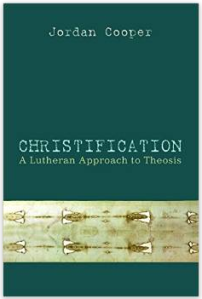
And now, Pastor Jordan Cooper has a new book out on theosis, called “Christification” (see sidebar). One of Pastor Cooper’s main points is that just because we Lutherans can and should say that we believe in theosis, that does not mean that we mean quite what the Eastern Orthodox mean. There are some very important distinctions that need to be made here.
More on the book:
The doctrine of theosis has enjoyed a recent resurgence among varied theological traditions across the realms of historical, dogmatic, and exegetical theology. In Christification: A Lutheran Approach to Theosis, Jordan Cooper evaluates this teaching from a Lutheran perspective. He examines the teachings of the church fathers, the New Testament, and the Lutheran Confessional tradition in conversation with recent scholarship on theosis. Cooper proposes that the participationist soteriology of the early fathers expressed in terms of theosis is compatible with Luther’s doctrine of forensic justification. The historic Lutheran tradition, Scripture, and the patristic sources do not limit soteriological discussions to legal terminology, but instead offer a multifaceted doctrine of salvation that encapsulates both participatory and forensic motifs. This is compared and contrasted with the development of the doctrine of deification in the Eastern tradition arising from the thought of Pseudo-Dionysius. Cooper argues that the doctrine of the earliest fathers—such as Irenaeus, Athanasius, and Justin—is primarily a Christological and economic reality defined as “Christification.” This model of theosis is placed in contradistinction to later Neoplatonic forms of deification.
 A couple of the endorsements on the book:
“Cooper’s work exhibits all the elements one would expect from a Lutheran scholar—a commitment to sola scriptura, a strong defense of a forensic notion of justification, and an emphasis on sacramentology—while at the same time incorporating a notion of theosis as Christification. Alongside other Protestant construals of theosis, Cooper’s work makes a fine addition.”
—Myk Habets, Carey Baptist College, Auckland, New Zealand
“On the basis of a clear exposition of the Eastern Orthodox teaching on deification, with particular emphasis on the aspect of Christification, Jordan Cooper argues eloquently for its compatibility with Lutheran theology. Without obscuring the differences between the Orthodox and Lutheran approaches, he makes a valuable contribution to ecumenical theological dialogue and potentially to the renewal of the mystical tradition in the Western churches.”
—Norman Russell, St. Stephen’s House, University of Oxford, Oxford, UK
You can purchase the book here. You can also listen to Pastor Cooper talk about the issue of theosis on two of his podcasts, here (“Theosis and Mystical Union”) and here (“Mystical Union in the Lutheran Tradition”). Lend him your ear.
FIN
Previous Post

July 24, 2014
Episode 7: "Don' gimme any LIP!" - Terminal Tulip Romp
Next Post
July 25, 2014 Sermon on Romans 8:18-27
Browse Our Archives
Select a Category American Lutheran Classics Blog Posts Book Review Christian Dogmatics Course Church Resources Curtis Leins Dogmatic Theology Ethics FAQs Historical Theology Just & Sinner Publications Luther Quotations Podcast Sermons The American Lutheran Theological Journal The complete works of Revere Franklin Weidner Theology Proper Uncategorized Videos
Select a Month October 2019 September 2019 July 2019 June 2019 May 2019 April 2019 March 2019 February 2019 January 2019 December 2018 November 2018 October 2018 September 2018 July 2018 June 2018 May 2018 April 2018 March 2018 February 2018 January 2018 December 2017 November 2017 October 2017 September 2017 August 2017 July 2017 June 2017 May 2017 April 2017 March 2017 February 2017 January 2017 December 2016 November 2016 October 2016 September 2016 August 2016 July 2016 June 2016 May 2016 April 2016 March 2016 February 2016 January 2016 December 2015 November 2015 October 2015 September 2015 August 2015 July 2015 June 2015 May 2015 April 2015 March 2015 February 2015 January 2015 December 2014 November 2014 October 2014 September 2014 August 2014 July 2014 June 2014 May 2014
Follow Us!
TAKE THE
Religious Wisdom Quiz
True or False: Hebrews teaches that the blood of bulls and goats can take away sins.
Select your answer to see how you score.
TRUE FALSE
Related posts from Just and Sinner
I Am Not Your Pastor, and That's a...
What Should the Christian Do With Wicked Desires...

Diagnosing Christian Bad Boy Syndrome
All Philosophy is Morality and Teleology – and...
TRENDING AT PATHEOS Evangelical

The REST of Your Life: A Creative Wrestles...
This week I had a conversation with a good friend from church....

How the author of the world's best hymn...
I've been working with John Newton for a while now. This makes...

Long before this Lectio Divina, Psalm 130 - the song - started...

What About the Trees? Another Living Parable
After I finished writing the last article about falling leaves as a...

Why Classical Education Is a Conversation, Not a...
Come and Read: Joy in Classical Education When I was a little...

Cornell University has received a great deal of negative publicity and intense...
view all Evangelical blogs
Ad-Free & Subscriber Log-In Subscription Support
- About Us
- 2026 Calendar
- Videos
- Podcasts
- Library of World Religions
- Faith In Media Tracker
- Advertise With Us
- Write for Us
- Privacy Policy
- Terms of Service
- Do Not Sell My Data
- Contact Us
- Radiant Digital
- Manage Newsletter Subscriptions
- Unsubscribe From Notifications
- Sitemap
Copyright 2008-2026, Patheos. All rights reserved.
Subscription Support Ad-Free & Subscriber Log-In
Follow Patheos