
BuddhistCatholicContemplativeEvangelicalGeneral ChristianHinduJewishLatter-day SaintMuslimNew VisionsProgressive Christian
Beliefs
- Buddhist
- Catholic
- Contemplative
- Evangelical
- General Christian
- Hindu
- Jewish
- Latter-day Saint
- More Voices
- Muslim
- New Visions
- Pagan
- Progressive Christian
Topics
- Religion News
- Food and Religion
- Sports and Religion
- Religious Art
- Religious Music and Entertainment
- Religious Events
- History and Religion
- Style and Religion
- Politics and Religion
- Women in Religion
- Recreation Outdoors and Religion
- Business Finance and Religion
- Careers Workplace and Religion
- Education and Religion
- Family Parenting and Religion
- Health Fitness and Religion
- Home and Religion
- Relationships and Religion
- Technology and Religion
- Travel and Religion
Columnists
- Buddhist Columnists
- Business Finance and Religion Columnists
- Careers Workplace and Religion Columnists
- Catholic Columnists
- Contemplative Columnists
- Education and Religion Columnists
- Evangelists Columnists
- Family Parenting and Religion Columnists
- General Christian Columnists
- Health Fitness and Religion Columnists
- Hindu Columnists
- History and Religion Columnists
- Home and Religion Columnists
- Jewish Columnists
- More Voices Columnists
- Latter Day Columnists
- Muslim Columnists
- New Visions Columnists
- Nonreligious Columnists
- Pagan Columnists
- Politics and Religion Columnists
- Progressive Columnists
- Recreation Outdoors and Religion Columnists
- Relationships and Religion Columnists
- Religion News Columnists
- Religious Art Columnists
- Religious Events Columnists
- Religious Music and Entertainment Columnists
- Sports and Religion Columnists
- Style and Religion Columnists
- Technology and Religion Columnists
- Travel and Religion Columnists
- Women in Religion Columnists
Resource Library
- 2026 Calendar
- Library of World Religions
- The 100 Most Holy Places on Earth
- Patheos Answers
- Podcasts
- Videos
- Faith Leaders Database
- Anglican Episcopalian
- Bahai
- Baptist
- Buddhism
- Christianity
- Confucianism
- Eastern Orthodoxy
- Hinduism
- Holiness and Pentecostal
- ISKCON
- Islam
- Judaism
- Lutheran
- Methodist
- The Church of Jesus Christ of Latter-day Saints
- New Age
- Paganism
- Presbytarian and Reformed
- Protestantism
- Religion Behind the Scenes
- Roman Catholic
- Scientology
- Shia Islam
- Sikhism
- Sufism
- Sunni Islam
- Taoism
- Zen
- See all religions
Research Tools
 Ad-Free & Subscriber Log-In Subscription Support
Ad-Free & Subscriber Log-In Subscription Support
Follow Patheos 

- Trending:
- Forgiveness
- |
- Marriage
- |
- Consciousness
- |
- Death Penalty
- |
- Election
- |
- Halloween
 Just and Sinner
- Home
- Evangelical
- Semper Vendenda!?: Was the Reformation about Creative Marketing with Disruptive Technology?
Semper Vendenda!?: Was the Reformation about Creative Marketing with Disruptive Technology?
Last updated on: October 21, 2016 at 6:58 am by nathanrinne
Semper Vendenda!?: Was the Reformation about Creative Marketing with Disruptive Technology? 2016-10-21T06:58:24-06:00 nathanrinne
Patheos Explore the world's faith through different perspectives on religion and spirituality! Patheos has the views of the prevalent religions and spiritualities of the world.
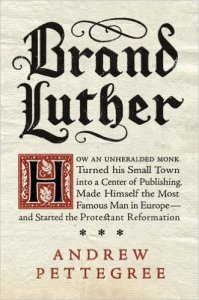
“Many things conspired to ensure Luther’s unlikely survival through the first years of the Reformation, but one of them was undoubtedly print.” – Andrew Pettegree
+++
Short answer: “Yes”, but it was also much, much more.

Before 1517, this man was largely unpublished and unnoticed. What happened!?
Not too long from now, Reformation Day (All Saint’s Day) will be upon us once again. And next year, of course, will mark the 500th anniversary of Luther nailing the 95 theses to the church door in Wittenberg, and subsequently setting the world on fire – either a good thing (the Holy Spirit!) or a bad thing (Heretic!) depending on your churchly perspective.
A relatively new book brings to mind a very modern question though: to what extent was the Reformation a marketing coup? How in the world did a backwater town become the the printing center and hub of big and important ideas in the 16th century Western world?
Martin Luther famously said that God caused the Reformation of the church. Luther “did nothing”, but while he slept and drank Wittenberg beer with friends, “the Word did it all” in his battle vs. the Roman Catholic papacy.
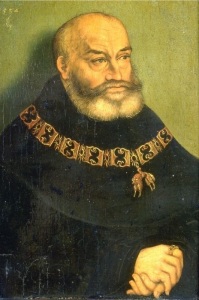
George, the Catholic Duke of Albertine Saxony: “That a single monk, out of such a hole, could undertake a Reformation, is not to be tolerated.”
God’s providence may have guided the Reformation, but Brand Luther, by historian and media scholar Andrew Pettegree, argues Martin Luther created a new style – a unique brand that changed history, including ways many have yet to more fully explore.
I heard about the book when the author was interviewed on Albert Mohler’s fine program “Thinking in Public”. Mohler said that he initially had feared that the book, with its title, would be a “reductionistic understanding of Luther,” but that he was pleasantly surprised. “[T]his is the single most interesting book on Luther I believe I have ever read,” he told the author. I’m not done with it yet, but have read enough to know that it would be a good buy.
All in all, Pettegree shows us that there was, “at such a time as [that]”, a “perfect storm” for a reformation. With 20-20 hindsight that is scholarly attuned, he helps us to see that all of the following elements played a part in making the Reformation a reality:
But intended by Satan? Or of Providence, through and through?
Luther’s fearsome theological conviction
A “good Catholic,” when he nailed (or glued, as Pettegree believes!) his 95 Theses to the door of Wittenberg, Germany, church in 1517, it was “for the purpose of eliciting truth”. In short, from thesis 11 we can see that all saints are saved by grace, through faith, revealed by God’s Word in Christ, **“**even without letters of pardon” (i.e. “indulgences”)!
The protection of his Prince, Elector Frederick
Frederick was a deeply pious Catholic man who collected the same kinds of relics that Luther attacked. Did he protect Luther, the defamed heretic, in the interest of his own rising political power? After Luther’s life ended, the window of opportunity closed, as “Wittenberg… was reabsorbed back into the Holy Roman Empire.”
Unpopularity of the Roman Church
There was already in Luther’s day a lot of criticism towards the Roman Catholic church, theologically and morally. The great humanist scholar Erasmus had already had a field day attacking Rome. Luther stirred this pot.
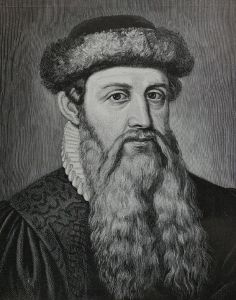
Gutenberg, the inventor of movable type (and Time-Life’s and A&E Bio’s “Person of the Millennium”), went bankrupt for a lack of market.
Channeling disruptive technology
The inventor of the printing press, Johannes Gutenberg, had gone bankrupt. Reading the “market” for his “product” and mastering the technology of his day, Luther is the first one who helped make a distribution infrastructure possible. In short, he singlehandedly made printing books a viable activity for printers everywhere.
Brief, popular writing (not in Latin!)
Luther’s writings in the common tongue, “lucid, accessible, and above all, short”, were all that sold consistently, offering immediate financial returns for the printers. With numerous new readers, he outpublished all other authors 10 to 1 and the most successful of his theological opponents 30 to 1.
High standards of professionalism
As one Amazon reviewer of the book put it, “[Luther’s] eye for good printing, artistic wood cuts, and different font types show a creative Luther who tenderly cared for his movement every step of the way.” Pettegree: “how the text would appear would have something to do with how credible it was understood to be”.
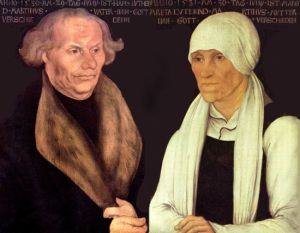
Martin Luther came from a mining household and his parents instilled in him a sense of shrewdness in financial and business matters: “a practical man, well-grounded in the harsh economics of profit and loss…” (Pettegree)
Product differentiation
Lucas Cranach, a court painter in Wittenberg “… clothed Luther’s works in a new and distinctive livery, immediately recognizable on a crowded bookstall. The result was the development of a form of book that was itself a powerful representative of the movement – bold, clear, and recogniseably distinct from what has gone before.”
Political, business, and media savviness
Luther understood his personal shortcomings, astutely read the political scene, and “saw the value of friendships where both parties could benefit” (Amazon rewiew). Media? Impeccable timing for publications, and he thought that “[t]he oxygen of publicity was, quite literally, a matter of life and death.” (p. 89)
A Cast of supporting characters
Politicians, artists (Cranach, Dürer), printers (Rhau-Grunenberg), church leaders and other figures throughout Europe joined the movement at no small risk to themselves.
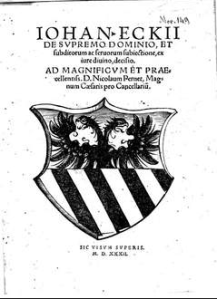
Though Luther never received remuneration for his work, he enriched the printers, as his books sold 30 times more than long, Latin works like this one from opponent Johann Eck.
Even though he was also a charismatic personality (“he had a sort of personal magnetism which somehow carried people over their natural borders and boundaries,” Pettegree says), he often talked very convincingly and practically about the importance of being simple and humble in his writings. None of this however precluded having a deep understanding of his times and environment, nor the need to be quite strategic as well: Luther was politically savvy, a master of media manipulation, a creative marketer.
So, going along with that line of thinking, I think the core question for all people in general and Christians in particular is this: was Luther offering a new “product” – or were his efforts in line with that of the catholic church throughout all time, offering a course correction for a train that had gone off the rails? Roland Bainton, in his classic book on Luther, Here I Stand, opted for the latter:
“The center about which all the petals clustered was the affirmation of the forgiveness of sins through the utterly unmerited grace of God made possible by the cross of Christ, which reconciled wrath and mercy, routed the hosts of hell, triumphed over sin and death, and by the resurrection manifested that power which enables man to die to sin and rise to newness of life. This was of course the theology of Paul, heightened, intensified, and clarified. Beyond these cardinal tenets Luther was never to go.” (italics mine)
Semper reformanda!
FIN
P.S. Please consider also looking at the Reformation Day post from the past I am most proud of: The Coming Vindication of Martin Luther.
Select images: Portrait of George, Duke of Saxony (1471-1539),by Lucas Cranach the Elder, from Wikipedia ; Portraits of Hans and Margarethe Luther, Martin’s parents, by Lucas Cranach the Elder, 1527,, from http://www.uncommon-travel-germany.com/martin-luther-biography.html ; Johannes Gutenberg from Wikipedia
Previous Post
October 20, 2016
Biblical Themes: Clothing
Next Post
October 29, 2016 The Redemption of Creation in a Two Kingdom Context
Browse Our Archives
Select a Category American Lutheran Classics Blog Posts Book Review Christian Dogmatics Course Church Resources Curtis Leins Dogmatic Theology Ethics FAQs Historical Theology Just & Sinner Publications Luther Quotations Podcast Sermons The American Lutheran Theological Journal The complete works of Revere Franklin Weidner Theology Proper Uncategorized Videos
Select a Month October 2019 September 2019 July 2019 June 2019 May 2019 April 2019 March 2019 February 2019 January 2019 December 2018 November 2018 October 2018 September 2018 July 2018 June 2018 May 2018 April 2018 March 2018 February 2018 January 2018 December 2017 November 2017 October 2017 September 2017 August 2017 July 2017 June 2017 May 2017 April 2017 March 2017 February 2017 January 2017 December 2016 November 2016 October 2016 September 2016 August 2016 July 2016 June 2016 May 2016 April 2016 March 2016 February 2016 January 2016 December 2015 November 2015 October 2015 September 2015 August 2015 July 2015 June 2015 May 2015 April 2015 March 2015 February 2015 January 2015 December 2014 November 2014 October 2014 September 2014 August 2014 July 2014 June 2014 May 2014
Follow Us!
TAKE THE
Religious Wisdom Quiz
Who built the ark to survive the flood?
Select your answer to see how you score.
Abraham Noah Moses Elijah
Related posts from Just and Sinner

Is Andres Manuel Lopez Obrador the “Moral Shakedown...

Is Today’s Christianity Increasingly Filtered Through Marxist Categories?
The "Mansplaining" Approach to Female Modesty?: Go Duggars...
Can an Atheist Love Anyone? Is Anyone Who...
TRENDING AT PATHEOS Evangelical

The REST of Your Life: A Creative Wrestles...
This week I had a conversation with a good friend from church....

How the author of the world's best hymn...
I've been working with John Newton for a while now. This makes...

Long before this Lectio Divina, Psalm 130 - the song - started...

What About the Trees? Another Living Parable
After I finished writing the last article about falling leaves as a...

Why Classical Education Is a Conversation, Not a...
Come and Read: Joy in Classical Education When I was a little...

Cornell University has received a great deal of negative publicity and intense...
view all Evangelical blogs
Ad-Free & Subscriber Log-In Subscription Support
- About Us
- 2026 Calendar
- Videos
- Podcasts
- Library of World Religions
- Faith In Media Tracker
- Advertise With Us
- Write for Us
- Privacy Policy
- Terms of Service
- Do Not Sell My Data
- Contact Us
- Radiant Digital
- Manage Newsletter Subscriptions
- Unsubscribe From Notifications
- Sitemap
Copyright 2008-2026, Patheos. All rights reserved.
Subscription Support Ad-Free & Subscriber Log-In
Follow Patheos