
BuddhistCatholicContemplativeEvangelicalGeneral ChristianHinduJewishLatter-day SaintMuslimNew VisionsProgressive Christian
Beliefs
- Buddhist
- Catholic
- Contemplative
- Evangelical
- General Christian
- Hindu
- Jewish
- Latter-day Saint
- More Voices
- Muslim
- New Visions
- Pagan
- Progressive Christian
Topics
- Religion News
- Food and Religion
- Sports and Religion
- Religious Art
- Religious Music and Entertainment
- Religious Events
- History and Religion
- Style and Religion
- Politics and Religion
- Women in Religion
- Recreation Outdoors and Religion
- Business Finance and Religion
- Careers Workplace and Religion
- Education and Religion
- Family Parenting and Religion
- Health Fitness and Religion
- Home and Religion
- Relationships and Religion
- Technology and Religion
- Travel and Religion
Columnists
- Buddhist Columnists
- Business Finance and Religion Columnists
- Careers Workplace and Religion Columnists
- Catholic Columnists
- Contemplative Columnists
- Education and Religion Columnists
- Evangelists Columnists
- Family Parenting and Religion Columnists
- General Christian Columnists
- Health Fitness and Religion Columnists
- Hindu Columnists
- History and Religion Columnists
- Home and Religion Columnists
- Jewish Columnists
- More Voices Columnists
- Latter Day Columnists
- Muslim Columnists
- New Visions Columnists
- Nonreligious Columnists
- Pagan Columnists
- Politics and Religion Columnists
- Progressive Columnists
- Recreation Outdoors and Religion Columnists
- Relationships and Religion Columnists
- Religion News Columnists
- Religious Art Columnists
- Religious Events Columnists
- Religious Music and Entertainment Columnists
- Sports and Religion Columnists
- Style and Religion Columnists
- Technology and Religion Columnists
- Travel and Religion Columnists
- Women in Religion Columnists
Resource Library
- 2026 Calendar
- Library of World Religions
- The 100 Most Holy Places on Earth
- Patheos Answers
- Podcasts
- Videos
- Faith Leaders Database
- Anglican Episcopalian
- Bahai
- Baptist
- Buddhism
- Christianity
- Confucianism
- Eastern Orthodoxy
- Hinduism
- Holiness and Pentecostal
- ISKCON
- Islam
- Judaism
- Lutheran
- Methodist
- The Church of Jesus Christ of Latter-day Saints
- New Age
- Paganism
- Presbytarian and Reformed
- Protestantism
- Religion Behind the Scenes
- Roman Catholic
- Scientology
- Shia Islam
- Sikhism
- Sufism
- Sunni Islam
- Taoism
- Zen
- See all religions
Research Tools
 Ad-Free & Subscriber Log-In Subscription Support
Ad-Free & Subscriber Log-In Subscription Support
Follow Patheos 

- Trending:
- Forgiveness
- |
- Marriage
- |
- Consciousness
- |
- Death Penalty
- |
- Election
- |
- Halloween
 Just and Sinner
- Home
- Evangelical
- A Review of Confessing the Gospel: A Lutheran Approach to Systematic Theology
A Review of Confessing the Gospel: A Lutheran Approach to Systematic Theology
Last updated on: September 7, 2017 at 11:55 am by Jordan Cooper
A Review of Confessing the Gospel: A Lutheran Approach to Systematic Theology 2017-09-07T11:55:39-06:00 Jordan Cooper
Patheos Explore the world's faith through different perspectives on religion and spirituality! Patheos has the views of the prevalent religions and spiritualities of the world.
Concordia Publishing House recently released a two volume systematic theology titled Confessing the Gospel: A Lutheran Approach to Systematic Theology. This is a much needed set, as there has been a severe lack of Lutheran systematic theological texts in recent years, aside from the Confessional Lutheran Dogmatics series from Luther Academy. I recently received both volumes in the mail, and I have decided to do a series of reviews on these books as I read them section by section. In this first entry, I will examine the overall structure of the text, as well as the Prolegomena.
The volumes themselves are of high quality, hardback texts which are clearly meant to last. It is the intention of these books to be a staple in Lutheran theological education, and I will be curious to see whether these will replace Pieper’s volumes at the Concordia seminaries. I, myself, will have to make such a decision in my Doctrine courses at ALTS, where we currently use Pieper as our dogmatics text, though supplemented by the Confessional Lutheran Dogmatics volumes. Apparently, a new dogmatics series was something that the LCMS had decided to do in 1983, and this work has been in process since that time (before I was even born!). There were around seventy contributors to the project, but each locus has one or two primary authors. One of the most surprising things about the list of authors is the absence of David Scaer, Kurt Marquart, Joel Biermann, Roland Zeigler, and John Stephenson, who are all highly influential Lutheran thinkers that I would have assumed to be some of the primary contributors to a project like this. Many of the major contributors are relatively unknown for other publications. This has simply left me unsure of what to expect as I begin reading.
The setup of the series is unique. Each topic is divided into five sections: Scriptural foundation, confessional witness, systematic formulation, historical and contemporary developments, and implications for life and ministry. The positive element of this structure is that there is a strong emphasis on Biblical theological teaching. In the Scriptural sections, the topic is engaged in relation to the entire Scripture, often citing passages in the Torah, the prophets, the psalms, the Gospels, and epistolary literature. It is refreshing to see that the discussion is not drawn solely from Pauline writings as is the temptation is some Reformation theology, but that it extends throughout Scripture, with a heavy emphasis on the Old Testament. The negative, however, is that because the Biblical and systematic elements are not interspersed, there are some systematic theological elements and debates surrounding various doctrines that simply are not given enough attention due to the prominence of the exegetical element.
Prolegomena
The section on theological prolegomena was written primarily by David A Lumpp who I had not previously been acquainted with. Lumpp is Professor of Theology and Ministry at Concordia University in St. Paul, MN. He is the author of several published articles and a book titled First Things First. [1]
The primary emphasis in the Prolegomena section is the centrality of the gospel for Lutheran theological discourse. Lumpp outlines some essential distinctives of Lutheran thought such as law/gospel, the theology of the cross, and the hidden and revealed God. Lumpp helpfully outlines the relationship of theology to Scripture, the church, and tradition. Scripture is the norm of all theological discourse, but that is not to be divorced from the theologian working within the context of the church. Lumpp emphasizes the importance of Confessional documents within the theological task, as well as listening to the voices of the past when formulating doctrine.
Though a more lengthy discussion may have been of benefit, one of the best aspects of this section is his exposition of the relationship between faith and reason. Lumpp draws on the work of Brian Gerrish who defends Luther from the charges of irrationalism. He argues that what Luther fought against was the “domination of theology by philosophy” rather than reason as such (31). Reason is to be used in the earthly kingdom to discern what is useful and right in the world. He also mentions that there is “regenerate reason,” which is to be used in service of theology (31). This is a reason which serves in humility, submitting itself to the Word of God. It is arrogant reason which Luther opposes, wherein clear teachings of Scripture are overthrown based upon logical assertion. This is identified as the classical distinction between the magisterial and ministerial uses of reason.
While Lumpp’s writing is helpful as far as it goes, there are some notable differences between his approach and that of Pieper and other early twentieth century dogmaticians. This text lacks a discussion of many of the classic ideas explored in Prolegomena in Protestant scholasticism, which I think are extremely important foundational points. He does not explore the archetypal/ectypal theology distinction, nor does he discuss analogical predication in discourse about God. There is no extensive treatment of true and false theology, or natural and revealed theology. Traditional questions about theology as a science are also notably absent here. I also would have preferred to have seen some interaction with various philosophies which guide one’s approach to theology. Lumpp relies primarily on twentieth century Luther scholarship to determine his topics, rather than Gerhard, Quenstedt, and other scholastic thinkers. The writing would benefit from a more consistent use of older authors, rather than simply dealing with twentieth century thinkers.[2]
The second major concern I have with this Prolegomena is the use of the phrase “law/gospel polarity” throughout the text (3). It is certainly an odd choice of words, and one which I hardly ever see used in a positive light. Joel Biermann has used the phrase “law/gospel polarity” to refer to a mistaken notion of the Lutheran distinctive which approaches them as contradictory words of God. The law and the gospel are distinct, but they are not to be polarized against one another. Such a contention has immense theological problems. It may perhaps simply be the case of unfortunate wording on Lumpp’s part rather than an actual theological issue at this point. However, due to so many common misconceptions surrounding Lutheran thought on the law-gospel distinction, wording in this area should be as precise as possible.
Conclusion
Thus far, I have found both positive and negative elements to this treatment in its introductory section. The Biblical and exegetical element is to be appreciated, as it thoroughly grounds doctrine upon the entirety of Scriptural revelation, rather than solely through the Pauline writings. The Prolegomena helpfully emphasizes the centrality of the gospel in Lutheran theology, as well as its churchly character. Lumpp also helpfully defines the connection between faith and reason, and interacts with contemporary scholarship on a number of points. However, the doctrinal precision of the older scholastic texts is missing here, which is an unfortunate departure from other dogmatic treatments.
[1] I corrected my original post which said that he had not authored any books. I was mistaken.
[2] As I’ve read these volumes, I have seen many more references to Gerhard Ebeling and Helmut Thielecke, than I have to figures like Abraham Calov and David Hollaz. While I certainly think its important to deal with developments in Lutheran theology from outside of the strict confines of Confessionalism, I find it unfortunate that seventeenth century thinkers are not given more attention, especially as they were so important for Pieper and other early LCMS thinkers.
Previous Post
September 6, 2017
In Memory of Robert Jenson
Next Post

September 8, 2017 Confessing the Gospel: John F. Johnson on the Trinity
Browse Our Archives
Select a Category American Lutheran Classics Blog Posts Book Review Christian Dogmatics Course Church Resources Curtis Leins Dogmatic Theology Ethics FAQs Historical Theology Just & Sinner Publications Luther Quotations Podcast Sermons The American Lutheran Theological Journal The complete works of Revere Franklin Weidner Theology Proper Uncategorized Videos
Select a Month October 2019 September 2019 July 2019 June 2019 May 2019 April 2019 March 2019 February 2019 January 2019 December 2018 November 2018 October 2018 September 2018 July 2018 June 2018 May 2018 April 2018 March 2018 February 2018 January 2018 December 2017 November 2017 October 2017 September 2017 August 2017 July 2017 June 2017 May 2017 April 2017 March 2017 February 2017 January 2017 December 2016 November 2016 October 2016 September 2016 August 2016 July 2016 June 2016 May 2016 April 2016 March 2016 February 2016 January 2016 December 2015 November 2015 October 2015 September 2015 August 2015 July 2015 June 2015 May 2015 April 2015 March 2015 February 2015 January 2015 December 2014 November 2014 October 2014 September 2014 August 2014 July 2014 June 2014 May 2014
Follow Us!
TAKE THE
Religious Wisdom Quiz
What Christian group worships on Saturday instead of Sunday?
Select your answer to see how you score.
Baptists Seventh-day Adventists Pentecostals Presbyterians
Related posts from Just and Sinner
Summary of the Christian Faith Volume 2 is...
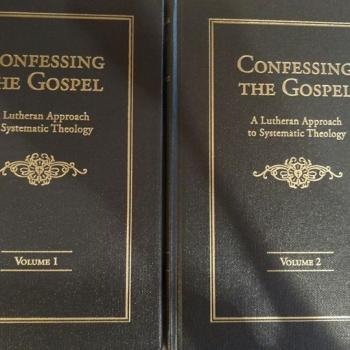
Apologetics in Confessing the Gospel
Review of CPH's New “So-Called Third Use of...
Completely Impartial Book Review of Pastor Jordan Cooper's...
TRENDING AT PATHEOS Evangelical

The REST of Your Life: A Creative Wrestles...
This week I had a conversation with a good friend from church....

How the author of the world's best hymn...
I've been working with John Newton for a while now. This makes...

Long before this Lectio Divina, Psalm 130 - the song - started...

What About the Trees? Another Living Parable
After I finished writing the last article about falling leaves as a...

Why Classical Education Is a Conversation, Not a...
Come and Read: Joy in Classical Education When I was a little...

Cornell University has received a great deal of negative publicity and intense...
view all Evangelical blogs
Ad-Free & Subscriber Log-In Subscription Support
- About Us
- 2026 Calendar
- Videos
- Podcasts
- Library of World Religions
- Faith In Media Tracker
- Advertise With Us
- Write for Us
- Privacy Policy
- Terms of Service
- Do Not Sell My Data
- Contact Us
- Radiant Digital
- Manage Newsletter Subscriptions
- Unsubscribe From Notifications
- Sitemap
Copyright 2008-2026, Patheos. All rights reserved.
Subscription Support Ad-Free & Subscriber Log-In
Follow Patheos