
BuddhistCatholicContemplativeEvangelicalGeneral ChristianHinduJewishLatter-day SaintMuslimNew VisionsProgressive Christian
Beliefs
- Buddhist
- Catholic
- Contemplative
- Evangelical
- General Christian
- Hindu
- Jewish
- Latter-day Saint
- More Voices
- Muslim
- New Visions
- Pagan
- Progressive Christian
Topics
- Religion News
- Food and Religion
- Sports and Religion
- Religious Art
- Religious Music and Entertainment
- Religious Events
- History and Religion
- Style and Religion
- Politics and Religion
- Women in Religion
- Recreation Outdoors and Religion
- Business Finance and Religion
- Careers Workplace and Religion
- Education and Religion
- Family Parenting and Religion
- Health Fitness and Religion
- Home and Religion
- Relationships and Religion
- Technology and Religion
- Travel and Religion
Columnists
- Buddhist Columnists
- Business Finance and Religion Columnists
- Careers Workplace and Religion Columnists
- Catholic Columnists
- Contemplative Columnists
- Education and Religion Columnists
- Evangelists Columnists
- Family Parenting and Religion Columnists
- General Christian Columnists
- Health Fitness and Religion Columnists
- Hindu Columnists
- History and Religion Columnists
- Home and Religion Columnists
- Jewish Columnists
- More Voices Columnists
- Latter Day Columnists
- Muslim Columnists
- New Visions Columnists
- Nonreligious Columnists
- Pagan Columnists
- Politics and Religion Columnists
- Progressive Columnists
- Recreation Outdoors and Religion Columnists
- Relationships and Religion Columnists
- Religion News Columnists
- Religious Art Columnists
- Religious Events Columnists
- Religious Music and Entertainment Columnists
- Sports and Religion Columnists
- Style and Religion Columnists
- Technology and Religion Columnists
- Travel and Religion Columnists
- Women in Religion Columnists
Resource Library
- 2026 Calendar
- Library of World Religions
- The 100 Most Holy Places on Earth
- Patheos Answers
- Podcasts
- Videos
- Faith Leaders Database
- Anglican Episcopalian
- Bahai
- Baptist
- Buddhism
- Christianity
- Confucianism
- Eastern Orthodoxy
- Hinduism
- Holiness and Pentecostal
- ISKCON
- Islam
- Judaism
- Lutheran
- Methodist
- The Church of Jesus Christ of Latter-day Saints
- New Age
- Paganism
- Presbytarian and Reformed
- Protestantism
- Religion Behind the Scenes
- Roman Catholic
- Scientology
- Shia Islam
- Sikhism
- Sufism
- Sunni Islam
- Taoism
- Zen
- See all religions
Research Tools
 Ad-Free & Subscriber Log-In Subscription Support
Ad-Free & Subscriber Log-In Subscription Support
Follow Patheos 

- Trending:
- Forgiveness
- |
- Marriage
- |
- Consciousness
- |
- Death Penalty
- |
- Election
- |
- Halloween
 Just and Sinner
- Home
- Evangelical
- Republication and the Inadequacy of the Covenantal Framework
Republication and the Inadequacy of the Covenantal Framework
Last updated on: March 17, 2015 at 4:30 pm by Jordan Cooper
Republication and the Inadequacy of the Covenantal Framework 2015-03-17T16:30:18-06:00 Jordan Cooper
Patheos Explore the world's faith through different perspectives on religion and spirituality! Patheos has the views of the prevalent religions and spiritualities of the world.
In traditional Federal theology, a distinction is made between a covenant of works and a covenant of grace. All Biblical covenants are read through the lens of this distinction. Typically, the relationship between God and man in the Garden of Eden is considered a covenant of works, wherein Adam merits life by his obedience (an idea I have critiqued here). There is then an overarching covenant of grace, extending through the promise given to Adam and Eve in Genesis 3:15, through the Abrahamic promise, the Davidic covenant, and the New Covenant. These are not different covenants, but reiterations of the same.
There has been an extensive amount of debate within Reformed circles over the nature of the Mosaic covenant. Some view the Mosaic covenant as another iteration of the covenant of grace. This is based on the fact that God’s grace in releasing the Jews from Egypt stands as the basis of God’s covenant with his people, and thus the law was not given to merit anything per se, but simply to God the people who have already been redeemed (see, for example the prologue to the Ten Commandments which is based in God’s deliverance). Others argue that the Mosaic covenant is actually a covenant of works, a republication of the covenant that God made with Adam. The obedience of the people determined their standing within the land of Palestine, just as Adam’s place in Eden was determined by his merit. The Mosaic covenant then is opposed to the covenant of grace. This position utilizes passages such as Galatians 3-4 in which Paul argues extensively that salvation is tied, not to the Mosaic law, but the Abrahamic promise.
Within these two positions, there are then a variety of different views. Some, such as Rich Lusk, argue that the law of Moses never demanded perfect obedience, and contained a remedy for sin within the sacrificial system. It is thus a pure covenant of grace. On the other hand, some, such as theologian from the Westminster Escondido tradition, tend to emphasize only the condemnatory aspects of the law, thus almost negating the sense that the Mosaic covenant is a covenant of grace. Most are probably somewhere in the middle, and end up having to say that the Mosaic covenant is “in some sense” a covenant of grace and “in some sense” a covenant of works.
I’ve followed these debates for some time, and at one time was involved in them myself, taking a firm “republication” position as a Reformed Christian. But the longer I have been away from the Reformed tradition, the more I have seen the inadequacy of such a covenantal framework. The discussions about the Mosaic covenant are extremely convoluted, and it shows a weakness in Reformed theology: the covenant of works-grace distinction simply doesn’t fit the Biblical data. The Mosaic covenant doesn’t really fit into either category, and Reformed theologians are so divided on this issue because there is no clear answer. The positions on both sides have good points. There are gracious promises in the Mosaic covenant. There is also law in the Mosaic covenant. But there is no need to fit it into some overarching covenantal schema that is, frankly, absent in the New Testament.
Paul’s argument in Galatians is not that the covenant with Moses was bad, and the covenant with Abraham was good; rather, he is distinguishing between two specific things: the law of Moses, and the promise given to Abraham. The distinction is not one between two overarching covenants, but between God’s two words: law and gospel-command and promise. Thus, we don’t need to create such confusing categories when discussing the Old Testament Mosaic economy. One can simply say: the Mosaic covenant included both law (in all three uses) and gospel. The Abrahamic promise of Genesis 12 and 15 was simply a word of gospel. That doesn’t negate the fact that Abraham is later given law that he must obey, nor does it mean that the fulfillment of the promise was in any way dependent upon his obedience.
There is no doubt that “covenant” is a Biblical category. There are many covenants in Scripture, and they are in some sense connected with one another. Yet, a strong bifurcation of a covenant of works and a covenant of grace is simply not in the Biblical text. One can only come to such conclusions after imposing such a hermeneutic on the text. The distinction made by Paul is that between the promise and the law. Why not simply use that distinction, which is much more understandable to the average Christian in the pew, then complicating it with unnecessary categories?
Previous Post
March 15, 2015
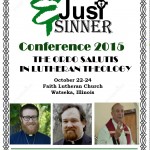
Announcing the 2015 Just and Sinner Conference
Next Post

March 18, 2015 Peter Leithart's Doctrine of Justification
Browse Our Archives
Select a Category American Lutheran Classics Blog Posts Book Review Christian Dogmatics Course Church Resources Curtis Leins Dogmatic Theology Ethics FAQs Historical Theology Just & Sinner Publications Luther Quotations Podcast Sermons The American Lutheran Theological Journal The complete works of Revere Franklin Weidner Theology Proper Uncategorized Videos
Select a Month October 2019 September 2019 July 2019 June 2019 May 2019 April 2019 March 2019 February 2019 January 2019 December 2018 November 2018 October 2018 September 2018 July 2018 June 2018 May 2018 April 2018 March 2018 February 2018 January 2018 December 2017 November 2017 October 2017 September 2017 August 2017 July 2017 June 2017 May 2017 April 2017 March 2017 February 2017 January 2017 December 2016 November 2016 October 2016 September 2016 August 2016 July 2016 June 2016 May 2016 April 2016 March 2016 February 2016 January 2016 December 2015 November 2015 October 2015 September 2015 August 2015 July 2015 June 2015 May 2015 April 2015 March 2015 February 2015 January 2015 December 2014 November 2014 October 2014 September 2014 August 2014 July 2014 June 2014 May 2014
Follow Us!
TAKE THE
Religious Wisdom Quiz
What does Paul tell Timothy to fan into flame?
Select your answer to see how you score.
The Holy Spirit His faith His zeal The gift of God
Related posts from Just and Sinner
Do Lutherans Believe in Covenant Theology?

A Discussion of The Great Divide: A Lutheran...

2 Peter 3:9 Does Not Teach Particular Redemption
TRENDING AT PATHEOS Evangelical

The REST of Your Life: A Creative Wrestles...
This week I had a conversation with a good friend from church....

How the author of the world's best hymn...
I've been working with John Newton for a while now. This makes...

Long before this Lectio Divina, Psalm 130 - the song - started...

What About the Trees? Another Living Parable
After I finished writing the last article about falling leaves as a...

Why Classical Education Is a Conversation, Not a...
Come and Read: Joy in Classical Education When I was a little...

Cornell University has received a great deal of negative publicity and intense...
view all Evangelical blogs
Ad-Free & Subscriber Log-In Subscription Support
- About Us
- 2026 Calendar
- Videos
- Podcasts
- Library of World Religions
- Faith In Media Tracker
- Advertise With Us
- Write for Us
- Privacy Policy
- Terms of Service
- Do Not Sell My Data
- Contact Us
- Radiant Digital
- Manage Newsletter Subscriptions
- Unsubscribe From Notifications
- Sitemap
Copyright 2008-2026, Patheos. All rights reserved.
Subscription Support Ad-Free & Subscriber Log-In
Follow Patheos