
BuddhistCatholicContemplativeEvangelicalGeneral ChristianHinduJewishLatter-day SaintMuslimNew VisionsProgressive Christian
Beliefs
- Buddhist
- Catholic
- Contemplative
- Evangelical
- General Christian
- Hindu
- Jewish
- Latter-day Saint
- More Voices
- Muslim
- New Visions
- Pagan
- Progressive Christian
Topics
- Religion News
- Food and Religion
- Sports and Religion
- Religious Art
- Religious Music and Entertainment
- Religious Events
- History and Religion
- Style and Religion
- Politics and Religion
- Women in Religion
- Recreation Outdoors and Religion
- Business Finance and Religion
- Careers Workplace and Religion
- Education and Religion
- Family Parenting and Religion
- Health Fitness and Religion
- Home and Religion
- Relationships and Religion
- Technology and Religion
- Travel and Religion
Columnists
- Buddhist Columnists
- Business Finance and Religion Columnists
- Careers Workplace and Religion Columnists
- Catholic Columnists
- Contemplative Columnists
- Education and Religion Columnists
- Evangelists Columnists
- Family Parenting and Religion Columnists
- General Christian Columnists
- Health Fitness and Religion Columnists
- Hindu Columnists
- History and Religion Columnists
- Home and Religion Columnists
- Jewish Columnists
- More Voices Columnists
- Latter Day Columnists
- Muslim Columnists
- New Visions Columnists
- Nonreligious Columnists
- Pagan Columnists
- Politics and Religion Columnists
- Progressive Columnists
- Recreation Outdoors and Religion Columnists
- Relationships and Religion Columnists
- Religion News Columnists
- Religious Art Columnists
- Religious Events Columnists
- Religious Music and Entertainment Columnists
- Sports and Religion Columnists
- Style and Religion Columnists
- Technology and Religion Columnists
- Travel and Religion Columnists
- Women in Religion Columnists
Resource Library
- 2026 Calendar
- Library of World Religions
- The 100 Most Holy Places on Earth
- Patheos Answers
- Podcasts
- Videos
- Faith Leaders Database
- Anglican Episcopalian
- Bahai
- Baptist
- Buddhism
- Christianity
- Confucianism
- Eastern Orthodoxy
- Hinduism
- Holiness and Pentecostal
- ISKCON
- Islam
- Judaism
- Lutheran
- Methodist
- The Church of Jesus Christ of Latter-day Saints
- New Age
- Paganism
- Presbytarian and Reformed
- Protestantism
- Religion Behind the Scenes
- Roman Catholic
- Scientology
- Shia Islam
- Sikhism
- Sufism
- Sunni Islam
- Taoism
- Zen
- See all religions
Research Tools
 Ad-Free & Subscriber Log-In Subscription Support
Ad-Free & Subscriber Log-In Subscription Support
Follow Patheos 

- Trending:
- Forgiveness
- |
- Marriage
- |
- Consciousness
- |
- Death Penalty
- |
- Election
- |
- Halloween
 Just and Sinner
- Home
- Evangelical
- Problems with Mormonism: The Book of Abraham
Problems with Mormonism: The Book of Abraham
Last updated on: April 28, 2016 at 12:09 pm by Jordan Cooper
Problems with Mormonism: The Book of Abraham 2016-04-28T12:09:05-06:00 Jordan Cooper
Patheos Explore the world's faith through different perspectives on religion and spirituality! Patheos has the views of the prevalent religions and spiritualities of the world.
Perhaps the biggest apologetic difficulty for those following the Mormon faith is that surrounding one particular canonical book supposedly translated by Joseph Smith titled The Book of Abraham. This document was purchased by Smith in 1835 from an Egyptian exhibition which was then touring throughout the United States. This occurred prior to the discovery of the Rosetta Stone, and the correct translation of Egyptian characters was then largely unknown. Smith claimed that these ancient Egyptian documents that he had gotten a hold of contained a record written by the patriarch of Abraham, along with something written by Joseph of Egypt. While the document from Joseph was never translated, the Book of Abraham was translated, disseminated, and included within the canonical book The Pearl of Great Price. If one purchases the Mormon Scriptures today (in a triple volume which includes the Book of Mormon, The Pearl of Great Price, and Doctrine and Covenants) they will contain this book.
Anyone looking into the Mormon faith must seriously grapple with this work for two primary reasons. First, the historical veracity of this book is extremely difficult (I would say impossible) to defend from a rational perspective. Second, this work contains many of the unique Mormon doctrines that are absent in the more popular Book of Mormon.
This book was written in Egyptian Hieroglyphics, and supposedly contained the story of Abraham. It tells of Abraham’s family members worshiping false gods, and of the practice of human sacrifice in ancient Egypt. In the narrative, the priest of Elkenah offers up three virgins to be sacrificed for not bowing down to idols, after which the priest attempts to do the same to Abraham. Just prior to being slain by the pagan priest, God appears in a vision to Abraham, and sets him free. There are several historical problems just in this first chapter of the book.
First, there is no historical record of any of the Egyptian gods mentioned in the narrative including: Elkenah, Libnah, and Mahmackrah. There is certainly the possibility that some Egyptian deities have simply not survived in any existing records, but due to the hot and arid conditions of Egypt, more historical records exist in this part of the world than most other ancient societies. There has been an extensive amount of historical Egyptological research surround Egyptian religion, writing, etc. One would think that there would be some record of at least one of the gods mentioned in the story. These gods were, apparently, important enough to sacrifice human lives for.
The second problem is the nature of human sacrifice in ancient Egypt. The narrative clearly portrays sacrifice to the Egyptian gods as a normal occurrence. It is almost certain that Joseph Smith is simply modeling his view of Egyptian sacrifice after that of the Canaanites as described in the Old Testament. For a long time, Egyptologists did not believe that the practice of human sacrifice occurred at all in Egypt, but this has, after various discoveries, been demonstrated to be false. The most prominent type of sacrifice was the “retainer sacrifice” which involved the killing of a Pharoah’s servants after his death in order that they might be together in the afterlife. The retainer sacrifice does not match the story for three reasons: first, it likely died out prior to the second dynasty (about 1,000 years prior to Abraham’s birth). Second, the sacrifices described in the BoA are cultic in nature, and are not performed on Pharoah’s servants. Third, the manner of sacrifice differs. Retainer sacrifices likely involved poisoning and strangulation. The BoA portrays sacrifice on an altar. There are some small hints that a separate cultic sacrifice existed in ancient Egypt. This, however, does not comport with the BoA either for three reasons. First, the evidence for this practice is relatively small, consisting only of a few illustrations. The practice does not appear to be widespread. In the BoA, this is described as a normal occurrence (BoA 1:8). Second, it is believed that whatever cultic sacrifices did exist involved prisoners of war and criminals. This is not the case in the BoA. Third, the illustrations of sacrifice include one’s neck being cut open while kneeling in front of a bowl. The BoA portrays a sacrifice while lying down on an altar. The story of the Book of Abraham simply does not match any historical evidence when it comes to the nature of sacrifice in ancient Egypt.
Perhaps even more problematic than these historical difficulties are the three facsimiles that Smith attached to the Book of Abraham, which are included in any contemporary edition of the Pearl of Great Price. While each of these could be examined in great depth, we will just look at Facsimile 1. Smith includes the following illustration as part of his work: 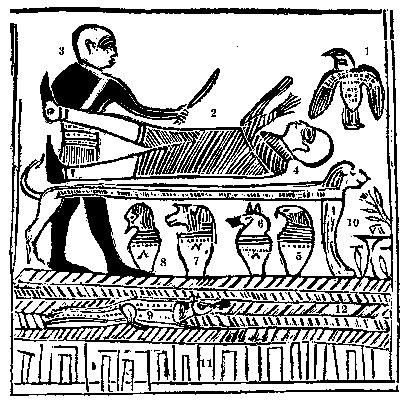
According to Smith, this illustration is a depiction of an ancient image which portrays Abraham on an altar. The priest of Elkenah is standing beside him so that the patriarch might be offered up as a sacrifice to the Egyptian gods. These gods are then depicted below the altar, and the bird in the top right corner is the Holy Spirit.
The problem is simply that we know that this is not what this picture actually portrays. The first problem is Smith’s obvious additions to the picture. Even a cursory and uneducated look at this picture indicates that the human head on the priest simply does not look Egyptian. The features do not actually match the type of art in the rest of the image. The suspicion of Egyptologists had always been that Smith simply added several details which simply did not exist in the original picture, including the knife and the head on the “priest.” This was vindicated when the actual documents used by Smith were discovered. The actual papyrus looks like this:
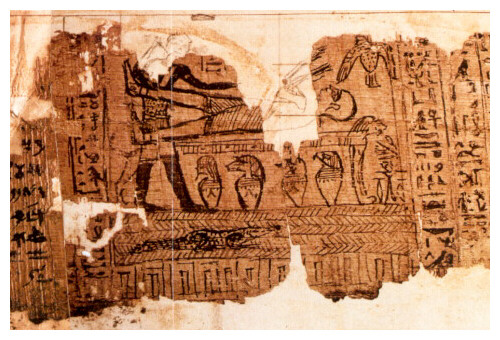 Notably, just as suspected, the head of the priest, along with several other details, were not actually part of the original papyrus. Smith simply added them to fit the narrative he wanted to tell.
What this image actually is is relatively clear. It is a common scene in Egyptian art which portrays the resurrection of Osiris by Anubis. Look at this image as just one example:
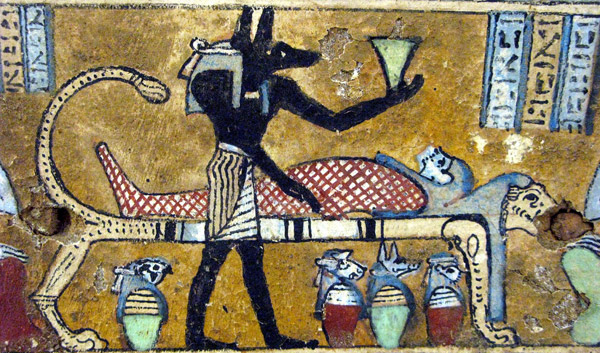 The similarities between the two images are readily apparent. One figure is on the lion couch (not an altar), and another is standing above him with hand extended. The same four jars appear below the lion couch in each image. The elements which would make facsimile 1 unique in comparison with this common scene are the human head on the Anubis figure, and the knife in his hand. These portions of the image are conveniently missing from the original document.
Along with the facsimiles, there was Egyptian text discovered with the images. Now that Egyptian characters can be easily translated, scholars can decipher the original writing on the scroll. The actual text has no similarity to the Book of Abraham, but is in fact the Hor Book of Breathings.
Mormon apologists have attempted to give some possible answers to the problems surrounding the Book of Abraham. Some have argued that the original papyrus of Smith has actually mostly been lost. Originally, the human head of the priest was actually part of facsimile 1, though somehow that portion was lost. Also, it is argued that a much longer scroll was in Smith’s possession which did in fact have the BoA on it. That portion just so happens to be the part that was lost. Thus, all parts of the BoA manuscript owned by Smith which would corroborate his story simply disappeared. The second explanation is that the facsimiles were reinterpreted so as to refer to the story of Abraham, while simultaneously also portraying the resurrection of Osiris. It is pointed out here that there is one existing papyrus which contains a picture of Osiris and also has the name Abraham written on it. Such a connection is, however, extremely weak, and does not support such a broad claim that Osiris and Abraham were often identified, and that an image of Osiris could be applied to a completely different situation in the life of Abraham.
Perhaps the most problematic part of this is simply that no record of a Book of Abraham exists anywhere else. The manuscript owned by Smith dates back to 200 BC. Abraham lived around 2,000 BC. This manuscript supposedly existed for 1800 years and passed through numerous editions. Yet, in those 1800 years, no mention of such a book and no manuscript of this book exists anywhere. Surely, had the Jews known about a book directly written by the hand of Abraham, it would have had some place of importance in their theological and spiritual development. Yet, nothing exists. Even if this was a purely Egyptian manuscript, it would have been known by some Jews who were continual trading partners with Egypt. It also would have most likely been known by early Christians in Alexandria. Yet, again, no one mentions it.
These are only a few of the issues surrounding the Book of Abraham. The problems are much bigger than I have briefly addressed here, both historically and theologically. If you are considering Mormonism, or are currently a Mormon, think about these issues. I think, when doing so, that you will find Smith’s claims about this supposed ancient book to be completely indefensible.
Previous Post
April 19, 2016
The Theology of Mormonism
Next Post
May 5, 2016 If Christians Enjoy Making Assertions, Why Speak with Them?
Browse Our Archives
Select a Category American Lutheran Classics Blog Posts Book Review Christian Dogmatics Course Church Resources Curtis Leins Dogmatic Theology Ethics FAQs Historical Theology Just & Sinner Publications Luther Quotations Podcast Sermons The American Lutheran Theological Journal The complete works of Revere Franklin Weidner Theology Proper Uncategorized Videos
Select a Month October 2019 September 2019 July 2019 June 2019 May 2019 April 2019 March 2019 February 2019 January 2019 December 2018 November 2018 October 2018 September 2018 July 2018 June 2018 May 2018 April 2018 March 2018 February 2018 January 2018 December 2017 November 2017 October 2017 September 2017 August 2017 July 2017 June 2017 May 2017 April 2017 March 2017 February 2017 January 2017 December 2016 November 2016 October 2016 September 2016 August 2016 July 2016 June 2016 May 2016 April 2016 March 2016 February 2016 January 2016 December 2015 November 2015 October 2015 September 2015 August 2015 July 2015 June 2015 May 2015 April 2015 March 2015 February 2015 January 2015 December 2014 November 2014 October 2014 September 2014 August 2014 July 2014 June 2014 May 2014
Follow Us!
TAKE THE
Religious Wisdom Quiz
What does "Shiloh" (where the Tabernacle stood) mean?
Select your answer to see how you score.
House of Prayer Land of Bread Well of Water Place of Peace
Related posts from Just and Sinner
Problems with Mormonism: Adam God
Five Problems with the Book of Mormon
Problems with the Book of Mormon
TRENDING AT PATHEOS Evangelical

The REST of Your Life: A Creative Wrestles...
This week I had a conversation with a good friend from church....

How the author of the world's best hymn...
I've been working with John Newton for a while now. This makes...

Long before this Lectio Divina, Psalm 130 - the song - started...

What About the Trees? Another Living Parable
After I finished writing the last article about falling leaves as a...

Why Classical Education Is a Conversation, Not a...
Come and Read: Joy in Classical Education When I was a little...

Cornell University has received a great deal of negative publicity and intense...
view all Evangelical blogs
Ad-Free & Subscriber Log-In Subscription Support
- About Us
- 2026 Calendar
- Videos
- Podcasts
- Library of World Religions
- Faith In Media Tracker
- Advertise With Us
- Write for Us
- Privacy Policy
- Terms of Service
- Do Not Sell My Data
- Contact Us
- Radiant Digital
- Manage Newsletter Subscriptions
- Unsubscribe From Notifications
- Sitemap
Copyright 2008-2026, Patheos. All rights reserved.
Subscription Support Ad-Free & Subscriber Log-In
Follow Patheos