
BuddhistCatholicContemplativeEvangelicalGeneral ChristianHinduJewishLatter-day SaintMuslimNew VisionsProgressive Christian
Beliefs
- Buddhist
- Catholic
- Contemplative
- Evangelical
- General Christian
- Hindu
- Jewish
- Latter-day Saint
- More Voices
- Muslim
- New Visions
- Pagan
- Progressive Christian
Topics
- Religion News
- Food and Religion
- Sports and Religion
- Religious Art
- Religious Music and Entertainment
- Religious Events
- History and Religion
- Style and Religion
- Politics and Religion
- Women in Religion
- Recreation Outdoors and Religion
- Business Finance and Religion
- Careers Workplace and Religion
- Education and Religion
- Family Parenting and Religion
- Health Fitness and Religion
- Home and Religion
- Relationships and Religion
- Technology and Religion
- Travel and Religion
Columnists
- Buddhist Columnists
- Business Finance and Religion Columnists
- Careers Workplace and Religion Columnists
- Catholic Columnists
- Contemplative Columnists
- Education and Religion Columnists
- Evangelists Columnists
- Family Parenting and Religion Columnists
- General Christian Columnists
- Health Fitness and Religion Columnists
- Hindu Columnists
- History and Religion Columnists
- Home and Religion Columnists
- Jewish Columnists
- More Voices Columnists
- Latter Day Columnists
- Muslim Columnists
- New Visions Columnists
- Nonreligious Columnists
- Pagan Columnists
- Politics and Religion Columnists
- Progressive Columnists
- Recreation Outdoors and Religion Columnists
- Relationships and Religion Columnists
- Religion News Columnists
- Religious Art Columnists
- Religious Events Columnists
- Religious Music and Entertainment Columnists
- Sports and Religion Columnists
- Style and Religion Columnists
- Technology and Religion Columnists
- Travel and Religion Columnists
- Women in Religion Columnists
Resource Library
- 2026 Calendar
- Library of World Religions
- The 100 Most Holy Places on Earth
- Patheos Answers
- Podcasts
- Videos
- Faith Leaders Database
- Anglican Episcopalian
- Bahai
- Baptist
- Buddhism
- Christianity
- Confucianism
- Eastern Orthodoxy
- Hinduism
- Holiness and Pentecostal
- ISKCON
- Islam
- Judaism
- Lutheran
- Methodist
- The Church of Jesus Christ of Latter-day Saints
- New Age
- Paganism
- Presbytarian and Reformed
- Protestantism
- Religion Behind the Scenes
- Roman Catholic
- Scientology
- Shia Islam
- Sikhism
- Sufism
- Sunni Islam
- Taoism
- Zen
- See all religions
Research Tools
 Ad-Free & Subscriber Log-In Subscription Support
Ad-Free & Subscriber Log-In Subscription Support
Follow Patheos 

- Trending:
- Forgiveness
- |
- Marriage
- |
- Consciousness
- |
- Death Penalty
- |
- Election
- |
- Halloween
 Just and Sinner
- Home
- Evangelical
- Problems with Mormonism: Adam God
Problems with Mormonism: Adam God
Last updated on: February 10, 2018 at 1:47 pm by Jordan Cooper
Problems with Mormonism: Adam God 2018-02-10T13:47:35-06:00 Jordan Cooper
Patheos Explore the world's faith through different perspectives on religion and spirituality! Patheos has the views of the prevalent religions and spiritualities of the world.
(A video form of this post can also be found here).
The Problem of False Revelation
Though a relatively young religious movement, the Mormon faith has experienced an extensive amount of revision since its founding in the 1820s to 1840s by Joseph Smith. A number of controversial doctrines were taught by earlier leaders in the movement–especially by Brigham Young–including things like polygamy, blood atonement, and a denial of interracial marriage. Throughout the years, many of these teachings have been officially rejected by the church. The problem, however, with simply ignoring these doctrines as mistaken notions of the past, is that they were taught by prophets, and often within the context of having received supposed direct revelation from God.
One can point to ideas which are problematic in the founders of nearly any movement. Martin Luther’s writings on the Jews have been disregarded by the majority of Lutherans, and John Calvin’s views on the death penalty as a proper response to heresy have been rejected by many Reformed Christians. However, none of these other religious figures were claiming that they taught such things by any divinely revealed prophetic authority, but instead through their interpretations of Sacred Scripture. They did not set themselves up as prophets to be obeyed as the very mouthpiece of God, but instead as sinners pointing people back to God’s revelation in sacred writ. Such cannot be said of the prophets of the LDS church.
Claims of being a messenger of God are common in the history of the world, and God himself has established a simple test to examine those individual claims. The Old Testament presents a test for the people of Israel in order to determine whether or not a prophet is true or false. The text states:
But the prophet who presumes to speak a word in my name that I have not commanded him to speak, or who speaks in the name of other gods, that same prophet shall die.’ 21 And if you say in your heart, ‘How may we know the word that the Lord has not spoken?’— 22 when a prophet speaks in the name of the Lord, if the word does not come to pass or come true, that is a word that the Lord has not spoken; the prophet has spoken it presumptuously. You need not be afraid of him. – Deuteronomy 18:20-22
A false prophet is one who falsely claims that something was taught by direct revelation. The punishment for presenting false information is death. There is no place, Scripturally, for any category of a prophet who is fallible in his proclamation. This is not to say that prophets can never be wrong in any area. I am sure that Jeremiah might have made a mistake if someone presented him with a complex math problem. However, what is not possible is for a true prophet to claim that something had come directly from God, but offer a false prophecy. This leads us, then, to consider a teaching of Brigham Young often referred to as the “Adam-God” doctrine. If he is wrong in promoting this idea, which he claimed to know by revelation, this should cause one to question his status as a prophet.
Defining Adam-God
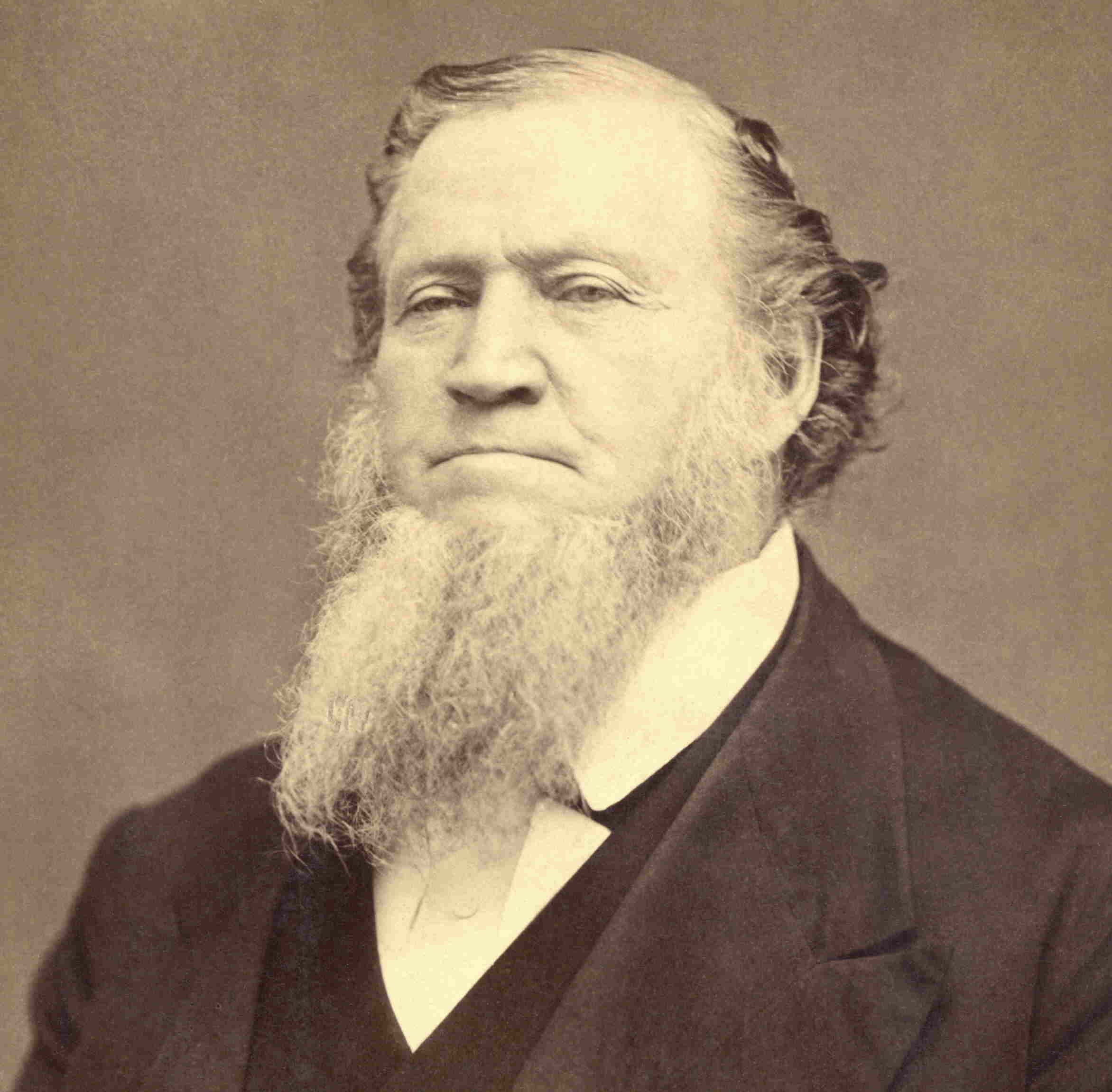
“When our father Adam came into the garden of Eden, he came into it with a celestial body, and brought Eve, one of his wives, with him. He helped to make and organize this world. He is MICHAEL, the Archangel, the ANCIENT OF DAYS! about whom holy men have written and spoken—He is our FATHER and our GOD, and the only God with whom WE have to do.” (Source)
Young taught that Adam had lived a mortal life previous to the Scriptural account with his wife Eve. Through obedience, they both achieved exaltation unto godhood. Adam, as a god, received the title “Ancient of Days,” and he also is identical with the archangel Michael. Adam is known as the creator, though he is only one among many in the council of gods. With Eve, Adam gave birth to children including Lucifer and Jesus. Adam also fathered (perhaps through Eve or other wives, since it appears to be the assumption that he also was polygamous) the spirits which would become those who populate the earth. Out of a desire to give physical bodies to their spirit children, Adam and Eve entered the earth as the Biblical figures described in Genesis 1-3. They then became the parents of the physical bodies of the human race, becoming then both spiritual and physical progenitors of humanity. Physical bodies are a necessary step in achieving exaltation to godhood, and thus this is the motivation behind the actions of Michael/Adam in giving birth to physical children. After his time on the earth, Adam then ascended into heaven, and is identical with the God of Israel, forming a three-person godhead with his son Jesus and the Holy Spirit.
The modern LDS church has repeatedly condemned the idea of Adam-God in recent years. Spencer Kimball officially repudiated the idea in 1976 as false doctrine. Bruce McConkie, in Mormon Doctrine, similarly writes against the idea, and contends that Young’s statements do not actually support such a teaching when viewed in “gospel perspective” (Mormon Doctrine, 18). The current Wikipedia article on Adam-God also contains the sentence: ” The claim that the doctrine was taught by Young relies on a particular interpretation of a few quotes and is not supported by the full body of his teachings and writings” (read it here). However, the claim that the Adam-God teaching is merely a misinterpretation of Young’s writings is extremely difficult to substantiate. The theme is a rather prevalent one in Young, as anyone will observe who does careful reading of his sermons and other writings (such as in this volume). BYU professor Robert Millet acknowledges that Adam-God teaching covers roughly 15% of Brigham Young’s writing on the godhead (Listen here).
It is thus widely acknowledged today that Adam-God was indeed a teaching of Brigham Young. Such might not be a major issue, had he simply framed these ideas in the context of private speculation. However, even the Mormon apologetic organization FairMormon acknowledges that Young “claimed to have received these beliefs by revelation” (Link here). Young taught Adam-God at general conference, under his authority as a prophet, and even included elements of this teaching in the endowment ceremony. He also stated that these ideas came directly from Joseph Smith, though that has not been proven. What is clear in all of this is that there is a divergence between Brigham Young and the LDS church, which both claim to have a position on this issue given by divine authority. They cannot both be right.
Conclusion
This discussion leads to basically three possibilities:
- Brigham Young taught falsely on this issue, and the modern LDS church is correct. This is the position of FairMormon and other apologetics organizations within Mormonism. However, this then leads to the necessary conclusion that Brigham Young does not actually comport with the Biblical qualifications of a prophet. If this is the case, then his calling is invalidated along with the rest of the LDS church.
- Brigham Young taught correctly, and the modern LDS church is wrong. This is the position of Mormon fundamentalist groups who reject the many changes in Mormon doctrine which have occurred over the years since its founding. While this leads to a number of other issues, one can at least admire the consistency here in holding to Young’s teachings.
- Brigham Young is a fraud, and so is the LDS church. In view of the mounting evidence against Mormonism, and Smith, it is the most logical conclusion that these ideas have been fraudulent from the beginning, and that the claims of both Young and modern prophets are just that: claims. They are not divinely revealed messages from God.
Previous Post

February 10, 2018
Why I am not Reformed
Next Post
February 10, 2018 The Adam God Teaching: A Problem for Mormonism
Browse Our Archives
Select a Category American Lutheran Classics Blog Posts Book Review Christian Dogmatics Course Church Resources Curtis Leins Dogmatic Theology Ethics FAQs Historical Theology Just & Sinner Publications Luther Quotations Podcast Sermons The American Lutheran Theological Journal The complete works of Revere Franklin Weidner Theology Proper Uncategorized Videos
Select a Month October 2019 September 2019 July 2019 June 2019 May 2019 April 2019 March 2019 February 2019 January 2019 December 2018 November 2018 October 2018 September 2018 July 2018 June 2018 May 2018 April 2018 March 2018 February 2018 January 2018 December 2017 November 2017 October 2017 September 2017 August 2017 July 2017 June 2017 May 2017 April 2017 March 2017 February 2017 January 2017 December 2016 November 2016 October 2016 September 2016 August 2016 July 2016 June 2016 May 2016 April 2016 March 2016 February 2016 January 2016 December 2015 November 2015 October 2015 September 2015 August 2015 July 2015 June 2015 May 2015 April 2015 March 2015 February 2015 January 2015 December 2014 November 2014 October 2014 September 2014 August 2014 July 2014 June 2014 May 2014
Follow Us!
TAKE THE
Religious Wisdom Quiz
Who saw a vision of the Lord seated on a throne, surrounded by seraphim?
Select your answer to see how you score.
Daniel Ezekiel Isaiah Jeremiah
Related posts from Just and Sinner
Five Problems with the Book of Mormon
Problems with the Book of Mormon
Problems with Mormonism: The Doctrine of God
TRENDING AT PATHEOS Evangelical

How the author of the world's best hymn...
I've been working with John Newton for a while now. This makes...

Long before this Lectio Divina, Psalm 130 - the song - started...

What About the Trees? Another Living Parable
After I finished writing the last article about falling leaves as a...

Why Classical Education Is a Conversation, Not a...
Come and Read: Joy in Classical Education When I was a little...

Falling Leaves: A Living Parable on Letting Go
I’ve spent the vast majority of my life in the southeast corner...

Cornell University has received a great deal of negative publicity and intense...
view all Evangelical blogs
Ad-Free & Subscriber Log-In Subscription Support
- About Us
- 2026 Calendar
- Videos
- Podcasts
- Library of World Religions
- Faith In Media Tracker
- Advertise With Us
- Write for Us
- Privacy Policy
- Terms of Service
- Do Not Sell My Data
- Contact Us
- Radiant Digital
- Manage Newsletter Subscriptions
- Unsubscribe From Notifications
- Sitemap
Copyright 2008-2026, Patheos. All rights reserved.
Subscription Support Ad-Free & Subscriber Log-In
Follow Patheos