
BuddhistCatholicContemplativeEvangelicalGeneral ChristianHinduJewishLatter-day SaintMuslimNew VisionsProgressive Christian
Beliefs
- Buddhist
- Catholic
- Contemplative
- Evangelical
- General Christian
- Hindu
- Jewish
- Latter-day Saint
- More Voices
- Muslim
- New Visions
- Pagan
- Progressive Christian
Topics
- Religion News
- Food and Religion
- Sports and Religion
- Religious Art
- Religious Music and Entertainment
- Religious Events
- History and Religion
- Style and Religion
- Politics and Religion
- Women in Religion
- Recreation Outdoors and Religion
- Business Finance and Religion
- Careers Workplace and Religion
- Education and Religion
- Family Parenting and Religion
- Health Fitness and Religion
- Home and Religion
- Relationships and Religion
- Technology and Religion
- Travel and Religion
Columnists
- Buddhist Columnists
- Business Finance and Religion Columnists
- Careers Workplace and Religion Columnists
- Catholic Columnists
- Contemplative Columnists
- Education and Religion Columnists
- Evangelists Columnists
- Family Parenting and Religion Columnists
- General Christian Columnists
- Health Fitness and Religion Columnists
- Hindu Columnists
- History and Religion Columnists
- Home and Religion Columnists
- Jewish Columnists
- More Voices Columnists
- Latter Day Columnists
- Muslim Columnists
- New Visions Columnists
- Nonreligious Columnists
- Pagan Columnists
- Politics and Religion Columnists
- Progressive Columnists
- Recreation Outdoors and Religion Columnists
- Relationships and Religion Columnists
- Religion News Columnists
- Religious Art Columnists
- Religious Events Columnists
- Religious Music and Entertainment Columnists
- Sports and Religion Columnists
- Style and Religion Columnists
- Technology and Religion Columnists
- Travel and Religion Columnists
- Women in Religion Columnists
Resource Library
- 2026 Calendar
- Library of World Religions
- The 100 Most Holy Places on Earth
- Patheos Answers
- Podcasts
- Videos
- Faith Leaders Database
- Anglican Episcopalian
- Bahai
- Baptist
- Buddhism
- Christianity
- Confucianism
- Eastern Orthodoxy
- Hinduism
- Holiness and Pentecostal
- ISKCON
- Islam
- Judaism
- Lutheran
- Methodist
- The Church of Jesus Christ of Latter-day Saints
- New Age
- Paganism
- Presbytarian and Reformed
- Protestantism
- Religion Behind the Scenes
- Roman Catholic
- Scientology
- Shia Islam
- Sikhism
- Sufism
- Sunni Islam
- Taoism
- Zen
- See all religions
Research Tools
 Ad-Free & Subscriber Log-In Subscription Support
Ad-Free & Subscriber Log-In Subscription Support
Follow Patheos 

- Trending:
- Forgiveness
- |
- Marriage
- |
- Consciousness
- |
- Death Penalty
- |
- Election
- |
- Halloween
 Just and Sinner
- Home
- Evangelical
- Why I Now Embrace the Two Kinds of Righteousness (a Review of Jordan Cooper’s Hands of Faith)
Why I Now Embrace the Two Kinds of Righteousness (a Review of Jordan Cooper’s Hands of Faith)
Last updated on: April 21, 2017 at 6:28 am by nathanrinne
Why I Now Embrace the Two Kinds of Righteousness (a Review of Jordan Cooper’s Hands of Faith) 2017-04-21T06:28:59-06:00 nathanrinne
Patheos Explore the world's faith through different perspectives on religion and spirituality! Patheos has the views of the prevalent religions and spiritualities of the world.

In his book Hands of Faith, Pastor Jordan Cooper makes a convincing case that the concept of the two kinds of righteousness is not only inherent in Lutheran theology (4, 11, 31, 70, 109), but that it is an important biblical concept with much to offer “the entire Christian world.” In sum, with this distinction antinomianism can be effectively countered while the centrality of justification is highlighted: faith, “mystical union” (“Christification”), and good works can all be put “within their proper contexts” (133).
Pastor Cooper appears to have thought rather deeply about the modern theological landscape – in confessional Lutheran circles and beyond – and put together an effective program to help believers find their bearings. Those familiar with his helpful podcasts and other work will find that Hands of Faith builds on two important previous books: The Righteousness of One, which offers a Lutheran answer to the “new perspective” on Paul (most well-known among evangelicals in N.T. Wright’s work), and Christification, which traces the theme of union with Christ (or “mystical union”) and its connection with sanctification in the writings of Lutheran writers up through the present day.
With this more recent offering, I believe that Jordan Cooper shows himself to be not only one of the most insightful, loyal, and bridge-building confessional Lutheran theologians of our day – but also one of the Christian church’s most biblically faithful, theologically astute, and ecumenically-minded spokesmen. As he describes his own efforts “I continue to offer a proposal for a Lutheranism that is genuinely catholic and avoids reductionistic caricatures” (2).
Right from the beginning, the book gets off to a great start with a powerful introduction from Concordia Seminary St. Louis professor Joel Bierrmann. What sticks out is Bierrmann’s comment that “there are myriad expressions of God’s truth that are faithful to what has been given.” Even as he talks about how he and Cooper differ – something that is made clear in the book (see 34, 35; 127) – he also goes on to say this:
“[Both Cooper and myself] are willingly and freely constrained by a common confession and a peculiar heritage within the body of the church. More remarkably than that, we are even linked by our mutual appreciation for the two kinds of righteousness as a dynamic and effective means of expressing God’s truth in a contemporary context. This, it turns out, is not universally true of all who join us in our heritage and confession. Perhaps this text will help remedy what is to my mind, an unnecessary and somewhat reactionary repudiation of the two kinds of righteousness by some who are fellow heirs of Luther.” (x)
I think he is right. In fact, I know he is right. I can say that because it was only Pastor Cooper who was able to firmly convince me that my reaction to one version of the “two kinds of righteousness” was, in fact, an overreaction (see the series I did four years ago here and here). I recant!
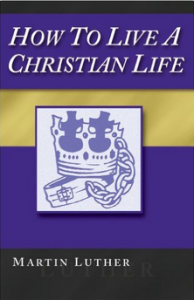
Luther’s jarring thesis: “A Christian is an utterly free man, lord of all, subject to none. A Christian is an utterly dutiful man, servant of all, subject to all.” Justification and sanctification, in a nutshell.
Pastor Cooper has helped me to see that the desire explain the Christian life in terms of the “two kinds of righteousness” can be a very good and helpful thing – perhaps particularly for the times that we live in. I think that he was able to do this because he basically looks at the wisdom the Lutheran Confessions have to share on the topic and builds his case from there.
As the Lutheran Confessions say (FC SD III.24):
…in this life believers who have become righteous through faith in Christ have first of all the righteousness of faith that is reckoned to them and then thereafter the righteousness of the new obedience or good works that are begun in them. But these two kinds of righteousness dare not be mixed with each other or simultaneously introduced into the article on justification by faith before God. For because this righteousness that is begun in us – this renewal – is imperfect and impure in this life because of our flesh, a person cannot use it in any way to stand before God’s judgement throne. Instead, only the righteousness of the obedience, suffering, and death of Christ, which is reckoned to faith, can stand before God’s tribunal. Even following their renewal, when they are already producing many good works and living the best kind of life, human beings…are acceptable [to God]…only because of Christ’s obedience (78).
As Pastor Cooper puts it, because the Christian will not be free of his old man, or old Adam, in this life, “[o]nly Christ, not any level of sanctification, can serve as a ground of assurance” (79). The two kinds of righteousness has to do with “how man relates to God (passive righteousness) and fellow man (active righteousness)” (125). With the vertical reality that is the passive righteousness we are “remind[ed]…that [we] cannot work to merit God’s favor or love, but that righteousness is given freely.” With the largely horizontal reality of our active righteousness we see “that [we] are called to live holy lives in the world for the sake of others” (128).
The “two kinds of righteousness,” Pastor Cooper tells us, “is essentially another manner in which to discuss the differences between justification and sanctification” (97). No doubt revealing an inspiration for the book’s title, Cooper says that “[Classical Lutheran theologian] Johannes Brentz” says that faith has ‘two hands.’ One hand extends upward toward God and receives his gifts. The other reaches down into the world of fellow man and performs works of love” (90).

Gustaf Wingren, Pastor Cooper’s favorite “existentialist” Lutheran.
So, how is the book laid out? After initially “diagnosing the problem” (chapter title) of a “law-gospel” and “justification-only reductionism” (7) among some contemporary Lutherans, Pastor Cooper analyzes three previous books that have dealt with the two kinds of righteousness. The views in Gustaf Wingren’s Luther On Vocation, Charles Arand’s and Robert Kolb’s The Genius of Luther’s Theology, and Joel Biermann’s A Case for Character are deftly summarized, accompanied by both ample praise and critique that is at once sensible and gentle. After this, he guides us into the two kinds of righteousness in Martin Luther’s most important writings, in the Lutheran Confessions, in the seventeenth-nineteenth century Lutheran theologians, and finally, in the Scriptures (an important Appendix where he demonstrates, among other things, that the two kinds of righteousness is a “pre-fall” reality).
Throughout these chapters, Cooper is keen to make several points. In all of these, we become aware that the case that the “two kinds of righteousness” is a biblical concept able to practically guide us in our Christian life is a powerful one.
First of all, it highlights the crucial truths about justification and sanctification which can be clearly seen in Ephesians 2:8-10: we are justified by grace through faith for the good works God has laid out for us. In the light of the two kinds of righteousness, Paul’s letters, for example, are able to give us specific moral instruction while never failing to root such guidance in the passive and saving righteousness freely given to us by God in Christ (see, e.g., 146-150). While the Apostle is clear about his intention to reveal our sin to us in Romans 1-3, the imperatives in other letters are primarily to help guide Christians’ behavior in the world (even as this can certainly accuse us as well).

A diagram of the two kinds of righteousness (see here for more)
Second, and quite importantly, we learn that previous portrayals of the two kinds of righteousness have failed to note that the distinction amounts to imperfect shorthand (see 118): while even in the Bible sanctification can indeed be spoken of largely as a horizontal reality (see, e.g., Rom. 12-16, specifically 13:10, Gal. 5:14-26, and Eph. 4 and 5), there still is the aspect of the Christian’s piety before God, what Pastor Cooper calls “eucharistic sacrifice”: “If love toward God and upward piety are placed solely in the category of thanksgiving, then love toward God is always in response to passive righteousness” (19, italics mine). This goes hand-in-hand with Joel Biermann’s point that while unbelievers can also act in accordance with God’s will in the creation, a.k.a “civic” or “civil righteousness,” they do not do this with the proper motivation nor with the proper goals in mind (works done out of love for God and for the neighbor’s need, as opposed to works done for one’s “self-justification”). “The Holy Spirit works in a unique manner in the life of the regenerate person” (30, see 112 also).
Third, Lutherans who actually adhere to their confessional documents have never been antinomian (see 81 and 82), and in the older theologians the good works that take place within sanctification can be seen to seamlessly integrate with believers’ mystical union with Christ (108-109). The believer is justified in Christ, whereby, per Hoenecke, they are “so cemented to Christ that he and you are as one person” (109, see 51), and is then also sanctified by His indwelling, “wherein the believer is changed and renewed in God’s image.” It is from this indwelling, this second kind of union, from which both spontaneous good works and conscious efforts to do them must necessarily arise. “As there are two kinds of righteousness,” Pastor Cooper tells us, “so also there are two kinds of union corresponding to each” (51, see 104-110 as well).
And how does this distinction of the two kinds of righteousness relate to other theological topics Lutherans are known for highlighting? Two more points.
First, it is not a “better paradigm” than “law and gospel” (127) but has a different function. As Biermann says, echoing Kolb and Arand as well, “the two kinds of righteousness helps to clarify the role of good works and the law in the life of the Christian in a way in which the simple law-gospel paradigm cannot” (26). The law and gospel distinction, by which we are “remind[ed]… that Christians always fall short of God’s will and are saved solely by God’s grace,” does not have to do with how we relate to God and man, but is about how God speaks” (128).“ The two kinds of righteousness reminds us that “Christian obedience,” as important as it is, “can never function as the basis for Christian assurance” (129, italics Cooper’s).
Second – and this relates to Pastor Cooper’s work outside of this particular book (see here or the embedded video below) – the passive righteousness of the Christian, according to Martin Luther, basically correlates with what the Apostle Paul calls the “inner man,” and the active righteousness of the Christian corresponds with what he calls the “outer man,” meaning the body which binds us to creation (see 2 Cor 4:16). The body is the place of our sanctification, so to speak, by which we not only serve our fellow human beings, but also serve as co-creators of them and also find ourselves bound with the land, or earth. These, of course, brings us back to the original purpose, or vocation, of human beings in Genesis 1-2. Post-fall, this is inevitably going to relate to what Lutherans have traditionally called the “two kingdoms” as well.[i]
These are the kinds of things that Pastor Cooper unpacks throughout the course of Hands of Faith, always with much supporting evidence and argumentation. And the book’s content is not only clear and appropriately concise, but the tone of the analysis and arguments is pitch-perfect throughout. Of course I write for his blog and you would expect me to say this (and I got a free review copy as well!), but I would be genuinely surprised if the vast majority of professors at confessional Lutheran seminaries, for example, did not agree with my assessment after reading this latest offering from Pastor Cooper.
In this book, like his previous offerings, there is a deep concern not only for sound doctrinal theology, but historical theology as well. Again, Pastor Cooper is always eager to see the teachings of Luther and those who followed him in the context of the Christian church throughout history – not just by paying lip service to the past, but by actually making critical historical and logical connections, with the practical implications of that never being far behind.
Readers of Hands of Faith: a Historical and Theological study of the Two Kinds of Righteousness in Lutheran Thought will not be disappointed. Not only clarifying for Lutherans, it is an ecumenical book for our times that should have wide appeal among Christians.
FIN
Note:
[i] Regarding the doctrine of the “two kingdoms,” the idea is that the Gospel rules the “right hand” kingdom (where in time, the church announces justification coram Deo, or before God), while the law rules the “left hand” kingdom, or temporal and material realm. In the book, Cooper shares words from Luther’s Galatians commentary that are a bit jarring. In society, we should “let nothing be known about the Gospel, conscience, grace, the forgiveness of sins, heavenly righteousness, or Christ himself; but let there be knowledge only of Moses, of Law and its works” (56). Roughly, speaking, we might say that since the believer’s sanctification is meant to be coram mundo (before the world) reality, human beings cannot live without a civil righteousness in earthly kingdoms. We might diagram this as follows:

“The reason why seemingly contradictory statements are often made in the Bible about Christians is due to the Christians two-fold nature. The simple fact is that within each Christian two natures constantly oppose each other. “The flesh wars against the spirit and the spirit wars against the flesh” (Gal. 5:17). – Martin Luther (diagram from this paper).
Here, the reviewer was reminded of the “Bethel Confession,” produced in by faithful Lutherans in the 1930s vs. the Nazis (see here). This document does not echo Luther by mentioning the law of Moses, but it certainly does so when it says that it is the role of the government, or nation, to bear the sword in order to punish the evildoer and enact justice. On the other hand, the realm of the church is to share God’s forgiveness in Christ through the means of grace, His Word, come to us in the Scriptures, and His sacraments (therefore, the Bethel Confession’s authors interestingly conclude “[we] reject the false doctrine of a ‘Christian state’ in every form”). It is perhaps worth noting there that Luther also talked about the “three estates”: the family, the church, and earthly government. Earthly government, he says, only became a necessity for human beings following the fall into sin.
Previous Post
April 20, 2017
Five Problems with Limited Atonement
Next Post
May 2, 2017 An Excerpt from my New Book
Browse Our Archives
Select a Category American Lutheran Classics Blog Posts Book Review Christian Dogmatics Course Church Resources Curtis Leins Dogmatic Theology Ethics FAQs Historical Theology Just & Sinner Publications Luther Quotations Podcast Sermons The American Lutheran Theological Journal The complete works of Revere Franklin Weidner Theology Proper Uncategorized Videos
Select a Month October 2019 September 2019 July 2019 June 2019 May 2019 April 2019 March 2019 February 2019 January 2019 December 2018 November 2018 October 2018 September 2018 July 2018 June 2018 May 2018 April 2018 March 2018 February 2018 January 2018 December 2017 November 2017 October 2017 September 2017 August 2017 July 2017 June 2017 May 2017 April 2017 March 2017 February 2017 January 2017 December 2016 November 2016 October 2016 September 2016 August 2016 July 2016 June 2016 May 2016 April 2016 March 2016 February 2016 January 2016 December 2015 November 2015 October 2015 September 2015 August 2015 July 2015 June 2015 May 2015 April 2015 March 2015 February 2015 January 2015 December 2014 November 2014 October 2014 September 2014 August 2014 July 2014 June 2014 May 2014
Follow Us!
TAKE THE
Religious Wisdom Quiz
The Lord is in his holy temple. Let all the earth keep what before him?
Select your answer to see how you score.
Silence Peace Reverence Watch
Related posts from Just and Sinner
Joel Biermann on the Two Kinds of Righteousness
Four Fantastic Theology Lectures from Joel Biermann

Theosis and Christification Explained
Review of CPH's New “So-Called Third Use of...
TRENDING AT PATHEOS Evangelical

The REST of Your Life: A Creative Wrestles...
This week I had a conversation with a good friend from church....

How the author of the world's best hymn...
I've been working with John Newton for a while now. This makes...

Long before this Lectio Divina, Psalm 130 - the song - started...

What About the Trees? Another Living Parable
After I finished writing the last article about falling leaves as a...

Why Classical Education Is a Conversation, Not a...
Come and Read: Joy in Classical Education When I was a little...

Cornell University has received a great deal of negative publicity and intense...
view all Evangelical blogs
Ad-Free & Subscriber Log-In Subscription Support
- About Us
- 2026 Calendar
- Videos
- Podcasts
- Library of World Religions
- Faith In Media Tracker
- Advertise With Us
- Write for Us
- Privacy Policy
- Terms of Service
- Do Not Sell My Data
- Contact Us
- Radiant Digital
- Manage Newsletter Subscriptions
- Unsubscribe From Notifications
- Sitemap
Copyright 2008-2026, Patheos. All rights reserved.
Subscription Support Ad-Free & Subscriber Log-In
Follow Patheos