
BuddhistCatholicContemplativeEvangelicalGeneral ChristianHinduJewishLatter-day SaintMuslimNew VisionsProgressive Christian
Beliefs
- Buddhist
- Catholic
- Contemplative
- Evangelical
- General Christian
- Hindu
- Jewish
- Latter-day Saint
- More Voices
- Muslim
- New Visions
- Pagan
- Progressive Christian
Topics
- Religion News
- Food and Religion
- Sports and Religion
- Religious Art
- Religious Music and Entertainment
- Religious Events
- History and Religion
- Style and Religion
- Politics and Religion
- Women in Religion
- Recreation Outdoors and Religion
- Business Finance and Religion
- Careers Workplace and Religion
- Education and Religion
- Family Parenting and Religion
- Health Fitness and Religion
- Home and Religion
- Relationships and Religion
- Technology and Religion
- Travel and Religion
Columnists
- Buddhist Columnists
- Business Finance and Religion Columnists
- Careers Workplace and Religion Columnists
- Catholic Columnists
- Contemplative Columnists
- Education and Religion Columnists
- Evangelists Columnists
- Family Parenting and Religion Columnists
- General Christian Columnists
- Health Fitness and Religion Columnists
- Hindu Columnists
- History and Religion Columnists
- Home and Religion Columnists
- Jewish Columnists
- More Voices Columnists
- Latter Day Columnists
- Muslim Columnists
- New Visions Columnists
- Nonreligious Columnists
- Pagan Columnists
- Politics and Religion Columnists
- Progressive Columnists
- Recreation Outdoors and Religion Columnists
- Relationships and Religion Columnists
- Religion News Columnists
- Religious Art Columnists
- Religious Events Columnists
- Religious Music and Entertainment Columnists
- Sports and Religion Columnists
- Style and Religion Columnists
- Technology and Religion Columnists
- Travel and Religion Columnists
- Women in Religion Columnists
Resource Library
- 2026 Calendar
- Library of World Religions
- The 100 Most Holy Places on Earth
- Patheos Answers
- Podcasts
- Videos
- Faith Leaders Database
- Anglican Episcopalian
- Bahai
- Baptist
- Buddhism
- Christianity
- Confucianism
- Eastern Orthodoxy
- Hinduism
- Holiness and Pentecostal
- ISKCON
- Islam
- Judaism
- Lutheran
- Methodist
- The Church of Jesus Christ of Latter-day Saints
- New Age
- Paganism
- Presbytarian and Reformed
- Protestantism
- Religion Behind the Scenes
- Roman Catholic
- Scientology
- Shia Islam
- Sikhism
- Sufism
- Sunni Islam
- Taoism
- Zen
- See all religions
Research Tools
 Ad-Free & Subscriber Log-In Subscription Support
Ad-Free & Subscriber Log-In Subscription Support
Follow Patheos 

- Trending:
- Forgiveness
- |
- Marriage
- |
- Consciousness
- |
- Death Penalty
- |
- Election
- |
- Halloween
 Just and Sinner
- Home
- Evangelical
- No, 1 Corinthians 1:14 Does not Prove that Baptism is Purely Symbolic
No, 1 Corinthians 1:14 Does not Prove that Baptism is Purely Symbolic
Last updated on: March 30, 2018 at 10:23 am by Jordan Cooper
No, 1 Corinthians 1:14 Does not Prove that Baptism is Purely Symbolic 2018-03-30T10:23:15-06:00 Jordan Cooper
Patheos Explore the world's faith through different perspectives on religion and spirituality! Patheos has the views of the prevalent religions and spiritualities of the world.
I just came across an article posted on the 9Marks blog titled, “Waters that Unite: Five Truths About Water Baptism” (you can find it here). The article itself is pretty standard from a Baptist or non-denominational evangelical approach, arguing that baptism must follow faith, that it is a public profession, etc. The reason why I decided to respond to this article is because of the argument made in the second of these points, because it is exemplary of a broader problem with many readings of the sacramental texts in the New Testament.
The point he makes is this: “Baptism doesn’t save; it announces salvation.”
The argument that is presented against any notion of baptismal efficacy is taken from 1 Corinthians 1:14-16, wherein Paul writes the following:
“I thank God that I baptized none of you except Crispus and Gaius, lest anyone should say that I baptized in my own name. Yes, I also baptized the household of Stephanas. Besides, I do not know if I baptized any other.”
I encounter this objection quite often in discussions surrounding the nature and purpose of baptism, which I find odd for a couple of reasons. First, it is a general hermeneutical rule that a doctrine should be based primarily on texts which actually address that particular doctrine explicitly. Second, the implications drawn from the text by those from a Baptist perspective are simply unwarranted. Regarding the first point, those who object to baptismal regeneration hardly ever base their argument foundationally upon texts which use such language. Several texts in the New Testament explicit address the question: “what exactly does baptism do?” However, those who object to baptismal efficacy do not generally use such texts as the foundation for their perspective. Instead, other truths are first asserted, and then the clear baptismal texts are read through whatever convictions one has come to regarding the implications of other texts or doctrines. The most common arguments I hear are these:
“But, the thief on the cross was saved without being baptized!”
“But Paul says that he thanked God that he did not baptize anyone in Corinth. Therefore, it couldn’t be saving!”
“But some p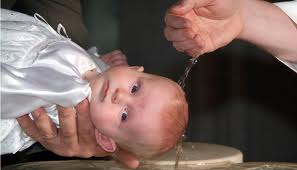 eople are baptized and then don’t live a Christian life afterward!”
“But Paul said that salvation is by faith, and baptism isn’t faith!”
While these issues are ones that should be discussed, and have been answered ad infinitum, none of them actually address what the text states about baptism itself. One’s position on a doctrine should not be based on “if x, therefore y,” reasoning, but instead primarily on those texts which actually address the subject directly. Certainly, implications can then play into debate, but only secondarily. This article is a great example of this problem.
David Schrock (the author of this article), writes the following regarding his contention that baptism is not saving:
More theologically, Paul’s words reveal that baptism is not salvific—i.e., baptism does not grant or guarantee salvation; it announces salvation. If baptism effected salvation (as in the erroneous doctrine of “baptismal regeneration”) he would not be able to say: “I’m glad I baptized only a few.” He can only say this if baptism symbolizes the real thing.
Therefore, we conclude from this verse (and the rest of the New Testament), baptism doesn’t confer or complete salvation; it announces the antecedent, already-present gift of salvation.
Again, this particular passage in Paul cites nothing specific whatsoever regarding what the effect of baptism is. He simply says that he is glad that he himself did not baptize many in Corinth. This then is used by Shrock to prove that baptism does not save. Step back for a moment, however, and examine the text itself. When this is done, Shrock’s argument is not so convincing.
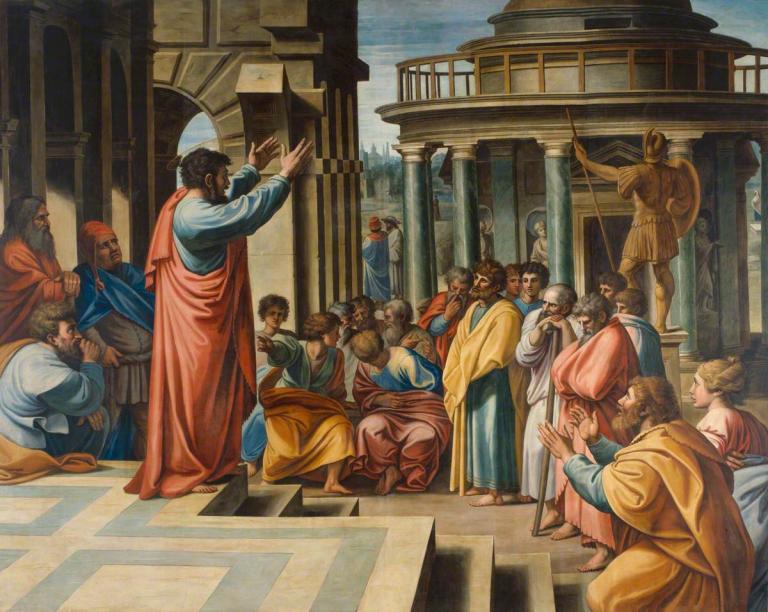
Thornhill, James; Paul Preaching in the Areopagus; Royal Academy of Arts; http://www.artuk.org/artworks/paul-preaching-in-the-areopagus-149263
First, in verse 17, Paul says that he was not sent by Christ to baptize, but instead to preach the gospel. This is taken to mean that because Paul was not the one baptizing, therefore it could not be a saving act. However, that conclusion is simply unwarranted. Christ gave Paul a very particular mission: to preach the gospel. Apparently, there were others who were with Paul that were performing the baptisms. The fact that this was not Paul’s mission does not mean that it wasn’t someone else’s, or that it wasn’t all that important. This is about as reasonable as saying that a congregation has multiple pastors, and one particular pastor (lets call him pastor A) is the one who preaches on most occasions. Therefore, since pastor B wasn’t called to preach on most occasions, the word of God must not really have any saving power. If it did, then he would be the one preaching. The conclusion simply does not follow.
Second, the entire context of Paul’s statement points to a much higher view of baptism than a purely symbolic one. In this chapter, Paul cites extensive divisions within the congregation. These divisions were partially due to the particular individuals who had baptized the congregants in the Corinthian church. The question I pose here is: if baptism were understood as a purely symbolic act, would the person performing that act be so important to the one baptized? Is it not more reasonable to assume that the reason why this division was so strong is precisely because baptism was viewed by the Corinthians as a saving act? This is why Paul is thankful that he was not sent to baptize. Not because baptism does not save, but because it does save, and he feared that because he would be performing such a saving act, people would view him as their savior rather than Christ. Paul distances himself from Christ, by informing them that he was not crucified, and that no one was baptized in his name. The whole point is that these people viewed the one baptizing them as a kind of savior. This is nearly inconceivable if baptism was viewed as symbolic.
Third, and most problematic, is that this argument is made without any reference whatsoever to all of the numerous texts which speak strongly about baptismal efficacy (you can find a discussion of those texts here). Schrock simply states, “baptism doesn’t save,” when St. Peter says, “baptism now saves you” (1 Peter 3:21). This is no mere isolated text, but similar language is found in Acts 2:38, Romans 6:3-4, Acts 22:16, etc. He does not even address such texts here, which state exactly the opposite of Schrock’s contention. The argument simply fails.
The point here is not to go after Davis Schrock who, to be fair, only gave a very short statement on that subject. He may perhaps speak more extensively on the subject elsewhere. However, this short article is exemplary of the kinds of short and dismissive arguments that often happen in these discussions surrounding sacramental efficacy. If one wants to contend that baptism really does not save (and do so convincingly) then they must actually engage the texts which speak about the subject.
Previous Post

March 23, 2018
Should we pray to the saints?
Next Post
April 5, 2018 Five Proofs that Christ's True Body and Blood are Present in the Sacrament
Browse Our Archives
Select a Category American Lutheran Classics Blog Posts Book Review Christian Dogmatics Course Church Resources Curtis Leins Dogmatic Theology Ethics FAQs Historical Theology Just & Sinner Publications Luther Quotations Podcast Sermons The American Lutheran Theological Journal The complete works of Revere Franklin Weidner Theology Proper Uncategorized Videos
Select a Month October 2019 September 2019 July 2019 June 2019 May 2019 April 2019 March 2019 February 2019 January 2019 December 2018 November 2018 October 2018 September 2018 July 2018 June 2018 May 2018 April 2018 March 2018 February 2018 January 2018 December 2017 November 2017 October 2017 September 2017 August 2017 July 2017 June 2017 May 2017 April 2017 March 2017 February 2017 January 2017 December 2016 November 2016 October 2016 September 2016 August 2016 July 2016 June 2016 May 2016 April 2016 March 2016 February 2016 January 2016 December 2015 November 2015 October 2015 September 2015 August 2015 July 2015 June 2015 May 2015 April 2015 March 2015 February 2015 January 2015 December 2014 November 2014 October 2014 September 2014 August 2014 July 2014 June 2014 May 2014
Follow Us!
TAKE THE
Religious Wisdom Quiz
True or False: Isaiah prophesied that a virgin would conceive and bear a son called Jesus.
Select your answer to see how you score.
FALSE TRUE
Related posts from Just and Sinner
Five Scriptural Proofs that Baptism Saves
Five Reasons Why Babies Should be Baptized

Second Response to Rev. Schwertley on Baptismal Regeneration
TRENDING AT PATHEOS Evangelical

The REST of Your Life: A Creative Wrestles...
This week I had a conversation with a good friend from church....

How the author of the world's best hymn...
I've been working with John Newton for a while now. This makes...

Long before this Lectio Divina, Psalm 130 - the song - started...

What About the Trees? Another Living Parable
After I finished writing the last article about falling leaves as a...

Why Classical Education Is a Conversation, Not a...
Come and Read: Joy in Classical Education When I was a little...

Cornell University has received a great deal of negative publicity and intense...
view all Evangelical blogs
Ad-Free & Subscriber Log-In Subscription Support
- About Us
- 2026 Calendar
- Videos
- Podcasts
- Library of World Religions
- Faith In Media Tracker
- Advertise With Us
- Write for Us
- Privacy Policy
- Terms of Service
- Do Not Sell My Data
- Contact Us
- Radiant Digital
- Manage Newsletter Subscriptions
- Unsubscribe From Notifications
- Sitemap
Copyright 2008-2026, Patheos. All rights reserved.
Subscription Support Ad-Free & Subscriber Log-In
Follow Patheos