
BuddhistCatholicContemplativeEvangelicalGeneral ChristianHinduJewishLatter-day SaintMuslimNew VisionsProgressive Christian
Beliefs
- Buddhist
- Catholic
- Contemplative
- Evangelical
- General Christian
- Hindu
- Jewish
- Latter-day Saint
- More Voices
- Muslim
- New Visions
- Pagan
- Progressive Christian
Topics
- Religion News
- Food and Religion
- Sports and Religion
- Religious Art
- Religious Music and Entertainment
- Religious Events
- History and Religion
- Style and Religion
- Politics and Religion
- Women in Religion
- Recreation Outdoors and Religion
- Business Finance and Religion
- Careers Workplace and Religion
- Education and Religion
- Family Parenting and Religion
- Health Fitness and Religion
- Home and Religion
- Relationships and Religion
- Technology and Religion
- Travel and Religion
Columnists
- Buddhist Columnists
- Business Finance and Religion Columnists
- Careers Workplace and Religion Columnists
- Catholic Columnists
- Contemplative Columnists
- Education and Religion Columnists
- Evangelists Columnists
- Family Parenting and Religion Columnists
- General Christian Columnists
- Health Fitness and Religion Columnists
- Hindu Columnists
- History and Religion Columnists
- Home and Religion Columnists
- Jewish Columnists
- More Voices Columnists
- Latter Day Columnists
- Muslim Columnists
- New Visions Columnists
- Nonreligious Columnists
- Pagan Columnists
- Politics and Religion Columnists
- Progressive Columnists
- Recreation Outdoors and Religion Columnists
- Relationships and Religion Columnists
- Religion News Columnists
- Religious Art Columnists
- Religious Events Columnists
- Religious Music and Entertainment Columnists
- Sports and Religion Columnists
- Style and Religion Columnists
- Technology and Religion Columnists
- Travel and Religion Columnists
- Women in Religion Columnists
Resource Library
- 2026 Calendar
- Library of World Religions
- The 100 Most Holy Places on Earth
- Patheos Answers
- Podcasts
- Videos
- Faith Leaders Database
- Anglican Episcopalian
- Bahai
- Baptist
- Buddhism
- Christianity
- Confucianism
- Eastern Orthodoxy
- Hinduism
- Holiness and Pentecostal
- ISKCON
- Islam
- Judaism
- Lutheran
- Methodist
- The Church of Jesus Christ of Latter-day Saints
- New Age
- Paganism
- Presbytarian and Reformed
- Protestantism
- Religion Behind the Scenes
- Roman Catholic
- Scientology
- Shia Islam
- Sikhism
- Sufism
- Sunni Islam
- Taoism
- Zen
- See all religions
Research Tools
 Ad-Free & Subscriber Log-In Subscription Support
Ad-Free & Subscriber Log-In Subscription Support
Follow Patheos 

- Trending:
- Forgiveness
- |
- Marriage
- |
- Consciousness
- |
- Death Penalty
- |
- Election
- |
- Halloween
 Just and Sinner
- Home
- Evangelical
- The Mystery of Good Friday: Why is it Good That Jesus is Punished in Our Place
The Mystery of Good Friday: Why is it Good That Jesus is Punished in Our Place
Last updated on: February 13, 2021 at 1:46 pm by nathanrinne
The Mystery of Good Friday: Why is it Good That Jesus is Punished in Our Place 2021-02-13T13:46:55-06:00 nathanrinne
Patheos Explore the world's faith through different perspectives on religion and spirituality! Patheos has the views of the prevalent religions and spiritualities of the world.
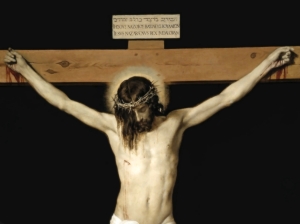
“Vicarious satisfaction”: Upon him was the chastisement that brought us peace…
Hundreds of years before Jesus lived, the prophet Isaiah said, in part (53rd chapter)
…But he was pierced for our transgressions;
he was crushed for our iniquities;
upon him was the chastisement that brought us peace,
and with his wounds we are healed.
6 All we like sheep have gone astray;
we have turned—every one—to his own way;
and the Lord has laid on him
the iniquity of us all.7 He was oppressed, and he was afflicted,
yet he opened not his mouth;
like a lamb that is led to the slaughter,
and like a sheep that before its shearers is silent,
so he opened not his mouth.
And in Romans 3:24-26, the Apostle Paul says this to us:
“Being justified freely by His grace through the redemption that is in Christ Jesus, whom God set forth as a propitiation by His blood, through faith, to demonstrate His righteousness, because in His forbearance God had passed over the sins that were previously committed, to demonstrate at the present time His righteousness, that He might be just and the justifier of the one who has faith in Jesus.”
Scriptures like these are undoubtedly at the heart of the Christian faith.[i]
Commenting on the Romans passage, T.R. Halverson writes:
“…since justice is satisfied by Christ crucified for us, it would be unjust of God not to justify us. He would have to disregard the righteousness of Christ to refuse to justify us. Paul wants us to rest our assurance of salvation, in part, on the knowledge that God certainly would not be unjust. God is just – depend on it – and therefore, given that the righteousness of Christ is given to us, dependably, God justifies us. It was mercy that He gave his Only Begotten Son to die for us, but once the Son did die for us, it is also justice that God forgives us all our sins.”
I think this is an excellent insight and that we cannot escape this conclusion. After all, per Rom. 3:19-21, God’s Law is meant to accuse and condemn us, not just subjectively, but objectively (it is not the law that makes us objectively guilty, but it reveals our sin, which we may or may not have subjective guilt about). The fact of the matter is that nothing impure will finally enter the Kingdom of glory: we sinful men not only need Christ, but the whole of His righteous life—His just life—to stand before God. One is holy! One is worthy! See me, O Lord, in Him alone! This is all that we can claim, and He gladly gives us the right to claim it.[ii]
This is the confidence that we have from the day we call “Good Friday.”
Good Friday, though, provokes a lot of questions. Christians, understandably, want to dig deeply into what it means, and many “atonement theories” have resulted.[iii]
And Good Friday raises even more question among non-Christians as well, and really, who can blame them? More than once in my life, I have been asked “Why is it called ‘Good Friday’?”
After all, even those who do not trust in Jesus as their Savior often find the man to be, externally, an attractive and compelling figure (not all though — the famous atheist Christopher Hitchens, for instance, dug deeply and came to the opposite conclusion about Jesus’ teachings). In fact, many can’t help themselves from liking Him and so they are often perplexed that God would let Him die as He does.
To make this confusion people experience more concrete and to try and put us on a similar page, let us use our imaginations a bit. Think of your ideal Hero and Leader. Am I right to think that your Leader has strength, courage, humility, and kindness that is known to all? And now, let’s say that your ideal Leader is your King, and mine as well! We are fellow citizens in an earthly Kingdom we both love.
But then the following happens: another Good King determines that our Good King must die because of the full accumulation of our very real evils, evils we cannot deny.
Would that not, in any world, be a bad thing? I have to say “yes”. First of all, many would find this to be a scandalous thing for that other “Good King” to do: totally unjust! Second, even if we don’t question the justice of this there is a problem! If we ourselves were in fact spared precisely because of this act, how would this not simply compound our guilt and make us feel more horrible?
Furthermore, connecting this with real life, it is of course reasonable to say that every non-believer who lived in Jesus’ day was not ready to kill Christ or even approve of His death (even if the sin that can’t not rebel against the Promised Messiah lurks in each one of us)! So what is going on with this “Good” Friday thing?
Here is how all of this shakes out for me, as I reflect on what the Bible says about all of the topics involved in this Atoning Sacrifice…
First, let us speak of justice. To be sure, God must be just.
That said, justice is not strictly mathematical, calculating this tit for that tat. And though going hand-in-hand with God’s wrath, it is also not some “pound-of-flesh revenge”, but rather an exacting of accountability.
Justice is also a help to the oppressed godly ones – a balancing of the scales weighed against them! Their vindication! Their protection! Their preservation! Defeat to those who rebel vs their God and His eternal will! To them, God’s righteous anger, born of His Father’s heart for His children, is Gospel. Come quickly Lord Jesus!
Furthermore, the law itself demands not only a justice born of such righteous anger, but mercy (Matthew 23:23) – even for one’s greatest enemies. Both justice and mercy must be done, for the law, being His good will, reflects God Himself, Love Himself (see Matthew 5:45, Acts 14).
Now, let’s go back to this day called Good Friday. This thing called the Atonement.
Why does the cross happen? It is because sin kills Him. Our sin kills Him. We, in our sin, blindly kill the One who loves us more than anyone! We kill our Perfect King and Master! Injustice abounds! Therefore, in this, we actually bring more sin – and punishment – on ourselves. Sin increases. The cup is filled to the brim with sin, as God’s wrath is satisfied in this truly unique way.
What do I mean? In effect, the following occurs: God “gives us over” to our evil (look at Romans 1) to the nth degree. Through us, the King who takes all the evil that we have to offer is executed according to God’s will. Nevertheless, He can rightly accuse us through His apostle “You did this!”[iv]
God gives us rebels over to our sin, allowing us to kill our good King, the new Adam and Head of the human race.
Bad news right? Or is it?
No, for mercy triumphs over judgement. When sin has so increased, grace increases all the more. He is “declared to be the Son of God in power according to the Spirit of holiness by his resurrection from the dead, Jesus Christ our Lord!” To our surprise, He rises again, proving that we, the unjust, have now been justified (Rom 4:25)!
What has just happened?
In short, God, “being compassionate, effected propitiation for guilt, and did not destroy.” (Psalm 78:38).
We now can see the cross as good news! God using evil for good. God in human flesh overcoming our sin, death, and the devil! And we, in fact, were “the joy set before Him” for which reason Christ endured the cross (Hebrews 12:1-2).
In Christ, our sins are truly paid for, but in a truly unique way. Our Servant-King is crushed for our iniquities, killed in our place. God has put our sin and death penalty on Jesus, who willingly and gladly did so to bring us to Him! (I Pet. 3:18) Though he was innocent, He was treated like the guilty (see Psalm 22), becoming sin for us (2 Cor. 5:21)!
Proverbs 21:18 here takes on a new, stunning, meaning: “The wicked become a ransom for the righteous, and the unfaithful for the upright” (see also Isaiah 43:4).
Therefore, we now live by grace through faith in Christ.
We do not despair because as “new creations in Christ” (see 2 Cor 5) we realize that He — the Enduring Love — would not have us actually bear the guilt and punishment due to us for our sins against His law, even for our role in His unjust crucifixion. In fact, amazingly, we are forgiven because of crucifixion: the Lamb of God is, after all, “slain from the foundation of the world.” For He is the Passover Lamb of God—our Scapegoat—who has drunk the cup of wrath – and come out alive!
The Father sees the Perfect One who absorbs all of our sin—again, who desired to do just this!—and says “Your sins have been paid for. It is finished.”
In sum, God is so good and strong and wise that He finds a way to clean our slate even for the crucifixion – by the crucifixion! We are justified (Rom 4:25)! We are healed (Isaiah 53)! Because of Christ’s completed work—cross and resurrection—we can now even say the cross is good news.
That even the cross, the horrible cross, is our forgiveness. Today is a Good Friday.
Amen!
FIN
[i] In Pastor Wil Weedon’s talk here (around 36, but at least start at 34 minutes in) he talks about atonement passages from the earlier church fathers that sync with Reformation-era concerns: John Chrysostom talking about the punishment we deserved, St. Cyril of Jersualem talking about how Jesus “staved the wrath of God”, and Palamas stating how a sacrifice was needed reconcile the Father on high with us… the human race.
[ii] Since the price has been paid and it is now finished, God, in a sense, obligates Himself to treat us not as our sin deserves but as one whose guilt has been atoned for.
[iii] Halverson mentions the many “atonement theories” in his piece: “moral influence or moral exemplar; Christus Victor, conquest, or the dramatic idea; several ransom ideas; several incarnational ideas; a new federal headship; mystical theory; recapitulation theory; satisfaction; penal substitution; and the kaleidoscopic theory.” I admit that I don’t know much about all of these theories of the atonement that he mentions. I simply have not thought about the topic this much.
[iv] So strictly speaking, it is not false to say something like “the raging fire of God’s wrath would burn itself out on the Messiah’s corpse,” but that language may not be the best way of speaking, as it hides what else is going on here.
Previous Post

April 12, 2017
Five Lutheran Books that Every Christian Should Read
Next Post
April 20, 2017 Five Problems with Limited Atonement
Browse Our Archives
Select a Category American Lutheran Classics Blog Posts Book Review Christian Dogmatics Course Church Resources Curtis Leins Dogmatic Theology Ethics FAQs Historical Theology Just & Sinner Publications Luther Quotations Podcast Sermons The American Lutheran Theological Journal The complete works of Revere Franklin Weidner Theology Proper Uncategorized Videos
Select a Month October 2019 September 2019 July 2019 June 2019 May 2019 April 2019 March 2019 February 2019 January 2019 December 2018 November 2018 October 2018 September 2018 July 2018 June 2018 May 2018 April 2018 March 2018 February 2018 January 2018 December 2017 November 2017 October 2017 September 2017 August 2017 July 2017 June 2017 May 2017 April 2017 March 2017 February 2017 January 2017 December 2016 November 2016 October 2016 September 2016 August 2016 July 2016 June 2016 May 2016 April 2016 March 2016 February 2016 January 2016 December 2015 November 2015 October 2015 September 2015 August 2015 July 2015 June 2015 May 2015 April 2015 March 2015 February 2015 January 2015 December 2014 November 2014 October 2014 September 2014 August 2014 July 2014 June 2014 May 2014
Follow Us!
TAKE THE
Religious Wisdom Quiz
Who prophesied about a locust plague and called for national repentance?
Select your answer to see how you score.
Joel Daniel Amos Micah
Related posts from Just and Sinner
Should You Go to a Lutheran Church This...
The Biggest Radical Lutheran Straw Man of Them...

My Problem with Steven Paulson's Theology

A Classic Work on the Atonement Now Made...
TRENDING AT PATHEOS Evangelical

The REST of Your Life: A Creative Wrestles...
This week I had a conversation with a good friend from church....

How the author of the world's best hymn...
I've been working with John Newton for a while now. This makes...

Long before this Lectio Divina, Psalm 130 - the song - started...

What About the Trees? Another Living Parable
After I finished writing the last article about falling leaves as a...

Why Classical Education Is a Conversation, Not a...
Come and Read: Joy in Classical Education When I was a little...

Cornell University has received a great deal of negative publicity and intense...
view all Evangelical blogs
Ad-Free & Subscriber Log-In Subscription Support
- About Us
- 2026 Calendar
- Videos
- Podcasts
- Library of World Religions
- Faith In Media Tracker
- Advertise With Us
- Write for Us
- Privacy Policy
- Terms of Service
- Do Not Sell My Data
- Contact Us
- Radiant Digital
- Manage Newsletter Subscriptions
- Unsubscribe From Notifications
- Sitemap
Copyright 2008-2026, Patheos. All rights reserved.
Subscription Support Ad-Free & Subscriber Log-In
Follow Patheos