
BuddhistCatholicContemplativeEvangelicalGeneral ChristianHinduJewishLatter-day SaintMuslimNew VisionsProgressive Christian
Beliefs
- Buddhist
- Catholic
- Contemplative
- Evangelical
- General Christian
- Hindu
- Jewish
- Latter-day Saint
- More Voices
- Muslim
- New Visions
- Pagan
- Progressive Christian
Topics
- Religion News
- Food and Religion
- Sports and Religion
- Religious Art
- Religious Music and Entertainment
- Religious Events
- History and Religion
- Style and Religion
- Politics and Religion
- Women in Religion
- Recreation Outdoors and Religion
- Business Finance and Religion
- Careers Workplace and Religion
- Education and Religion
- Family Parenting and Religion
- Health Fitness and Religion
- Home and Religion
- Relationships and Religion
- Technology and Religion
- Travel and Religion
Columnists
- Buddhist Columnists
- Business Finance and Religion Columnists
- Careers Workplace and Religion Columnists
- Catholic Columnists
- Contemplative Columnists
- Education and Religion Columnists
- Evangelists Columnists
- Family Parenting and Religion Columnists
- General Christian Columnists
- Health Fitness and Religion Columnists
- Hindu Columnists
- History and Religion Columnists
- Home and Religion Columnists
- Jewish Columnists
- More Voices Columnists
- Latter Day Columnists
- Muslim Columnists
- New Visions Columnists
- Nonreligious Columnists
- Pagan Columnists
- Politics and Religion Columnists
- Progressive Columnists
- Recreation Outdoors and Religion Columnists
- Relationships and Religion Columnists
- Religion News Columnists
- Religious Art Columnists
- Religious Events Columnists
- Religious Music and Entertainment Columnists
- Sports and Religion Columnists
- Style and Religion Columnists
- Technology and Religion Columnists
- Travel and Religion Columnists
- Women in Religion Columnists
Resource Library
- 2026 Calendar
- Library of World Religions
- The 100 Most Holy Places on Earth
- Patheos Answers
- Podcasts
- Videos
- Faith Leaders Database
- Anglican Episcopalian
- Bahai
- Baptist
- Buddhism
- Christianity
- Confucianism
- Eastern Orthodoxy
- Hinduism
- Holiness and Pentecostal
- ISKCON
- Islam
- Judaism
- Lutheran
- Methodist
- The Church of Jesus Christ of Latter-day Saints
- New Age
- Paganism
- Presbytarian and Reformed
- Protestantism
- Religion Behind the Scenes
- Roman Catholic
- Scientology
- Shia Islam
- Sikhism
- Sufism
- Sunni Islam
- Taoism
- Zen
- See all religions
Research Tools
 Ad-Free & Subscriber Log-In Subscription Support
Ad-Free & Subscriber Log-In Subscription Support
Follow Patheos 

- Trending:
- Forgiveness
- |
- Marriage
- |
- Consciousness
- |
- Death Penalty
- |
- Election
- |
- Halloween
 Just and Sinner
- Home
- Evangelical
- Is Martin Luther’s Sola Scriptura Our Sola Scriptura?
Is Martin Luther’s Sola Scriptura Our Sola Scriptura?
Last updated on: May 24, 2016 at 3:28 am by nathanrinne
Is Martin Luther’s Sola Scriptura Our Sola Scriptura? 2016-05-24T03:28:02-06:00 nathanrinne
Patheos Explore the world's faith through different perspectives on religion and spirituality! Patheos has the views of the prevalent religions and spiritualities of the world.

The seal of the author’s church body, Note the three solas.
Adam Hamilton is the senior pastor of the United Methodist Church of the Resurrection in Leawood, Kansas, “one of the fastest growing, most highly visible churches in the country” (see here). He is the author of several popular books, and in his book When Christians Get it Wrong, he writes that the Bible is a document that is both divine and human, which for him means that the authors “were people who had a deep faith in God” who “heard and understood God in light of their culture and times.” He goes on to write that “..the Bible is the timeless, inspired word of God found within the writings and reflections of very human authors.” (italics mine, quote from here)
From a more scholarly perspective, Stephen Fowl, in his book “Engaging Scripture”, writes the following
“…theological convictions, ecclesial practices, and communal and social concerns should shape and be shaped by biblical interpretation” and “Biblical interpretation will be the occasion of a complex interaction between the biblical text and the varieties of theological, moral, material, political, and ecclesial concerns that are part of the contexts in which they find themselves.” (p. 60).
How do these views of the Bible compare with those of the 16th century church Reformer Martin Luther? Not long ago I had noted that at a recent theology conference in Bloomington, Minnesota, my pastor, Paul Strawn, had given “a rip-roaring scholarly paper” titled “Martin Luther’s Sola Scriptura”. The paper has not been published yet, but I have been given permission to publish some excerpts from the paper, which are found below.
In the paper’s introduction, Strawn writes about the recent history of the phrase “sola Scriptura” in his church body, the Lutheran Church – Missouri Synod:
“The Latin expression sola Scriptura (by Scripture alone) used to be regularly included in the slogan that summarized the Reformation of the western church in the 16th century via Martin Luther (1483-1546): sola scriptura, sola gratia, sola fide. At the last centenary of the Reformation in 1917 it was accepted as an accurate summation of the causes of that event.[1] It was incorporated into the newly designed seal of the Lutheran Church-Missouri Synod in 1948 and popularized by the Oscar-nominated film Martin Luther in 1953—a film on which both Theodore G. Tappert (1904-1973) and Jaroslav Pelikan (1923-2006) served as consultants. A more recent (apparently) derivation of the slogan replaces sola Scriptura with solus Christus, that is, instead of Luther’s championing of the Bible being a leading cause of the Reformation, it was his confession of Christ…..
He goes on to provocatively state:
So perhaps can be understood the liturgical innovation of late of removing the place where the lectionary—a book containing the readings from the Bible used in worship—has traditionally been placed and from which it was read: the lectern… The Bible no longer has an authority in its own right deserving its own liturgical appointment (lectern) as does baptism (font) the Lord’s Supper (altar) and preaching (pulpit). Instead, its authority is derived from its proclamation (from the pulpit) by the church (the pastor).

Again Martin Luther believed “the Holy Spirit is no skeptic” and that the text was not just established, but actually existed: “Holy Scripture is God’s Word, written and formed in letters, just as Christ is the eternal Word of God enveloped in the human nature.”
The paper’s first section is titled “Scriptura Plastica”. Some of the highlights from this section:
- The idea of establishing an original text of the New Testament (i.e. an “autograph”) was abandoned already in 1979, by critical scholar Kurt Aland, in the 26th edition of the Nestle-Aland Novum Testamentum Graece (the critical edition of the Greek New Testament). A new process, called the “local-genealogical method”, or “eclecticism” was adopted instead.
- The contemporary “coherence-based genealogical method” is the newest method whereby scholars endeavor not to discover the original text of the New Testament, but rather the first “witness” in the New Testament tradition.
- According to Strawn, we now have “witness criticism”: “The use of this term ‘witness’ is not insignificant, for it was an important term in the theology of the preeminent Protestant (Reformed) theologian of the 20th century, Karl Barth (1886-1968), allowing him to assert that in Scripture, you don’t necessarily have the Word of God itself, but the fallible ‘witness’ of man to God’s Word.”
- “…the methodology of NA28 [i.e. the 28th edition of the Nestle-Aland text noted above] has further implications, specifically that of the authority of Scripture, or in essence, the meaning of sola Scriptura”, and this has prompted some to suggest that traditional approaches towards biblical hermeneutics (that is the art and science of biblical interpretation) need to be reconsidered.
The final point made in this section:
- “Why did [Martin] Luther take a number of manuscripts, reduce them to a single text, insist that that text was the inerrant Word of God, and also that its simple meaning be pursued? Was is that Luther was simply ignorant? Or could it be that he had a difference understanding of sola Scriptura than what we have today?”
The next section of the paper is titled “Luther and Scripture”. Within this section, the following points are made:
- Martin Luther lived during a time when the Bible was seen to exist as a fixed text (i.e. Jerome’s Latin Vulgate), and he personally had extensive exposure to the Bible in this form while growing up.
- “The sheer volume of Luther’s interaction with the Bible simply overwhelms. He read the Bible cover to cover twice a year.. Luther prepared a timeline of the history of the world, based on the text of Scripture… he translated the entire Bible from Hebrew and Greek into German (1534).” Throughout his life he held classes on many of the particular books of the Bible.
- It is interesting to note that Luther received his first degree in Aristotelian philosophy and even taught the same. That said, in the long run, he “bypassed Aristotle (philosophy), Plato (mysticism), Lombard (medieval theology) and the patristics (Dogmengeschichte) and spent his life studying, teaching, preaching and translating the Bible.”
- According to Luther, “The reason Scripture has never erred, is ‘clearer, simpler, and more reliable,’ and ‘alone is the true lord and master of all writings and doctrine on earth.’ The Bible is the ‘book of the Holy Spirit’ Luther asserted in comments on Psalm 40:8-9.[2] The Scriptures ‘did not grow on earth’[3] but ‘have been spoken by the Holy Spirit.’”[4]
- “Thus Scripture, for Luther, seems ultimately to be a matter of the work of the Holy Spirit, especially in view of the end times, who is to convict the world of ‘Sin, righteousness and judgment’” (John 16:8).[5]

“All Holy Scripture was divinely inspired and perfected by God, its author…divine Scripture…contains nothing idle…Believe none of those things which you see with your own eyes and handle with your own hands to be as true as what you read there. It is certain from the divine words that heaven and earth will pass away…Although men lie and err, the truth of God neither deceives nor is deceived.” — Erasmus, Luther’s skeptical opponent!
The final section of the paper is titled “Luther and the Texts of Scripture”. There, we read:
- “Even though Luther grew up hearing and studying the text of Jerome’s Vulgate, he was not unaware of its textual tradition. Jerome’s edition was not a straight translation… already in 1504, when Luther was 21, the first edition of the Vulgate with variant readings had been printed.”
- In Erasmus’ “Textus Receptus”, “he also compared the Byzantine texts [Greek texts of the New Testament] to the references to Scripture found in the writings of the church fathers[i]—something not done with the critical text until the middle of the 20th century!”
- “Erasmus apparently had access to the Greek manuscripts of the Eastern fathers he mentioned. This is not insignificant, for it means that he had access to some of the earliest manuscripts of Scripture known today.” (see a summary of another important paper by my pastor here: “An Overview of the Influence of the Publication of Patristic Literature Upon the Reformation”)
- Why did Luther undertake the translation of Scriptures into German at all? “Eighteen editions of the Bible in German—fourteen in High German and four in Low—were published before Luther’s… the reason was clarity of meaning: a Bible which people could read and understand.”
- For Luther, “the literal or historical meaning of the text was its Christological meaning, since the center of Scripture was Christ…” As he said: “In the Scriptures, therefore, no allegory, tropology, or analogy is valid, unless the same truth is expressly stated historically elsewhere. Otherwise Scripture would become a mockery.”
- “How did all of these resources which clearly revealed a complex history of the textual transmission of Scripture affect Luther? It really seems not to have been an issue at all. A text, a clear text is assumed, and consequently, bad renderings, bad translations, can be spotted and corrected.”
- “Modern scholarship…most assiduously endeavors to create unique contexts for each author, language and time period. Luther had no such proclivity, believing apparently Scripture to be a coherent whole, in spite of its many writers, languages, historical contexts and transmission issues.”
The views of Hamilton and Fowl, noted at the beginning of this article, are both related to the teachings of Karl Barth, i.e. his “Neo-Orthodoxy”. Approaches like theses are decidedly different from those of Luther. In the paper’s conclusion (you can read the entire conclusion, as well as other quotes from the paper in this article, which examines these issues in a larger context), we read the following: “The Bible as we have it is a work of the Holy Spirit even in these end times. Therefore, in spite of the questions raised by modern textual criticism, it remains without error, readable and understandable.”
Some in the church today would see this as opposed to solus Christus. This would have made absolutely no sense to Martin Luther. As noted earlier in the paper, the Church has always viewed the Scriptures as “a third-article topic, as that of the work of the Holy Spirit in history” and not “so much as of that of the second article, the person of Christ, in the present.”
FIN
Note: if you would like to talk to my pastor about his paper, he can be reached at [email protected]
Notes:
[1] Theo. Engelder, “The Three Principles of the Reformation: Sola Scriptura, Sola Gratia, Sola Fides,” in Four Hundred Years. Commemorative Essays on the Reformation of Dr. Martin Luther and Its Blessed Results. In the Year of the Four-Hundredth Anniversary of the Reformation. By Various Lutheran Writers, Ed. by W.H.T. Dau (St. Louis: Concordia, 1916), p. 97-109.
[2] Walch 2nd ed., IX, col. 1775.
[3] Sermon on John 3:34 (ca. 1538-1540), Walch 2nd ed., VII, col. 2095.
[4] From the Last Words of David (2 Sam. 23: 1-7), Walch 2nd ed., III, col. 1895.
[5] Cf. Martin Luther, Convicted by the Spirit, trans. by Holger Sonntag (Minneapolis: Lutheran Press, 2009).
[i] “Complete New Instrument diligently reviewed and improved by Erasmus of Rotterdam in relation to not only the Greek truth but also the trustworthiness of many codices – old and improved – of both languages [Greek and Latin]; then also in relation to the quotations, improvements, and interpretations by the best authors, chiefly Origen, Chrysostom, Cyril, Vulgarius [d. 928], Jerome, Cyprian, Ambrose, Hilary [of Poitiers d. 367] , Augustine – together with annotations that may instruct the reader concerning what has been changed for which reason. Therefore, whoever you are and love true theology, read, understand, and then judge. And do not be offended right away, should you indeed find fault with what was changed, but consider whether it was changed for the better.” (NOVVM IN strumentū omne, diligenter ab ERASMO ROTERODAMO recognitum & emendatum, nō solum ad graecam veritatem, verumetiam ad multorum utrius [que] linguae codicum, eorum[que] veterum simul & emendatorum fidem, postremo ad probatissimorum autorum citationem, emendationem & interpretationem praecipue, Origenis, Chrysostomi, Cyrilli, Vulgarii, Hieronymi, Cypriani, Ambrosii, Hilarii, Augustini, una cū Annotationibus, quae lectorem doceant, quid qua ratione mutatum sit. Quisquis igitur amas veram Theologiam, lege, cognosce, ac deinde iudica. Ne[que] statim offendere, si quid mutatum offenderis, sed expende, num in melius mutatum sit) (Basil: Froben, 1516).
Previous Post
May 19, 2016
This Week's Podcast on Baptized into Christ
Next Post

May 27, 2016 The Gospel Reading (A Guide to the Liturgy)
Browse Our Archives
Select a Category American Lutheran Classics Blog Posts Book Review Christian Dogmatics Course Church Resources Curtis Leins Dogmatic Theology Ethics FAQs Historical Theology Just & Sinner Publications Luther Quotations Podcast Sermons The American Lutheran Theological Journal The complete works of Revere Franklin Weidner Theology Proper Uncategorized Videos
Select a Month October 2019 September 2019 July 2019 June 2019 May 2019 April 2019 March 2019 February 2019 January 2019 December 2018 November 2018 October 2018 September 2018 July 2018 June 2018 May 2018 April 2018 March 2018 February 2018 January 2018 December 2017 November 2017 October 2017 September 2017 August 2017 July 2017 June 2017 May 2017 April 2017 March 2017 February 2017 January 2017 December 2016 November 2016 October 2016 September 2016 August 2016 July 2016 June 2016 May 2016 April 2016 March 2016 February 2016 January 2016 December 2015 November 2015 October 2015 September 2015 August 2015 July 2015 June 2015 May 2015 April 2015 March 2015 February 2015 January 2015 December 2014 November 2014 October 2014 September 2014 August 2014 July 2014 June 2014 May 2014
Follow Us!
TAKE THE
Religious Wisdom Quiz
Who was the high priest during the boyhood of Samuel?
Select your answer to see how you score.
Eli Phinehas Ahijah Hophni
Related posts from Just and Sinner
And Now... A Message for Today's LC-MS Mainstream...
Does God Expect Rulers Today to "Kiss the...
Male Headship as Domestic Abuse: a Crypto-Feminist Plot...
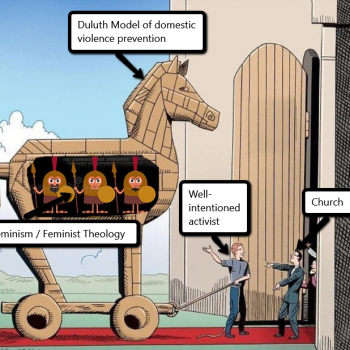
The Duluth Model as Trojan Horse of Feminist...
TRENDING AT PATHEOS Evangelical

The REST of Your Life: A Creative Wrestles...
This week I had a conversation with a good friend from church....

How the author of the world's best hymn...
I've been working with John Newton for a while now. This makes...

Long before this Lectio Divina, Psalm 130 - the song - started...

What About the Trees? Another Living Parable
After I finished writing the last article about falling leaves as a...

Why Classical Education Is a Conversation, Not a...
Come and Read: Joy in Classical Education When I was a little...

Cornell University has received a great deal of negative publicity and intense...
view all Evangelical blogs
Ad-Free & Subscriber Log-In Subscription Support
- About Us
- 2026 Calendar
- Videos
- Podcasts
- Library of World Religions
- Faith In Media Tracker
- Advertise With Us
- Write for Us
- Privacy Policy
- Terms of Service
- Do Not Sell My Data
- Contact Us
- Radiant Digital
- Manage Newsletter Subscriptions
- Unsubscribe From Notifications
- Sitemap
Copyright 2008-2026, Patheos. All rights reserved.
Subscription Support Ad-Free & Subscriber Log-In
Follow Patheos