
BuddhistCatholicContemplativeEvangelicalGeneral ChristianHinduJewishLatter-day SaintMuslimNew VisionsProgressive Christian
Beliefs
- Buddhist
- Catholic
- Contemplative
- Evangelical
- General Christian
- Hindu
- Jewish
- Latter-day Saint
- More Voices
- Muslim
- New Visions
- Pagan
- Progressive Christian
Topics
- Religion News
- Food and Religion
- Sports and Religion
- Religious Art
- Religious Music and Entertainment
- Religious Events
- History and Religion
- Style and Religion
- Politics and Religion
- Women in Religion
- Recreation Outdoors and Religion
- Business Finance and Religion
- Careers Workplace and Religion
- Education and Religion
- Family Parenting and Religion
- Health Fitness and Religion
- Home and Religion
- Relationships and Religion
- Technology and Religion
- Travel and Religion
Columnists
- Buddhist Columnists
- Business Finance and Religion Columnists
- Careers Workplace and Religion Columnists
- Catholic Columnists
- Contemplative Columnists
- Education and Religion Columnists
- Evangelists Columnists
- Family Parenting and Religion Columnists
- General Christian Columnists
- Health Fitness and Religion Columnists
- Hindu Columnists
- History and Religion Columnists
- Home and Religion Columnists
- Jewish Columnists
- More Voices Columnists
- Latter Day Columnists
- Muslim Columnists
- New Visions Columnists
- Nonreligious Columnists
- Pagan Columnists
- Politics and Religion Columnists
- Progressive Columnists
- Recreation Outdoors and Religion Columnists
- Relationships and Religion Columnists
- Religion News Columnists
- Religious Art Columnists
- Religious Events Columnists
- Religious Music and Entertainment Columnists
- Sports and Religion Columnists
- Style and Religion Columnists
- Technology and Religion Columnists
- Travel and Religion Columnists
- Women in Religion Columnists
Resource Library
- 2026 Calendar
- Library of World Religions
- The 100 Most Holy Places on Earth
- Patheos Answers
- Podcasts
- Videos
- Faith Leaders Database
- Anglican Episcopalian
- Bahai
- Baptist
- Buddhism
- Christianity
- Confucianism
- Eastern Orthodoxy
- Hinduism
- Holiness and Pentecostal
- ISKCON
- Islam
- Judaism
- Lutheran
- Methodist
- The Church of Jesus Christ of Latter-day Saints
- New Age
- Paganism
- Presbytarian and Reformed
- Protestantism
- Religion Behind the Scenes
- Roman Catholic
- Scientology
- Shia Islam
- Sikhism
- Sufism
- Sunni Islam
- Taoism
- Zen
- See all religions
Research Tools
 Ad-Free & Subscriber Log-In Subscription Support
Ad-Free & Subscriber Log-In Subscription Support
Follow Patheos 

- Trending:
- Forgiveness
- |
- Marriage
- |
- Consciousness
- |
- Death Penalty
- |
- Election
- |
- Halloween
 Just and Sinner
- Home
- Evangelical
- Infant Faith
Infant Faith
Last updated on: June 3, 2014 at 1:21 am by Jordan Cooper
Infant Faith 2014-06-03T01:21:55-06:00 Jordan Cooper
Patheos Explore the world's faith through different perspectives on religion and spirituality! Patheos has the views of the prevalent religions and spiritualities of the world.
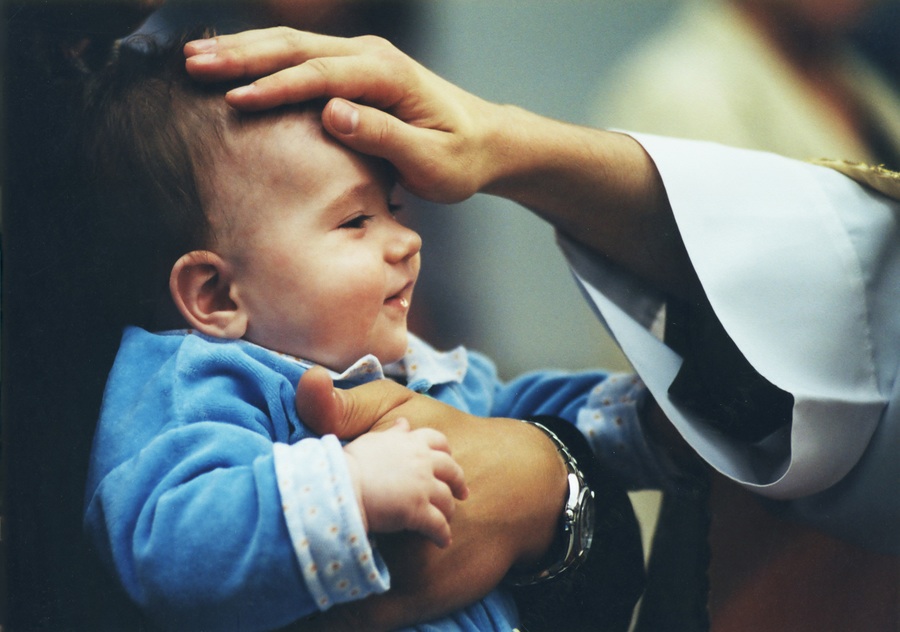
One of the most contested aspects of Lutheran theology when talking to people tends to be the concept that infants have faith. Luther vigorously upheld the ancient practice of infant baptism against the anabaptist movement, and also sought to uphold baptismal efficacy. An objection which he often encountered was that since salvation is by faith alone, how can baptism save an infant, who does not yet have faith? Rather than answering the question in the way that Augustine does, wherein a parent’s faith or the church’s faith is imputed to the child, Luther argued that infants do indeed have faith.
In opposition to what human reason might suppose, infants can have faith. The Biblical testimony on this is clear. Look for example at Psalm 22.
“Yet you are he who took me from the womb;
you made me trust you at my mother’s breasts.
On you was I cast from my birth,
and from my mother’s womb you have been my God.” (Psalm 22:9-10)
In this Psalm, David discusses his faith, and in doing so references the fact that he had faith at a time when he was still nursing. How is this possible? The answer is just as clear, “you made me trust you.” In Reformation theology (and all Augustinian theology for that matter)faith is a gift of God. It is not a human achievement, not something that one chooses out of a free will. If this were so, then infant faith would be impossible. But according to a monergistic scheme, faith is a divine gift, a divine work through the operation of the Holy Spirit. This being the case, why is it not possible that God could do such a work for an infant? To argue otherwise seems to imply that there is something necessary in a person for faith to be a possibility. This is in opposition to Reformation theology.
Peter Leithart makes the argument that infant faith is proven by the fact that we talk to infants. If we spend time talking to infants, and interacting with them, we do so because we know that they have an awareness of others. However limited that awareness might be, it is apparent. Are we, as Christians, willing to say that this is the case with other human beings but not God? Is not the reality of God even more apparent and real than that of creation? An infant has to constantly look outside of themselves to receive help; they look to others to get food, to move to where they need to be,and for every type of sustenance in life. Is this not precisely what faith is? Looking to one outside of ourselves as helpless creatures?
Just to make this more clear, look at a couple more passages. First, look at the example of John the baptist. Luke writes, “And when Elizabeth heard the greeting of Mary, the baby leaped in her womb. And Elizabeth was filled with the Holy Spirit” (Luke 1:41) John clearly had faith even before birth. It might be objected that this is not a valid example because of John’s unique place in redemptive history. This may be the case, but what it does demonstrate is that infant faith is a possibility, not an absurdity.
Look at Matthew 18:1-6
“At that time the disciples came to Jesus, saying, “Who is the greatest in the kingdom of heaven?” And calling to him a child, he put him in the midst of them and said, “Truly, I say to you, unless you turn and become like children, you will never enter the kingdom of heaven. Whoever humbles himself like this child is the greatest in the kingdom of heaven.
“Whoever receives one such child in my name receives me, but whoever causes one of these little ones who believe in me to sin, it would be better for him to have a great millstone fastened around his neck and to be drowned in the depth of the sea.”
This text demonstrates that children can and do believe at a young age. The greek term used here “παιδία” usually has reference to an infant or young child.
There is a parallel text in Luke,
“Now they were bringing even infants to him that he might touch them. And when the disciples saw it, they rebuked them. But Jesus called them to him, saying, “Let the children come to me, and do not hinder them, for to such belongs the kingdom of God. Truly, I say to you, whoever does not receive the kingdom of God like a child shall not enter it.” (Luke 18:15-17)
This text is significant because it uses the term “βρέφη” which refers to infants rather to children in general. Jesus plainly admits in this text that infants can obtain the kingdom of God. How does one obtain the kingdom of God? Through faith.
Some might argue that this is an invalid argument because the point Jesus is making is not about infant faith and salvation, but about humility. He is using a child merely as an illustration. Even if this is the case, this does not negate the fact that the illustration is real. Even is he is primarily making the point that becoming like a child is necessary to enter the kingdom, this is only the case because children indeed do have faith. He says that “to such belongs the kingdom of God.” This includes both infants and those who approach God with childlike faith.
This story is apparently so important that it is included in all three synoptic accounts. Mark writes similarly,
“And they were bringing children to him that he might touch them, and the disciples rebuked them. But when Jesus saw it, he was indignant and said to them, “Let the children come to me;do not hinder them, for to such belongs the kingdom of God. Truly, I say to you, whoever does not receive the kingdom of God like a child shall not enter it.” And he took them in his arms and blessed them, laying his hands on them.” (Mark 10:13-16)
Thus it is apparent that infants can have faith. There are numerous examples of this such as in the case of John the Baptist and David. This is clear due to the nature of faith as a gift. If faith as a divine act of the Spirit, surely it can be applied to infants. Finally, this is demonstrated by the fact that Jesus says that infants and small children can have faith and enter the kingdom of God.
Previous Post

June 3, 2014
Properly Understanding the Two Kingdoms
Next Post
June 3, 2014 Problems with Covenant Theology
Browse Our Archives
Select a Category American Lutheran Classics Blog Posts Book Review Christian Dogmatics Course Church Resources Curtis Leins Dogmatic Theology Ethics FAQs Historical Theology Just & Sinner Publications Luther Quotations Podcast Sermons The American Lutheran Theological Journal The complete works of Revere Franklin Weidner Theology Proper Uncategorized Videos
Select a Month October 2019 September 2019 July 2019 June 2019 May 2019 April 2019 March 2019 February 2019 January 2019 December 2018 November 2018 October 2018 September 2018 July 2018 June 2018 May 2018 April 2018 March 2018 February 2018 January 2018 December 2017 November 2017 October 2017 September 2017 August 2017 July 2017 June 2017 May 2017 April 2017 March 2017 February 2017 January 2017 December 2016 November 2016 October 2016 September 2016 August 2016 July 2016 June 2016 May 2016 April 2016 March 2016 February 2016 January 2016 December 2015 November 2015 October 2015 September 2015 August 2015 July 2015 June 2015 May 2015 April 2015 March 2015 February 2015 January 2015 December 2014 November 2014 October 2014 September 2014 August 2014 July 2014 June 2014 May 2014
Follow Us!
TAKE THE
Religious Wisdom Quiz
What caused the sailors to throw Jonah overboard?
Select your answer to see how you score.
A mutiny A violent storm A prophecy A vision
Related posts from Just and Sinner
An Explanation and Defense of Holy Absolution

Questions and Answers June 2017
TRENDING AT PATHEOS Evangelical

The REST of Your Life: A Creative Wrestles...
This week I had a conversation with a good friend from church....

How the author of the world's best hymn...
I've been working with John Newton for a while now. This makes...

Long before this Lectio Divina, Psalm 130 - the song - started...

What About the Trees? Another Living Parable
After I finished writing the last article about falling leaves as a...

Why Classical Education Is a Conversation, Not a...
Come and Read: Joy in Classical Education When I was a little...

Cornell University has received a great deal of negative publicity and intense...
view all Evangelical blogs
Ad-Free & Subscriber Log-In Subscription Support
- About Us
- 2026 Calendar
- Videos
- Podcasts
- Library of World Religions
- Faith In Media Tracker
- Advertise With Us
- Write for Us
- Privacy Policy
- Terms of Service
- Do Not Sell My Data
- Contact Us
- Radiant Digital
- Manage Newsletter Subscriptions
- Unsubscribe From Notifications
- Sitemap
Copyright 2008-2026, Patheos. All rights reserved.
Subscription Support Ad-Free & Subscriber Log-In
Follow Patheos