
BuddhistCatholicContemplativeEvangelicalGeneral ChristianHinduJewishLatter-day SaintMuslimNew VisionsProgressive Christian
Beliefs
- Buddhist
- Catholic
- Contemplative
- Evangelical
- General Christian
- Hindu
- Jewish
- Latter-day Saint
- More Voices
- Muslim
- New Visions
- Pagan
- Progressive Christian
Topics
- Religion News
- Food and Religion
- Sports and Religion
- Religious Art
- Religious Music and Entertainment
- Religious Events
- History and Religion
- Style and Religion
- Politics and Religion
- Women in Religion
- Recreation Outdoors and Religion
- Business Finance and Religion
- Careers Workplace and Religion
- Education and Religion
- Family Parenting and Religion
- Health Fitness and Religion
- Home and Religion
- Relationships and Religion
- Technology and Religion
- Travel and Religion
Columnists
- Buddhist Columnists
- Business Finance and Religion Columnists
- Careers Workplace and Religion Columnists
- Catholic Columnists
- Contemplative Columnists
- Education and Religion Columnists
- Evangelists Columnists
- Family Parenting and Religion Columnists
- General Christian Columnists
- Health Fitness and Religion Columnists
- Hindu Columnists
- History and Religion Columnists
- Home and Religion Columnists
- Jewish Columnists
- More Voices Columnists
- Latter Day Columnists
- Muslim Columnists
- New Visions Columnists
- Nonreligious Columnists
- Pagan Columnists
- Politics and Religion Columnists
- Progressive Columnists
- Recreation Outdoors and Religion Columnists
- Relationships and Religion Columnists
- Religion News Columnists
- Religious Art Columnists
- Religious Events Columnists
- Religious Music and Entertainment Columnists
- Sports and Religion Columnists
- Style and Religion Columnists
- Technology and Religion Columnists
- Travel and Religion Columnists
- Women in Religion Columnists
Resource Library
- 2026 Calendar
- Library of World Religions
- The 100 Most Holy Places on Earth
- Patheos Answers
- Podcasts
- Videos
- Faith Leaders Database
- Anglican Episcopalian
- Bahai
- Baptist
- Buddhism
- Christianity
- Confucianism
- Eastern Orthodoxy
- Hinduism
- Holiness and Pentecostal
- ISKCON
- Islam
- Judaism
- Lutheran
- Methodist
- The Church of Jesus Christ of Latter-day Saints
- New Age
- Paganism
- Presbytarian and Reformed
- Protestantism
- Religion Behind the Scenes
- Roman Catholic
- Scientology
- Shia Islam
- Sikhism
- Sufism
- Sunni Islam
- Taoism
- Zen
- See all religions
Research Tools
 Ad-Free & Subscriber Log-In Subscription Support
Ad-Free & Subscriber Log-In Subscription Support
Follow Patheos 

- Trending:
- Forgiveness
- |
- Marriage
- |
- Consciousness
- |
- Death Penalty
- |
- Election
- |
- Halloween
 Just and Sinner
- Home
- Evangelical
- “How Shall We Sing…? With Joy!” by Rev. Delwyn Campbell
“How Shall We Sing…? With Joy!” by Rev. Delwyn Campbell
Last updated on: March 21, 2019 at 10:40 am by nathanrinne
“How Shall We Sing…? With Joy!” by Rev. Delwyn Campbell 2019-03-21T10:40:56-06:00 nathanrinne
Patheos Explore the world's faith through different perspectives on religion and spirituality! Patheos has the views of the prevalent religions and spiritualities of the world.

Pastor Delwyn Campbell
For my post this week, I want to give the floor to the Reverend Delwyn Campbell. His excellent article informs us of current Lutheran Church–Missouri Synod mission efforts in inner city communities. Enjoy!
For those interested in more of the kind of history Pastor Campbell mentions below, see pages 17-21 in this LC-MS document (the document will download upon clicking that link), and also check pages 41-61 in the book United by Faith (2004).
+++
The LCMS project, “Mission Field: USA,” led by Rev. Dr. Steve Schave, has an ambitious goal. Going into inner city communities that have either a declining Lutheran population or no Lutheran presence at all, to preach the pure Gospel and establish Confessional communities in such places as Ferguson Missouri under Rev. Micah Glenn, Albuquerque, NM with Rev. Adam DeGroot, and Gary, IN, where I serve. Each of these communities has in common a lack of a Germanic Lutheran population, and a population of groups that are not stereotypically Lutheran.
For many Lutherans, the idea of developing a Lutheran community in places where there seems to be little cultural connection seems like a fantasy, a foolhardy notion, or perhaps something akin to romantically going to Africa or South America. We go there, implant our (German) Lutheran culture and worship, subliminally in that order, and make that community become Lutheran. To a certain extent, that works because the missionary understands his/her native culture much better than the culture of the mission community. It also requires that both the missionary and the people he serves accepts the cultural superiority of the missionary’s exegesis of the Christian faith.
One issue that clearly sets Confessional Evangelical Christians apart from the general Christian culture in many urban communities is the issue of “Enthusiasm.” I’m not talking about the feeling of joy that one has when the Cubs win ball games in September and have a clean shot at the post season, or the Bears get quarterback that can throw passes that actually reach receivers instead of linebackers and defensive backs. I’m talking about what the Epitome of the Formula of Concord describes in Article II, paragraph 13:
The Book of Concord Article II: Concerning the Free Will
[13] 6. Likewise, we also reject and condemn the error of the Enthusiasts, who contrive the idea that God draws people to himself, enlightens them, makes them righteous, and saves them without means, without the hearing of God’s Word, even without the use of the holy sacraments.
The glossary of the newest edition of the Book of Concord, Concordia: the Lutheran Confessions, defines the term this way:
Enthusiasm. Enthusiasts. Belief that Christians should expect special revelations or experiences from the Holy Spirit. Enthusiasts expect God to draw, enlighten, justify, and save them without the means of grace (Word and Sacraments)[1].
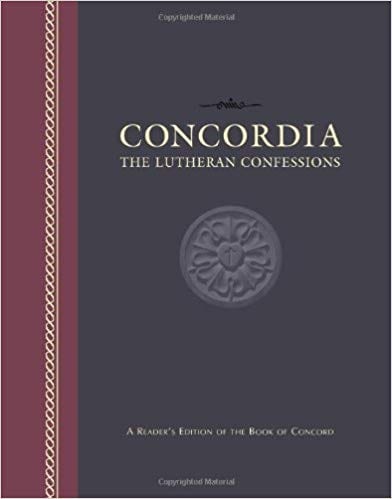
The 1580 Book of Concord.
Although that perhaps sounds weird or spooky to your typical cradle Lutheran, for those who have come to hear about Jesus Christ at a “revival,” watching The Word Network or Trinity Broadcast Network, or going to church with their grandmother, that is part and parcel of Sunday church or Wednesday night Bible Study or Friday Night Evangelism service. That is the essence of the song, “The Presence of the Lord is Here.”
The presence of the Lord is here,
The presence of the Lord is here.
I feel it in the atmosphere,
The presence of the Lord is here,
The presence of the Lord is here[2].
For those who came out of the American Slavery experience, God was not found in the text of Scripture, because from colonial days, many of the local governments made it illegal to teach them to read:
Excerpt from South Carolina Act of 1740
Whereas, the having slaves taught to write, or suffering them to be employed in writing, may be attended with great inconveniences; Be it enacted, that all and every person and persons whatsoever, who shall hereafter teach or cause any slave or slaves to be taught to write, or shall use or employ any slave as a scribe, in any manner of writing whatsoever, hereafter taught to write, every such person or persons shall, for every such offense, forfeit the sum of one hundred pounds, current money.
Excerpt from Virginia Revised Code of 1819
That all meetings or assemblages of slaves, or free negroes or mulattoes mixing and associating with such slaves at any meeting-house or houses, &c., in the night; or at any SCHOOL OR SCHOOLS for teaching them READING OR WRITING, either in the day or night, under whatsoever pretext, shall be deemed and considered an UNLAWFUL ASSEMBLY; and any justice of a county, &c., wherein such assemblage shall be, either from his own knowledge or the information of others, of such unlawful assemblage, &c., may issue his warrant, directed to any sworn officer or officers, authorizing him or them to enter the house or houses where such unlawful assemblages, &c., may be, for the purpose of apprehending or dispersing such slaves, and to inflict corporal punishment on the offender or offenders, at the discretion of any justice of the peace, not exceeding twenty lashes.
(https://www.thirteen.org/wnet/slavery/experience/education/docs1.html).

“I will sing unto the Lord for He has triumphed gloriously, the horse and rider thrown into the sea…”
Instead, God became known to the slaves and to their descendants by His emotional impact upon those who heard the stories of God’s intervention in the lives of another group of slaves, the Israelites who escaped from Egypt. In the story of the Exodus, the American slaves heard the prophecy of their own liberation from chattel tyranny and its heir, Jim Crow institutional racist subordination and economic subjugation. While the primary form of subjugation ended at Appomattox Courthouse, VA in 1865 with the defeat of the Confederacy, it didn’t die, but simply morphed into other, less self-evident forms for the next 100 years.
There was, however, an interesting segment of Lutheran history that provided an alternative to this stereotype, the story of Rosa Young. An Alabama schoolteacher, Young desired to erect schools for those who had been recently freed from slavery but were still shackled by their lack of education. After planting a school, finding herself lacking resources, she contacted educator and founder of the Tuskegee Institute, Booker T. Washington, asking for his assistance. “Washington replied that he was unable to help, but advised her to contact the Board of Colored Missions of the Lutheran Church—Missouri Synod (LCMS). According to Washington, Lutherans were doing more for African-Americans than any other denomination.
The LCMS sent pastor Nils Bakke to investigate. When he found she was telling the truth, he arranged for help. Young joined the Lutheran church and with its aid founded thirty rural schools, a high school, and a teacher training college, on whose faculty she served. She also planted Lutheran churches. Although derided for leaving the Methodists, she defended herself: “I was born and reared in gross darkness, wholly ignorant of the true meaning of the saving Gospel contained in the Holy Bible…I did not know that I could not read the Bible and pray enough to win heaven.”[3]
This historical connection between the LCMS and the spiritual and educational enrichment of the American Descendants of Slaves often goes unknown and uncelebrated, even within the communities where it had the biggest impact. The Divine Service is viewed as a manifestation of white culture, the songs and sermonic style fail to reflect the cultural sensitivities of many in the black communities, and fears of being labeled an “enthusiast” lead some to keep the enthusiastic preaching that is the hallmark of black Gospel preaching under wraps.
Lectures are not sermons, although you can learn a lot about Jesus from a sermon. While God can speak in a “still small voice,” I find that it is still good to
Psalm 47:1 ESV
Clap your hands, all peoples!
Shout to God with loud songs of joy!
If for no other reason, it’s good to “preach it like you feel it!” Even the Lord Himself will return to us one day, not with a whisper, but with a shout:
1 Thessalonians 4:16 (ESV)
16 For the Lord himself will descend from heaven with a cry of command, with the voice of an archangel, and with the sound of the trumpet of God. And the dead in Christ will rise first.
To paraphrase a Christian songwriter, “why should the organ have all the good music?” Worship is not a dry reception of dry promises into a dry life. It is the response of our joyful hearts, having been washed from our guilty stains in living water by the Word, tasting the fragrant bread of God’s exceeding great and precious promises refreshed by the fountain of the Holy Spirit to bring forth “streams in the desert” of our lives that are drained daily by the world, the flesh, and the devil. Knowing these things, I remain “glad when they said unto me, let us go into the House of the Lord.” I hope that wherever you are, you will also, as you “think about the goodness of Jesus and all He has done for me,” be encouraged to “cry out, “Hallelujah – I thank God for saving me!”
“To the Glory of God alone.”
FIN
[1] Paul Timothy McCain, ed., Concordia: The Lutheran Confessions (St. Louis, MO: Concordia Publishing House, 2005), 669.
[2] Byron Cage, Live at New Birth Cathedral,” composed by Kurt Carr, GospoCentric Records, 2003
[3] Dan Graves, “It Happened on June 1 – Rosa Young Spread Learning & Lutheranism in Alabama.” https://christianhistoryinstitute.org/it-happened-today/6/1. accessed Feb 22, 2019.
Previous Post
March 20, 2019
A Discussion of the Recent Debates on Social Justice
Next Post

March 27, 2019 Sola Fide in the Church Fathers
Browse Our Archives
Select a Category American Lutheran Classics Blog Posts Book Review Christian Dogmatics Course Church Resources Curtis Leins Dogmatic Theology Ethics FAQs Historical Theology Just & Sinner Publications Luther Quotations Podcast Sermons The American Lutheran Theological Journal The complete works of Revere Franklin Weidner Theology Proper Uncategorized Videos
Select a Month October 2019 September 2019 July 2019 June 2019 May 2019 April 2019 March 2019 February 2019 January 2019 December 2018 November 2018 October 2018 September 2018 July 2018 June 2018 May 2018 April 2018 March 2018 February 2018 January 2018 December 2017 November 2017 October 2017 September 2017 August 2017 July 2017 June 2017 May 2017 April 2017 March 2017 February 2017 January 2017 December 2016 November 2016 October 2016 September 2016 August 2016 July 2016 June 2016 May 2016 April 2016 March 2016 February 2016 January 2016 December 2015 November 2015 October 2015 September 2015 August 2015 July 2015 June 2015 May 2015 April 2015 March 2015 February 2015 January 2015 December 2014 November 2014 October 2014 September 2014 August 2014 July 2014 June 2014 May 2014
Follow Us!
TAKE THE
Religious Wisdom Quiz
Which prophet predicted God would pour out His Spirit on all people?
Select your answer to see how you score.
Joel Micah Amos Hosea
Related posts from Just and Sinner
A Discussion of the Recent Debates on Social...
A Discussion on Liturgical Worship

A Response to the Statement on Social Justice...

Thoughts on The Southern Baptist Convention and the...
TRENDING AT PATHEOS Evangelical

The REST of Your Life: A Creative Wrestles...
This week I had a conversation with a good friend from church....

How the author of the world's best hymn...
I've been working with John Newton for a while now. This makes...

Long before this Lectio Divina, Psalm 130 - the song - started...

What About the Trees? Another Living Parable
After I finished writing the last article about falling leaves as a...

Why Classical Education Is a Conversation, Not a...
Come and Read: Joy in Classical Education When I was a little...

Cornell University has received a great deal of negative publicity and intense...
view all Evangelical blogs
Ad-Free & Subscriber Log-In Subscription Support
- About Us
- 2026 Calendar
- Videos
- Podcasts
- Library of World Religions
- Faith In Media Tracker
- Advertise With Us
- Write for Us
- Privacy Policy
- Terms of Service
- Do Not Sell My Data
- Contact Us
- Radiant Digital
- Manage Newsletter Subscriptions
- Unsubscribe From Notifications
- Sitemap
Copyright 2008-2026, Patheos. All rights reserved.
Subscription Support Ad-Free & Subscriber Log-In
Follow Patheos