
BuddhistCatholicContemplativeEvangelicalGeneral ChristianHinduJewishLatter-day SaintMuslimNew VisionsProgressive Christian
Beliefs
- Buddhist
- Catholic
- Contemplative
- Evangelical
- General Christian
- Hindu
- Jewish
- Latter-day Saint
- More Voices
- Muslim
- New Visions
- Pagan
- Progressive Christian
Topics
- Religion News
- Food and Religion
- Sports and Religion
- Religious Art
- Religious Music and Entertainment
- Religious Events
- History and Religion
- Style and Religion
- Politics and Religion
- Women in Religion
- Recreation Outdoors and Religion
- Business Finance and Religion
- Careers Workplace and Religion
- Education and Religion
- Family Parenting and Religion
- Health Fitness and Religion
- Home and Religion
- Relationships and Religion
- Technology and Religion
- Travel and Religion
Columnists
- Buddhist Columnists
- Business Finance and Religion Columnists
- Careers Workplace and Religion Columnists
- Catholic Columnists
- Contemplative Columnists
- Education and Religion Columnists
- Evangelists Columnists
- Family Parenting and Religion Columnists
- General Christian Columnists
- Health Fitness and Religion Columnists
- Hindu Columnists
- History and Religion Columnists
- Home and Religion Columnists
- Jewish Columnists
- More Voices Columnists
- Latter Day Columnists
- Muslim Columnists
- New Visions Columnists
- Nonreligious Columnists
- Pagan Columnists
- Politics and Religion Columnists
- Progressive Columnists
- Recreation Outdoors and Religion Columnists
- Relationships and Religion Columnists
- Religion News Columnists
- Religious Art Columnists
- Religious Events Columnists
- Religious Music and Entertainment Columnists
- Sports and Religion Columnists
- Style and Religion Columnists
- Technology and Religion Columnists
- Travel and Religion Columnists
- Women in Religion Columnists
Resource Library
- 2026 Calendar
- Library of World Religions
- The 100 Most Holy Places on Earth
- Patheos Answers
- Podcasts
- Videos
- Faith Leaders Database
- Anglican Episcopalian
- Bahai
- Baptist
- Buddhism
- Christianity
- Confucianism
- Eastern Orthodoxy
- Hinduism
- Holiness and Pentecostal
- ISKCON
- Islam
- Judaism
- Lutheran
- Methodist
- The Church of Jesus Christ of Latter-day Saints
- New Age
- Paganism
- Presbytarian and Reformed
- Protestantism
- Religion Behind the Scenes
- Roman Catholic
- Scientology
- Shia Islam
- Sikhism
- Sufism
- Sunni Islam
- Taoism
- Zen
- See all religions
Research Tools
 Ad-Free & Subscriber Log-In Subscription Support
Ad-Free & Subscriber Log-In Subscription Support
Follow Patheos 

- Trending:
- Forgiveness
- |
- Marriage
- |
- Consciousness
- |
- Death Penalty
- |
- Election
- |
- Halloween
 Just and Sinner
- Home
- Evangelical
- How Did Christians 500 Years Ago “Do Church”?
How Did Christians 500 Years Ago “Do Church”?
Last updated on: October 8, 2015 at 6:33 am by nathanrinne
How Did Christians 500 Years Ago “Do Church”? 2015-10-08T06:33:00-06:00 nathanrinne
Patheos Explore the world's faith through different perspectives on religion and spirituality! Patheos has the views of the prevalent religions and spiritualities of the world.

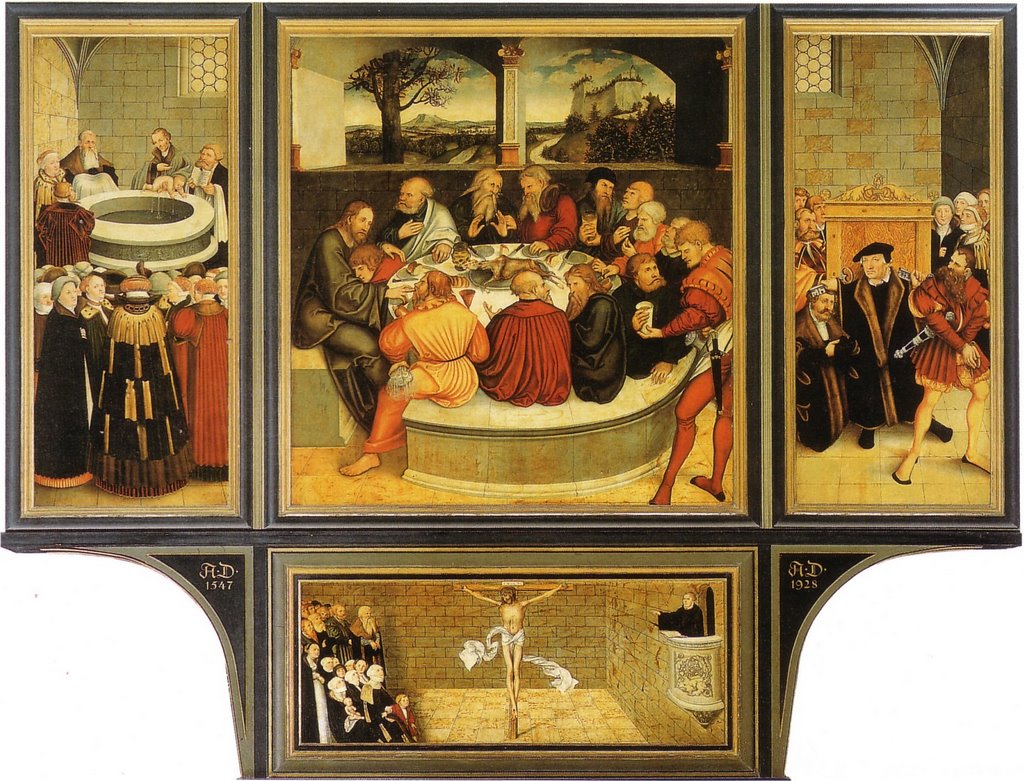
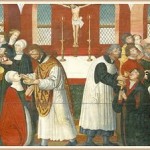
16th c. altar painting in St. Mary’s Church in Wittenberg, Germany (by Cranach). The panels show the four primary ways Christ’s word of forgiveness comes to us: Holy Baptism, Lord’s Supper, Office of the Keys, and Preaching.
In just a couple of years, the 500-year anniversary of Martin Luther’s putting forth the 95 theses – which launched what is called the Reformation – will be upon us.
As we Lutherans like to say, if Luther’s actions – and those who adhered to his teaching – were rebellious in any sense, it was a peculiar kind of rebellion. These were, as Jaroslav Pelikan put it, “obedient rebels”. Their reformation was, according to 19th c. Lutheran theologian Charles Porterfield Krauth, a “Conservative Reformation”.[i]
As evidence for this claim, we can look at how these early “Protestants” (see here for why I have that in quotes) “did church”. What is particularly interesting is their conviction that it was necessary to preserve all that was good from the church’s history. The Lutherans, in particular, wanted to keep those things that highlighted the Gospel in its narrow sense – the message of Christ crucified for our forgiveness, life and salvation from sin, death, and the devil (see I Cor. 15).
Several of the 16th c. Protestant Reformers largely retained the liturgical forms and words used in the church’s traditional worship service – even as several with more radical tendencies “purged” the churches of images. Here, as a Lutheran, I am keen to emphasize that the services of the Lutheran reformers not only basically looked and sounded the same as those of the Roman Catholic Church, but also that they did not see themselves as innovators in any sense of the word – “re-imagining church” in this or that way.[ii]
In fact, over and against their Roman Catholic opponents, the claim of these “first evangelicals” was that their teachings truly were “holy, catholic and apostolic”: “the churches among us do not dissent from the catholic church in any article of faith”, they said.[iii] If this is indeed true, it would be a very “conservative Reformation” indeed!
Using quotes from the 1580 Lutheran Book of Concord (which confessional Lutherans subscribe to) and other sources, let’s quickly look at six aspects of their worship: Preaching, Baptism and the Lord’s Supper, Confession and Absolution, Liturgy and ceremonies, the Church Year, and Church Discipline.
Preaching:

For Protestants, preaching has always been a primary component of the church’s life together. Two of the main contributors to the Lutheran “Book of Concord,” Martin Chemnitz and Jacob Andreae gave a clear explanation of what sermons should be all about “in our Lutheran congregations”:
“Preachers should be diligent not to preach in generalities, but always to arrange the material according to these parts: sin; God’s wrath and punishment of sin; contrition, remorse, anxiety of the conscience, etc.; the resolve to abandon and avoid sin; the person of Christ; His office and merit; God’s grace; the forgiveness of sin; faith; the good fruits of faith, such as the good resolve to do better, good works, patience in suffering, etc. This is done so that in the sermons, the teaching may always have its application or accommodation to use, as the doctrine should be used in the best way.”
Incidentally, this kind concern for doctrine’s application/use is what encourages Pastor Cooper to ask the kinds of penetrating questions that he does about the pastoral implications of John Piper’s theology of justification. And as for debates among Lutherans themselves, it is true that Confessional Lutherans today are debating about just what sermons should look like[iv], but, not insignificantly, all of them do agree that “the Gospel [that is, the message of Christ crucified for our continual forgiveness, life, and salvation] should predominate!” The church is where Christ’s little lambs gather to hear the good voice of their shepherd. Generally speaking, if you are going away from sermons feeling guilty and uncertain as your status as a Christian, you are missing what God intends preaching to be.
Baptism and the Lord’s Supper:

Philip Melanchton pictured as baptizing.
Regarding baptism, Lutherans have always upheld with the ancient church that baptism – water combined with God’s word of promise – regenerates and brings men and women into Christ’s church. This is true even for the youngest among us (see Pastor Cooper’s very helpful short Bible study on baptism and his three-part response to James White).
Further, also unlike most other Protestants, Lutherans have also vigorously upheld the importance of the Lord’s Supper as a means of God’s grace whereby He visits His people in love and forgiveness (see this helpful short Bible study on the Lord’s Supper from Pastor Cooper). In this sacrament, God’s gracious presence in His true body and blood gives us not only the assurance of His forgiveness, but His forgiveness in fact.
As the Lutheran reformer Philip Melanchton put it in the Book of Concord[v], “we defend the doctrine received in the entire Church, that in the Lord’s Supper the body and blood of Christ are truly and substantially present, and are truly tendered with those things which are seen, bread and wine. And we speak of the presence of the living Christ [living body]; for we know that death hath no more dominion over Him.” (for more on the early church and the Lord’s Supper see here).

Luther, in his disguise as “Junker Jorge”, at the Last Supper. He is being handed the cup.
And as he put it later on, in language that might shock many of us today[vi], “We do not abolish the Mass, but religiously keep and defend it. Masses are celebrated among us every Lord’s Day and on the other festivals. The Sacrament is offered to those who wish to use it, after they have been examined and absolved.”
Confession and Absolution:
“It is taught among us that private absolution should be retained in the churches and not be allowed to fall into disuse” says Melanchton.[vii] In Confessional Lutheran churches today one will find not only this comforting practice retained, but also find a corporate confession and absolution at the beginning of the service.
In spite of very clear passages found in Matthew 16, 18, and John 20 which deal with just this issue, some Christians are simply scandalized by confession and absolution for all kinds of reasons (for example, “how can a pastor forgive sins?!”), but as I wrote in a previous post:
“Lutherans[, unlike other Protestants,] insist that the Christian faith cannot be based on the individual and his relationship with God. If it were, then in effect there could be no other person who could in real confidence tell you, in your time of despair, that Christ really does forgive and save even you. In other words, they are not only saying to you that “good works are not necessary for salvation” (listen to this podcast by Jordan Cooper on Mark Jone’s book about antinomianism) but that the appropriation of Christian faith does not ultimately depend on you, the naked individual before God.
Rather, it is given [see this post from Pastor Cooper on the “covenant of works” (updated from original post)]. Therefore, we even have pastors – irreplaceable in the church’s structure – who as God’s officially appointed representatives can bring true comfort to even the most authority-minded person:
‘Almighty God in His mercy has given His Son to die for you and for His sake forgives you all your sins. As a called and ordained servant of the Word, I therefore forgive you all your sins in the name of the Father and of the Son and of the Holy Spirit.’[viii]“
Liturgy and Ceremonies:
Right after talking about how the Mass and Sacrament are retained in the Lutheran Churches, Melanchton went on to write: “And the usual public ceremonies are observed, the series of lessons, of prayers, vestments, and other such things”.[ix] In his book, Heaven on Earth, Arthur Just says that it is not ritual that is dead; rather, it is we who are dead (insofar as we are sinners, this is evidence of the original sin, which remains in us). What is in mind here is the primacy of the life-giving word of God (the lessons), “at work in you believers” (I Thes. 2:13), and the universal church’s response to that word (the prayers).
Further, from the book of Revelation, one can see that even the multi-cultural worship in heaven includes many liturgical features, which all participate in together. And regarding the broad matter of church ritual, Pastor Holger Sonntag helpfully writes:
“After the end of the comprehensive ceremonial law of the OT, Christians are free to add humanly devised ceremonies (“adiaphora”)[x] to the ceremonies of the gospel Christ has established already [i.e. baptism and the Lord’s Supper, administered by a pastor]. Lest these ceremonies contradict the ceremonies of the gospel itself, they must conform to the gospel in both content and form. This means, they need to proclaim the gospel and be humble and simple in nature. By doing so, they agree with the Christian faith (doctrine) and further faith in Christ as the highest worship. By doing so, they also agree with the simplicity of worship in paradise before man’s fall into sin.” (see here for more)
The Church Year:
Recently, the popular Calvinist professor James K.A. Smith, speaking to a more charismatic church body, said:
“Historically, the church had its own calendar. It actually adopted a way of keeping time that signaled that the people of God, in a way, inhabit the world differently.” Smith further noted that practices like Advent, Epiphany, Lent, etc. are actually able to help form us as Christians in largely unconscious ways (something he notes is also true of the many “secular liturgies” that we participate in – the mall, the academy, sports).

A picture of Bugenhagen (Luther’s pastor and confessor) administering the “office of the keys”. The impenitent man’s hands are bound with a cord.
Versus pastors who would just “do their own thing” every week, the church year is meant to expose Christians to the “whole counsel of God” every year, even as the message of “Christ crucified” is the overriding theme. As Lutheran pastor Dr. Arthur Just says, exposing the heart of the matter: “The Church year exists for the sole reason of centering the Church’s life in the life of Christ and proclaiming that the historic reality that ‘Jesus died’ is now the sacramental reality that ‘Jesus died for you.’”
Church Discipline:
Churches in America often seem to be in competition with one another today, and therefore administering church discipline often seems an impossible task (as there is always a church eager to receive a new member). An added difficulty is the very real possibility of unjust discipline or excommunication, perhaps administered by persons of questionable authority. As Martin Luther himself was excommunicated from the church and declared a heretic, the Lutheran churches of the Reformation certainly shared this second concern.
That said, in the Lutheran Confessional writings, Martin Luther wrote that proper excommunication “excludes those who are manifest and impenitent sinners from the sacrament and other fellowship of the church until they mend their ways and avoid sin.” (SA III, ix) For the Lutherans, the goal of excommunication was like that of the Apostle Paul in I Corinthians, chapter 5: that such impenitent sinners be “absolve[d]… if they are converted and ask for absolution.”[xi] Presupposed, of course, is a loving heart that longs for reconciliation with the lost coin, lost sheep, and lost son (Luke 15).
When it comes to granting mercy and grace, the church imitates her Lord. As Hebrews 4:15 says: “For we do not have a high priest who is unable to empathize with our weaknesses, but we have one who has been tempted in every way, just as we are – yet he did not sin…” (emphasis mine). In practice, this means that the church should humbly (see Gal. 6:1) call sin “sin”, make it easy for the guilty to confess, and keep appropriate consequences[xii] while speaking well of those brothers and sisters in Christ who repent.
FIN
Image credit: complete altarpiece: http://www.medievalhistories.com/wp-content/uploads/reformationsaltar.jpg
Notes:
[i] For a particularly good take on the Reformation, see Pastor Jay Webber’s article, “Reformations Before the Reformation”, here.
[ii] From John Bugay here:
“Dr. Donald Fortson related the following metaphor for understanding the different groups within the Reformation, which I thought was very helpful.
We all have a “top dresser drawer” into which we throw everything that there’s no other place for. Over time, it just gets full of all different kinds of things.
In church history, “tradition” kind of filled up the way that drawer does. And there were four different ways that the Reformers dealt with that drawer.
The Lutherans went through the drawer, looking for things that weren’t Biblical. Lutheranism took out the things that weren’t biblical, but they left everything else in there.
The Reformed took the drawer and dumped everything out on the bed. Then they went through all that stuff, checked it over carefully, and put back the things that were Biblical.
The Anglicans opened the drawer and took out one thing, called “the Pope,” and put back in one other thing, called “the Archbishop of Canterbury.” (He acknowledged that this was probably the least analogous part of the metaphor, given the 39 articles and all.)
The Anabaptists took out the whole drawer, dumped everything in the trash, and lit the trash can on fire.”
[iii] Phillip Melanchthon, in the Augsburg Confession.
Lutherans meant for that Augsburg Confession to be a confession of the universal (“catholic” with a small “c”) church. Unfortunately, it was not to be the case: it was disputed by Rome (and other new Protestants) and more confessional documents followed.
[iv] This smart post from Trent Demerest does a nice job of laying out the debate in a thorough and light-hearted way.
[v] Apology to the Augsburg Confession, X, “of the Holy Supper”.
[vi] In Apology, Article XXIV, “The Mass”. In a later Confessional document called the Smalcald Articles (written by Luther), the Roman Catholic interpretation of the word mass was directly countered. For example, “since the Mass is nothing else and can be nothing else (as the Canon and all books declare), than a work of men (even of wicked scoundrels), by which one attempts to reconcile himself and others to God, and to obtain and merit the remission of sins and grace (for thus the Mass is observed when it is observed at the very best; otherwise what purpose would it serve?), for this very reason it must and should [certainly] be condemned and rejected. For this directly conflicts with the chief article, which says that it is not a wicked or a godly hireling of the Mass with his own work, but the Lamb of God and the Son of God, that taketh away our sins.” (italics mine)
[vii] In the Augsburg Confession, XI
[viii] “To even the most authority-minded persons” – yes, that would be Martin Luther, as I argued in my series “The Coming Vindication of Martin Luther”. Luther realized that this kind of thing needed to happen in institutional of Christ’s church, where the means of grace were to be delivered in all of their richness: the regular preaching of the Word and the administration of baptism and the Supper (see here if you are Reformed) – really and truly for forgiveness, life and salvation.
[ix] I recently read an article from Pastor Jordan McKinely in which he said the following: “Dr. Naomichi Masaki of the [LCMS’s] Fort Wayne seminary asked the question in one of my classes, ‘Whose liturgy is it?’ If it’s about preference, it’s yours and mine to do as we see fit. If it’s the church’s liturgy as it has developed from the time of the Apostles (Acts 2:42)–and even from the time of the Old Testament prophets (Psalmody, anyone?), we really should show greater restraint in changing what is done. After all, don’t we say in the creed, ‘I believe in one, holy, Christian [catholic] and apostolic church?’ The liturgy is the possession of the whole church. Who am I to exercise my preference in the matter? Yes, it has room to shrink, grow, or change, but it shouldn’t be based on preference. I suppose I don’t get much of a voice because I’m white and married to a German (being of Scottish heritage doesn’t gain me any points, does it?), it’s going to sound like I’m advocating an emotionless, Germanic traditionalism. You don’t have to listen to me, but you should listen to Dr. Masaki, who isn’t German, nor is he emotionless.” (see here)
[x] Here are some more thoughts about the matter of “adiaphora”, from the current LC-MS President Matthew Harrison: “….we note an unpublished study conducted in the early 1990s by Pr. Brian Saunders, formerly of Holy Cross Lutheran in Ft. Wayne. Pr. Saunders surveyed some 300 who regularly attended a “contemporary worship” service at Holy Cross (with rock band, testimonies, “liturgical” dance, etc…). One question asked: If you were to move to another community where there was a church which did not confess the true bodily presence of Christ in the Sacrament, nor baptize babies, but did worship in the way you do now; and there was an LC-MS congregation which used the liturgy/hymnal, which church would you join? 74% said they would opt out of Lutheranism. It has been said that historical-critical theology is merely a way for unbelievers to find haven in the church. I would suggest that much of “contemporary worship” is simply a way for the weak to be robbed of Lutheranism, yet remain within the Lutheran church.” (Matthew Harrison, “Martin Chemnitz and FC X,” in Mysteria Dei: Essays in Honor Kurt Marquart, ed., Paul McCain and John Stephenson (Fort Wayne: Concordia Theological Seminary Press, 1999), 98-99, n. 31., quoted here).
[xi] See Ap XXVIII. 13-14 ; also see Treatise [the Tractate on the Power and Primacy of the Pope], 74. Regarding re-conversion, the Lutheran confessions say: “But when the baptized have acted against their conscience, allowed sin to rule in them, and thus have grieved and lost the Holy Ghost in them, they need not be rebaptized, but must be converted again, as has been sufficiently said before.” (In the Formula of Concord, Article II, under “Free Will, or Human Powers” [see paragraph 69]) Also see my post: Judging Jesus stye?: the real reasons for discipline in the church.
[xii] For example.
Previous Post
October 7, 2015
The Mission of the Holy Spirit
Next Post
October 8, 2015 Kretzmann on the Mystical Union
Browse Our Archives
Select a Category American Lutheran Classics Blog Posts Book Review Christian Dogmatics Course Church Resources Curtis Leins Dogmatic Theology Ethics FAQs Historical Theology Just & Sinner Publications Luther Quotations Podcast Sermons The American Lutheran Theological Journal The complete works of Revere Franklin Weidner Theology Proper Uncategorized Videos
Select a Month October 2019 September 2019 July 2019 June 2019 May 2019 April 2019 March 2019 February 2019 January 2019 December 2018 November 2018 October 2018 September 2018 July 2018 June 2018 May 2018 April 2018 March 2018 February 2018 January 2018 December 2017 November 2017 October 2017 September 2017 August 2017 July 2017 June 2017 May 2017 April 2017 March 2017 February 2017 January 2017 December 2016 November 2016 October 2016 September 2016 August 2016 July 2016 June 2016 May 2016 April 2016 March 2016 February 2016 January 2016 December 2015 November 2015 October 2015 September 2015 August 2015 July 2015 June 2015 May 2015 April 2015 March 2015 February 2015 January 2015 December 2014 November 2014 October 2014 September 2014 August 2014 July 2014 June 2014 May 2014
Follow Us!
TAKE THE
Religious Wisdom Quiz
True or False: John's Gospel identifies Jesus as 'the Lamb of God' in the first chapter.
Select your answer to see how you score.
TRUE FALSE
Related posts from Just and Sinner
An Explanation and Defense of Holy Absolution
"How Shall We Sing...? With Joy!" by Rev....
A Discussion on Liturgical Worship
TRENDING AT PATHEOS Evangelical

The REST of Your Life: A Creative Wrestles...
This week I had a conversation with a good friend from church....

How the author of the world's best hymn...
I've been working with John Newton for a while now. This makes...

Long before this Lectio Divina, Psalm 130 - the song - started...

What About the Trees? Another Living Parable
After I finished writing the last article about falling leaves as a...

Why Classical Education Is a Conversation, Not a...
Come and Read: Joy in Classical Education When I was a little...

Cornell University has received a great deal of negative publicity and intense...
view all Evangelical blogs
Ad-Free & Subscriber Log-In Subscription Support
- About Us
- 2026 Calendar
- Videos
- Podcasts
- Library of World Religions
- Faith In Media Tracker
- Advertise With Us
- Write for Us
- Privacy Policy
- Terms of Service
- Do Not Sell My Data
- Contact Us
- Radiant Digital
- Manage Newsletter Subscriptions
- Unsubscribe From Notifications
- Sitemap
Copyright 2008-2026, Patheos. All rights reserved.
Subscription Support Ad-Free & Subscriber Log-In
Follow Patheos