
BuddhistCatholicContemplativeEvangelicalGeneral ChristianHinduJewishLatter-day SaintMuslimNew VisionsProgressive Christian
Beliefs
- Buddhist
- Catholic
- Contemplative
- Evangelical
- General Christian
- Hindu
- Jewish
- Latter-day Saint
- More Voices
- Muslim
- New Visions
- Pagan
- Progressive Christian
Topics
- Religion News
- Food and Religion
- Sports and Religion
- Religious Art
- Religious Music and Entertainment
- Religious Events
- History and Religion
- Style and Religion
- Politics and Religion
- Women in Religion
- Recreation Outdoors and Religion
- Business Finance and Religion
- Careers Workplace and Religion
- Education and Religion
- Family Parenting and Religion
- Health Fitness and Religion
- Home and Religion
- Relationships and Religion
- Technology and Religion
- Travel and Religion
Columnists
- Buddhist Columnists
- Business Finance and Religion Columnists
- Careers Workplace and Religion Columnists
- Catholic Columnists
- Contemplative Columnists
- Education and Religion Columnists
- Evangelists Columnists
- Family Parenting and Religion Columnists
- General Christian Columnists
- Health Fitness and Religion Columnists
- Hindu Columnists
- History and Religion Columnists
- Home and Religion Columnists
- Jewish Columnists
- More Voices Columnists
- Latter Day Columnists
- Muslim Columnists
- New Visions Columnists
- Nonreligious Columnists
- Pagan Columnists
- Politics and Religion Columnists
- Progressive Columnists
- Recreation Outdoors and Religion Columnists
- Relationships and Religion Columnists
- Religion News Columnists
- Religious Art Columnists
- Religious Events Columnists
- Religious Music and Entertainment Columnists
- Sports and Religion Columnists
- Style and Religion Columnists
- Technology and Religion Columnists
- Travel and Religion Columnists
- Women in Religion Columnists
Resource Library
- 2026 Calendar
- Library of World Religions
- The 100 Most Holy Places on Earth
- Patheos Answers
- Podcasts
- Videos
- Faith Leaders Database
- Anglican Episcopalian
- Bahai
- Baptist
- Buddhism
- Christianity
- Confucianism
- Eastern Orthodoxy
- Hinduism
- Holiness and Pentecostal
- ISKCON
- Islam
- Judaism
- Lutheran
- Methodist
- The Church of Jesus Christ of Latter-day Saints
- New Age
- Paganism
- Presbytarian and Reformed
- Protestantism
- Religion Behind the Scenes
- Roman Catholic
- Scientology
- Shia Islam
- Sikhism
- Sufism
- Sunni Islam
- Taoism
- Zen
- See all religions
Research Tools
 Ad-Free & Subscriber Log-In Subscription Support
Ad-Free & Subscriber Log-In Subscription Support
Follow Patheos 

- Trending:
- Forgiveness
- |
- Marriage
- |
- Consciousness
- |
- Death Penalty
- |
- Election
- |
- Halloween
 Just and Sinner
- Home
- Evangelical
- Fatal Words Christians Should Not Utter: John Updike and Christian Life & Witness
Fatal Words Christians Should Not Utter: John Updike and Christian Life & Witness
Last updated on: March 13, 2015 at 2:41 pm by nathanrinne
Fatal Words Christians Should Not Utter: John Updike and Christian Life & Witness 2015-03-13T14:41:21-06:00 nathanrinne
Patheos Explore the world's faith through different perspectives on religion and spirituality! Patheos has the views of the prevalent religions and spiritualities of the world.
Post by Nathan Rinne
In the days of Martin Luther, many persons thought that God was harsh, unforgiving, and cruel. I think it is safe to say that in our day many think that God is indulgent, conviction-less, and, as a result, boring.
I could not help thinking that after I had read Gerald R. McDermott’s new piece on the Witherspoon Institute’s Public Discourse site “A Rather Antinomian Christianity”: John Updike’s Religion.
I will admit to not being all that familiar with John Updike’s work, but Mr. McDermott certainly gives the impression that he is. And his article, as can be seen by the title, expresses some real concerns about the kind of faith Mr. Updike expressed.
He sums this up by saying:
“It was a strange sort of Christianity that rejected the strictures of traditional faith, choosing divine comfort while rejecting divine commands. In other words, it was gospel without law, grace without repentance, the love of God without the holiness of God.”
It is true that as Christians we ought to always be eager to proclaim, highlight, and get to the grace of God in Christ Jesus our Lord. And as I noted in my last post here, the Gospel of the forgiveness of sins, life and salvation in the person of Jesus Christ is perpetually for Christians – all of who fail – and not just unbelievers.
And yet, as a Lutheran who wants to be all about God’s radical grace, I must say that I share McDermott’s concerns. He brings important matters to our attention. For example, McDermott states that Updike’s God helped him, as [his recent biographer] Begley puts it, to “cherish whatever happened to him”, and “His beautifully precise descriptions of desire—and the vague implication that its fulfillment could be religiously justified—reassured readers who feared they might not be justified.”
And then there is this:
In Updike’s religion, then, there are no commandments we are meant to keep except the obligation to accept what is: “Religion includes, as its enemies say, fatalism, an acceptance and consecration of what is.” Our only responsibility is to “appreciate” the great gift that life represents. He learned from Barth that the next life is simply this life in review, and from his Lutheranism, he wrote, “a rather antinomian Christianity”—the idea that there are no laws we should fear or live by—which he was “too timid to discard.” There is no hint of final judgment. Nor is there any imperative to repent or improve ourselves: in Begley’s words, “Original sin may be inescapable, but any concerted effort to improve one’s game resembles a righteous struggle for salvation.” And if there was anything he learned from Barth, it was that all human efforts to save ourselves are wrongheaded and futile. As one critic summed it up, Updike “radically divorced” Christian theology from Christian ethics.
A Google search on some of those passages satisfied my question of whether McDermott has been responsible in how he has quoted Updike – even if a phrase of his own describing Updike, like “so enthusiastic for infidelity” for example, begs to be unpacked and explored.
A few key comments about all of this. First, and most importantly, it seems that Updike was not careful to make clear that while God may indeed use evil for good, we should be careful never to think God planned and meant for us to do such evil – believing such a thing can be fatal to Christian faith. Second, it seems to me that John Updike clearly did have much important truth to share – G.K. Chesterton to, for example, said “every man who knocks on the door of a brothel is looking for God.” Third, as a confessional Lutheran who is troubled by Updike’s own understanding of the Lutheran faith, I nevertheless firmly believe that it is never given to us to pronounce on the final condition of a man’s soul (something McDermott is not doing either, I hasten to add).
Which brings me to a final point, which I take to dovetail with McDermott’s concerns: we need men from the established institution of the church who will challenge our sovereignty of self – whereby we would presume to be our own judge, and administer forgiveness to ourselves. In Holy Confession and Absolution our pastors (please note I am not one of these), as partakers of the Apostolic Ministry, are called to administer in Christ’s name the forgiveness of sins – or not (John 20:23) This is alternatively called binding and loosing (Matthew 16:19).
This requires a judgment on their part of what a person – any person they speak to but particularly to Christians – needs to hear: law or gospel. Perhaps an extended conversation with Mr. Updike – with a humble, strong and wise Christian pastor, for example – may have been necessary to make a good judgment of where he stood… what he believed about the nature of his actions.
Or perhaps not. Perhaps other writings from Updike give us a very good idea of just what he needed to hear. Either something simply like “Do not be deceived: Neither the sexually immoral nor idolaters nor adulterers nor men who have sex with men nor thieves nor the greedy nor drunkards nor slanderers nor swindlers will inherit the kingdom of God”, fullstop (I Cor. 6:9-10), or, on the other hand, something like the rest of that passage: “And that is what some of you were. But you were washed, you were sanctified, you were justified in the name of the Lord Jesus Christ and by the Spirit of our God.” (I Cor. 6:11)
In either case though, it is clear to me that Mr. Updike certainly could have used some good advice – not necessarily literary – on how to proceed in his vocation as a writer who claimed Christ. As a friend wrote in a related context: “The teacher should not try to astound the young with the gravity of his past sins; it will often have the opposite effect than was intended.” I’d say that that should inform how one speaks about one’s own life, and all aspects of one’s vocation in the world as well.
FIN
Updike pic: www.openculture.com
Previous Post
March 13, 2015
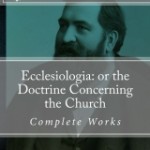
Ecclesiologia by Revere Franklin Weidner
Next Post
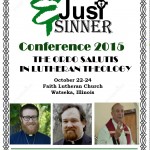
March 15, 2015 Announcing the 2015 Just and Sinner Conference
Browse Our Archives
Select a Category American Lutheran Classics Blog Posts Book Review Christian Dogmatics Course Church Resources Curtis Leins Dogmatic Theology Ethics FAQs Historical Theology Just & Sinner Publications Luther Quotations Podcast Sermons The American Lutheran Theological Journal The complete works of Revere Franklin Weidner Theology Proper Uncategorized Videos
Select a Month October 2019 September 2019 July 2019 June 2019 May 2019 April 2019 March 2019 February 2019 January 2019 December 2018 November 2018 October 2018 September 2018 July 2018 June 2018 May 2018 April 2018 March 2018 February 2018 January 2018 December 2017 November 2017 October 2017 September 2017 August 2017 July 2017 June 2017 May 2017 April 2017 March 2017 February 2017 January 2017 December 2016 November 2016 October 2016 September 2016 August 2016 July 2016 June 2016 May 2016 April 2016 March 2016 February 2016 January 2016 December 2015 November 2015 October 2015 September 2015 August 2015 July 2015 June 2015 May 2015 April 2015 March 2015 February 2015 January 2015 December 2014 November 2014 October 2014 September 2014 August 2014 July 2014 June 2014 May 2014
Follow Us!
TAKE THE
Religious Wisdom Quiz
Who was Miriam?
Select your answer to see how you score.
Pharaoh's wife Moses' daughter Moses' sister Moses' wife
Related posts from Just and Sinner

Facing Hostility, Can Some Christian Colleges Boldly Continue...

Gradually Embracing Jack Kevorkian's World?: Christians and Death...

Fighting Critical Theory Approaches in the Academic Library...

"Finding God at the State Fair" by Paul...
TRENDING AT PATHEOS Evangelical

The REST of Your Life: A Creative Wrestles...
This week I had a conversation with a good friend from church....

How the author of the world's best hymn...
I've been working with John Newton for a while now. This makes...

Long before this Lectio Divina, Psalm 130 - the song - started...

What About the Trees? Another Living Parable
After I finished writing the last article about falling leaves as a...

Why Classical Education Is a Conversation, Not a...
Come and Read: Joy in Classical Education When I was a little...

Cornell University has received a great deal of negative publicity and intense...
view all Evangelical blogs
Ad-Free & Subscriber Log-In Subscription Support
- About Us
- 2026 Calendar
- Videos
- Podcasts
- Library of World Religions
- Faith In Media Tracker
- Advertise With Us
- Write for Us
- Privacy Policy
- Terms of Service
- Do Not Sell My Data
- Contact Us
- Radiant Digital
- Manage Newsletter Subscriptions
- Unsubscribe From Notifications
- Sitemap
Copyright 2008-2026, Patheos. All rights reserved.
Subscription Support Ad-Free & Subscriber Log-In
Follow Patheos