
BuddhistCatholicContemplativeEvangelicalGeneral ChristianHinduJewishLatter-day SaintMuslimNew VisionsProgressive Christian
Beliefs
- Buddhist
- Catholic
- Contemplative
- Evangelical
- General Christian
- Hindu
- Jewish
- Latter-day Saint
- More Voices
- Muslim
- New Visions
- Pagan
- Progressive Christian
Topics
- Religion News
- Food and Religion
- Sports and Religion
- Religious Art
- Religious Music and Entertainment
- Religious Events
- History and Religion
- Style and Religion
- Politics and Religion
- Women in Religion
- Recreation Outdoors and Religion
- Business Finance and Religion
- Careers Workplace and Religion
- Education and Religion
- Family Parenting and Religion
- Health Fitness and Religion
- Home and Religion
- Relationships and Religion
- Technology and Religion
- Travel and Religion
Columnists
- Buddhist Columnists
- Business Finance and Religion Columnists
- Careers Workplace and Religion Columnists
- Catholic Columnists
- Contemplative Columnists
- Education and Religion Columnists
- Evangelists Columnists
- Family Parenting and Religion Columnists
- General Christian Columnists
- Health Fitness and Religion Columnists
- Hindu Columnists
- History and Religion Columnists
- Home and Religion Columnists
- Jewish Columnists
- More Voices Columnists
- Latter Day Columnists
- Muslim Columnists
- New Visions Columnists
- Nonreligious Columnists
- Pagan Columnists
- Politics and Religion Columnists
- Progressive Columnists
- Recreation Outdoors and Religion Columnists
- Relationships and Religion Columnists
- Religion News Columnists
- Religious Art Columnists
- Religious Events Columnists
- Religious Music and Entertainment Columnists
- Sports and Religion Columnists
- Style and Religion Columnists
- Technology and Religion Columnists
- Travel and Religion Columnists
- Women in Religion Columnists
Resource Library
- 2026 Calendar
- Library of World Religions
- The 100 Most Holy Places on Earth
- Patheos Answers
- Podcasts
- Videos
- Faith Leaders Database
- Anglican Episcopalian
- Bahai
- Baptist
- Buddhism
- Christianity
- Confucianism
- Eastern Orthodoxy
- Hinduism
- Holiness and Pentecostal
- ISKCON
- Islam
- Judaism
- Lutheran
- Methodist
- The Church of Jesus Christ of Latter-day Saints
- New Age
- Paganism
- Presbytarian and Reformed
- Protestantism
- Religion Behind the Scenes
- Roman Catholic
- Scientology
- Shia Islam
- Sikhism
- Sufism
- Sunni Islam
- Taoism
- Zen
- See all religions
Research Tools
 Ad-Free & Subscriber Log-In Subscription Support
Ad-Free & Subscriber Log-In Subscription Support
Follow Patheos 

- Trending:
- Forgiveness
- |
- Marriage
- |
- Consciousness
- |
- Death Penalty
- |
- Election
- |
- Halloween
 Just and Sinner
- Home
- Evangelical
- Facing Hostility, Can Some Christian Colleges Boldly Continue to Welcome All?
Facing Hostility, Can Some Christian Colleges Boldly Continue to Welcome All?
Last updated on: March 25, 2015 at 12:10 pm by nathanrinne
Facing Hostility, Can Some Christian Colleges Boldly Continue to Welcome All? 2015-03-25T12:10:21-06:00 nathanrinne
Patheos Explore the world's faith through different perspectives on religion and spirituality! Patheos has the views of the prevalent religions and spiritualities of the world.
Post by Nathan Rinne
How Christian colleges and universities in America can continue to be faithful to their calling – and continue to influence our society – is a very interesting question and will be more so in the years to come.
Traditionally, many Christian colleges were founded in large part explicitly to serve the purpose of Christian education. This describes the colleges and universities of the Lutheran Church – Missouri Synod, of which I am a part. Initially, the primary purpose and goal of these schools was to prepare pastors and Christian educators, and this goal was not realized apart from a liberal arts education. Others not pursuing those vocations could attend, but the schools were not geared towards them.
In the later years of those schools, the mission became more general (we won’t go into the details about the various reasons given for this): provide a good education for the broader church (and beyond, if others would like to come) with the goal being a good Christian liberal arts education. In even more recent years, the emphasis has shifted yet again to more vocationally-based education, with, for many, a corresponding effort to attract non-Christians into the schools.
Of course there are some in the secular world, the truly “liberal-minded” (historically labeled affectionately as “noble pagans”), who see the great value of these institutions. Lutheran cultural guru Gene Veith recently writes that “A major secular educator, David Coleman, spent some time at Wheaton College, which taught him that Christian colleges have an important part to play in American higher education.” Veith then points to Michael Gerson’s article on Coleman, quoting the following:
The point, [Coleman] told me, is not “merely their right to exist.” It is their “animating values that are precious to higher education, and inescapably so.” The first he describes as “productive solitude,” which is both characteristic of the spiritual life and “important for academic growth.” The second he calls the “reverent reading” of shared texts, which allows “different minds to act on the same problems.” Many modern academic settings, in his view, “now don’t share a single text” studied across disciplines. And this is a problem, because learning “relates to powerful, haunting language held in common.” The third comparative advantage of religious education, according to Coleman, is the determination to be a “safe haven for body and spirit.” Modern student life often involves “abuse of alcohol” and “premature, reckless sexual encounters.” Noting Dartmouth’s recent campus ban on hard liquor, Coleman offered: “Maybe it is time to construct stronger norms.”
And yet despite Coleman’s encouraging words, Gerson’s article also does talk about the moves of several institutions – “called to serious ethical reflection and capable of serious moral preening” – who have moved to deny recognition to student groups “that use conservative religious beliefs on sexuality (and other issues) as a criterion in choosing officers”. Of course, on the opposite side of the fence, many Christian colleges and universities are being asked – or pressured to – allow for groups where LGBTQ[….] causes could be advocated.
Serious ethical – and yes, political – reflection is certainly needed here, and this is something that I, as a servant of a Christian university, have had to do myself. It is with this in mind, that I offer for consideration the following theses for Christian colleges and universities who want to both honor Christ and welcome all. I think that is extremely important that they boldly advocate for the rights they should have in their own homes, as genuinely private institutions.
Students who have choose to attend distinctly Christian colleges and universities have a right to hear it emphasized that…
1) As traditional Christian thought and practice loses hold in Western culture, their college/university will nevertheless hold to its right to “self-determine” (actually, the right to be who it, by God’s truth and grace, knows itself to be – along with the church of which it is a part).*
2) To this island in the storm of a fallen world, it a good and noble desire to say “all are welcome” – and the true, pure and lovely hope is that all persons, in line with common Western and American sentiment, would be able to freely express themselves and become the selves they wish to be – even as this hope cannot be fulfilled in all situations.**
3) It is a fact that all colleges and universities – not just private or religious ones – are more or less consciously taking deliberate steps to indoctrinate students into a specific and limited range of acceptable ways of understanding the world.
4) Therefore, in spite of any claims to the contrary, academic and intellectual freedom are never absolute things regardless of whether one is in a secular, private, or religious setting.
5) Speaking sociologically, whatever one’s beliefs about the world, it is human nature to either directly or indirectly shun and stigmatize contemporary voices who promote certain views that one and one’s community determine to be “out of bounds”.
6) Traditionally, private or religious schools have had the freedom to teach and practice their beliefs as they saw fit – their belief and practice have not been considered “out of bounds” but within the bounds of the law, itself admittedly influenced by Christian notions.***
7) In their efforts to take a stand, make their voices heard, and influence the culture that they inhabit, private or religious schools have the freedom to directly or indirectly – through artistic, didactic, or political means – confront contemporary voices that promote certain views determined to be “out of bounds” – for their community, and beyond, as determined necessary.
8) Because the form of toleration that some Christians in leadership positions have practiced can be interpreted as capitulation, a lack of courage, or inconsistency, the reasons for this tolerance should be made explicit and explained.
9) “If you love something, you let it be free”. Unlike other religions, our Kingdom is “not of this world”, and therefore Christian love – the Church’s love – as it is expressed in the world, begets a political tolerance which bestows “the right to be wrong”: in one’s heart of hearts, the beloved is absolutely free to reject the Lover.
10) On earth this means Christians, while still holding to critical norms in their churches and other institutions, should not only eschew physical force and practice forbearance, but can seek to understand – and sympathize with insofar as possible for them (i.e. without sin) – the unbelieving beloved in her search for identity, security and meaning.****
11) Ideally, Christians gain and share knowledge about the cosmos not only because they are curious or gain control by doing so, but also because knowing, teaching, and living in accordance with what is true, pure, just, lovely, commendable, etc. is one way to serve one’s neighbor in love.
12) Their Christian college/university desires that all would know Jesus Christ and His love and can only continue in this mission if it sees itself more as an extension of the church, or, one hopes, holds firm to what it might currently be: a mild expression of an earthly kingdom of sorts, ruled by Christians as best they can in fallen world.
13) Their Christian college/university must be vigilant about running its household, in accordance with who they are. Neither can the “spirit of the age” nor the “customer” always be right for them – open and collegial conversation must always exist in a context where kind but forceful intellectual opposition and attempts to gently correct can be provided.
Please let me know what you think.
+Nathan
Notes:
* When it comes to how we see political matters today I think we can say, among other things, that “a good society is a society that makes it easier to choose to be good.” Also note that even if the “pursuit of happiness” is seen to be problematic from a Christian perspective (necessarily or potentially), simply desiring satisfaction and contentment for one’s self, one’s family, and one’s neighbor is unobjectionable.
**For “true, pure, and lovely” see Philippians 4:8. The concepts of ”individualism” or “autonomy” do not necessarily need to be understood in a secular way, but in fact can be argued to have Christian origins (see p. 9 of this paper: http://digitalcommons.unl.edu/libphilprac/146/). It is a particular feature of contemporary Western nations, i.e. liberal democracies, that, all things being equal, most desire that persons should be allowed to freely express themselves and become the types of selves they wish to become. That said, all should recognize that they also believe there are things that are better left unexpressed and selves better left unwished. Therefore, realistically, given the realities of human nature, this hope is an ideal that in many particular cases will be unattainable.
*** The freedom of speech, the press, assembly, and religion, for example, have been widely allowed in the West and particularly in America (even as there are limits on behavior and certain activities that cannot be participated in, or that are circumscribed only to particular times and places)

Next Post
March 4, 2015 The Theonomy Debate
Browse Our Archives
Select a Category American Lutheran Classics Blog Posts Book Review Christian Dogmatics Course Church Resources Curtis Leins Dogmatic Theology Ethics FAQs Historical Theology Just & Sinner Publications Luther Quotations Podcast Sermons The American Lutheran Theological Journal The complete works of Revere Franklin Weidner Theology Proper Uncategorized Videos
Select a Month October 2019 September 2019 July 2019 June 2019 May 2019 April 2019 March 2019 February 2019 January 2019 December 2018 November 2018 October 2018 September 2018 July 2018 June 2018 May 2018 April 2018 March 2018 February 2018 January 2018 December 2017 November 2017 October 2017 September 2017 August 2017 July 2017 June 2017 May 2017 April 2017 March 2017 February 2017 January 2017 December 2016 November 2016 October 2016 September 2016 August 2016 July 2016 June 2016 May 2016 April 2016 March 2016 February 2016 January 2016 December 2015 November 2015 October 2015 September 2015 August 2015 July 2015 June 2015 May 2015 April 2015 March 2015 February 2015 January 2015 December 2014 November 2014 October 2014 September 2014 August 2014 July 2014 June 2014 May 2014
Follow Us!
TAKE THE
Religious Wisdom Quiz
How many chapters are in the book of Genesis?
Select your answer to see how you score.
40 50 66 45
Related posts from Just and Sinner
And Now... A Message for Today's LC-MS Mainstream...
Does God Expect Rulers Today to "Kiss the...

Male Headship as Domestic Abuse: a Crypto-Feminist Plot...
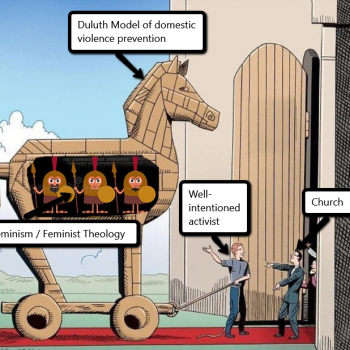
The Duluth Model as Trojan Horse of Feminist...
TRENDING AT PATHEOS Evangelical

The REST of Your Life: A Creative Wrestles...
This week I had a conversation with a good friend from church....

How the author of the world's best hymn...
I've been working with John Newton for a while now. This makes...

Long before this Lectio Divina, Psalm 130 - the song - started...

What About the Trees? Another Living Parable
After I finished writing the last article about falling leaves as a...

Why Classical Education Is a Conversation, Not a...
Come and Read: Joy in Classical Education When I was a little...

Cornell University has received a great deal of negative publicity and intense...
view all Evangelical blogs
Ad-Free & Subscriber Log-In Subscription Support
- About Us
- 2026 Calendar
- Videos
- Podcasts
- Library of World Religions
- Faith In Media Tracker
- Advertise With Us
- Write for Us
- Privacy Policy
- Terms of Service
- Do Not Sell My Data
- Contact Us
- Radiant Digital
- Manage Newsletter Subscriptions
- Unsubscribe From Notifications
- Sitemap
Copyright 2008-2026, Patheos. All rights reserved.
Subscription Support Ad-Free & Subscriber Log-In
Follow Patheos