
BuddhistCatholicContemplativeEvangelicalGeneral ChristianHinduJewishLatter-day SaintMuslimNew VisionsProgressive Christian
Beliefs
- Buddhist
- Catholic
- Contemplative
- Evangelical
- General Christian
- Hindu
- Jewish
- Latter-day Saint
- More Voices
- Muslim
- New Visions
- Pagan
- Progressive Christian
Topics
- Religion News
- Food and Religion
- Sports and Religion
- Religious Art
- Religious Music and Entertainment
- Religious Events
- History and Religion
- Style and Religion
- Politics and Religion
- Women in Religion
- Recreation Outdoors and Religion
- Business Finance and Religion
- Careers Workplace and Religion
- Education and Religion
- Family Parenting and Religion
- Health Fitness and Religion
- Home and Religion
- Relationships and Religion
- Technology and Religion
- Travel and Religion
Columnists
- Buddhist Columnists
- Business Finance and Religion Columnists
- Careers Workplace and Religion Columnists
- Catholic Columnists
- Contemplative Columnists
- Education and Religion Columnists
- Evangelists Columnists
- Family Parenting and Religion Columnists
- General Christian Columnists
- Health Fitness and Religion Columnists
- Hindu Columnists
- History and Religion Columnists
- Home and Religion Columnists
- Jewish Columnists
- More Voices Columnists
- Latter Day Columnists
- Muslim Columnists
- New Visions Columnists
- Nonreligious Columnists
- Pagan Columnists
- Politics and Religion Columnists
- Progressive Columnists
- Recreation Outdoors and Religion Columnists
- Relationships and Religion Columnists
- Religion News Columnists
- Religious Art Columnists
- Religious Events Columnists
- Religious Music and Entertainment Columnists
- Sports and Religion Columnists
- Style and Religion Columnists
- Technology and Religion Columnists
- Travel and Religion Columnists
- Women in Religion Columnists
Resource Library
- 2026 Calendar
- Library of World Religions
- The 100 Most Holy Places on Earth
- Patheos Answers
- Podcasts
- Videos
- Faith Leaders Database
- Anglican Episcopalian
- Bahai
- Baptist
- Buddhism
- Christianity
- Confucianism
- Eastern Orthodoxy
- Hinduism
- Holiness and Pentecostal
- ISKCON
- Islam
- Judaism
- Lutheran
- Methodist
- The Church of Jesus Christ of Latter-day Saints
- New Age
- Paganism
- Presbytarian and Reformed
- Protestantism
- Religion Behind the Scenes
- Roman Catholic
- Scientology
- Shia Islam
- Sikhism
- Sufism
- Sunni Islam
- Taoism
- Zen
- See all religions
Research Tools
 Ad-Free & Subscriber Log-In Subscription Support
Ad-Free & Subscriber Log-In Subscription Support
Follow Patheos 

- Trending:
- Forgiveness
- |
- Marriage
- |
- Consciousness
- |
- Death Penalty
- |
- Election
- |
- Halloween
 Just and Sinner
- Home
- Evangelical
- Does “Non-Denominational” Now Mean “Hermeneutical Democracy”?
Does “Non-Denominational” Now Mean “Hermeneutical Democracy”?
Last updated on: December 8, 2015 at 6:28 am by nathanrinne
Does “Non-Denominational” Now Mean “Hermeneutical Democracy”? 2015-12-08T06:28:21-06:00 nathanrinne
Patheos Explore the world's faith through different perspectives on religion and spirituality! Patheos has the views of the prevalent religions and spiritualities of the world.
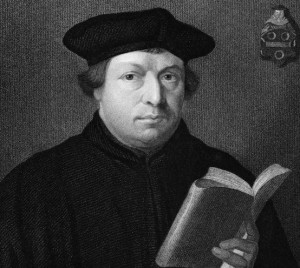
Did Martin Luther start a “Hermeneutical Democracy”?
First of all, what is a “hermeneutical democracy”? The popular blogger Rod Dreher recently talked about an article by Abilene Christian University professor Richard Beck. In the article, Beck points out the complexity that lies behind the word “Protestant”, and urges Protestants to own the fact that they “have never agreed on what the Bible says.” Rod Dreher goes on to say:
Beck goes on to make what I think is a solid point: that what Protestant churches and organizations are really doing in these [contemporary] debates [about same-sex marriage] are trying to find out if its membership wants to change, and if so, how much change will it accept. The truth is, says Beck, is that Protestantism is a “hermeneutical democracy,” in which the individual consciences of believers determine what is true and what is false. This, he says, is the “genius of the tradition,” and having to do all this “relational work” is a key part of what it means to be Protestant. The Bible doesn’t speak for itself; it has to be interpreted, and for Protestants, that means that everybody gets a vote.
In other words, Beck is making the case that saying something like we “have a biblical view of sexuality”, for example, is not enough. And this kind of “hermeneutical democracy”- like thinking would seem, on the face of it, to track well with what Stephen Fowl, in his 2008 book “Engaging Scripture”, says: “…theological convictions, ecclesial practices, and communal and social concerns should shape and be shaped by biblical interpretation” and “Biblical interpretation will be the occasion of a complex interaction between the biblical text and the varieties of theological, moral, material, political, and ecclesial concerns that are part of the contexts in which they find themselves.” (p. 60) (I addressed the problems with this kind of statement the fourth footnote in my previous post).
Not only this, but all of this put me in mind of the complexity of another term associated with Protestants: “non-denominational”. In the online theology classes I teach on basic Christianity, I always bring up this term.
What does this mean? I would say that at its best, “non-denominational” is used in order to avoid denominational labels (Lutheran, Presbyterian, Methodist, etc) – all with the good intention of drawing interested persons into environments where Jesus Christ and the Scriptures of what we might call “historic, biblical Christianity” are at the center. It has had some real appeal with some, because there really are things that many who bear the name of Christ have historically agreed on: e.g., that the Bible is God’s word, that the church’s Creeds are basically correct (even if it is not recited in worship), etc.
All this said, in practice the word “non-denominational” has, at least until recently, tended to track not just with some pan-Protestant ethos, but particularly with an American evangelical form of theology that embraces not infant baptism, but believer’s baptism. How many “non-denominational” churches do you know of that are actually willing to baptize infants (and if any do, they certainly do not embrace the idea of baptismal regeneration)?
But what does the term “non-denominational” signify today? I always ask my students this, and it seems they increasingly have no idea. Among those who are willing to take a stab at giving a definition, many give the impression that “non-denominational” no longer means something like “evangelical”, but rather “whatever I think Christianity means”. In short, any group or individual wanting to be identified in some way with the group called “Christianity” – even those who do not assume the Bible is God’s word – can be “non-denominational”.
And for some in this “hermeneutical democracy” called “Christianity”, a key assumption is that the meaning of the Bible is all really rather unclear – and that those “on the right side of history” will end up winning the day by interpreting it as they see fit and necessary (again, see my last post mentioned above). Not so much because this will be decided by some vote, but because, as Beck says, “what you are searching for is a hermeneutical consensus, the degree to which your community can tolerate certain hermeneutical choices.”
How to respond to all of this?
First of all, as I have said in the past, “while we should not think that a sincere agnostic, truly seeking to understand the Bible as a complete work, would come up with the Nicene Creed, what Mark Twain said about the Scriptures is certainly relevant here: ‘It ain’t those parts of the Bible that I can’t understand that bother me, it is the parts that I do understand.’ Certainly, as we all know, there are some interpretations that certain words, whatever their context may be, will simply eliminate from the get go.” Those who are able to carefully explore the Bible can indeed begin to grasp and understand what it is all about.
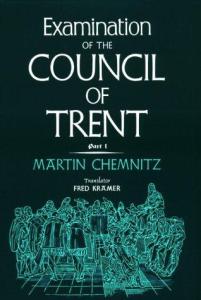
One of the greatest defenses of the catholicity of the Lutheran reformation.
Second, it should be pretty obvious to all of us that tradition is not a nothing either. In Martin Chemnitz’s great work critiquing the Roman Catholic Council of Trent, what he wrote clearly indicates the Lutherans believed in “Holy Tradition.” (something the 1580 Lutheran Confessions, the Book of Concord, clearly attest to as well) A paper my pastor wrote some years ago nicely breaks down the issue:
“The concept of a contemporaneous existence of the Word of God in a corrupted verbal form, and a pure written form, spawned Chemnitz’s explanation of traditiones in the second locus, De traditionibus. Here he lists the first of eight different types of traditiones as…
- Scripture itself, i.e. the things that Christ and the Apostles preached orally and were later written down. Then follows:
- the faithful transmission of the Scriptures;
- the oral tradition of the Apostles (which by its very nature must agree with the contents of the New Testament canon);
- the proper interpretation of the Scriptures received from the Apostles and “Apostolic men”;
- dogmas that are not set forth in so many words in Scripture but are clearly apparent from a sampling of texts;
- the consensus of true and pure antiquity;
- rites and customs that are edifying and believed to be Apostolic, but cannot be proved from Scripture.
Chemnitz rejects only the eighth kind of tradition: traditions pertaining to faith and morals that cannot be proved with any testimony of Scripture; but which the Council of Trent commanded to be accepted and venerated with the same reverence and devotion as the Scripture.
The important element of this last of the traitiones appears not to be the fact that such traditions of faith and morals not provable from Scripture actually existed, but that their status of equality with Scripture was foisted upon the church by the Council of Trent.” (italics mine) [i]
Now, this does not mean that confessional Lutherans do not need to do any “relational work” Beck says that Protestants must do. It just means that our overall context is – or should be! – much larger than the useful shorthand “Scripture alone” can capture. Again, the existence of things like Creeds and Confessions speak to this reality. Useful shorthand should not become unthinking slogans.
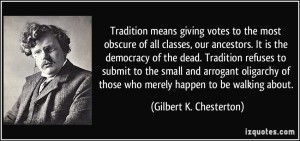
Not a bad way of putting it. Even if some things – critically – aren’t “up for a vote”. Jesus Christ is, after all, the same yesterday, now, and forever.
And speaking of such slogans, Beck says “Own your Protestantism… The ultimate authority in Protestantism isn’t the Bible, it’s the individual conscience.” But the problem is this: the idea of a “hemeneutical democracy” is clearly not only a Protestant issue – the progressive wing of the Roman Catholic Church has shown us that in spades in recent months. This kind of thing happens in quarters of Dreher’s own Eastern Orthodox Church as well (see here).
Is the issue really Martin Luther’s purported emphasis on the “individual conscience” – and the related problem “private interpretation”? Or, ultimately, is the issue whether or not the Bible is clear and understandable in its core message? The Ancient church said that it was clear. The Lutheran Confessions and those who adhere to them also assume “yes”. I tend to think that most everyone else – Protestant or not – will fudge on this critical issue in one way or another (see here for more)
FIN
Notes:
[i] P. Strawn, Cyril of Alexandria as a Source for Martin Chemnitz, in Die Patristik in der Bibelexegese des 16. Jahrhunderts, Wolfenbu”ttleler Forschungen, Bd. 85, Hrsg. v. David C. Steinmetz, Wiesbaden 1999, p. 213-14. See more excellent stuff from Strawn here. If you would like to read more of Strawn’s material, I used some of it in a debate with R.C. apologist Dave Armstrong in this series of posts (three parts – here is the last round). Of this debate, Armstrong said to me: “I think you have argued your case well. I commend you, and you have earned my respect, without question (including very much so, your cordiality)…”
Previous Post

December 5, 2015
2 Peter 3:9 Does Not Teach Particular Redemption
Next Post
December 10, 2015 The Call (Jacobs Study)
Browse Our Archives
Select a Category American Lutheran Classics Blog Posts Book Review Christian Dogmatics Course Church Resources Curtis Leins Dogmatic Theology Ethics FAQs Historical Theology Just & Sinner Publications Luther Quotations Podcast Sermons The American Lutheran Theological Journal The complete works of Revere Franklin Weidner Theology Proper Uncategorized Videos
Select a Month October 2019 September 2019 July 2019 June 2019 May 2019 April 2019 March 2019 February 2019 January 2019 December 2018 November 2018 October 2018 September 2018 July 2018 June 2018 May 2018 April 2018 March 2018 February 2018 January 2018 December 2017 November 2017 October 2017 September 2017 August 2017 July 2017 June 2017 May 2017 April 2017 March 2017 February 2017 January 2017 December 2016 November 2016 October 2016 September 2016 August 2016 July 2016 June 2016 May 2016 April 2016 March 2016 February 2016 January 2016 December 2015 November 2015 October 2015 September 2015 August 2015 July 2015 June 2015 May 2015 April 2015 March 2015 February 2015 January 2015 December 2014 November 2014 October 2014 September 2014 August 2014 July 2014 June 2014 May 2014
Follow Us!
TAKE THE
Religious Wisdom Quiz
Who taught, "Love your enemies and pray for those who persecute you"?
Select your answer to see how you score.
John Paul Jesus James
Related posts from Just and Sinner

35 (or 33) Christian Theses (and Core Assumptions)...

The First Issue of ALTJ Now Available for...

Gradually Embracing Jack Kevorkian's World?: Christians and Death...

Fighting Critical Theory Approaches in the Academic Library...
TRENDING AT PATHEOS Evangelical

The REST of Your Life: A Creative Wrestles...
This week I had a conversation with a good friend from church....

How the author of the world's best hymn...
I've been working with John Newton for a while now. This makes...

Long before this Lectio Divina, Psalm 130 - the song - started...

What About the Trees? Another Living Parable
After I finished writing the last article about falling leaves as a...

Why Classical Education Is a Conversation, Not a...
Come and Read: Joy in Classical Education When I was a little...

Cornell University has received a great deal of negative publicity and intense...
view all Evangelical blogs
Ad-Free & Subscriber Log-In Subscription Support
- About Us
- 2026 Calendar
- Videos
- Podcasts
- Library of World Religions
- Faith In Media Tracker
- Advertise With Us
- Write for Us
- Privacy Policy
- Terms of Service
- Do Not Sell My Data
- Contact Us
- Radiant Digital
- Manage Newsletter Subscriptions
- Unsubscribe From Notifications
- Sitemap
Copyright 2008-2026, Patheos. All rights reserved.
Subscription Support Ad-Free & Subscriber Log-In
Follow Patheos