
BuddhistCatholicContemplativeEvangelicalGeneral ChristianHinduJewishLatter-day SaintMuslimNew VisionsProgressive Christian
Beliefs
- Buddhist
- Catholic
- Contemplative
- Evangelical
- General Christian
- Hindu
- Jewish
- Latter-day Saint
- More Voices
- Muslim
- New Visions
- Pagan
- Progressive Christian
Topics
- Religion News
- Food and Religion
- Sports and Religion
- Religious Art
- Religious Music and Entertainment
- Religious Events
- History and Religion
- Style and Religion
- Politics and Religion
- Women in Religion
- Recreation Outdoors and Religion
- Business Finance and Religion
- Careers Workplace and Religion
- Education and Religion
- Family Parenting and Religion
- Health Fitness and Religion
- Home and Religion
- Relationships and Religion
- Technology and Religion
- Travel and Religion
Columnists
- Buddhist Columnists
- Business Finance and Religion Columnists
- Careers Workplace and Religion Columnists
- Catholic Columnists
- Contemplative Columnists
- Education and Religion Columnists
- Evangelists Columnists
- Family Parenting and Religion Columnists
- General Christian Columnists
- Health Fitness and Religion Columnists
- Hindu Columnists
- History and Religion Columnists
- Home and Religion Columnists
- Jewish Columnists
- More Voices Columnists
- Latter Day Columnists
- Muslim Columnists
- New Visions Columnists
- Nonreligious Columnists
- Pagan Columnists
- Politics and Religion Columnists
- Progressive Columnists
- Recreation Outdoors and Religion Columnists
- Relationships and Religion Columnists
- Religion News Columnists
- Religious Art Columnists
- Religious Events Columnists
- Religious Music and Entertainment Columnists
- Sports and Religion Columnists
- Style and Religion Columnists
- Technology and Religion Columnists
- Travel and Religion Columnists
- Women in Religion Columnists
Resource Library
- 2026 Calendar
- Library of World Religions
- The 100 Most Holy Places on Earth
- Patheos Answers
- Podcasts
- Videos
- Faith Leaders Database
- Anglican Episcopalian
- Bahai
- Baptist
- Buddhism
- Christianity
- Confucianism
- Eastern Orthodoxy
- Hinduism
- Holiness and Pentecostal
- ISKCON
- Islam
- Judaism
- Lutheran
- Methodist
- The Church of Jesus Christ of Latter-day Saints
- New Age
- Paganism
- Presbytarian and Reformed
- Protestantism
- Religion Behind the Scenes
- Roman Catholic
- Scientology
- Shia Islam
- Sikhism
- Sufism
- Sunni Islam
- Taoism
- Zen
- See all religions
Research Tools
 Ad-Free & Subscriber Log-In Subscription Support
Ad-Free & Subscriber Log-In Subscription Support
Follow Patheos 

- Trending:
- Forgiveness
- |
- Marriage
- |
- Consciousness
- |
- Death Penalty
- |
- Election
- |
- Halloween
 Just and Sinner
- Home
- Evangelical
- Distinguo brevis – Mannermaa, Osiander, and Eastern Orthodoxy
Distinguo brevis – Mannermaa, Osiander, and Eastern Orthodoxy
Last updated on: June 30, 2014 at 11:42 pm by georgefields
Distinguo brevis – Mannermaa, Osiander, and Eastern Orthodoxy 2014-06-30T23:42:52-06:00 georgefields
Patheos Explore the world's faith through different perspectives on religion and spirituality! Patheos has the views of the prevalent religions and spiritualities of the world.
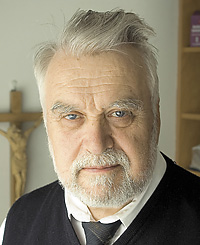
…starting in medias res.
The reason why Tuomo Mannermaa’s article is controversial is less theological than political and cultural, though there may be a theological component to it. Part of Mannermaa’s thesis is that Luther’s very realistic understanding of the atonement was forgotten and therefore not present in the Formula of Concord, and that therefore there exists a chasm between Luther and the Formula, as well as Luther and Chemnitz, on the nature of deification. He finds this chasm to be spelled out particularly in the Formula’s condemnation of Osiandrianism.
What Mannermaa fails to see, according to my opinion, is that the Formula does not condemn Osiander’s soteriological realism, but rather it condemns Osiander on two points: firstly, that Osiander taught that Christ’s presence in us is only according to the divine nature, and not according to both, as Lutheran Christology would demand (this topic would be dealt with at length in Chemnitz’s De Duabus Naturis in Christo), and secondly, that Osiander found that logical “reason” for our justification to be found not in the judgment upon Christ qua Mankind on the cross, but upon our inner renewal through the indwelling of Christ. The problem of Osiandrianism is that of “who is the Father looking at when He declares ‘not guilty’”? Is He looking at you with the divine nature renewing you from within (an idea which seems almost a Lutheranized form of Catholicism’s “infused grace”), or is He looking at Christ as the first and fullness of a new humanity?
The second reason for the controversy over Mannermaa is that since his entire theology was developed in the crucible of the dialogue with the Eastern Orthodox, there is suspicion that when Mannermaa speaks of Luther’s doctrine of deification, he is actively trying to make it sound just a little more Orthodox so as to make it appealing to them, as opposed to allowing it to sit in its full Lutheran glory. The main way he does this is in (seemingly) repeating Osiander’s mistake (and the mistake of the Orthodox) and finding the locus of justification in the presently-living Christian who has Christ within him by faith, and not in Christ on the cross, who has Mankind in Him.
The primary question of the Lutheran doctrine of the Forensic Atonement is this: where does God find you righteous?
- If the answer is, “On the cross, where Christ was declared both guilty and righteous, Him becoming one with our guilt, us becoming one with His righteousness,” then you are a Lutheran.
- If the answer is, “Within the sinner who possess Christ by faith and is renewed by Christ’s divinity,” then you are an Osiandrian.
- If the answer is, “Within the sinner who has Christ within him, both as a renewal and as a pledge of God’s good will,” then you are a follower of the Finnish Interpretation.
- If the answer is, “Within the sinner who by participation in the divine energies is purified of all sin and so made pleasing to God,” then you are Eastern Orthodox.
I argue, of course, the first, and so you can see how it differs from the others.
The question would again be put: by what merits are you declared to be righteous?
- If the answer is: “By the merits of Christ depicted in His Incarnation, obedience, passion, death and resurrection, in which we all participate through baptism in faith, and which are truly made ours,” then you are a Lutheran.
- If the answer is: “By new merits gained by Christ through and in us by his indwelling,” then you are some sort of Osiandrian-Finn.
- If the answer is: “By new merits (though they would never use the term merit…) gained by myself as a renewed man through theosis,” then you are Orthodox.
Again, I argue the first.
The final and abiding rule of “what makes it truly Lutheran, &c.” is the question of, “Did Christ finish it already, or is there something to be done, even if Christ ‘does it in or through us’?” The Lutheran answer is to say with Christ “It is finished.” Whether it be justification, sanctification (in the broad sense), deification, glorification, we must be able to say that with Christ in His life, “It is finished.”
+SDG+

Browse Our Archives
Select a Category American Lutheran Classics Blog Posts Book Review Christian Dogmatics Course Church Resources Curtis Leins Dogmatic Theology Ethics FAQs Historical Theology Just & Sinner Publications Luther Quotations Podcast Sermons The American Lutheran Theological Journal The complete works of Revere Franklin Weidner Theology Proper Uncategorized Videos
Select a Month October 2019 September 2019 July 2019 June 2019 May 2019 April 2019 March 2019 February 2019 January 2019 December 2018 November 2018 October 2018 September 2018 July 2018 June 2018 May 2018 April 2018 March 2018 February 2018 January 2018 December 2017 November 2017 October 2017 September 2017 August 2017 July 2017 June 2017 May 2017 April 2017 March 2017 February 2017 January 2017 December 2016 November 2016 October 2016 September 2016 August 2016 July 2016 June 2016 May 2016 April 2016 March 2016 February 2016 January 2016 December 2015 November 2015 October 2015 September 2015 August 2015 July 2015 June 2015 May 2015 April 2015 March 2015 February 2015 January 2015 December 2014 November 2014 October 2014 September 2014 August 2014 July 2014 June 2014 May 2014
Follow Us!
TAKE THE
Religious Wisdom Quiz
In Revelation, what does John eat that is sweet in his mouth but sour in his stomach?
Select your answer to see how you score.
A little scroll The word of God A sealed book Honey
Related posts from Just and Sinner

Theosis and Christification Explained
C.F.W. Walther on the Mystical Union and Pentecost
I Am Not Your Pastor, and That's a...

TRENDING AT PATHEOS Evangelical

The REST of Your Life: A Creative Wrestles...
This week I had a conversation with a good friend from church....

How the author of the world's best hymn...
I've been working with John Newton for a while now. This makes...

Long before this Lectio Divina, Psalm 130 - the song - started...

What About the Trees? Another Living Parable
After I finished writing the last article about falling leaves as a...

Why Classical Education Is a Conversation, Not a...
Come and Read: Joy in Classical Education When I was a little...

Cornell University has received a great deal of negative publicity and intense...
view all Evangelical blogs
Ad-Free & Subscriber Log-In Subscription Support
- About Us
- 2026 Calendar
- Videos
- Podcasts
- Library of World Religions
- Faith In Media Tracker
- Advertise With Us
- Write for Us
- Privacy Policy
- Terms of Service
- Do Not Sell My Data
- Contact Us
- Radiant Digital
- Manage Newsletter Subscriptions
- Unsubscribe From Notifications
- Sitemap
Copyright 2008-2026, Patheos. All rights reserved.
Subscription Support Ad-Free & Subscriber Log-In
Follow Patheos