
BuddhistCatholicContemplativeEvangelicalGeneral ChristianHinduJewishLatter-day SaintMuslimNew VisionsProgressive Christian
Beliefs
- Buddhist
- Catholic
- Contemplative
- Evangelical
- General Christian
- Hindu
- Jewish
- Latter-day Saint
- More Voices
- Muslim
- New Visions
- Pagan
- Progressive Christian
Topics
- Religion News
- Food and Religion
- Sports and Religion
- Religious Art
- Religious Music and Entertainment
- Religious Events
- History and Religion
- Style and Religion
- Politics and Religion
- Women in Religion
- Recreation Outdoors and Religion
- Business Finance and Religion
- Careers Workplace and Religion
- Education and Religion
- Family Parenting and Religion
- Health Fitness and Religion
- Home and Religion
- Relationships and Religion
- Technology and Religion
- Travel and Religion
Columnists
- Buddhist Columnists
- Business Finance and Religion Columnists
- Careers Workplace and Religion Columnists
- Catholic Columnists
- Contemplative Columnists
- Education and Religion Columnists
- Evangelists Columnists
- Family Parenting and Religion Columnists
- General Christian Columnists
- Health Fitness and Religion Columnists
- Hindu Columnists
- History and Religion Columnists
- Home and Religion Columnists
- Jewish Columnists
- More Voices Columnists
- Latter Day Columnists
- Muslim Columnists
- New Visions Columnists
- Nonreligious Columnists
- Pagan Columnists
- Politics and Religion Columnists
- Progressive Columnists
- Recreation Outdoors and Religion Columnists
- Relationships and Religion Columnists
- Religion News Columnists
- Religious Art Columnists
- Religious Events Columnists
- Religious Music and Entertainment Columnists
- Sports and Religion Columnists
- Style and Religion Columnists
- Technology and Religion Columnists
- Travel and Religion Columnists
- Women in Religion Columnists
Resource Library
- 2026 Calendar
- Library of World Religions
- The 100 Most Holy Places on Earth
- Patheos Answers
- Podcasts
- Videos
- Faith Leaders Database
- Anglican Episcopalian
- Bahai
- Baptist
- Buddhism
- Christianity
- Confucianism
- Eastern Orthodoxy
- Hinduism
- Holiness and Pentecostal
- ISKCON
- Islam
- Judaism
- Lutheran
- Methodist
- The Church of Jesus Christ of Latter-day Saints
- New Age
- Paganism
- Presbytarian and Reformed
- Protestantism
- Religion Behind the Scenes
- Roman Catholic
- Scientology
- Shia Islam
- Sikhism
- Sufism
- Sunni Islam
- Taoism
- Zen
- See all religions
Research Tools
 Ad-Free & Subscriber Log-In Subscription Support
Ad-Free & Subscriber Log-In Subscription Support
Follow Patheos 

- Trending:
- Forgiveness
- |
- Marriage
- |
- Consciousness
- |
- Death Penalty
- |
- Election
- |
- Halloween
 Just and Sinner
- Home
- Evangelical
- Are Evolutionary Ethics Good for a Nation?
Are Evolutionary Ethics Good for a Nation?
Last updated on: July 4, 2017 at 8:08 am by nathanrinne
Are Evolutionary Ethics Good for a Nation? 2017-07-04T08:08:53-06:00 nathanrinne
Patheos Explore the world's faith through different perspectives on religion and spirituality! Patheos has the views of the prevalent religions and spiritualities of the world.

Why is this man, for whom “the Darwinian world is more real than the physical world,” promoting morality compatible with Christianity?
The famous 20th century theologian Karl Barth, perhaps largely because of his preferred political orientation[i], made a very interesting point:
Historically speaking, certainly prior to the 20th century in the West, elites concerned with keeping stability and order were more than happy to use the Bible to help them rule.
As Barth argued more specifically, here the Bible had been brought under human control and reason. He said that it had come to be seen not so much as revelation from God, but rather as a part of the “natural knowledge” of God that every man could discover by his own rational powers. In his view, “the Bible grounded upon itself apart from the mystery of Christ and the Holy Ghost… was no longer a free and spiritual force, but an instrument of human power” (1/2:522-525).
One might, like myself, want to further explore the contours of Barth’s argument – just what, given the challenges of human governing, constitutes the salutary “use” of the Bible by a political leader from one that is not? Might, for example, one unbelieving ruler’s use of it be less culpable than another’s?
In any case, it is unarguable that, in the West, rulers in the past thought that they had to rule their people by using the Bible. And when it comes to this, we might wonder: “Is this so bad? What’s the big deal? Isn’t it good that rulers would engender respect for the Bible and use it to help them rule? And of course, since they were politicians, who wouldn’t expect them to be tempted to misinterpret the text to their own advantage from time to time?”[ii]

“It ain’t those parts of the Bible that I can’t understand that bother me, it is the parts that I do understand.”
The fact of the matter, contra Barth, is that there is much wisdom in the Bible that even nonbelievers can recognize. For example, one need not be a Christian – or even a conservative politician – to recognize that until being re-oriented by Christian conviction, the world really did reveal a general lack of concern regarding children, women, and the practice of slavery (see my wider article about how Christian values and sentiments have been formed in Western nations in spite of a lack of belief in Christianity).
Therefore, I contend that we simply should not be surprised when even hostile witnesses like atheists or non-Christians recognize that the morality the Bible upholds – and even the “Fear of God” itself — are important for maintaining a civilization that values human freedom (another example).
In other words, this is a very human and existential matter. One can’t continually ignore creation’s “design specifications” and expect that only good things will come. We all, for example, need to eat to live and we all need to uphold certain standards of what amounts to universally preferable behavior (see this argued for more fully here). We all, inevitably, will “should” one another, and we need to do that “shoulding” rightly.

Karl might say: “I’m looking at you Jordan Peterson”….
Here Jordan Peterson, who I introduced in a past post and the topic of a very interesting recent piece in the Huffington Post, is an interesting example. Peterson has got the ear of American conservatives (and he just recently did a big talk for Canadian conservatives called “12 principles for a 21st century conservatism“). And his whole intellectual program is built on the assumption that the evolutionary story is true – a story which has, in the past, been thought to be problematic when it comes to implications for human moral behavior.
Peterson would vigorously contend vs. this idea – and he has all kinds of reasons that he can martial to support his view.[iii] In fact, from within his understanding of the evolutionary framework he upholds the Bible as critical to Western civilization and insists that getting morality right – evidently with real rights and wrongs that apply across the board – is really the most important and consequential thing human beings can be concerned with.
And – very interestingly – an exploration of his views of right and wrong reveals they map rather closely with the traditionally-held views of Christian churches.[iv]
For me though, the interesting, long-term question is this: is there any reason why the moral views that Peterson holds must remain stable? Even though Jordan Peterson might make this or that moral claim now, is there any reason why those who follow him would need to do the same?
One highly significant aspect of Peterson’s program is that the goal of the morality he speaks of is oriented towards earthly survival – not just of individual, or perhaps, even one’s group, but ultimately encompassing humanity more broadly. In sum, everything about our morality – absolutely everything – must come to be seen through this controlling lens.
Some might be thinking: “Isn’t this what Christianity is all about though? Being good to gain God’s favor in this world, surviving vs. ones’ enemies, and to be able to survive His final judgment?” Actually, no. In fact, this is a total perversion of Christianity, which ultimately works in the world for one’s neighbor’s sake from a place of peace with God.[v] In Him, we have survived our sin, our first and second deaths, and the oppression of the demonic, and hence have nothing to fear — even in a fallen world racked by suffering.

Not surviving you say? Well, this act is intentional — and it defeats our enemies, giving us peace with God. The resurrection removes all doubt.
As a 1930s church document written up vs. the Nazis, the Bethel Confession, put it:
“Struggle is not the basic principle of the original creation, and a fighting attitude is therefore not a commandment by God established by the original creation.”
What do Christians who have come to support the evolutionary theory have to say about this? Presumably folks like the popular Evangelical Bishop of the Church of England N.T. Wright – as well as other Christian theistic evolutionists – would agree that the Bethel Confession is right, but how can they? For where is their Eden? Their “original creation”? History has significance because where we are going has something to do with where we started. The “what happened?” is momentous.
Perhaps it can make sense that Peterson, starting from and coming from his evolutionary perspective, thinks that matters of right and wrong are intimately connected with survival.
…but what do theistic evolutionists like Wright have to say about why their view of evolution – featuring a morality not oriented towards earthly survival but rather God and His purposes – should be favored? What are the reasons that they give for why the ethical framework they wish to promote should be more important than any “survival of the fittest” – even seemingly more civilized and palatable versions of survival of the fittest like Peterson’s?
That’s what I want to know. I imagine that they are going to say that this simply comes down to us needing to think about what it means to be human, that we are rational animals that give reasons for our views and can work together, the responsibility to respect the history of religious and philosophical thought, etc., etc.
But Peterson can say all of that as well, and does. So what, other than intellectual inconsistency (“No, we must not say that the goal of our morality is survival, for the individual, group, or otherwise!”), makes them say that we should not see life primarily in terms of survival?
Why is it not about this? Why is not survival, and survival alone, when it comes to determining our morality?
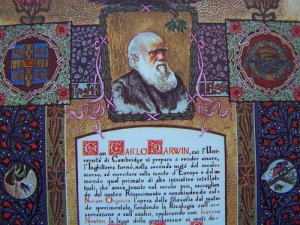
Saint Darwin? Not so fast.
Perhaps some of the more conservative, evolution-supporting churches disagree with the way that Dietrich Bonhoeffer and those who authored the Bethel Confession put it back in the 1930s?
In other words, maybe from the very beginning of humanity the principle of struggle – for survival – was there right from the beginning? There never has been a real Eden?
And of course, when combined not with an Aristotelian frame (where there are some things, i.e. “forms” or “natures” on earth that are good and are eternal, never changing) but with a Hegelian/Darwinian frame, this means that in order to survive, the fit are going to need to change. And if this is the case, what is the good reason that their morality, or behavior, would not need to change – and perhaps quickly?
This means that there is no reason that the moral views Peterson endorses – again, with practical survival being the modus operandi of ethics – should remain stable. What is advantageous and good for humanity as a whole yesterday may not be good tomorrow.[vi]
In other words, the evolutionary framework cannot be re-jiggered to prevent it from being acidic to conservative frames of mind.[vii]

“The philosopher Daniel Dennett, for example, describes Darwinism as a universal acid, dissolving all our traditional concepts, such as religion…” (see here).
Even from the perspective of human reason, Christianity and its Bible can only be used by “wise” elites to help govern our nations or guide our cultures so much and for so long – to perhaps protect our society from the internal and external enemies that threaten it for so long. Insofar as a Darwinian-infused Hegelianism lies at the foundation of our thought – insofar as this is the most real story – Christianity will be of no real help.
For His Kingdom is, ultimately, in this world — though oh so humbly veiled — but not of it.
Man cannot serve two masters and God is not mocked. He is, however, mocking us already through – and ironically, through reason alone.
To say the least, this presents some real issues for Christians – not to mention all of humanity.
We need something strong, don’t we? Something stable. Something we can be confident of.
Indeed. We need the Lex Aeterna (the Eternal Law) – and even more, the One who fulfills the Lex Aeterna on our behalf.

And Dr. Peterson — if you are listening, remember that the Apostle Paul says that “if even an angel of heaven…” (referring to this and this)…
FIN
Jordan Peterson, Mark Twain and Barth all from Wikipedia (CC by 2.0).
Notes
[i] Socialism, vis a vis what one has recently called a “a totally crude patriarchal dirt-and-toil society.”
[ii] Again, we might think: “Is this really so bad? Aren’t the stability and order that might come out of this good things?” “Well, not if it means living in a state like Nazi Germany or North Korea!,” you might say! On the other hand, perhaps even that is preferable to utter chaos as well (an interesting debate there).
[iii] One does not need to listen to any of his major lectures or interviews (try this one for a lot of depth) for very long in order to recognize that his understanding of what he calls the “dominance hierarchy” is a very nuanced and well-thought-out position.
[iv] Peterson believes in real good and evil (see 2:30:00 here). In his third recent religion lecture (around 2:13:30), he said, followed by rousing applause: “Empirical data says it’s much better for kids to have two parents. Marriage is not for the people getting married. It’s for the children. If you can’t handle that, grow the hell up. Seriously.”
Also, when it comes to a topic like gay marriage, the comment Peterson made on an article in the Atlantic called “The Gay Guide to Wedded Bliss,” namely:
“When gay marriage normalizes in the US, as it has in Sweden, then the divorce rate will be higher among gay partners, just as it is in Sweden. But why let facts bother you? Andersson, Gunnar (February 2006). “The Demographics of Same-Sex ‘Marriages’ in Norway and Sweden” (PDF). Demography 43 (1): 79–98.”
….would suggest that he is somewhat willing to question the popular narrative here. Around the time I was writing this post, he also said the following: “Intact heterosexual two-parent families constitute the necessary bedrock for a stable polity.” Also note his comments about people living together without being married (again, with rousing applause, at 1:30 here), his comments having children (see here) and on abortion (see here), as well as his comments on transgender issues in this post.
[v] At the same time, given the way that the issue of survival is makes itself known to us existentially, it’s not hard for a Christian to see some wisdom in this. That said, for Christian believers who have peace with God (Rom. 5:1 and I John 5:12-13), life is not ultimately about our physical – or even spiritual – survival.
[vi] As is clear from his first interview with Sam Harris and here (this one is a shorter clip), Peterson is a full-blown evolutionary pragmatist who has difficulty saying that any one statement a person might make is true, period (this fits with the views of Hegel, who is often appropriated by figures not only on the left, but on the right – see here for information on this phenomena in general and here for thoughts about Peterson’s possible debt to Hegel).
In sum, it seems that for him, in some sense, truth equals what works and fitness (taking into account what he says about what he calls the “dominance hierarchy”).
In his third religion lecture (1:34:30) he says that the postmodernists are right that there are an infinite number of interpretations of most anything, but they are wrong in saying that none of them are preferable….
I say “exactly,” – but why are some preferable? For Peterson, postmodernism and relativism are not reasonable because there are social and material constraints in the universe that can’t be overcome and therefore must be taken into consideration (therefore some interpretations are preferable)….
But what about the “fact” of evolution, whose ways proponents admit they do not fully understand? (see footnote below)
For me, some interpretations are preferable because of what the Author said and the fact that language is stable, which “works” because there are many things in the creation that are not necessarily eternal, but nevertheless stable and consistent until the life to come (vs. Hegel, again, see here).
While I do not deny that there are real Christian believers can fully embrace the evolutionary narrative and remain real Christian believers, I think many persons, even those who are not overly literalistic, will conclude that they must embrace one view or the other. My own view on the viability of the evolutionary narrative – as one who is quite aware of what is put forth as the best evidence – is one of rather severe skepticism and doubt.
Here, I suggest that voices like David Berlinski’s are worthy of our respect and consideration.
[vii] An additional question we need to ask today is why the evolutionary account of reality should necessarily favor truth-telling (read on). Peterson is commendable for his focus on personal honesty in one’s life (he notes that we are the only creatures who “can truly deceive,” and gravely says “Do not say what you believe to be false”), and for his fighting vs. postmodernism/relativism. That said, note that if postmodernism is only constrained by physical and social reality and honesty rules the day, any real stability still cannot be assured. The reason for this is that if evolution is our key “what happened” account, it also has something important to say about where we are going. In Peterson’s account, in this “I suffer therefore I am world,” we basically find things to be meaningful and also create, albeit slowly over time, things, ideas, gods, etc. to survive (he’d be quick to note that this does not mean there is no god). The questions arise: 1) Why should we care deeply beyond our in-group, racial, ethnic, or ideological? ; 2) Why isn’t postmodernism – with its steering us towards more freedom for us in our in-group of other postmodernists – simply a luxury item must of us can’t afford yet? ; 3) If this naturalistic story is the key “what happened” truth, why might not some overcoming of traditional morals – and the accompanying guilt – be the next step in human evolution? ; 4) Finally, even if think 1-3 are true because evolution is true, if evolutionary fitness is also somehow the truth (pragmatically – in this third religion lecture, he says*:* “What’s real from the Darwinian perspective is plenty real enough, because we’re alive and everything….”[1:53:20]), how does it not, empowered by modern physical theories, ultimately throw the truth of everything – including evolution itself – into question, finally just making us the truth?
(He has also said that he doesn’t think you can dispute the proposition that the longer something [here he means an idea, a myth/story] has had a selection effect on life the more real it is. It’s the fundamental axiom of Darwinian biology. The Darwinian world is more real than the physical world. [1:59:00]). Also in his second interview with Sam Harris he says: “The most permanent things are the most real.” See also his comment recorded in my previous post talking about him regarding how “the things we see around us [are] lasting no time.”)
Previous Post

June 24, 2017
Faith and Reason in Luther, Zwingli, and Lutheranism
Next Post

July 7, 2017 Misconceptions about Lutheranism: A Response to James White
Browse Our Archives
Select a Category American Lutheran Classics Blog Posts Book Review Christian Dogmatics Course Church Resources Curtis Leins Dogmatic Theology Ethics FAQs Historical Theology Just & Sinner Publications Luther Quotations Podcast Sermons The American Lutheran Theological Journal The complete works of Revere Franklin Weidner Theology Proper Uncategorized Videos
Select a Month October 2019 September 2019 July 2019 June 2019 May 2019 April 2019 March 2019 February 2019 January 2019 December 2018 November 2018 October 2018 September 2018 July 2018 June 2018 May 2018 April 2018 March 2018 February 2018 January 2018 December 2017 November 2017 October 2017 September 2017 August 2017 July 2017 June 2017 May 2017 April 2017 March 2017 February 2017 January 2017 December 2016 November 2016 October 2016 September 2016 August 2016 July 2016 June 2016 May 2016 April 2016 March 2016 February 2016 January 2016 December 2015 November 2015 October 2015 September 2015 August 2015 July 2015 June 2015 May 2015 April 2015 March 2015 February 2015 January 2015 December 2014 November 2014 October 2014 September 2014 August 2014 July 2014 June 2014 May 2014
Follow Us!
TAKE THE
Religious Wisdom Quiz
Which mountain did this Abraham's near-sacrifice event occur on?
Select your answer to see how you score.
Mount Ararat Mount Sinai Mount Moriah Mount Carmel
Related posts from Just and Sinner

Fighting Critical Theory Approaches in the Academic Library...

Is Andres Manuel Lopez Obrador the “Moral Shakedown...

Is Today’s Christianity Increasingly Filtered Through Marxist Categories?
TRENDING AT PATHEOS Evangelical

The REST of Your Life: A Creative Wrestles...
This week I had a conversation with a good friend from church....

How the author of the world's best hymn...
I've been working with John Newton for a while now. This makes...

Long before this Lectio Divina, Psalm 130 - the song - started...

What About the Trees? Another Living Parable
After I finished writing the last article about falling leaves as a...

Why Classical Education Is a Conversation, Not a...
Come and Read: Joy in Classical Education When I was a little...

Cornell University has received a great deal of negative publicity and intense...
view all Evangelical blogs
Ad-Free & Subscriber Log-In Subscription Support
- About Us
- 2026 Calendar
- Videos
- Podcasts
- Library of World Religions
- Faith In Media Tracker
- Advertise With Us
- Write for Us
- Privacy Policy
- Terms of Service
- Do Not Sell My Data
- Contact Us
- Radiant Digital
- Manage Newsletter Subscriptions
- Unsubscribe From Notifications
- Sitemap
Copyright 2008-2026, Patheos. All rights reserved.
Subscription Support Ad-Free & Subscriber Log-In
Follow Patheos