
BuddhistCatholicContemplativeEvangelicalGeneral ChristianHinduJewishLatter-day SaintMuslimNew VisionsProgressive Christian
Beliefs
- Buddhist
- Catholic
- Contemplative
- Evangelical
- General Christian
- Hindu
- Jewish
- Latter-day Saint
- More Voices
- Muslim
- New Visions
- Pagan
- Progressive Christian
Topics
- Religion News
- Food and Religion
- Sports and Religion
- Religious Art
- Religious Music and Entertainment
- Religious Events
- History and Religion
- Style and Religion
- Politics and Religion
- Women in Religion
- Recreation Outdoors and Religion
- Business Finance and Religion
- Careers Workplace and Religion
- Education and Religion
- Family Parenting and Religion
- Health Fitness and Religion
- Home and Religion
- Relationships and Religion
- Technology and Religion
- Travel and Religion
Columnists
- Buddhist Columnists
- Business Finance and Religion Columnists
- Careers Workplace and Religion Columnists
- Catholic Columnists
- Contemplative Columnists
- Education and Religion Columnists
- Evangelists Columnists
- Family Parenting and Religion Columnists
- General Christian Columnists
- Health Fitness and Religion Columnists
- Hindu Columnists
- History and Religion Columnists
- Home and Religion Columnists
- Jewish Columnists
- More Voices Columnists
- Latter Day Columnists
- Muslim Columnists
- New Visions Columnists
- Nonreligious Columnists
- Pagan Columnists
- Politics and Religion Columnists
- Progressive Columnists
- Recreation Outdoors and Religion Columnists
- Relationships and Religion Columnists
- Religion News Columnists
- Religious Art Columnists
- Religious Events Columnists
- Religious Music and Entertainment Columnists
- Sports and Religion Columnists
- Style and Religion Columnists
- Technology and Religion Columnists
- Travel and Religion Columnists
- Women in Religion Columnists
Resource Library
- 2026 Calendar
- Library of World Religions
- The 100 Most Holy Places on Earth
- Patheos Answers
- Podcasts
- Videos
- Faith Leaders Database
- Anglican Episcopalian
- Bahai
- Baptist
- Buddhism
- Christianity
- Confucianism
- Eastern Orthodoxy
- Hinduism
- Holiness and Pentecostal
- ISKCON
- Islam
- Judaism
- Lutheran
- Methodist
- The Church of Jesus Christ of Latter-day Saints
- New Age
- Paganism
- Presbytarian and Reformed
- Protestantism
- Religion Behind the Scenes
- Roman Catholic
- Scientology
- Shia Islam
- Sikhism
- Sufism
- Sunni Islam
- Taoism
- Zen
- See all religions
Research Tools
 Ad-Free & Subscriber Log-In Subscription Support
Ad-Free & Subscriber Log-In Subscription Support
Follow Patheos 

- Trending:
- Forgiveness
- |
- Marriage
- |
- Consciousness
- |
- Death Penalty
- |
- Election
- |
- Halloween
 Just and Sinner
- Home
- Evangelical
- C. S. Lewis explains why we're publishing the American Lutheran Classics, et al…
C. S. Lewis explains why we're publishing the American Lutheran Classics, et al…
Last updated on: June 30, 2014 at 2:11 am by trentdemarest
C. S. Lewis explains why we're publishing the American Lutheran Classics, et al… 2014-06-30T02:11:03-06:00 trentdemarest
Patheos Explore the world's faith through different perspectives on religion and spirituality! Patheos has the views of the prevalent religions and spiritualities of the world.
for “The Kids”…
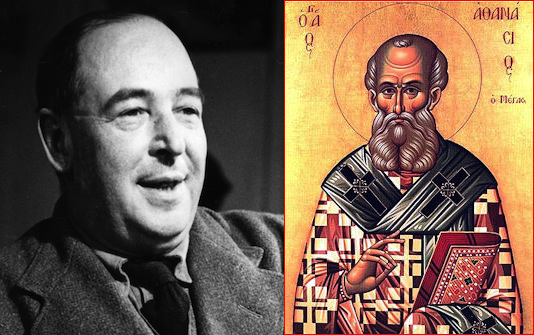
by C. S. Lewis // Introduction to De Incarnatione by St. Athanasius of Alexandria
There is a strange idea abroad that in every subject the ancient books should be read only by the professionals, and that the amateur should content himself with the modern books. Thus I have found as a tutor in English Literature that if the average student wants to find out something about Platonism, the very last thing he thinks of doing is to take a translation of Plato off the library shelf and read the Symposium. He would rather read some dreary modern book ten times as long, all about “isms” and influences and only once in twelve pages telling him what Plato actually said. The error is rather an amiable one, for it springs from humility. The student is half afraid to meet one of the great philosophers face to face. He feels himself inadequate and thinks he will not understand him. But if he only knew, the great man, just because of his greatness, is much more intelligible than his modern commentator. The simplest student will be able to understand, if not all, yet a very great deal of what Plato said; but hardly anyone can understand some modern books on Platonism. It has always therefore been one of my main endeavours as a teacher to persuade the young that firsthand knowledge is not only more worth acquiring than secondhand knowledge, but is usually much easier and more delightful to acquire.
This mistaken preference for the modern books and this shyness of the old ones is nowhere more rampant than in theology. Wherever you find a little study circle of Christian laity you can be almost certain that they are studying not St. Luke or St. Paul or St. Augustine or Thomas Aquinas or Hooker or Butler, but M. Berdyaev or M. Maritain or M. Niebuhr or Miss Sayers or even myself.
Now this seems to me topsy-turvy. Naturally, since I myself am a writer, I do not wish the ordinary reader to read no modern books. But if he must read only the new or only the old, I would advise him to read the old. And I would give him this advice precisely because he is an amateur and therefore much less protected than the expert against the dangers of an exclusive contemporary diet. A new book is still on its trial and the amateur is not in a position to judge it. It has to be tested against the great body of Christian thought down the ages, and all its hidden implications (often unsuspected by the author himself) have to be brought to light. Often it cannot be fully understood without the knowledge of a good many other modern books. If you join at eleven o’clock a conversation which began at eight you will often not see the real bearing of what is said. Remarks which seem to you very ordinary will produce laughter or irritation and you will not see why — the reason, of course, being that the earlier stages of the conversation have given them a special point. In the same way sentences in a modern book which look quite ordinary may be directed at some other book; in this way you may be led to accept what you would have indignantly rejected if you knew its real significance. The only safety is to have a standard of plain, central Christianity (“mere Christianity” as Baxter called it) which puts the controversies of the moment in their proper perspective. Such a standard can be acquired only from the old books. It is a good rule, after reading a new book, never to allow yourself another new one till you have read an old one in between. If that is too much for you, you should at least read one old one to every three new ones.
Every age has its own outlook. It is specially good at seeing certain truths and specially liable to make certain mistakes. We all, therefore, need the books that will correct the characteristic mistakes of our own period. And that means the old books. All contemporary writers share to some extent the contemporary outlook — even those, like myself, who seem most opposed to it. Nothing strikes me more when I read the controversies of past ages than the fact that both sides were usually assuming without question a good deal which we should now absolutely deny. They thought that they were as completely opposed as two sides could be, but in fact they were all the time secretly united—united with each other and against earlier and later ages—by a great mass of common assumptions. We may be sure that the characteristic blindness of the twentieth century — the blindness about which posterity will ask, “But how could they have thought that?” — lies where we have never suspected it, and concerns something about which there is untroubled agreement between Hitler and President Roosevelt or between Mr. H. G. Wells and Karl Barth. None of us can fully escape this blindness, but we shall certainly increase it, and weaken our guard against it, if we read only modern books. Where they are true they will give us truths which we half knew already. Where they are false they will aggravate the error with which we are already dangerously ill. The only palliative is to keep the clean sea breeze of the centuries blowing through our minds, and this can be done only by reading old books. Not, of course, that there is any magic about the past. People were no cleverer then than they are now; they made as many mistakes as we. But not the same mistakes. They will not flatter us in the errors we are already committing; and their own errors, being now open and palpable, will not endanger us. Two heads are better than one, not because either is infallible, but because they are unlikely to go wrong in the same direction. To be sure, the books of the future would be just as good a corrective as the books of the past, but unfortunately we cannot get at them.
I myself was first led into reading the Christian classics, almost accidentally, as a result of my English studies. Some, such as Hooker, Herbert, Traherne, Taylor and Bunyan, I read because they are themselves great English writers; others, such as Boethius, St. Augustine, Thomas Aquinas and Dante, because they were “influences.” George Macdonald I had found for myself at the age of sixteen and never wavered in my allegiance, though I tried for a long time to ignore his Christianity. They are, you will note, a mixed bag, representative of many Churches, climates and ages. And that brings me to yet another reason for reading them. The divisions of Christendom are undeniable and are by some of these writers most fiercely expressed. But if any man is tempted to think — as one might be tempted who read only contemporaries — that “Christianity” is a word of so many meanings that it means nothing at all, he can learn beyond all doubt, by stepping out of his own century, that this is not so. Measured against the ages “mere Christianity” turns out to be no insipid interdenominational transparency, but something positive, self-consistent, and inexhaustible. I know it, indeed, to my cost. In the days when I still hated Christianity, I learned to recognise, like some all too familiar smell, that almost unvarying something which met me, now in Puritan Bunyan, now in Anglican Hooker, now in Thomist Dante. It was there (honeyed and floral) in Francois de Sales; it was there (grave and homely) in Spenser and Walton; it was there (grim but manful) in Pascal and Johnson; there again, with a mild, frightening, Paradisial flavour, in Vaughan and Boehme and Traherne. In the urban sobriety of the eighteenth century one was not safe—Law and Butler were two lions in the path. The supposed “Paganism” of the Elizabethans could not keep it out; it lay in wait where a man might have supposed himself safest, in the very centre of The Faerie Queene and the Arcadia. It was, of course, varied; and yet — after all — so unmistakably the same; recognisable, not to be evaded, the odour which is death to us until we allow it to become life:
an air that kills
From yon far country blows.
We are all rightly distressed, and ashamed also, at the divisions of Christendom. But those who have always lived within the Christian fold may be too easily dispirited by them. They are bad, but such people do not know what it looks like from without. Seen from there, what is left intact despite all the divisions, still appears (as it truly is) an immensely formidable unity. I know, for I saw it; and well our enemies know it. That unity any of us can find by going out of his own age. It is not enough, but it is more than you had thought till then. Once you are well soaked in it, if you then venture to speak, you will have an amusing experience. You will be thought a Papist when you are actually reproducing Bunyan, a Pantheist when you are quoting Aquinas, and so forth. For you have now got on to the great level viaduct which crosses the ages and which looks so high from the valleys, so low from the mountains, so narrow compared with the swamps, and so broad compared with the sheep-tracks.
The present book is something of an experiment. The translation is intended for the world at large, not only for theological students. If it succeeds, other translations of other great Christian books will presumably follow. In one sense, of course, it is not the first in the field. Translations of the Theologia Germanica, the Imitation, the Scale of Perfection, and the Revelations of Lady Julian of Norwich, are already on the market, and are very valuable, though some of them are not very scholarly. But it will be noticed that these are all books of devotion rather than of doctrine. Now the layman or amateur needs to be instructed as well as to be exhorted. In this age his need for knowledge is particularly pressing. Nor would I admit any sharp division between the two kinds of book. For my own part I tend to find the doctrinal books often more helpful in devotion than the devotional books, and I rather suspect that the same experience may await many others. I believe that many who find that “nothing happens” when they sit down, or kneel down, to a book of devotion, would find that the heart sings unbidden while they are working their way through a tough bit of theology with a pipe in their teeth and a pencil in their hand.
This is a good translation of a very great book. St. Athanasius has suffered in popular estimation from a certain sentence in the “Athanasian Creed.” I will not labour the point that that work is not exactly a creed and was not by St. Athanasius, for I think it is a very fine piece of writing. The words “Which Faith except every one do keep whole and undefiled, without doubt he shall perish everlastingly” are the offence. They are commonly misunderstood. The operative word is keep; not acquire, or even believe, but keep. The author, in fact, is not talking about unbelievers, but about deserters, not about those who have never heard of Christ, nor even those who have misunderstood and refused to accept Him, but of those who having really understood and really believed, then allow themselves, under the sway of sloth or of fashion or any other invited confusion to be drawn away into sub-Christian modes of thought. They are a warning against the curious modern assumption that all changes of belief, however brought about, are necessarily exempt from blame. But this is not my immediate concern. I mention “the creed (commonly called) of St. Athanasius” only to get out of the reader’s way what may have been a bogey and to put the true Athanasius in its place. His epitaph is Athanasius contra mundum, “Athanasius against the world.” We are proud that our own country has more than once stood against the world. Athanasius did the same. He stood for the Trinitarian doctrine, “whole and undefiled,” when it looked as if all the civilised world was slipping back from Christianity into the religion of Arius — into one of those “sensible” synthetic religions which are so strongly recommended today and which, then as now, included among their devotees many highly cultivated clergymen. It is his glory that he did not move with the times; it is his reward that he now remains when those times, as all times do, have moved away.
When I first opened his De Incarnatione I soon discovered by a very simple test that I was reading a masterpiece. I knew very little Christian Greek except that of the New Testament and I had expected difficulties. To my astonishment I found it almost as easy as Xenophon; and only a master mind could, in the fourth century, have written so deeply on such a subject with such classical simplicity. Every page I read confirmed this impression. His approach to the Miracles is badly needed today, for it is the final answer to those who object to them as “arbitrary and meaningless violations of the laws of Nature.” They are here shown to be rather the re-telling in capital letters of the same message which Nature writes in her crabbed cursive hand; the very operations one would expect of Him who was so full of life that when He wished to die He had to “borrow death from others.” The whole book, indeed, is a picture of the Tree of Life — a sappy and golden book, full of buoyancy and confidence. We cannot, I admit, appropriate all its confidence today. We cannot point to the high virtue of Christian living and the gay, almost mocking courage of Christian martyrdom, as a proof of our doctrines with quite that assurance which Athanasius takes as a matter of course. But whoever may be to blame for that it is not Athanasius.
The translator knows so much more Christian Greek than I that it would be out of place for me to praise her version. But it seems to me to be in the right tradition of English translation. I do not think the reader will find here any of that sawdusty quality which is so common in modern renderings from the ancient languages. That is as much as the English reader will notice; those who compare the version with the original will be able to estimate how much wit and talent is presupposed in such a choice, for example, as “these wiseacres” on the very first page.
+SDG+
Previous Post

June 30, 2014
Romans 7:1-14
Next Post
June 30, 2014 Distinguo brevis - Mannermaa, Osiander, and Eastern Orthodoxy
Browse Our Archives
Select a Category American Lutheran Classics Blog Posts Book Review Christian Dogmatics Course Church Resources Curtis Leins Dogmatic Theology Ethics FAQs Historical Theology Just & Sinner Publications Luther Quotations Podcast Sermons The American Lutheran Theological Journal The complete works of Revere Franklin Weidner Theology Proper Uncategorized Videos
Select a Month October 2019 September 2019 July 2019 June 2019 May 2019 April 2019 March 2019 February 2019 January 2019 December 2018 November 2018 October 2018 September 2018 July 2018 June 2018 May 2018 April 2018 March 2018 February 2018 January 2018 December 2017 November 2017 October 2017 September 2017 August 2017 July 2017 June 2017 May 2017 April 2017 March 2017 February 2017 January 2017 December 2016 November 2016 October 2016 September 2016 August 2016 July 2016 June 2016 May 2016 April 2016 March 2016 February 2016 January 2016 December 2015 November 2015 October 2015 September 2015 August 2015 July 2015 June 2015 May 2015 April 2015 March 2015 February 2015 January 2015 December 2014 November 2014 October 2014 September 2014 August 2014 July 2014 June 2014 May 2014
Follow Us!
TAKE THE
Religious Wisdom Quiz
How many years did the Israelites wander in the wilderness?
Select your answer to see how you score.
40 years 100 years 25 years 10 years
Related posts from Just and Sinner

I Am Not Your Pastor, and That's a...
What Should the Christian Do With Wicked Desires...

Diagnosing Christian Bad Boy Syndrome
All Philosophy is Morality and Teleology – and...
TRENDING AT PATHEOS Evangelical

The REST of Your Life: A Creative Wrestles...
This week I had a conversation with a good friend from church....

How the author of the world's best hymn...
I've been working with John Newton for a while now. This makes...

Long before this Lectio Divina, Psalm 130 - the song - started...

What About the Trees? Another Living Parable
After I finished writing the last article about falling leaves as a...

Why Classical Education Is a Conversation, Not a...
Come and Read: Joy in Classical Education When I was a little...

Cornell University has received a great deal of negative publicity and intense...
view all Evangelical blogs
Ad-Free & Subscriber Log-In Subscription Support
- About Us
- 2026 Calendar
- Videos
- Podcasts
- Library of World Religions
- Faith In Media Tracker
- Advertise With Us
- Write for Us
- Privacy Policy
- Terms of Service
- Do Not Sell My Data
- Contact Us
- Radiant Digital
- Manage Newsletter Subscriptions
- Unsubscribe From Notifications
- Sitemap
Copyright 2008-2026, Patheos. All rights reserved.
Subscription Support Ad-Free & Subscriber Log-In
Follow Patheos