
BuddhistCatholicContemplativeEvangelicalGeneral ChristianHinduJewishLatter-day SaintMuslimNew VisionsProgressive Christian
Beliefs
- Buddhist
- Catholic
- Contemplative
- Evangelical
- General Christian
- Hindu
- Jewish
- Latter-day Saint
- More Voices
- Muslim
- New Visions
- Pagan
- Progressive Christian
Topics
- Religion News
- Food and Religion
- Sports and Religion
- Religious Art
- Religious Music and Entertainment
- Religious Events
- History and Religion
- Style and Religion
- Politics and Religion
- Women in Religion
- Recreation Outdoors and Religion
- Business Finance and Religion
- Careers Workplace and Religion
- Education and Religion
- Family Parenting and Religion
- Health Fitness and Religion
- Home and Religion
- Relationships and Religion
- Technology and Religion
- Travel and Religion
Columnists
- Buddhist Columnists
- Business Finance and Religion Columnists
- Careers Workplace and Religion Columnists
- Catholic Columnists
- Contemplative Columnists
- Education and Religion Columnists
- Evangelists Columnists
- Family Parenting and Religion Columnists
- General Christian Columnists
- Health Fitness and Religion Columnists
- Hindu Columnists
- History and Religion Columnists
- Home and Religion Columnists
- Jewish Columnists
- More Voices Columnists
- Latter Day Columnists
- Muslim Columnists
- New Visions Columnists
- Nonreligious Columnists
- Pagan Columnists
- Politics and Religion Columnists
- Progressive Columnists
- Recreation Outdoors and Religion Columnists
- Relationships and Religion Columnists
- Religion News Columnists
- Religious Art Columnists
- Religious Events Columnists
- Religious Music and Entertainment Columnists
- Sports and Religion Columnists
- Style and Religion Columnists
- Technology and Religion Columnists
- Travel and Religion Columnists
- Women in Religion Columnists
Resource Library
- 2026 Calendar
- Library of World Religions
- The 100 Most Holy Places on Earth
- Patheos Answers
- Podcasts
- Videos
- Faith Leaders Database
- Anglican Episcopalian
- Bahai
- Baptist
- Buddhism
- Christianity
- Confucianism
- Eastern Orthodoxy
- Hinduism
- Holiness and Pentecostal
- ISKCON
- Islam
- Judaism
- Lutheran
- Methodist
- The Church of Jesus Christ of Latter-day Saints
- New Age
- Paganism
- Presbytarian and Reformed
- Protestantism
- Religion Behind the Scenes
- Roman Catholic
- Scientology
- Shia Islam
- Sikhism
- Sufism
- Sunni Islam
- Taoism
- Zen
- See all religions
Research Tools
 Ad-Free & Subscriber Log-In Subscription Support
Ad-Free & Subscriber Log-In Subscription Support
Follow Patheos 

- Trending:
- Forgiveness
- |
- Marriage
- |
- Consciousness
- |
- Death Penalty
- |
- Election
- |
- Halloween
 Just and Sinner
- Home
- Evangelical
- Baptismus ubique et semper: Some reflections on Baptismal motifs in the Gospel narratives
Baptismus ubique et semper: Some reflections on Baptismal motifs in the Gospel narratives
Last updated on: September 28, 2014 at 12:56 am by trentdemarest
Baptismus ubique et semper: Some reflections on Baptismal motifs in the Gospel narratives 2014-09-28T00:56:52-06:00 trentdemarest
Patheos Explore the world's faith through different perspectives on religion and spirituality! Patheos has the views of the prevalent religions and spiritualities of the world.
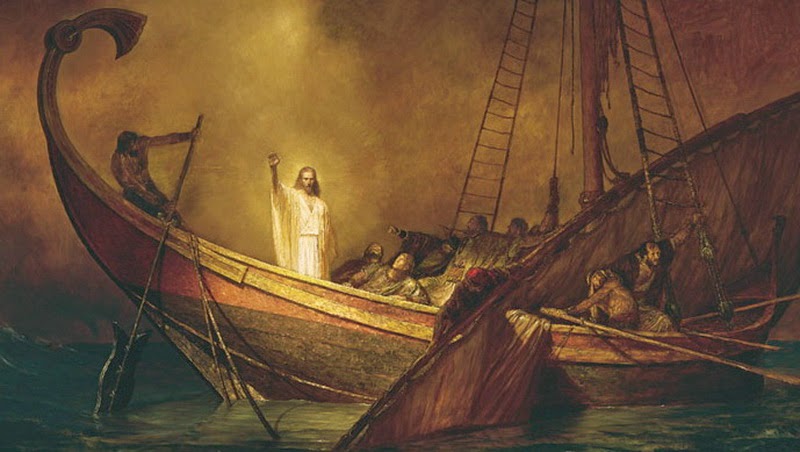
“Peace Be Still”; Arnold Friberg
There is surely some justice to the accusation (made in jest and in earnest) that whenever Lutherans see a reference to any trace bit of moisture in a Biblical passage, we immediately think it’s a reference to the sacrament of Baptism. Though I suppose this tendency could lead to silly eisegetical gymnastics, it’s actually a bit of a challenge to find a watery text that admits absolutely no typological reference to baptism—and if not to baptism, then to the sacraments generally. “Through the Baptism in the Jordan of Your beloved Son, Our Lord Jesus Christ,” opens Doctor Luther’s Flood Prayer, “You sanctified and instituted all waters to be a blessed flood, and a lavish washing away of sin.” I forget who said it: “Baptism isn’t like water; water is like Baptism.” Kind of in the same vein as, “Christ and the Church are not like a groom and a bride; a groom and a bride are like Christ and the Church.” All water is baptismal. Because of Christ.
Like light, there is something fundamentally mysterious about the elementality of water. Today we scour the universe with satellites looking for any hunk of stardust with the faintest trace of H2O. Why? Because it means (we think) that there might have been life there. To go on with the science (always a unwise thing for me to do), water is known as the “universal solvent”, a substance that will dissolve anything, given enough time (though Coke will do so much more quickly). On a macro level we behold with awe the power of water when it is imbued with kinetic energy: the unstoppable Niagara Falls, the explosive Old Faithful, the horrific tsunami.
While modern science’s quantized and quantified facsimile of the natural world is certainly interesting in its own right, it’s the wrong place to start. So let’s consider the significance of water to the Hebrew people. Like most of the ancients, the Hebrews (Israelites, Judeans, et al) saw water in a sort of dual light, both as a means of life and as a means of death: it cleansed and it destroyed; it nourished and it drowned. To the fishermen, traders, and other seafarers of Jesus’s day the Sea of Galilee was a mysterious and untameable creature, and as such it was accorded due respect and healthy fear. Though she might yield up gifts—fish to the fishermen, safe passage to the sailor, etc.—she was an unmerciful mistress when enraged. Deep water especially was seen as the “abyss”, the realm of the dead, and not without cause: events such as the Noachian Flood and the closing of the Red Sea upon Pharoah’s army ominously transfigured the sea into the embodiment of Sheol, a watery mass grave swimming with the souls of those smitten by the wrath of Yahweh. At various times during His ministry Our Lord identifies the Sea of Galilee in this way, both by precept and example.
“Who ever causes one of these little ones who believe in Me to sin, it would be better for him if a millstone were hung around his neck, and he were drowned in the depth of the sea,” Christ says in the Gospel according to St. Matthew, chapter 18 (SS. Mark and Luke also record this imprecation). “Woe to the world because of offenses! For offenses must come, but woe to that man by whom the offense comes!” This is just one of those passages of Scripture that interprets itself: don’t lead children away from Christ—and they’re all children. (Honestly, this verse put the fear of God in me when I was a teacher.)
When Christ heals the demon-possessed man (or the two men, as St. Matthew records) in the land of the Gadarenes, casting the evil spirits into the unclean swine, it is not random or accidental that the herd charges off a steep cliff into the sea. The same manifestation of judgment would not have been achieved if the herd were to have fallen to their deaths in, say, a dry canyon. Why? Because the deep water, the abyss, was the realm of the demons. One also sees in the perishing of the demon-infested swine a foreshadowing of the doom of the unbelievers, those who are not incorporated into the Body of Christ by faith (Who is Himself the new Israel), whether through the Old Testament or the New. In the New Testament the lot of those unwashed by Water and the Word is to remain unclean and bereft of the Holy Spirit and ultimately to perish in thrall to the evil one and his minions. Good Lord, deliver us!
Three of the evangelists (all but St. Luke) record Christ walking on the water. Again, this is not just a random impressive feat: it is nothing less than a manifestation of the power of the God-Man to tread down Hell and its legions and subdue the power of death. When St. Peter, having walked out to meet Christ on the Sea of Galilee, falters and begins to sink, we are to understand this as a warning to all Christians who lose sight of the object of their faith and seek to defy the power of sin, death, and Hell by the strength of their own works. Without God’s Word (Jesus Christ, the Λόγος made flesh), the water is plain water. And that much plain water combined with that much wind is just going to do what it’s going to do: drown you. It’s the way of nature. But this is not the end of the story, for the one Who created the waves is walking upon them and has called His disciple to endure this trial: “Lord, save me!” St. Peter cries. And the Lord does. He who calls us is faithful, and He will do it.
Then there’s St. Luke’s account of Our Lord calming the wind and the waves:
Now it happened, on a certain day, that He got into a boat with His disciples. And He said to them, “Let us cross over to the other side of the lake.” And they launched out. But as they sailed He fell asleep. And a windstorm came down on the lake, and they were filling with water, and were in jeopardy. And they came to Him and awoke Him, saying, “Master, Master, we are perishing!”
Then He arose and rebuked the wind and the raging of the water. And they ceased, and there was a calm. But He said to them, “Where is your faith?”
And they were afraid, and marveled, saying to one another, “Who can this be? For He commands even the winds and water, and they obey Him!”
“Where is your faith?” Jesus asks. Well, by the end of the ordeal they have faith. Because they’ve seen. Christ has once again displayed his power for their benefit, in order to show them Who He is. But as He later says to St. Thomas after His Resurrection, “Blessed are those who have not seen, and yet believe.” In the present narrative, the thing which the disciples were to have believed was “fear not; I am with you.” They should have believed this all along. God was sleeping in their boat. They needn’t have been afraid.
But like many a baby in the middle of getting baptized, the disciples do not feel particularly blessed by the presence of God. They feel distraught and confused, for Christ their Master is asleep and seems to be unaware of their plight. This is no trivial detail: Christ’s sleep on the boat foreshadows the sleep of death to which He would succumb on the cross. The heaving of the seas and raging of the wind are prolepses of the darkness and the earthquake which would attend His suffering and death. Thus the disciples are exactly where they need to be: with Christ. They are safe, even though they don’t feel safe. They are, as the Flood Prayer so beautifully puts it, “safe, dry, and secure in the Holy Ark of Christendom,” which, for the time being, is a small fishing boat on the Sea of Galilee.
 So, too, are we, the baptized: we are safe, dry, and secure in the Holy Ark, the navis (Latin: “ship”; the origin of the term “nave”) which is Christ Himself. For we were taken into Him when we were baptized with the water from His side. We were baptized; thus we are baptized—we are “the baptized ones.” We were with Him when He slept the sleep of death. And as He awoke, so shall we—to a new heavens and a new earth which hearken to the voice of the God-Man.
+SDG+
Previous Post

September 26, 2014
Episode 16: Your doctrine of Baptism is all wet...and spiritual.
Next Post
September 29, 2014 Some brief thoughts on "Wiki14"
Browse Our Archives
Select a Category American Lutheran Classics Blog Posts Book Review Christian Dogmatics Course Church Resources Curtis Leins Dogmatic Theology Ethics FAQs Historical Theology Just & Sinner Publications Luther Quotations Podcast Sermons The American Lutheran Theological Journal The complete works of Revere Franklin Weidner Theology Proper Uncategorized Videos
Select a Month October 2019 September 2019 July 2019 June 2019 May 2019 April 2019 March 2019 February 2019 January 2019 December 2018 November 2018 October 2018 September 2018 July 2018 June 2018 May 2018 April 2018 March 2018 February 2018 January 2018 December 2017 November 2017 October 2017 September 2017 August 2017 July 2017 June 2017 May 2017 April 2017 March 2017 February 2017 January 2017 December 2016 November 2016 October 2016 September 2016 August 2016 July 2016 June 2016 May 2016 April 2016 March 2016 February 2016 January 2016 December 2015 November 2015 October 2015 September 2015 August 2015 July 2015 June 2015 May 2015 April 2015 March 2015 February 2015 January 2015 December 2014 November 2014 October 2014 September 2014 August 2014 July 2014 June 2014 May 2014
Follow Us!
TAKE THE
Religious Wisdom Quiz
"Thou shalt not take the ___________ of the Lord thy God in vain...."
Select your answer to see how you score.
Words Name Thought Life
Related posts from Just and Sinner

A Response to the Statement on Social Justice...

Questions and Answers June 2017

Baptism is not the Replacement of Circumcision
TRENDING AT PATHEOS Evangelical

The REST of Your Life: A Creative Wrestles...
This week I had a conversation with a good friend from church....

How the author of the world's best hymn...
I've been working with John Newton for a while now. This makes...

Long before this Lectio Divina, Psalm 130 - the song - started...

What About the Trees? Another Living Parable
After I finished writing the last article about falling leaves as a...

Why Classical Education Is a Conversation, Not a...
Come and Read: Joy in Classical Education When I was a little...

Cornell University has received a great deal of negative publicity and intense...
view all Evangelical blogs
Ad-Free & Subscriber Log-In Subscription Support
- About Us
- 2026 Calendar
- Videos
- Podcasts
- Library of World Religions
- Faith In Media Tracker
- Advertise With Us
- Write for Us
- Privacy Policy
- Terms of Service
- Do Not Sell My Data
- Contact Us
- Radiant Digital
- Manage Newsletter Subscriptions
- Unsubscribe From Notifications
- Sitemap
Copyright 2008-2026, Patheos. All rights reserved.
Subscription Support Ad-Free & Subscriber Log-In
Follow Patheos