
BuddhistCatholicContemplativeEvangelicalGeneral ChristianHinduJewishLatter-day SaintMuslimNew VisionsProgressive Christian
Beliefs
- Buddhist
- Catholic
- Contemplative
- Evangelical
- General Christian
- Hindu
- Jewish
- Latter-day Saint
- More Voices
- Muslim
- New Visions
- Pagan
- Progressive Christian
Topics
- Religion News
- Food and Religion
- Sports and Religion
- Religious Art
- Religious Music and Entertainment
- Religious Events
- History and Religion
- Style and Religion
- Politics and Religion
- Women in Religion
- Recreation Outdoors and Religion
- Business Finance and Religion
- Careers Workplace and Religion
- Education and Religion
- Family Parenting and Religion
- Health Fitness and Religion
- Home and Religion
- Relationships and Religion
- Technology and Religion
- Travel and Religion
Columnists
- Buddhist Columnists
- Business Finance and Religion Columnists
- Careers Workplace and Religion Columnists
- Catholic Columnists
- Contemplative Columnists
- Education and Religion Columnists
- Evangelists Columnists
- Family Parenting and Religion Columnists
- General Christian Columnists
- Health Fitness and Religion Columnists
- Hindu Columnists
- History and Religion Columnists
- Home and Religion Columnists
- Jewish Columnists
- More Voices Columnists
- Latter Day Columnists
- Muslim Columnists
- New Visions Columnists
- Nonreligious Columnists
- Pagan Columnists
- Politics and Religion Columnists
- Progressive Columnists
- Recreation Outdoors and Religion Columnists
- Relationships and Religion Columnists
- Religion News Columnists
- Religious Art Columnists
- Religious Events Columnists
- Religious Music and Entertainment Columnists
- Sports and Religion Columnists
- Style and Religion Columnists
- Technology and Religion Columnists
- Travel and Religion Columnists
- Women in Religion Columnists
Resource Library
- 2026 Calendar
- Library of World Religions
- The 100 Most Holy Places on Earth
- Patheos Answers
- Podcasts
- Videos
- Faith Leaders Database
- Anglican Episcopalian
- Bahai
- Baptist
- Buddhism
- Christianity
- Confucianism
- Eastern Orthodoxy
- Hinduism
- Holiness and Pentecostal
- ISKCON
- Islam
- Judaism
- Lutheran
- Methodist
- The Church of Jesus Christ of Latter-day Saints
- New Age
- Paganism
- Presbytarian and Reformed
- Protestantism
- Religion Behind the Scenes
- Roman Catholic
- Scientology
- Shia Islam
- Sikhism
- Sufism
- Sunni Islam
- Taoism
- Zen
- See all religions
Research Tools
 Ad-Free & Subscriber Log-In Subscription Support
Ad-Free & Subscriber Log-In Subscription Support
Follow Patheos 

- Trending:
- Forgiveness
- |
- Marriage
- |
- Consciousness
- |
- Death Penalty
- |
- Election
- |
- Halloween
 Just and Sinner
- Home
- Evangelical
- Alcuin of York
Alcuin of York
Last updated on: June 3, 2014 at 1:34 am by Jordan Cooper
Alcuin of York 2014-06-03T01:34:02-06:00 Jordan Cooper
Patheos Explore the world's faith through different perspectives on religion and spirituality! Patheos has the views of the prevalent religions and spiritualities of the world.
Alcuin of York
It is an unfortunate fact in the study of church history that the early medieval period has been completely ignored. The time from the death Gregory (aprox. 600 A.D.) through the beginning of the scholastic period (aprox. 1100 A.D)is skipped over because there were no major theological advancements. In this period, the Western Church largely still followed Augustine, and not much theology was formulated beyond the words of Scripture and various compendiums of Patristic thought.
There were some extremely interesting disputes and figures within these so-called “dark ages.” There were debates about the nature of Christ’s presence in the Eucharist (between Ratramnus and Radbertus), the nature of predestination and the atonement (the Gottschalk controversy) as well as certain figures who challenged developments in the medieval church which went beyond Scripture (Claudius of Turrin for example). One figure who was influential in this period was Alcuin of York.
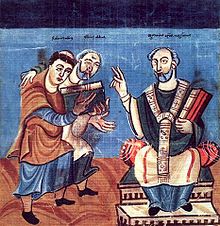
Alcuin was an 8th century British monk, writer, and teacher. He taught at the cathedral school at the time of Charlemagne, who he soon befriended. Alcuin became Charlemagne’s chief theological adviser. His life was public, being both an ecclesiastical and political figure. Alcuin’s writings were primarily influenced by the great bishop of Hippo, St. Augustine, as well as his British predecessor, the venerable Bede. He also drew heavily upon the writings of Gregory the Great.
Alcuin was most importantly, a devoted student of Scripture. Biblical allusion and quotation is abundant in his writings. There is most especially a devotion to the Psalter. Alcuin’s methodology involved an intense study of the Biblical text, along with reference to various Patristic commentaries. In this way, my own preaching preparation is similar to that of Alcuin. Alcuin is also an important voice in the history of liturgics. Many of his prayer manuals became prominent in the medieval church, and some of his prayers were adopted at public worship services. It is likely that the celebration of All Saints day comes from Alcuin’s influence.
Alcuin’s works fill two volumes of the Patrologia Latina, and have unfortunately mostly not been translated into English. There is a small collection of writings and prayers which are available in English translation in the volume A Mind Intent on God by Douglas Dales. I have found this volume extremely edifying in my own life. Here is an example of Alcuin’s prayer:
“Almighty Lord God, eternal and ineffable, without end or beginning: I confess you to be one in Trinity and threefold in unity: I adore you alone; I praise you; I bless and glorify you. I give thanks to you, O merciful and compassionate one, that you have granted me to lay aside the treachery and error of my spiritual night, and enabled me to participate in your grace. I beg you, O Lord, to perfect in me the work of your mercy that you have begun. Grant me always to think, speak and do what is pleasing to you. Guard me always and everywhere with your gracious care; and enable me, unworthy and wretched as I am, to come at last to the vision of your glory.” (pg. 11)
Previous Post

June 3, 2014
Who was the Real St. Patrick?
Next Post
June 3, 2014 Melito of Sardis on Christ as the Passover Lamb
Browse Our Archives
Select a Category American Lutheran Classics Blog Posts Book Review Christian Dogmatics Course Church Resources Curtis Leins Dogmatic Theology Ethics FAQs Historical Theology Just & Sinner Publications Luther Quotations Podcast Sermons The American Lutheran Theological Journal The complete works of Revere Franklin Weidner Theology Proper Uncategorized Videos
Select a Month October 2019 September 2019 July 2019 June 2019 May 2019 April 2019 March 2019 February 2019 January 2019 December 2018 November 2018 October 2018 September 2018 July 2018 June 2018 May 2018 April 2018 March 2018 February 2018 January 2018 December 2017 November 2017 October 2017 September 2017 August 2017 July 2017 June 2017 May 2017 April 2017 March 2017 February 2017 January 2017 December 2016 November 2016 October 2016 September 2016 August 2016 July 2016 June 2016 May 2016 April 2016 March 2016 February 2016 January 2016 December 2015 November 2015 October 2015 September 2015 August 2015 July 2015 June 2015 May 2015 April 2015 March 2015 February 2015 January 2015 December 2014 November 2014 October 2014 September 2014 August 2014 July 2014 June 2014 May 2014
Follow Us!
TAKE THE
Religious Wisdom Quiz
According to 1 Timothy, what is a trustworthy saying deserving of full acceptance?
Select your answer to see how you score.
Faith without works is dead The Lord is our shepherd Christ Jesus came into the world to save sinners God is love
Related posts from Just and Sinner
Was Martin Luther a Nominalist?
Thomas Aquinas and Thirteenth Century Scholasticism
A Review of Peter Lombard's "The Sentences" Book...
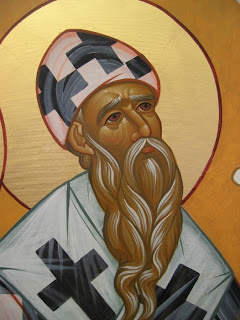
Cyril of Alexandria on the Importance of Having...
TRENDING AT PATHEOS Evangelical

The REST of Your Life: A Creative Wrestles...
This week I had a conversation with a good friend from church....

How the author of the world's best hymn...
I've been working with John Newton for a while now. This makes...

Long before this Lectio Divina, Psalm 130 - the song - started...

What About the Trees? Another Living Parable
After I finished writing the last article about falling leaves as a...

Why Classical Education Is a Conversation, Not a...
Come and Read: Joy in Classical Education When I was a little...

Cornell University has received a great deal of negative publicity and intense...
view all Evangelical blogs
Ad-Free & Subscriber Log-In Subscription Support
- About Us
- 2026 Calendar
- Videos
- Podcasts
- Library of World Religions
- Faith In Media Tracker
- Advertise With Us
- Write for Us
- Privacy Policy
- Terms of Service
- Do Not Sell My Data
- Contact Us
- Radiant Digital
- Manage Newsletter Subscriptions
- Unsubscribe From Notifications
- Sitemap
Copyright 2008-2026, Patheos. All rights reserved.
Subscription Support Ad-Free & Subscriber Log-In
Follow Patheos