
BuddhistCatholicContemplativeEvangelicalGeneral ChristianHinduJewishLatter-day SaintMuslimNew VisionsProgressive Christian
Beliefs
- Buddhist
- Catholic
- Contemplative
- Evangelical
- General Christian
- Hindu
- Jewish
- Latter-day Saint
- More Voices
- Muslim
- New Visions
- Pagan
- Progressive Christian
Topics
- Religion News
- Food and Religion
- Sports and Religion
- Religious Art
- Religious Music and Entertainment
- Religious Events
- History and Religion
- Style and Religion
- Politics and Religion
- Women in Religion
- Recreation Outdoors and Religion
- Business Finance and Religion
- Careers Workplace and Religion
- Education and Religion
- Family Parenting and Religion
- Health Fitness and Religion
- Home and Religion
- Relationships and Religion
- Technology and Religion
- Travel and Religion
Columnists
- Buddhist Columnists
- Business Finance and Religion Columnists
- Careers Workplace and Religion Columnists
- Catholic Columnists
- Contemplative Columnists
- Education and Religion Columnists
- Evangelists Columnists
- Family Parenting and Religion Columnists
- General Christian Columnists
- Health Fitness and Religion Columnists
- Hindu Columnists
- History and Religion Columnists
- Home and Religion Columnists
- Jewish Columnists
- More Voices Columnists
- Latter Day Columnists
- Muslim Columnists
- New Visions Columnists
- Nonreligious Columnists
- Pagan Columnists
- Politics and Religion Columnists
- Progressive Columnists
- Recreation Outdoors and Religion Columnists
- Relationships and Religion Columnists
- Religion News Columnists
- Religious Art Columnists
- Religious Events Columnists
- Religious Music and Entertainment Columnists
- Sports and Religion Columnists
- Style and Religion Columnists
- Technology and Religion Columnists
- Travel and Religion Columnists
- Women in Religion Columnists
Resource Library
- 2026 Calendar
- Library of World Religions
- The 100 Most Holy Places on Earth
- Patheos Answers
- Podcasts
- Videos
- Faith Leaders Database
- Anglican Episcopalian
- Bahai
- Baptist
- Buddhism
- Christianity
- Confucianism
- Eastern Orthodoxy
- Hinduism
- Holiness and Pentecostal
- ISKCON
- Islam
- Judaism
- Lutheran
- Methodist
- The Church of Jesus Christ of Latter-day Saints
- New Age
- Paganism
- Presbytarian and Reformed
- Protestantism
- Religion Behind the Scenes
- Roman Catholic
- Scientology
- Shia Islam
- Sikhism
- Sufism
- Sunni Islam
- Taoism
- Zen
- See all religions
Research Tools
 Ad-Free & Subscriber Log-In Subscription Support
Ad-Free & Subscriber Log-In Subscription Support
Follow Patheos 

- Trending:
- Forgiveness
- |
- Marriage
- |
- Consciousness
- |
- Death Penalty
- |
- Election
- |
- Halloween
 Just and Sinner
- Home
- Evangelical
- A Review of Confessing the Impassible God
A Review of Confessing the Impassible God
Last updated on: February 13, 2016 at 12:32 pm by Jordan Cooper
A Review of Confessing the Impassible God 2016-02-13T12:32:33-06:00 Jordan Cooper
Patheos Explore the world's faith through different perspectives on religion and spirituality! Patheos has the views of the prevalent religions and spiritualities of the world.
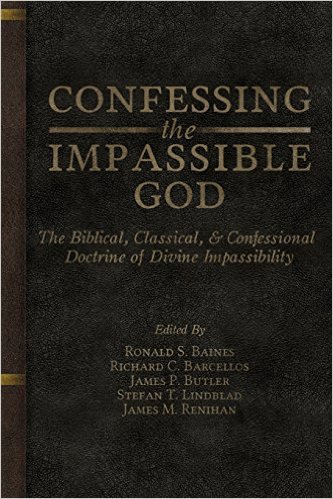 Despite the numerous debates between Lutheran, Reformed, and Roman Catholic theologians in the Post-Reformation scholastic era, there was a broad agreement, among all of these theologians, on the doctrine of God. With the rise of liberalism in the nineteenth century, this doctrinal consensus began to deteriorate. Liberal theologians argued against the supposed Hellenist imposition of static ontological concepts which helped formulate the traditional doctrine of God, often referred to as “Classical Theism.” These differences with Classical Theism were not only apparent in Schleiermacher and his disciples, but began to influence more conservative theologians in both the Lutheran and Reformed traditions. Thomasius and other Kenoticists posited accidental qualities in God which were set aside during the incarnation. Charles Hodge and other Princeton theologians reformulated the doctrine of simplicity among other traditional divine attributes.
These challenges to Classical Theism have remained, and continue to influence the writings of some contemporary Reformed writers such as Rob Lister, Bruce Ware, Kevin VanHoozer, John Frame, and Scott Oliphant. In Confessing the Impassible God, by Reformed Baptist Academic Press, a variety of authors seek to defend Classical Theism against these contemporary challenges, by focusing on the doctrine of divine impassibility in particular. The scope of this work is broad, and the essays are divided into various sections which include: Old Testament texts, New Testament texts, Historical Theology, and Systematic Theology. This volume is so comprehensive in scope that someone interest in impassibility in relation to any particular field, including practical theology, will have much to gain from this book.
The writing is straight-forward, and not overly academic. It is apparent that the intended audience of this book is the average parish pastor or studied layperson. There is not a heavy utilization of scholastic latin terminology, which has often framed these discussions in the past, or of lengthy footnotes. Doctrinal discussions surrounding the incommunicable attributes of God can become quite abstract and difficult for the average theologically educated reader. The authors of this volume are clear to define confusing terminology, and use a number of illustrations in order to simplify complex concepts. This fact has both positive and negative implications for the value of this particular work. On a positive note, this brings doctrine of God discussions to a level that many people are able to comprehend, and thus its impact will be broad among pastors and laity. Unfortunately, however, this also means that there is not as much depth as one might hope in some of the discussions. There are several points where more in-depth writing in the footnotes would have strengthened the argument.
Since they are written by different authors, the chapters are of various qualities. The strongest chapters in the book are Charles J. Rennie’s three essays which cover the systematic theological implications of impassibility. One should not read VanHoozer or Oliphant without taking Rennie’s criticisms into consideration. These essays show the most theological depth of any in the volume. The Biblical chapters point to important texts in this discussion, but the utilization of just about every text relevant to the doctrine means that no text gets a particularly in-depth exegetical treatment. I think it would have been more effective if the authors had selected a handful of the strongest texts for impassibility, and engaged in a more critical exposition of those passages, while critiquing the exegetical conclusions of those who take the opposite perspective. These chapters are helpful for the pastor who wants a Biblical basis for impassibility to use for his congregants if these issues arise, but will not likely have any profound impact in the broader scholarly debate surrounding impassibility in the Biblical text.
It is refreshing to read a work that is grounded in Classical Theism which also affirms the authority of Holy Scripture. This volume is well worth the price and time to read, and agree or not with the authors’ conclusions, it is sure to stimulate the mind of the one reading it, and point one back to the Biblical text to discover the God who is revealed in its pages. I cannot speak to the validity of usefulness of this text within the broader Reformed Baptist confessional tradition, as I am a Lutheran. These conversations are much broader, however, than the Reformed Baptist world, and this volume deserves reading from those outside of this tradition. Personally, I would like to see more work on this topic done which interacts not simply with contemporary evangelical theology, but engages figures like Moltmann, Jenson, Gunton, and others who have written critically of Classical Theistic positions.
The book can be purchased on Amazon here.
Previous Post

February 11, 2016
Divine Simplicity
Next Post

February 15, 2016 For Scalia, R.I.P. - Why Nature Must Be Stopped
Browse Our Archives
Select a Category American Lutheran Classics Blog Posts Book Review Christian Dogmatics Course Church Resources Curtis Leins Dogmatic Theology Ethics FAQs Historical Theology Just & Sinner Publications Luther Quotations Podcast Sermons The American Lutheran Theological Journal The complete works of Revere Franklin Weidner Theology Proper Uncategorized Videos
Select a Month October 2019 September 2019 July 2019 June 2019 May 2019 April 2019 March 2019 February 2019 January 2019 December 2018 November 2018 October 2018 September 2018 July 2018 June 2018 May 2018 April 2018 March 2018 February 2018 January 2018 December 2017 November 2017 October 2017 September 2017 August 2017 July 2017 June 2017 May 2017 April 2017 March 2017 February 2017 January 2017 December 2016 November 2016 October 2016 September 2016 August 2016 July 2016 June 2016 May 2016 April 2016 March 2016 February 2016 January 2016 December 2015 November 2015 October 2015 September 2015 August 2015 July 2015 June 2015 May 2015 April 2015 March 2015 February 2015 January 2015 December 2014 November 2014 October 2014 September 2014 August 2014 July 2014 June 2014 May 2014
Follow Us!
TAKE THE
Religious Wisdom Quiz
I am patient and kind. I do not envy or boast. I never fail and endure all things. What am I?
Select your answer to see how you score.
Love Grace Faith Hope
Related posts from Just and Sinner

A Critique of John Frame on the Doctrine...
A Critique of John Frame's "Two Models of...
Response to Frame's Criticism of Dolezal on Theistic...
Review of CPH's New “So-Called Third Use of...
TRENDING AT PATHEOS Evangelical

The REST of Your Life: A Creative Wrestles...
This week I had a conversation with a good friend from church....

How the author of the world's best hymn...
I've been working with John Newton for a while now. This makes...

Long before this Lectio Divina, Psalm 130 - the song - started...

What About the Trees? Another Living Parable
After I finished writing the last article about falling leaves as a...

Why Classical Education Is a Conversation, Not a...
Come and Read: Joy in Classical Education When I was a little...

Cornell University has received a great deal of negative publicity and intense...
view all Evangelical blogs
Ad-Free & Subscriber Log-In Subscription Support
- About Us
- 2026 Calendar
- Videos
- Podcasts
- Library of World Religions
- Faith In Media Tracker
- Advertise With Us
- Write for Us
- Privacy Policy
- Terms of Service
- Do Not Sell My Data
- Contact Us
- Radiant Digital
- Manage Newsletter Subscriptions
- Unsubscribe From Notifications
- Sitemap
Copyright 2008-2026, Patheos. All rights reserved.
Subscription Support Ad-Free & Subscriber Log-In
Follow Patheos