
BuddhistCatholicContemplativeEvangelicalGeneral ChristianHinduJewishLatter-day SaintMuslimNew VisionsProgressive Christian
Beliefs
- Buddhist
- Catholic
- Contemplative
- Evangelical
- General Christian
- Hindu
- Jewish
- Latter-day Saint
- More Voices
- Muslim
- New Visions
- Pagan
- Progressive Christian
Topics
- Religion News
- Food and Religion
- Sports and Religion
- Religious Art
- Religious Music and Entertainment
- Religious Events
- History and Religion
- Style and Religion
- Politics and Religion
- Women in Religion
- Recreation Outdoors and Religion
- Business Finance and Religion
- Careers Workplace and Religion
- Education and Religion
- Family Parenting and Religion
- Health Fitness and Religion
- Home and Religion
- Relationships and Religion
- Technology and Religion
- Travel and Religion
Columnists
- Buddhist Columnists
- Business Finance and Religion Columnists
- Careers Workplace and Religion Columnists
- Catholic Columnists
- Contemplative Columnists
- Education and Religion Columnists
- Evangelists Columnists
- Family Parenting and Religion Columnists
- General Christian Columnists
- Health Fitness and Religion Columnists
- Hindu Columnists
- History and Religion Columnists
- Home and Religion Columnists
- Jewish Columnists
- More Voices Columnists
- Latter Day Columnists
- Muslim Columnists
- New Visions Columnists
- Nonreligious Columnists
- Pagan Columnists
- Politics and Religion Columnists
- Progressive Columnists
- Recreation Outdoors and Religion Columnists
- Relationships and Religion Columnists
- Religion News Columnists
- Religious Art Columnists
- Religious Events Columnists
- Religious Music and Entertainment Columnists
- Sports and Religion Columnists
- Style and Religion Columnists
- Technology and Religion Columnists
- Travel and Religion Columnists
- Women in Religion Columnists
Resource Library
- 2026 Calendar
- Library of World Religions
- The 100 Most Holy Places on Earth
- Patheos Answers
- Podcasts
- Videos
- Faith Leaders Database
- Anglican Episcopalian
- Bahai
- Baptist
- Buddhism
- Christianity
- Confucianism
- Eastern Orthodoxy
- Hinduism
- Holiness and Pentecostal
- ISKCON
- Islam
- Judaism
- Lutheran
- Methodist
- The Church of Jesus Christ of Latter-day Saints
- New Age
- Paganism
- Presbytarian and Reformed
- Protestantism
- Religion Behind the Scenes
- Roman Catholic
- Scientology
- Shia Islam
- Sikhism
- Sufism
- Sunni Islam
- Taoism
- Zen
- See all religions
Research Tools
 Ad-Free & Subscriber Log-In Subscription Support
Ad-Free & Subscriber Log-In Subscription Support
Follow Patheos 

- Trending:
- Forgiveness
- |
- Marriage
- |
- Consciousness
- |
- Death Penalty
- |
- Election
- |
- Halloween
 Jonathan Wilson-Hartgrove
- Home
- Progressive Christian
- After Ten Years: A School for the World To Come
After Ten Years: A School for the World To Come
Last updated on: June 10, 2014 at 10:44 am by Jonathan Wilson-Hartgrove
After Ten Years: A School for the World To Come 2014-06-10T10:44:06-06:00 Jonathan Wilson-Hartgrove
Patheos Explore the world's faith through different perspectives on religion and spirituality! Patheos has the views of the prevalent religions and spiritualities of the world.
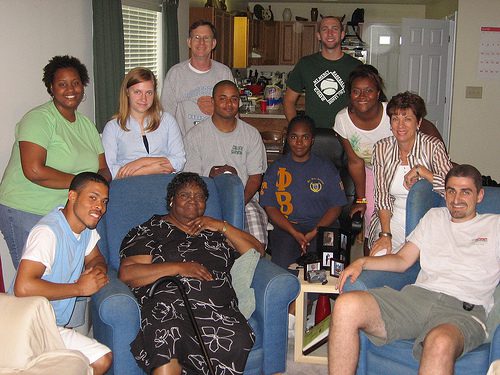
One of the hundreds of small groups SFC has convened over the past decade.
Ten years ago this month, Rutba House hosted a gathering of intentional Christian communities, scholars, and church leaders to talk about what we saw happening in the world around us and how we sensed the Spirit calling us to respond. In truth, we were a young, upstart community trying to find our way in a tradition that had inspired us, though we didn’t know it well. Thankfully, some elders with real wisdom came to share freely what they’d heard and seen. Over four days, we sketched twelve “marks” of a new monasticism that our communities shared in common.
Monasticism, for us, became a language to connect intentional Christian community today with a long tradition of folks who’ve tried to reshape a shared life around the gospel. In the early monastic literature, we found a name that struck a chord: for monastics who hungered and thirsted for righteousness in the ancient desert, intentional community had been a “school for conversion.” Maybe in could be the same in our own time.
All that we’ve done here at SFC has, in one way or another, grown out of that gathering ten years ago. “Come and see,” was our initial invitation. We invited hundreds of people, one small group at a time, to visit the communities that had inspired us. I took 30 young people to Reba Place Fellowship for a weekend; twelve of them signed up to come back for a year! Clearly young people like us were connecting deeply with a 24-7 gospel way of life.
But if we were to be a genuine school for conversion—a space for learning a new way of life—we knew we could not only be about connecting. We had to be intentional about going deeper. It wasn’t enough to feed the spiritually hungry; we had to ask why so many who had grown up in the church were starved for the gospel life.
This question moved us increasingly from community to justice. In every intentional community we worked with, young white people looking for community met children of color on their streets who were victims of generational injustice. “If you’ve come here to help me,” we heard neighbors say, “you’re wasting your time. But if you’ve come here because your liberation is bound up with mine, then let us work together.” Walltown Aspiring Youth became a concrete way for us to work together with the kids in Walltown for our shared freedom.
Education is a justice issue, we were learning. But life in community made it clear that no “issue” stands alone. Folks coming home from prison taught us that our kids were struggling to stay out of a “school to prison pipeline,” a seemingly inevitable path that so many of them had slipped into when they were in middle school. Most of us had never seriously considered America’s criminal justice system. We didn’t know it had anything to do with us. Project TURN became a way for some who’d never thought about prison and others who’d known its threat their whole lives to learn from one another.
Always, we’ve kept the circle small: six, twelve, twenty people seated in the round, sharing their own stories. From the beginning, we wanted to learn from those who’d gone before us. On community, the monastics were our guides. On justice, we began to look to the Southern Freedom Movement. 21st-Century Freedom Ridesbecame a way for us to invite others to “come and see.”
What have these ten years helped us to see? All the national surveys about religion say denominations are shrinking and religious “nones” are on the rise. But having worked with people who are hungry for a deeper faith that builds community and justice, this data doesn’t look like a decline in faith as much as a paradigm shift. I have a piece in the Washington Post this week about how some who we’ve worked with through SFC are leading what looks to me like the beginnings of a fourth Great Awakening.
But if the Spirit is indeed stirring a Movement to change the shape of faith not just for small groups of people but for society as a whole, where will folks go to imagine the new organizations and institutions that can sustain this faith as a way of life? More and more, it seems to me that this is the question SFC is called to ask. Our work will continue to be small. It’s not our job to build structures. But we have learned that we can carve out space for the people who do this important work to have the conversations that matter.
Indeed, such spaces are what makes trasformative education possible. I pray that over the next decade we can become a school for the world to come.
Previous Post

June 8, 2014
Pentecost Power: The Spirit Moving Through Moral Mondays
Next Post
June 14, 2014 Struggle for Racial Justice is Local
Browse Our Archives
Select a Category Features Front Porch Nurturing Communities Testimonies
Select a Month April 2015 March 2015 February 2015 January 2015 December 2014 September 2014 August 2014 July 2014 June 2014 May 2014 April 2014 March 2014 February 2014 January 2014 December 2013 November 2013 October 2013 September 2013 August 2013 July 2013 June 2013 May 2013 April 2013 March 2013 February 2013 January 2013 December 2012 November 2012 October 2012 September 2012 August 2012 July 2012 June 2012 May 2012 April 2012 March 2012 February 2012 January 2012
Follow Us!
TAKE THE
Religious Wisdom Quiz
Who said, "Vanity of vanities, all is vanity"?
Select your answer to see how you score.
David Job Solomon Isaiah
Related posts from Jonathan Wilson-Hartgrove
Arrests Resume As Moral Movement Continues
A Palm Sunday Invitation to Holy Ground

A White Southerner in the Freedom Movement
If Past Is Prologue, Pay Attention to the...
TRENDING AT PATHEOS Progressive Christian

What Being a Modern-Day Apostle Means to Me
In my last column, I discussed the ins and outs of modern-day...

Did Ancient China Once Worship the God of...
Across human history, a common thread weaves through the origins of the...

Love Your Neighbor – Including Earth-Kin: Lev. 19,...
God’s command to love your neighbor means acting in an ethical and...

Lead a Church Study of “Jesus and Lao...
Guest writer Jack Thomas (The Irreverent Reverend) reflects on leading his church...

Pastoral Wisdom for Responding to Sermon Pushback
Getting sermon pushback on your social justice sermon? Learn practical, Proverbs-based strategies...

Principles for Understanding the Apostolic Ministry Today
Whenever people discover that my formal ministry title is "apostle," as in...
view all Progressive Christian blogs
Ad-Free & Subscriber Log-In Subscription Support
- About Us
- 2026 Calendar
- Videos
- Podcasts
- Library of World Religions
- Faith In Media Tracker
- Advertise With Us
- Write for Us
- Privacy Policy
- Terms of Service
- Do Not Sell My Data
- Contact Us
- Radiant Digital
- Manage Newsletter Subscriptions
- Unsubscribe From Notifications
- Sitemap
Copyright 2008-2026, Patheos. All rights reserved.
Subscription Support Ad-Free & Subscriber Log-In
Follow Patheos