
BuddhistCatholicContemplativeEvangelicalGeneral ChristianHinduJewishLatter-day SaintMuslimNew VisionsProgressive Christian
Beliefs
- Buddhist
- Catholic
- Contemplative
- Evangelical
- General Christian
- Hindu
- Jewish
- Latter-day Saint
- More Voices
- Muslim
- New Visions
- Pagan
- Progressive Christian
Topics
- Religion News
- Food and Religion
- Sports and Religion
- Religious Art
- Religious Music and Entertainment
- Religious Events
- History and Religion
- Style and Religion
- Politics and Religion
- Women in Religion
- Recreation Outdoors and Religion
- Business Finance and Religion
- Careers Workplace and Religion
- Education and Religion
- Family Parenting and Religion
- Health Fitness and Religion
- Home and Religion
- Relationships and Religion
- Technology and Religion
- Travel and Religion
Columnists
- Buddhist Columnists
- Business Finance and Religion Columnists
- Careers Workplace and Religion Columnists
- Catholic Columnists
- Contemplative Columnists
- Education and Religion Columnists
- Evangelists Columnists
- Family Parenting and Religion Columnists
- General Christian Columnists
- Health Fitness and Religion Columnists
- Hindu Columnists
- History and Religion Columnists
- Home and Religion Columnists
- Jewish Columnists
- More Voices Columnists
- Latter Day Columnists
- Muslim Columnists
- New Visions Columnists
- Nonreligious Columnists
- Pagan Columnists
- Politics and Religion Columnists
- Progressive Columnists
- Recreation Outdoors and Religion Columnists
- Relationships and Religion Columnists
- Religion News Columnists
- Religious Art Columnists
- Religious Events Columnists
- Religious Music and Entertainment Columnists
- Sports and Religion Columnists
- Style and Religion Columnists
- Technology and Religion Columnists
- Travel and Religion Columnists
- Women in Religion Columnists
Resource Library
- 2026 Calendar
- Library of World Religions
- The 100 Most Holy Places on Earth
- Patheos Answers
- Podcasts
- Videos
- Faith Leaders Database
- Anglican Episcopalian
- Bahai
- Baptist
- Buddhism
- Christianity
- Confucianism
- Eastern Orthodoxy
- Hinduism
- Holiness and Pentecostal
- ISKCON
- Islam
- Judaism
- Lutheran
- Methodist
- The Church of Jesus Christ of Latter-day Saints
- New Age
- Paganism
- Presbytarian and Reformed
- Protestantism
- Religion Behind the Scenes
- Roman Catholic
- Scientology
- Shia Islam
- Sikhism
- Sufism
- Sunni Islam
- Taoism
- Zen
- See all religions
Research Tools
 Ad-Free & Subscriber Log-In Subscription Support
Ad-Free & Subscriber Log-In Subscription Support
Follow Patheos 

- Trending:
- Forgiveness
- |
- Marriage
- |
- Consciousness
- |
- Death Penalty
- |
- Election
- |
- Halloween
 Jonathan Wilson-Hartgrove
- Home
- Progressive Christian
- The Heart of Moral Monday
The Heart of Moral Monday
Last updated on: June 10, 2013 at 11:33 am by Jonathan Wilson-Hartgrove
The Heart of Moral Monday 2013-06-10T11:33:03-06:00 Jonathan Wilson-Hartgrove
Patheos Explore the world's faith through different perspectives on religion and spirituality! Patheos has the views of the prevalent religions and spiritualities of the world.
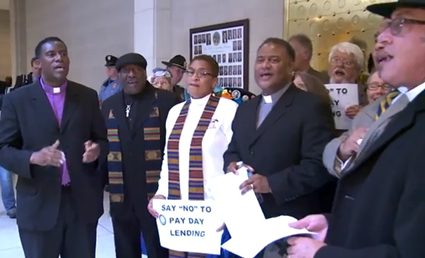
Clergy sing and pray in the rotunda of the NC Legislature building.
Hundreds of clergy from across North Carolina will gather in Raleigh today to lead the Moral Monday witness, a growing movement organized by the NC NAACP which has brought thousands of protesters to the General Assembly during this session, over 300 of whom have been arrested while petitioning their legislators. Rev. Jimmie Hawkins, a Presbyterian pastor from Durham, NC, organized the clergy witness because, he says, there is a great need for people of faith to say, “We stand with the poor. We stand against any policies that hurt the most vulnerable in our society.”
Rev. Hawkins is right. God’s people need to be here for Moral Monday.
The good news is that God’s people have been at the heart of Moral Monday since its beginnings.
Historians who look back on the black-led freedom movement of the 1960s often note the difference in culture between the Southern Christian Leadership Conference, led by Dr. King and other black ministers, and the Student Nonviolent Coordinating Committee, led by students who cut their teeth on nonviolent struggle at lunch counter sit-ins and on the 1961 Freedom Rides. SCLC played on the social power of respectable ministers who spoke on behalf of their communities, often in the rhythmic cadence of the preaching style that Martin Luther King mastered. But under the tutelage of Ella Baker, SNCC practiced the adage “strong people don’t need strong leaders.” In the rural communities of Mississippi and Alabama, SNCC field secretaries worked to identify and shine the spotlight on folks like Fannie Lou Hamer and Amzie Moore. These people were God’s children, too. If given the opportunity, they could speak for themselves.
SNCC showed America that the heart of the freedom movement is people who’ve been silenced finding a space to speak for themselves.
The beautiful truth at the heart of Moral Mondays is that all God’s children have been gathering for six weeks to speak for themselves about policies that are hurting them and their communities. The people of North Carolina have not come out to simply complain about bad leadership. We’ve not been organizing in desperate hope for some new, great leader. No, we have been speaking as clearly as we know how the truth that God speaks to each of us: “You are my beloved, with whom I am well pleased.”
Because we are loved, we are called to be our brother’s keeper. And because so many of our sisters and brothers are hurting, we cannot keep silent.
This is, of course, the heart of the message that clergy are called to preach in our communities each week. As keepers of our truest story, clergy in their robes and collars need to be among those speaking out and, if necessary, going to jail.
But I’ve been a preacher long enough to know that those of us who aim to preach God’s word are often prone to talk too much (I started preaching when I was sixteen, so I’ve done my fair share). I suspect this movement doesn’t need us to lead as much as it needs us to follow–to listen carefully, to pray fervently, and to ask how what is happening before us is rooted deeply in the story of what God has been doing since the foundation of the world.
Last night here in Durham, we had a wonderful performance of The Best of Enemies, a play about the unlikely friendship between a militant black activist, Ann Atwater, and a local KKK leader, C.P. Ellis, who both realized that their fears and hatred of one another were keeping them from helping their children find a better future. In a striking scene toward the end of the play, Atwater visits Ellis in his hospital room, where he confesses that he almost killed a black man when he was working with the Klan.
“I almost killed a man, too,” Atwater says.
“Oh yeah,” Ellis replies. “Who was that?”
“You,” she says.
Ann has been my mentor here in Durham for years, and I’ve heard her tell the story of how she pulled her knife out of her purse and stood up in a City Council meeting once to go cut C.P.’s head off. What stopped her? It was the hand of her pastor–the man who preached the radical love ethic of Jesus on Sunday, but was also there behind her on a Monday evening, watching and praying. He leaned forward and whispered in her ear, “Don’t do it, Ann. Don’t let him get to you.”
I reckon every movement needs its pastors. Sometimes up front, letting everyone see that the church is present. But just as often in the crowd, whispering the gospel in a sister’s ear. And following where only she can lead, one step at a time.
Previous Post

June 5, 2013
A Letter to My Kids: Why I Got Arrested
Next Post
June 12, 2013 Learning Community Alongside Walltown's Youth
Browse Our Archives
Select a Category Features Front Porch Nurturing Communities Testimonies
Select a Month April 2015 March 2015 February 2015 January 2015 December 2014 September 2014 August 2014 July 2014 June 2014 May 2014 April 2014 March 2014 February 2014 January 2014 December 2013 November 2013 October 2013 September 2013 August 2013 July 2013 June 2013 May 2013 April 2013 March 2013 February 2013 January 2013 December 2012 November 2012 October 2012 September 2012 August 2012 July 2012 June 2012 May 2012 April 2012 March 2012 February 2012 January 2012
Follow Us!
TAKE THE
Religious Wisdom Quiz
Which foreign woman married King Ahab and promoted Baal worship in Israel?
Select your answer to see how you score.
Jezebel Athaliah Tamar Rahab
Related posts from Jonathan Wilson-Hartgrove
Arrests Resume As Moral Movement Continues

Pentecost Power: The Spirit Moving Through Moral Mondays
Remembering Maya Angelou, Warrior for Justice
Heeding Our Prophets: 21st Century Freedom Ride
TRENDING AT PATHEOS Progressive Christian

Why Christians Have a Sacred Duty to Vote:...
The Bible offers strong support for the sacred duty to vote. Here...

What Being a Modern-Day Apostle Means to Me
In my last column, I discussed the ins and outs of modern-day...

Did Ancient China Once Worship the God of...
Across human history, a common thread weaves through the origins of the...

Love Your Neighbor – Including Earth-Kin: Lev. 19,...
God’s command to love your neighbor means acting in an ethical and...

Lead a Church Study of “Jesus and Lao...
Guest writer Jack Thomas (The Irreverent Reverend) reflects on leading his church...

Principles for Understanding the Apostolic Ministry Today
Whenever people discover that my formal ministry title is "apostle," as in...
view all Progressive Christian blogs
Ad-Free & Subscriber Log-In Subscription Support
- About Us
- 2026 Calendar
- Videos
- Podcasts
- Library of World Religions
- Faith In Media Tracker
- Advertise With Us
- Write for Us
- Privacy Policy
- Terms of Service
- Do Not Sell My Data
- Contact Us
- Radiant Digital
- Manage Newsletter Subscriptions
- Unsubscribe From Notifications
- Sitemap
Copyright 2008-2026, Patheos. All rights reserved.
Subscription Support Ad-Free & Subscriber Log-In
Follow Patheos