
BuddhistCatholicContemplativeEvangelicalGeneral ChristianHinduJewishLatter-day SaintMuslimNew VisionsProgressive Christian
Beliefs
- Buddhist
- Catholic
- Contemplative
- Evangelical
- General Christian
- Hindu
- Jewish
- Latter-day Saint
- More Voices
- Muslim
- New Visions
- Pagan
- Progressive Christian
Topics
- Religion News
- Food and Religion
- Sports and Religion
- Religious Art
- Religious Music and Entertainment
- Religious Events
- History and Religion
- Style and Religion
- Politics and Religion
- Women in Religion
- Recreation Outdoors and Religion
- Business Finance and Religion
- Careers Workplace and Religion
- Education and Religion
- Family Parenting and Religion
- Health Fitness and Religion
- Home and Religion
- Relationships and Religion
- Technology and Religion
- Travel and Religion
Columnists
- Buddhist Columnists
- Business Finance and Religion Columnists
- Careers Workplace and Religion Columnists
- Catholic Columnists
- Contemplative Columnists
- Education and Religion Columnists
- Evangelists Columnists
- Family Parenting and Religion Columnists
- General Christian Columnists
- Health Fitness and Religion Columnists
- Hindu Columnists
- History and Religion Columnists
- Home and Religion Columnists
- Jewish Columnists
- More Voices Columnists
- Latter Day Columnists
- Muslim Columnists
- New Visions Columnists
- Nonreligious Columnists
- Pagan Columnists
- Politics and Religion Columnists
- Progressive Columnists
- Recreation Outdoors and Religion Columnists
- Relationships and Religion Columnists
- Religion News Columnists
- Religious Art Columnists
- Religious Events Columnists
- Religious Music and Entertainment Columnists
- Sports and Religion Columnists
- Style and Religion Columnists
- Technology and Religion Columnists
- Travel and Religion Columnists
- Women in Religion Columnists
Resource Library
- 2026 Calendar
- Library of World Religions
- The 100 Most Holy Places on Earth
- Patheos Answers
- Podcasts
- Videos
- Faith Leaders Database
- Anglican Episcopalian
- Bahai
- Baptist
- Buddhism
- Christianity
- Confucianism
- Eastern Orthodoxy
- Hinduism
- Holiness and Pentecostal
- ISKCON
- Islam
- Judaism
- Lutheran
- Methodist
- The Church of Jesus Christ of Latter-day Saints
- New Age
- Paganism
- Presbytarian and Reformed
- Protestantism
- Religion Behind the Scenes
- Roman Catholic
- Scientology
- Shia Islam
- Sikhism
- Sufism
- Sunni Islam
- Taoism
- Zen
- See all religions
Research Tools
 Ad-Free & Subscriber Log-In Subscription Support
Ad-Free & Subscriber Log-In Subscription Support
Follow Patheos 

- Trending:
- Forgiveness
- |
- Marriage
- |
- Consciousness
- |
- Death Penalty
- |
- Election
- |
- Halloween
 Jonathan Wilson-Hartgrove
- Home
- Progressive Christian
- The Trouble With Earthly Cities
The Trouble With Earthly Cities
Last updated on: March 8, 2013 at 12:35 pm by Jonathan Wilson-Hartgrove
The Trouble With Earthly Cities 2013-03-08T12:35:38-07:00 Jonathan Wilson-Hartgrove
Patheos Explore the world's faith through different perspectives on religion and spirituality! Patheos has the views of the prevalent religions and spiritualities of the world.
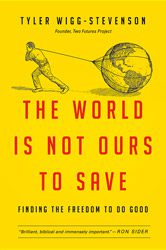 I’m grateful to Tyler Wigg-Stevenson and the conversation he’s invited with his new book, The World Is Not Ours to Save. It is a challenge for high-strung activists who come from privilege to acknowledge our limits and learn to lean on the Lord.
For folks who consider themselves “progressive,” it is a call to more conservative religion.
The confession at the heart of Tyler’s book is one that exposes how much the early 20th century Social Gospel and the late 20th century Religious Right had in common–namely, the assumption of power and privilege. At different times and in different settings, these movements had differing opinions about which way to steer history. But the purchase of each–the energy that drove the activists in both movements–was the belief that it is our job to save America.
As a white person who was captivated by the latter movement in my teens, I know this temptation well. But as someone who has spent the past fifteen years learning social engagement from America’s black-led Freedom Movement, I don’t see “cause-fatigue” as our greatest challenge. True, if you’re a 20-something who thinks you’re going to change the world by ending nuclear armament or drilling a million wells in Africa, you’re going to wear out. There’s not a smart phone smart enough to keep you fighting windmills like that into the second stage of life.
But such a realization has always been part and parcel of youthful idealism in the Western liberal tradition. You set out to change the world only to learn by the time it’s all said and done that God has saved you. And it’s all grace.
I don’t for a minute deny the importance of this realization. But it is increasingly clear to me that this is not the end of the story–especially for evangelicals in America today. For after so-called “privileged people” have learned our own limits and seen clearly what Augustine diagnosed as the “lust for power” in all worldly cities, we still have to somehow learn what it means to pray and work with all God’s people for a new world here and now. That is, after we’ve learned that privilege doesn’t help us follow Jesus, we still need saints to show us the way.
In my experience, the black-led Freedom Movement in North America is one great source of the wisdom we need. For since before the early abolitionist movements, black folks in America have known that it’s not their job to “save America,” but rather to proclaim liberty to captives and to carve out spaces where that liberty can be exercised. Strikingly, their religion has consistently been more conservative than that of progressive white allies. The sort of radical dependence on the Lord that Tyler’s story points toward is one that many educated people in the Western liberal tradition have struggled to accept.
But I think of someone like Bryan Stevenson, my fellow Eastern University alumus who’s doing incredible work for justice in Alabama. The identity out of which Bryan’s lifework flows is the conservative realism and radical hope of his grandmother and Ms. Rosa Park’s faith.
So, while I’m deeply grateful for this conversation–and for dozens of others like it about what it means for evangelicals today to hold Jesus and justice together–I hesitate when I read a line like this in The World Is Not Ours To Save:
Stewardship is thus the operative term guiding Christian public engagement, as with vocational activism.
Words can mean different things to different people, of course. But “stewardship” is a word that has carried a great deal of weight among white Christians in America. And it’s one that has been noticeably absent from the black-led Freedom Movement.
My point is not that Christians can deny or neglect our responsibility for social engagement. It is, instead, that those of us who have assumed that the world, if not ours to save, is at least ours to manage, must learn from sisters and brothers who’ve practiced our faith on the margins how to keep our eyes on the prize and hold on when the work is hard, hard, hard and we get tired, tired, tired.
From them, we might learn to sing even as we work, “I feel better, so much better / since I laid my burdens down.”
Previous Post

March 6, 2013
Update on Lenten Fast
Next Post
March 19, 2013 Remembering Baghdad, 2003
Browse Our Archives
Select a Category Features Front Porch Nurturing Communities Testimonies
Select a Month April 2015 March 2015 February 2015 January 2015 December 2014 September 2014 August 2014 July 2014 June 2014 May 2014 April 2014 March 2014 February 2014 January 2014 December 2013 November 2013 October 2013 September 2013 August 2013 July 2013 June 2013 May 2013 April 2013 March 2013 February 2013 January 2013 December 2012 November 2012 October 2012 September 2012 August 2012 July 2012 June 2012 May 2012 April 2012 March 2012 February 2012 January 2012
Follow Us!
TAKE THE
Religious Wisdom Quiz
Who said, "Do you not know that your bodies are temples of the Holy Spirit"?
Select your answer to see how you score.
Jesus James Peter Paul
Related posts from Jonathan Wilson-Hartgrove

Arrests Resume As Moral Movement Continues
A Palm Sunday Invitation to Holy Ground

A White Southerner in the Freedom Movement
If Past Is Prologue, Pay Attention to the...
TRENDING AT PATHEOS Progressive Christian

What Being a Modern-Day Apostle Means to Me
In my last column, I discussed the ins and outs of modern-day...

Did Ancient China Once Worship the God of...
Across human history, a common thread weaves through the origins of the...

Love Your Neighbor – Including Earth-Kin: Lev. 19,...
God’s command to love your neighbor means acting in an ethical and...

Lead a Church Study of “Jesus and Lao...
Guest writer Jack Thomas (The Irreverent Reverend) reflects on leading his church...

Pastoral Wisdom for Responding to Sermon Pushback
Getting sermon pushback on your social justice sermon? Learn practical, Proverbs-based strategies...

Principles for Understanding the Apostolic Ministry Today
Whenever people discover that my formal ministry title is "apostle," as in...
view all Progressive Christian blogs
Ad-Free & Subscriber Log-In Subscription Support
- About Us
- 2026 Calendar
- Videos
- Podcasts
- Library of World Religions
- Faith In Media Tracker
- Advertise With Us
- Write for Us
- Privacy Policy
- Terms of Service
- Do Not Sell My Data
- Contact Us
- Radiant Digital
- Manage Newsletter Subscriptions
- Unsubscribe From Notifications
- Sitemap
Copyright 2008-2026, Patheos. All rights reserved.
Subscription Support Ad-Free & Subscriber Log-In
Follow Patheos