
BuddhistCatholicContemplativeEvangelicalGeneral ChristianHinduJewishLatter-day SaintMuslimNew VisionsProgressive Christian
Beliefs
- Buddhist
- Catholic
- Contemplative
- Evangelical
- General Christian
- Hindu
- Jewish
- Latter-day Saint
- More Voices
- Muslim
- New Visions
- Pagan
- Progressive Christian
Topics
- Religion News
- Food and Religion
- Sports and Religion
- Religious Art
- Religious Music and Entertainment
- Religious Events
- History and Religion
- Style and Religion
- Politics and Religion
- Women in Religion
- Recreation Outdoors and Religion
- Business Finance and Religion
- Careers Workplace and Religion
- Education and Religion
- Family Parenting and Religion
- Health Fitness and Religion
- Home and Religion
- Relationships and Religion
- Technology and Religion
- Travel and Religion
Columnists
- Buddhist Columnists
- Business Finance and Religion Columnists
- Careers Workplace and Religion Columnists
- Catholic Columnists
- Contemplative Columnists
- Education and Religion Columnists
- Evangelists Columnists
- Family Parenting and Religion Columnists
- General Christian Columnists
- Health Fitness and Religion Columnists
- Hindu Columnists
- History and Religion Columnists
- Home and Religion Columnists
- Jewish Columnists
- More Voices Columnists
- Latter Day Columnists
- Muslim Columnists
- New Visions Columnists
- Nonreligious Columnists
- Pagan Columnists
- Politics and Religion Columnists
- Progressive Columnists
- Recreation Outdoors and Religion Columnists
- Relationships and Religion Columnists
- Religion News Columnists
- Religious Art Columnists
- Religious Events Columnists
- Religious Music and Entertainment Columnists
- Sports and Religion Columnists
- Style and Religion Columnists
- Technology and Religion Columnists
- Travel and Religion Columnists
- Women in Religion Columnists
Resource Library
- 2026 Calendar
- Library of World Religions
- The 100 Most Holy Places on Earth
- Patheos Answers
- Podcasts
- Videos
- Faith Leaders Database
- Anglican Episcopalian
- Bahai
- Baptist
- Buddhism
- Christianity
- Confucianism
- Eastern Orthodoxy
- Hinduism
- Holiness and Pentecostal
- ISKCON
- Islam
- Judaism
- Lutheran
- Methodist
- The Church of Jesus Christ of Latter-day Saints
- New Age
- Paganism
- Presbytarian and Reformed
- Protestantism
- Religion Behind the Scenes
- Roman Catholic
- Scientology
- Shia Islam
- Sikhism
- Sufism
- Sunni Islam
- Taoism
- Zen
- See all religions
Research Tools
 Ad-Free & Subscriber Log-In Subscription Support
Ad-Free & Subscriber Log-In Subscription Support
Follow Patheos 

- Trending:
- Forgiveness
- |
- Marriage
- |
- Consciousness
- |
- Death Penalty
- |
- Election
- |
- Halloween
 Jonathan Wilson-Hartgrove
- Home
- Progressive Christian
- Yoked: A Community Farm outside Winnipeg, MB
Yoked: A Community Farm outside Winnipeg, MB
Last updated on: February 22, 2013 at 1:54 pm by Jonathan Wilson-Hartgrove
Yoked: A Community Farm outside Winnipeg, MB 2013-02-22T13:54:49-07:00 Jonathan Wilson-Hartgrove
Patheos Explore the world's faith through different perspectives on religion and spirituality! Patheos has the views of the prevalent religions and spiritualities of the world.
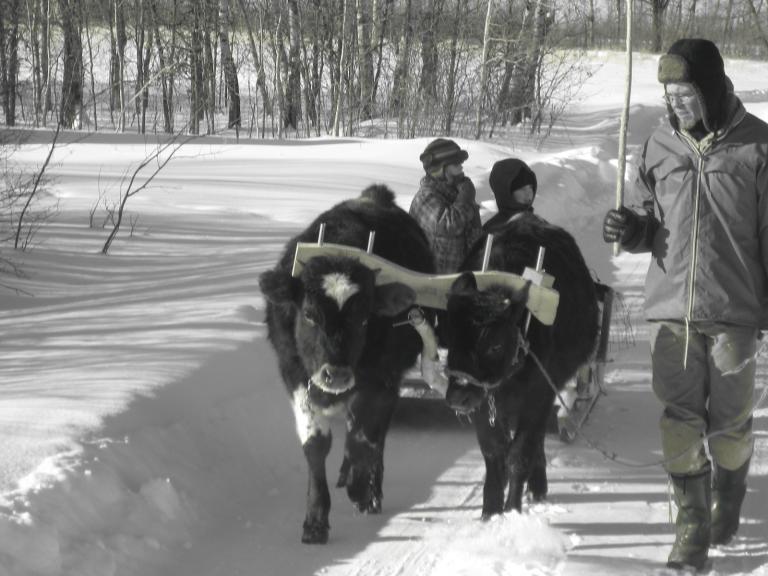
One of the gifts of my work with School for Conversion is that I get to meet and hear from folks who are getting caught up in the “everyday awakening” that’s happening all around us. For so many of those folks, this entails a journey into community. Marcus Rempel, our guest columnist today, writes about his experience at Plowshares Community Farm outside of Winnipeg, MN. I’m looking forward to visiting them in a few weeks. If you’d like to learn more about the community there, you can contact Marcus at [email protected].
Toward the very end of Judah’s existence as a kingdom, when its defensive and diplomatic stratagems were all played out, the prophet Jeremiah hoisted the yoke of an ox to his shoulders and walked the streets of Jerusalem, in a dramatic enactment of Judah’s future. People were appalled.
I think about this story as I lay the yoke across the growing shoulders of Oscar and Jonah. The very idea of working a team of oxen on a “first world” farm in the twenty-first century is an affront to the narrative of progress.
The official court prophet Hananiah grabbed the yoke from Jeremiah’s hunched shoulders and angrily broke its bars. Jeremiah’s “word from the Lord” predicted a future of servitude under the Babylonian Empire. Hananiah’s “word from the Lord” insisted that any such humbling would be brief; that Judah’s manifest destiny was to carry on the Davidic line in an unbroken trajectory of growth and success. Servitude could never define the throne of David. It was unthinkable that the Lord could let a son of David – his Anointed One – suffer the humiliation predicted by Jeremiah. History (and Jesus) showed Jeremiah the true prophet.
Last week, as thousands gathered on the White House lawn for the largest climate change rally in history, Oscar and Jonah hauled their first loads of hay together here at Ploughshares Community Farm, a small intentional community on the banks of the Brokenhead River in eastern Manitoba. They looked pretty sharp. We have a long way to go before we unhitch this farm from fossil fuels, but they helped us take our foot off the gas at least a little bit, and I love them for it.
We’re a pretty mixed bunch here at Ploughshares, but I think that each in our own way can identify with Jeremiah’s moment: a moment of decline, a moment of reckoning. We have lost faith in the grandiose project, the big dream; whatever is beautiful in our future will have to be small. We are cautious to declare a “word of the Lord” in any of this. We are aware of many competing “words of the Lord” clamouring to be heard in these times. When we do pray together as a community, we pray in silence.
Some of us go to church, some of us don’t. The little Anglican church where I worship is in its own moment of decline and reckoning. Jesus’ word about being present “wherever two or three of you are gathered…” is becoming increasingly acute there. Were it not for our priest, a kind old draft dodger from Texas, preaching a gospel that is consistently humble, hopeful and honest, I’d have dropped out by now, too. Many of my favorite people out here are church-averse. At best, they see the church as irrelevant to their lives; for many, it has been a place of humiliation and wounding. Many of our friends out here are gay. And then there are our conservative Christian friends in the neighbourhood – dear, warm-hearted folks still beholden to a theology that condemns these friends to non-being in this life or everlasting torment in the next.
James Alison, my new favourite theologian, writes that any theology not done in the space of a “heart-close-to-cracking” is probably off the mark. Ploughshares is a good place to enter that space. In simplest terms, we are trying to cultivate blessed friendship and food here, to eat and drink “worthily” as the New Testament puts it. To do this, Paul says we have to discern the body or we eat and drink damnation unto ourselves. It is easy to see the failures of communion, the damnations in the culture wars and the climate crisis. How to embody the beloved community in a way that does not shun and exclude, how to eat without stealing, how to farm without polluting?
Oscar, our “off” ox (the more mature, well-trained worker on the outside of the team) was named for Romero, a bookworm turned prophet of the poor, a priest sacrificially brave against systemic exploitation. Jonah, our “nigh” ox (the newer recruit, the one to keep close) is named for a prophet who discovered an expansiveness of mercy far beyond his imaginings.
There’s a long tradition of folktales where fools set out on adventure and succeed despite their ignorance, because they let their beasts of burden choose the way. Maybe Oscar and Jonah will help us find ours.
Previous Post

February 13, 2013
The Fast We've Chosen: Begging with Our Friends
Next Post
March 6, 2013 Update on Lenten Fast
Browse Our Archives
Select a Category Features Front Porch Nurturing Communities Testimonies
Select a Month April 2015 March 2015 February 2015 January 2015 December 2014 September 2014 August 2014 July 2014 June 2014 May 2014 April 2014 March 2014 February 2014 January 2014 December 2013 November 2013 October 2013 September 2013 August 2013 July 2013 June 2013 May 2013 April 2013 March 2013 February 2013 January 2013 December 2012 November 2012 October 2012 September 2012 August 2012 July 2012 June 2012 May 2012 April 2012 March 2012 February 2012 January 2012
Follow Us!
TAKE THE
Religious Wisdom Quiz
How many disciples did Jesus have?
Select your answer to see how you score.
Twelve One hundred Seven Thirty
Related posts from Jonathan Wilson-Hartgrove

Arrests Resume As Moral Movement Continues
A Palm Sunday Invitation to Holy Ground

A White Southerner in the Freedom Movement

If Past Is Prologue, Pay Attention to the...
TRENDING AT PATHEOS Progressive Christian

Why Christians Have a Sacred Duty to Vote:...
The Bible offers strong support for the sacred duty to vote. Here...

What Being a Modern-Day Apostle Means to Me
In my last column, I discussed the ins and outs of modern-day...

Did Ancient China Once Worship the God of...
Across human history, a common thread weaves through the origins of the...

Love Your Neighbor – Including Earth-Kin: Lev. 19,...
God’s command to love your neighbor means acting in an ethical and...

Lead a Church Study of “Jesus and Lao...
Guest writer Jack Thomas (The Irreverent Reverend) reflects on leading his church...

Principles for Understanding the Apostolic Ministry Today
Whenever people discover that my formal ministry title is "apostle," as in...
view all Progressive Christian blogs
Ad-Free & Subscriber Log-In Subscription Support
- About Us
- 2026 Calendar
- Videos
- Podcasts
- Library of World Religions
- Faith In Media Tracker
- Advertise With Us
- Write for Us
- Privacy Policy
- Terms of Service
- Do Not Sell My Data
- Contact Us
- Radiant Digital
- Manage Newsletter Subscriptions
- Unsubscribe From Notifications
- Sitemap
Copyright 2008-2026, Patheos. All rights reserved.
Subscription Support Ad-Free & Subscriber Log-In
Follow Patheos