
BuddhistCatholicContemplativeEvangelicalGeneral ChristianHinduJewishLatter-day SaintMuslimNew VisionsProgressive Christian
Beliefs
- Buddhist
- Catholic
- Contemplative
- Evangelical
- General Christian
- Hindu
- Jewish
- Latter-day Saint
- More Voices
- Muslim
- New Visions
- Pagan
- Progressive Christian
Topics
- Religion News
- Food and Religion
- Sports and Religion
- Religious Art
- Religious Music and Entertainment
- Religious Events
- History and Religion
- Style and Religion
- Politics and Religion
- Women in Religion
- Recreation Outdoors and Religion
- Business Finance and Religion
- Careers Workplace and Religion
- Education and Religion
- Family Parenting and Religion
- Health Fitness and Religion
- Home and Religion
- Relationships and Religion
- Technology and Religion
- Travel and Religion
Columnists
- Buddhist Columnists
- Business Finance and Religion Columnists
- Careers Workplace and Religion Columnists
- Catholic Columnists
- Contemplative Columnists
- Education and Religion Columnists
- Evangelists Columnists
- Family Parenting and Religion Columnists
- General Christian Columnists
- Health Fitness and Religion Columnists
- Hindu Columnists
- History and Religion Columnists
- Home and Religion Columnists
- Jewish Columnists
- More Voices Columnists
- Latter Day Columnists
- Muslim Columnists
- New Visions Columnists
- Nonreligious Columnists
- Pagan Columnists
- Politics and Religion Columnists
- Progressive Columnists
- Recreation Outdoors and Religion Columnists
- Relationships and Religion Columnists
- Religion News Columnists
- Religious Art Columnists
- Religious Events Columnists
- Religious Music and Entertainment Columnists
- Sports and Religion Columnists
- Style and Religion Columnists
- Technology and Religion Columnists
- Travel and Religion Columnists
- Women in Religion Columnists
Resource Library
- 2026 Calendar
- Library of World Religions
- The 100 Most Holy Places on Earth
- Patheos Answers
- Podcasts
- Videos
- Faith Leaders Database
- Anglican Episcopalian
- Bahai
- Baptist
- Buddhism
- Christianity
- Confucianism
- Eastern Orthodoxy
- Hinduism
- Holiness and Pentecostal
- ISKCON
- Islam
- Judaism
- Lutheran
- Methodist
- The Church of Jesus Christ of Latter-day Saints
- New Age
- Paganism
- Presbytarian and Reformed
- Protestantism
- Religion Behind the Scenes
- Roman Catholic
- Scientology
- Shia Islam
- Sikhism
- Sufism
- Sunni Islam
- Taoism
- Zen
- See all religions
Research Tools
 Ad-Free & Subscriber Log-In Subscription Support
Ad-Free & Subscriber Log-In Subscription Support
Follow Patheos 

- Trending:
- Forgiveness
- |
- Marriage
- |
- Consciousness
- |
- Death Penalty
- |
- Election
- |
- Halloween
 Jonathan Wilson-Hartgrove
- Home
- Progressive Christian
- Nurturing Communities of God’s Love
Nurturing Communities of God’s Love
Last updated on: October 11, 2012 at 8:59 am by Jonathan Wilson-Hartgrove
Nurturing Communities of God’s Love 2012-10-11T08:59:14-06:00 Jonathan Wilson-Hartgrove
Patheos Explore the world's faith through different perspectives on religion and spirituality! Patheos has the views of the prevalent religions and spiritualities of the world.
Guest Series by David Janzen
The Holy Spirit is planting a new generation of Christian intentional communities. For three years I’ve been visiting these groups and now, with the help of younger communitarians, the book about that movement that we’ve been working on together, is out. It’s titled The Intentional Christian Community Handbook: For Idealists, Hypocrites, and Wannabe Disciples of Jesus. Despite all this travel and research, at the recent Christian Community Development Association Conference (CCDA) in the Twin Cities, I kept meeting members of fledgling communities whom I’d not heard of before. Now I carry a wad of their addresses in my shirt pocket until I can follow up with an e-mail or a visit. To support groups like this, the Nurturing Communities Project (NCP) was launched.
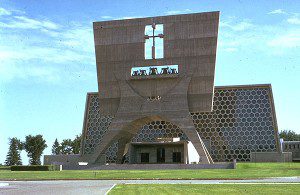
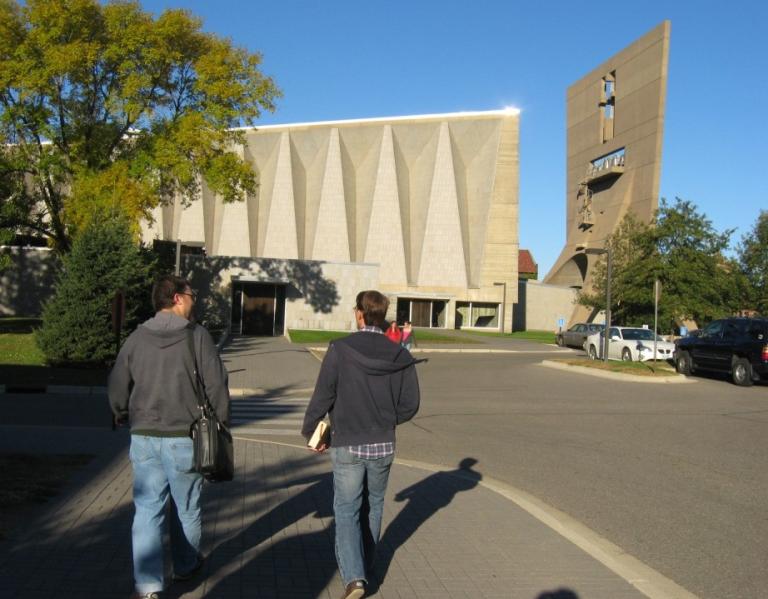 The NCP has just concluded its third annual gathering, bringing more experienced communal groups together with energetic leaders from younger communities to share old wisdom and new experiences for the long haul. This year NCP dipped into the 1,500 year-old Benedictine monastic tradition for two days of profound sharing at St. Johns Abbey in Collegeville, Minnesota.
The story of this Benedictine connection begins five years ago, when the monks at St. John’s Abbey invited Jonathan Wilson-Hartgrove to speak to them about the New Monasticism movement. A friendship grew between Jonathan and Abbot Timothy Kelly. Since then, Abbot Kelly has passed away, but his successor, John Klassen, has renewed the relationship and commitment. So it happened that Nurturing Communities Project folks gathered at the St. John’s University campus for two days (September 25-26), just in time to enjoy the gold and crimson hues of autumn on the edge of one of Minnesota’s 10,000 lakes. Even though the Abbot was away in Rome, he kept us in mind, sending e-mail instructions home to make sure we were well cared for in the guesthouse and in the monastery chapter house, the normal meeting place for the 145 local monks.
We were forty-five participants from about twenty-five communities coming from California, New York State, and points in between. Several veteran communities like Koinonia Partners, the Bruderhof, Jesus People USA, and Reba Place Fellowship were represented as well as younger groups like Radical Living from Brooklyn, Lotus House from St. Louis, and Oak Park from Kansas City.
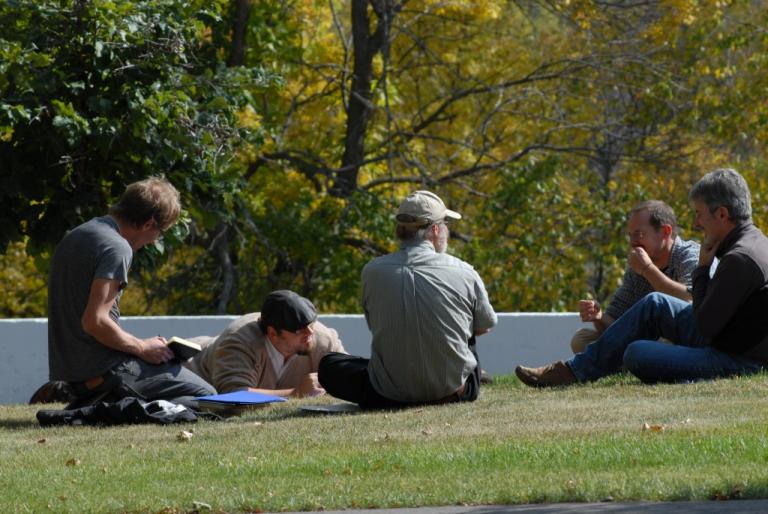 After getting acquainted with each other as communities, we broke into small discussion circles on requested topics such as “Reviewing and renewing the community vision,” “Speaking the truth in love,” “Becoming a neighborhood church,” “Egalitarian ideals and the need for leadership,” and “How much common life does a community need?” Our discussions spread out on the Monastery grounds in lively circles, sharing our experiences and counsel.
Four Benedictine Brothers joined us for a morning to share the treasures they find in being an order linked by a common rule of life, a shared spiritual formation and a history of visitations. Together we reflected on the ways our communities are exploring something like the supportive relationships of an emerging order. Brother Raverty, an anthropologist, asked about our structures for membership and leadership, concepts which seem a little slippery in our newer communities. It was useful to discover how different groups are taking hold of these important features of community order — a topic many want to pursue further in next year’s Gathering. In ways both visible and intangible, we witnessed God’s blessing and encouragement from the Brothers, who lifted up the importance of what is happening to our communities in the wider drama of God’s kingdom making its home on earth.
The bells at St. John’s Church reminded us of God’s gift of time, inviting us to join the monks for common prayer four times a day. As guests (including children) we were welcomed into the center of their worship space, sitting between Choirs One and Two. A gracious prompter helped us locate the proper pages in the nine prayer books that make up their three-year cycle of songs, scriptures and other readings. For two days we adjusted to the rhythms of monastic life, slowing down our busy minds to take in what our mouths were speaking and our ears were hearing as one body.
Ivan and Lois Kauffman played an important role in lining up some of our local arrangements. They awaited our arrival with nametags and welcoming hugs. The Kaufmans have been life-long Mennonites and more recently Menno-Catholics involved in the Bridgefolk movement bringing Anabaptists and Catholics together for dialogue. Ivan has also been a participant and cheerleader of the New Monasticism movement since its beginning, contributing a chapter in 12 Marks of the New Monasticism.
Ivan and Lois welcomed us for Tuesday dinner at the Michael Sattler House, a haven of hospitality for social-justice activists and others seeking a place of retreat and participation in local monastic life. For those familiar with 16th – century Anabaptism, the name “Michael Sattler” invokes a story of terror and persecution that, by God’s grace, is turning out to be a drama of redemption and reconciliation in our day.
Ivan read the story of Michael Sattler, a Benedictine prior who, during the time of the Peasant Uprising in Europe, realized that his wealthy monastery and the Roman Catholic hierarchy were siding against both Jesus and the poor. With anguished conscience, he left his position of privilege and power to find a more authentic New Testament life with the poor. Sattler joined the Anabaptists and lent the movement his theological gifts, most notably in calling together the clandestine conference that produced the Schleitheim Confession — a unifying mission statement for the Anabaptist movement. Within a year Michael Sattler, was imprisoned, tortured, and burned at the stake, but not before hot pinchers tore out his tongue to prevent him from giving public witness at the execution.
In our day, this gruesome saga of persecution by church and state has been resurrected to new life. The Benedictine monks at St. John’s Abbey have welcomed Michael Sattler back into their graces, claiming him as one of their own saints and blessing the Michael Sattler House as a place of meeting and reconciliation between Catholics and modern-day spiritual descendants of Michael Sattler. We were honored guests, folded by God into the pages of a drama that included Michael Sattler, the Kauffmans, plus a few Benedictine brothers and sisters who embodied this healing of history in the repentance and forgiveness of a common meal.
Our gathering participated in another celebration of sorts as each one attending received a copy of the just-published Intentional Christian Community Handbook: For Idealists, Hypocrites and Wannabe Disciples of Jesus. Many of us in the Gathering had participated in the dreaming, planning, and writing stages of this book. We were delighted to finally hold it in our hands and to consider how it might bless our communities along with the other idealists, hypocrites and disciples of Jesus we might know.
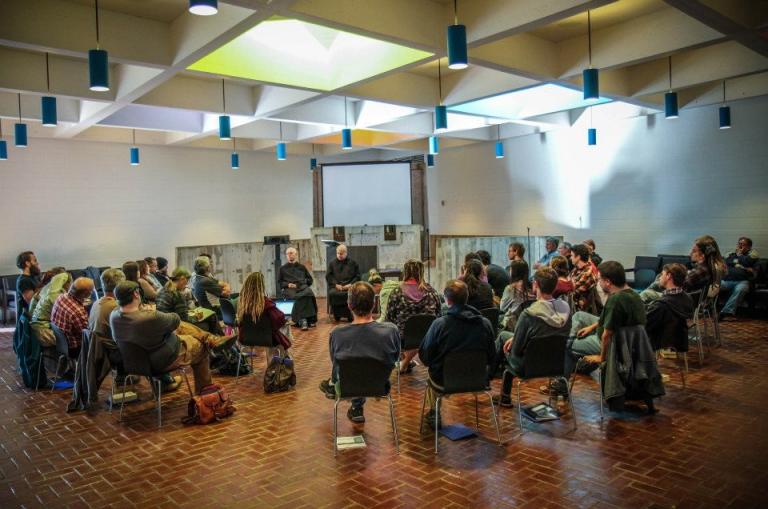 In our wrap-up session we heard a strong desire all around to continue such gatherings, next time giving ourselves at least three days to go deeper in discussions and friendship building. Each year the number of persons getting together has doubled in size. Our meetings have been deeply impacted by the host communities — Reba Place Fellowship (2010), Englewood Christian Church in Indianapolis (2011), and St. John’s Abbey (2012). The Bruderhof communities have offered to host next year’s gathering, perhaps in New York or Pennsylvania. We will post further plans as we work on them in the Nurturing Communties Project Committee that includes representatives from Plow Creek Fellowship, The Simple Way, Rutba House, and Reba Place Fellowship.
Finally, we want to acknowledge four communities from the Twin Cities who played a special role in hosting us for visits after the Nurturing Communities Gathering. Conversations continued and friendships grew with Thirdway, Ekklesia, Greenhouse and the Mennonite Worker (formerly called Missio Dei) as guests stayed on with them for the Christian Community Development Association Conference September 26-29.
Previous Post

October 1, 2012
Hope for the Future in Our Radical Past
Next Post
October 18, 2012 21st Century Freedom Ride
Browse Our Archives
Select a Category Features Front Porch Nurturing Communities Testimonies
Select a Month April 2015 March 2015 February 2015 January 2015 December 2014 September 2014 August 2014 July 2014 June 2014 May 2014 April 2014 March 2014 February 2014 January 2014 December 2013 November 2013 October 2013 September 2013 August 2013 July 2013 June 2013 May 2013 April 2013 March 2013 February 2013 January 2013 December 2012 November 2012 October 2012 September 2012 August 2012 July 2012 June 2012 May 2012 April 2012 March 2012 February 2012 January 2012
Follow Us!
TAKE THE
Religious Wisdom Quiz
Which queen tried to kill the royal seed?
Select your answer to see how you score.
Pharoah's Daughter Athaliah Sarah Esther
Related posts from Jonathan Wilson-Hartgrove

The Strange Glory of a Fully Human Life
A Bridge to the Green Movement
TRENDING AT PATHEOS Progressive Christian

Why Christians Have a Sacred Duty to Vote:...
The Bible offers strong support for the sacred duty to vote. Here...

What Being a Modern-Day Apostle Means to Me
In my last column, I discussed the ins and outs of modern-day...

Did Ancient China Once Worship the God of...
Across human history, a common thread weaves through the origins of the...

Love Your Neighbor – Including Earth-Kin: Lev. 19,...
God’s command to love your neighbor means acting in an ethical and...

Lead a Church Study of “Jesus and Lao...
Guest writer Jack Thomas (The Irreverent Reverend) reflects on leading his church...

Principles for Understanding the Apostolic Ministry Today
Whenever people discover that my formal ministry title is "apostle," as in...
view all Progressive Christian blogs
Ad-Free & Subscriber Log-In Subscription Support
- About Us
- 2026 Calendar
- Videos
- Podcasts
- Library of World Religions
- Faith In Media Tracker
- Advertise With Us
- Write for Us
- Privacy Policy
- Terms of Service
- Do Not Sell My Data
- Contact Us
- Radiant Digital
- Manage Newsletter Subscriptions
- Unsubscribe From Notifications
- Sitemap
Copyright 2008-2026, Patheos. All rights reserved.
Subscription Support Ad-Free & Subscriber Log-In
Follow Patheos