
BuddhistCatholicContemplativeEvangelicalGeneral ChristianHinduJewishLatter-day SaintMuslimNew VisionsProgressive Christian
Beliefs
- Buddhist
- Catholic
- Contemplative
- Evangelical
- General Christian
- Hindu
- Jewish
- Latter-day Saint
- More Voices
- Muslim
- New Visions
- Pagan
- Progressive Christian
Topics
- Religion News
- Food and Religion
- Sports and Religion
- Religious Art
- Religious Music and Entertainment
- Religious Events
- History and Religion
- Style and Religion
- Politics and Religion
- Women in Religion
- Recreation Outdoors and Religion
- Business Finance and Religion
- Careers Workplace and Religion
- Education and Religion
- Family Parenting and Religion
- Health Fitness and Religion
- Home and Religion
- Relationships and Religion
- Technology and Religion
- Travel and Religion
Columnists
- Buddhist Columnists
- Business Finance and Religion Columnists
- Careers Workplace and Religion Columnists
- Catholic Columnists
- Contemplative Columnists
- Education and Religion Columnists
- Evangelists Columnists
- Family Parenting and Religion Columnists
- General Christian Columnists
- Health Fitness and Religion Columnists
- Hindu Columnists
- History and Religion Columnists
- Home and Religion Columnists
- Jewish Columnists
- More Voices Columnists
- Latter Day Columnists
- Muslim Columnists
- New Visions Columnists
- Nonreligious Columnists
- Pagan Columnists
- Politics and Religion Columnists
- Progressive Columnists
- Recreation Outdoors and Religion Columnists
- Relationships and Religion Columnists
- Religion News Columnists
- Religious Art Columnists
- Religious Events Columnists
- Religious Music and Entertainment Columnists
- Sports and Religion Columnists
- Style and Religion Columnists
- Technology and Religion Columnists
- Travel and Religion Columnists
- Women in Religion Columnists
Resource Library
- 2026 Calendar
- Library of World Religions
- The 100 Most Holy Places on Earth
- Patheos Answers
- Podcasts
- Videos
- Faith Leaders Database
- Anglican Episcopalian
- Bahai
- Baptist
- Buddhism
- Christianity
- Confucianism
- Eastern Orthodoxy
- Hinduism
- Holiness and Pentecostal
- ISKCON
- Islam
- Judaism
- Lutheran
- Methodist
- The Church of Jesus Christ of Latter-day Saints
- New Age
- Paganism
- Presbytarian and Reformed
- Protestantism
- Religion Behind the Scenes
- Roman Catholic
- Scientology
- Shia Islam
- Sikhism
- Sufism
- Sunni Islam
- Taoism
- Zen
- See all religions
Research Tools
 Ad-Free & Subscriber Log-In Subscription Support
Ad-Free & Subscriber Log-In Subscription Support
Follow Patheos 

- Trending:
- Forgiveness
- |
- Marriage
- |
- Consciousness
- |
- Death Penalty
- |
- Election
- |
- Halloween
 Jonathan Wilson-Hartgrove
- Home
- Progressive Christian
- A Bridge to the Green Movement
A Bridge to the Green Movement
Last updated on: August 22, 2012 at 6:59 pm by Jonathan Wilson-Hartgrove
A Bridge to the Green Movement 2012-08-22T18:59:27-06:00 Jonathan Wilson-Hartgrove
Patheos Explore the world's faith through different perspectives on religion and spirituality! Patheos has the views of the prevalent religions and spiritualities of the world.
I’ve written here about the urban gardens movement that I see now almost everywhere I go these days. (Our friends at MSA are tracking this movement, too). Most of the time, these gardens are being planted by the new-comers to our nation’s abandoned inner-cities. That’s certainly been the case here in Walltown. But I was delighted to visit the Hoover Garden in Little Rock, AR, earlier this year and to learn that it was started from within one of the neighborhood’s landmark churches. One of this movement’s writer/practitioners, Ragan Sutterfield, helped a group dig begs for a pizza garden while I was there. Now that the crop is in, he returned to write this report for The Everyday Awakening*.*
By Ragan Sutterfield
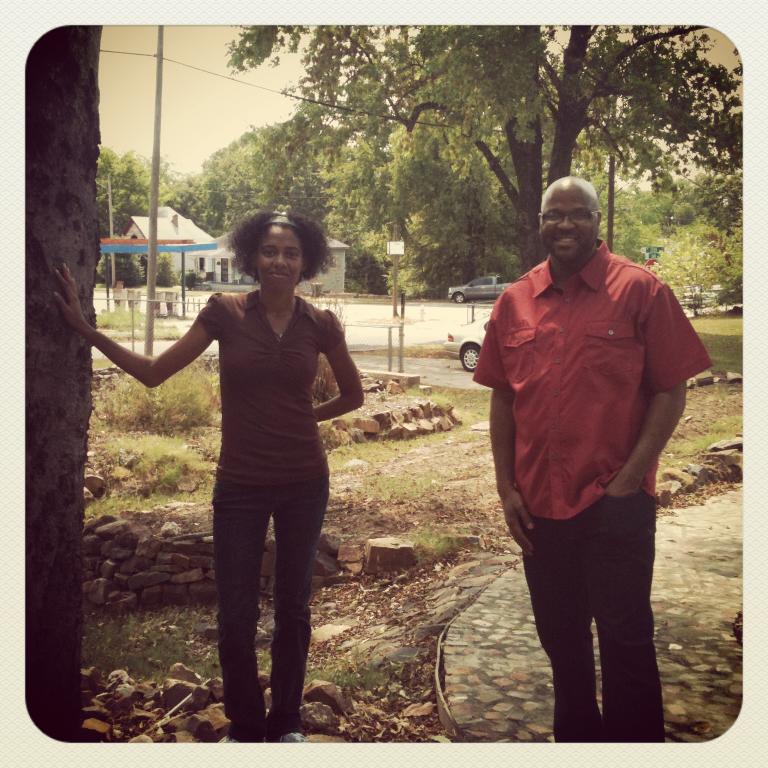
Andrea Coley and Pastor Malik Saafir at Hoover Garden
Riding my bike the few blocks to the Hoover Garden I start to think about space—how it’s used and who controls it. The neighborhood I’m riding through, called the 12th Street Corridor, is a space that’s been defined by passing through. The other neighborhoods nearby are called things like Hillcrest or Stifft Station or the Quapaw Quarter. These are the names of stable places, but the 12th Street Corridor—that’s the name for a place most people just drive right through and never stop. The result is a neighborhood that is dying; abandoned houses on every block, empty lots marking the places that have been burned down or bulldozed, never to be rebuilt again. It’s the kind of place you go through or leave, not the kind of place you stay.
But right on 12th Street, beside a house that was once abandoned and on a lot that once looked like the weed and trash filled vacant spaces dotting the neighborhood, new roots are going down and a garden is growing.
I arrive at the garden, struck by how close it is to where I live, and yet so different. There are big oaks framing the quarter acre, and two large stone lined perennial beds. On the other side there is a chain linked fence with morning glories climbing along it. The fence surrounds several large raised bed garden plots, a few of which are in the process of being torn down to accommodate a new irrigation system. Its late summer and the garden is getting ready to transition to Fall crops.
Malik Saafir pulls into the driveway, just in from teaching an ethics class at a local college. Malik is young, in his 30s, and just moved into the Senior Pastor role at Theresa Hoover UMC which sponsors the Hoover Garden a block away from the church. Malik is light hearted, yet professorial-ready to talk Tupac or Derrida in equal measure. He grew up in low income neighborhoods in Little Rock much like the 12th street corridor and found his way to education in big prestigious institutions like Vanderbilt, where he completed his M.Div. But rather than using that cache to land a job in a big city, Malik came back to Little Rock motivated by a desire to teach people in the community a holistic vision of life that emphasizes environmental justice, of which the garden is a critical part. Looking over the beds and talking about his vision for an environmental justice center out of the church, Malik says “the way this planet is headed, and the way lower income communities are going to be adversely affected by the limitation of resources, there is no doubt in my mind that we need to learn what to do to achieve the localization of food, the establishment of food sovereignty, and what we need to do to develop communal wealth.”
Saafir sees this garden, which was established through the work of his friend Gerald Cound, as a place to train people to become more self-reliant and at the same time community-reliant. The house which sits on the same property as the garden serves as work space for several local non-profit organizations and just across the street from the property is a community center. Saafir says that “With the links to both a spiritual place and a community center the garden is a kind of bridge to draw people through their faith into the green movement.”
As we talk, Adrea Coley the garden manager pulls in. She’s just finished her master’s degree in writing at a local university and created a community gardening manual utilizing her experience at Hoover to guide others into operating a community garden. Coley even designed a story board for a Sim City like garden video game to teach kids about gardening, using an apocalyptic future when oil will no longer be available, a fact that reflects the many surprises of her quiet demeanor.
Adrea jumps into the conversation with self-deprecating humor. She shares about how one of the motivations for her to join the work of the garden is independence. “Knowing how to grow your own food makes you less dependent on big systems to grow your own food and also provides a way to make income with your own hands,” she says. For both Coley and Saafir, an important aspect of getting people of color involved in gardening is the opportunity for self-reliance. As Saafir says, “For people who have a cultural history of farming for other people on other people’s land it is important to create a way for people to enjoy the fruits of their labor.”
In the August heat those fruits are hard to come by, but slowly, people are being drawn into the garden and learning the necessary skills for a more abundant future. Two kids jump a fence and run down to Adrea. “These are my watch dogs,” she says smiling at the boys, “they watch out for the garden and make sure no one messes with it.” The boys grin back and run around the plots. We look over the rows and talk about irrigation, the possibility of adding some rabbits, and dream dreams that we all hope will take root and claim this little patch for a new kind of kingdom.
Ragan Sutterfield is a writer and agrarian in Little Rock, Arkansas. He is author of Farming as a Spiritual Discipline and writes Soul W.O.D., a blog of daily spiritual exercises.
Previous Post

August 19, 2012
An Immeasurable Response to Gun Violence
Next Post
August 24, 2012 Evangelists of Hope
Browse Our Archives
Select a Category Features Front Porch Nurturing Communities Testimonies
Select a Month April 2015 March 2015 February 2015 January 2015 December 2014 September 2014 August 2014 July 2014 June 2014 May 2014 April 2014 March 2014 February 2014 January 2014 December 2013 November 2013 October 2013 September 2013 August 2013 July 2013 June 2013 May 2013 April 2013 March 2013 February 2013 January 2013 December 2012 November 2012 October 2012 September 2012 August 2012 July 2012 June 2012 May 2012 April 2012 March 2012 February 2012 January 2012
Follow Us!
TAKE THE
Religious Wisdom Quiz
Who wrote the majority of the Psalms?
Select your answer to see how you score.
Moses Solomon David Asaph
Related posts from Jonathan Wilson-Hartgrove

Vote Your Dreams, Not Your Fears: #MoralWeekofAction Concludes...


Struggle for Racial Justice is Local

The Strange Glory of a Fully Human Life
TRENDING AT PATHEOS Progressive Christian

What Being a Modern-Day Apostle Means to Me
In my last column, I discussed the ins and outs of modern-day...

Did Ancient China Once Worship the God of...
Across human history, a common thread weaves through the origins of the...

Love Your Neighbor – Including Earth-Kin: Lev. 19,...
God’s command to love your neighbor means acting in an ethical and...

Lead a Church Study of “Jesus and Lao...
Guest writer Jack Thomas (The Irreverent Reverend) reflects on leading his church...

Pastoral Wisdom for Responding to Sermon Pushback
Getting sermon pushback on your social justice sermon? Learn practical, Proverbs-based strategies...

Principles for Understanding the Apostolic Ministry Today
Whenever people discover that my formal ministry title is "apostle," as in...
view all Progressive Christian blogs
Ad-Free & Subscriber Log-In Subscription Support
- About Us
- 2026 Calendar
- Videos
- Podcasts
- Library of World Religions
- Faith In Media Tracker
- Advertise With Us
- Write for Us
- Privacy Policy
- Terms of Service
- Do Not Sell My Data
- Contact Us
- Radiant Digital
- Manage Newsletter Subscriptions
- Unsubscribe From Notifications
- Sitemap
Copyright 2008-2026, Patheos. All rights reserved.
Subscription Support Ad-Free & Subscriber Log-In
Follow Patheos