
BuddhistCatholicContemplativeEvangelicalGeneral ChristianHinduJewishLatter-day SaintMuslimNew VisionsProgressive Christian
Beliefs
- Buddhist
- Catholic
- Contemplative
- Evangelical
- General Christian
- Hindu
- Jewish
- Latter-day Saint
- More Voices
- Muslim
- New Visions
- Pagan
- Progressive Christian
Topics
- Religion News
- Food and Religion
- Sports and Religion
- Religious Art
- Religious Music and Entertainment
- Religious Events
- History and Religion
- Style and Religion
- Politics and Religion
- Women in Religion
- Recreation Outdoors and Religion
- Business Finance and Religion
- Careers Workplace and Religion
- Education and Religion
- Family Parenting and Religion
- Health Fitness and Religion
- Home and Religion
- Relationships and Religion
- Technology and Religion
- Travel and Religion
Columnists
- Buddhist Columnists
- Business Finance and Religion Columnists
- Careers Workplace and Religion Columnists
- Catholic Columnists
- Contemplative Columnists
- Education and Religion Columnists
- Evangelists Columnists
- Family Parenting and Religion Columnists
- General Christian Columnists
- Health Fitness and Religion Columnists
- Hindu Columnists
- History and Religion Columnists
- Home and Religion Columnists
- Jewish Columnists
- More Voices Columnists
- Latter Day Columnists
- Muslim Columnists
- New Visions Columnists
- Nonreligious Columnists
- Pagan Columnists
- Politics and Religion Columnists
- Progressive Columnists
- Recreation Outdoors and Religion Columnists
- Relationships and Religion Columnists
- Religion News Columnists
- Religious Art Columnists
- Religious Events Columnists
- Religious Music and Entertainment Columnists
- Sports and Religion Columnists
- Style and Religion Columnists
- Technology and Religion Columnists
- Travel and Religion Columnists
- Women in Religion Columnists
Resource Library
- 2026 Calendar
- Library of World Religions
- The 100 Most Holy Places on Earth
- Patheos Answers
- Podcasts
- Videos
- Faith Leaders Database
- Anglican Episcopalian
- Bahai
- Baptist
- Buddhism
- Christianity
- Confucianism
- Eastern Orthodoxy
- Hinduism
- Holiness and Pentecostal
- ISKCON
- Islam
- Judaism
- Lutheran
- Methodist
- The Church of Jesus Christ of Latter-day Saints
- New Age
- Paganism
- Presbytarian and Reformed
- Protestantism
- Religion Behind the Scenes
- Roman Catholic
- Scientology
- Shia Islam
- Sikhism
- Sufism
- Sunni Islam
- Taoism
- Zen
- See all religions
Research Tools
 Ad-Free & Subscriber Log-In Subscription Support
Ad-Free & Subscriber Log-In Subscription Support
Follow Patheos 

- Trending:
- Forgiveness
- |
- Marriage
- |
- Consciousness
- |
- Death Penalty
- |
- Election
- |
- Halloween
 Jonathan Wilson-Hartgrove
- Home
- Progressive Christian
- Celebrating Jim Douglass’ Witness
Celebrating Jim Douglass’ Witness
Last updated on: April 19, 2012 at 7:28 pm by Jonathan Wilson-Hartgrove
Celebrating Jim Douglass’ Witness 2012-04-19T19:28:43-06:00 Jonathan Wilson-Hartgrove
Patheos Explore the world's faith through different perspectives on religion and spirituality! Patheos has the views of the prevalent religions and spiritualities of the world.
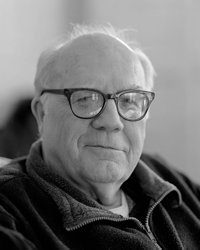 One of the things that I love most about hosting this blog is the chance to invite testimonies from witnesses who have heard and seen what God is up to in The Everyday Awakening that’s happening all around us. If you have a story to share, I’d love to hear it. Today, I want to celebrate a witness who’s testimony has been a guiding light to me over the past decade. One of the most promising theologians of the 1960’s Catholic peace movement, Jim Douglass was successively “released” from teaching posts at universities because of a stubborn insistence on practicing the nonviolence of Jesus that he was teaching and writing about. And so the mind of a gifted scholar found itself at work in abandoned neighborhoods and out-of-the-way places. And Jim learned to see America as it is with a deeply Christian imagination.
The fruit of Jim’s peculiar vocation is that he has learned to re-tell the story of 20th century politics in light of the reality that Thomas Merton called “the Unspeakable.” I had the chance to talk with John Wilson of Books and Culture this week about why I find it so helpful to name what we’re up against through this lens.
Merton wrote his Raids on the Unspeakable in the midst of the turmoil of the ’60s. He was corresponding with friends around the world about the civil rights movement, the peace movement, the threat of nuclear disaster. He’d become a spiritual counselor to activists (including Jim Douglass). And yet, at the same time, Merton’s superiors forbade him to write on political issues. In a fascinating way, this forced him to explore the spiritual dynamics of activism.
So, the notion of the “Unspeakable” emerges as a way of naming what can’t be spoken—those powers that lurk in the silence, defying description and so paralyzing us all the more. Raids on the Unspeakable reads like an apocalypse. It’s a prose poem, really. Out of context, it almost seems crazy. But it is a prayer at the heart of the world’s dark night. In the midst of it, Merton names a bedrock truth: “Christian hope begins where every other truth stands frozen stiff before the power of the Unspeakable.”
Continue reading Jonathan’s interview with John Wilson at Books and Culture.
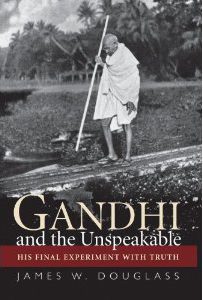 This radical Christian hope is what I have seen in Jim’s witness. And it is, more than anything, the force that I see driving the awakening of hope in new monastic communities and other emerging movements of the Spirit in our world today. Jim’s newest book, Gandhi and the Unspeakable (Orbis Books) is an incredible testimony to the power of this hope. I’ll never forget meeting Jim on the way to Baghdad in 2003 and sharing our faith journeys over a cheese sandwich in a little cafe in Amman, Jordan. When I asked him how he ever got into this strange and fascinating life with Jesus, he paused and said, “Well, I guess it started when Dorothy Day sat across a little table like this one and said to me, ‘Jim, you’re a miracle.’ And she believed it. Of course, she believed it about every single person. But somehow, because she believed it, I was able to believe it too.”
Jim told me stories of lobbying against nuclear war at Vatican II, of going to prison for trying to stop electronic warfare in Vietnam, of walking “Snipers Alley” alone in Sarajevo, of working for years with a broad-based coalition to stop the “White Train” that carried nuclear weapons to First Strike submarines in Bangor, Washington. All of this, he said, was an attempt to follow the way of Jesus. But I’ll never forget what he said about Gandhi in that conversation. “I’ve spent my life trying to figure out how the most faithful disciple of Jesus in the 20th century may have been a man who wasn’t himself a Christian.”
Jim’s new biography of Gandhi is, in a sense, a way of living that question. It is deeply Christian history. And yet, it is the story of a man who struggled with Christians all his life. His struggle, as Jim sees well, was a struggle about an issue at the heart of the gospel. As Gandhi said, “Living Christ means a living cross. Without it life is a living death.” But many who’ve said, “Lord, Lord” would not agree. We have too often reduced the cross to an end for our atonement that does not radically redefine the means of our action. Jim Douglass has helped us see how Gandhi points to the cross as an either/or for all of us. I’ve summarized the decision this way:
WHILE TIME magazine’s Person of the Year for 2011 was the nonviolent protester who awakened hope from the Arab Spring to America’s Autumn, it is no accident that a close second was Adm. William McRaven, who oversaw the Special Forces operation that assassinated Osama bin Laden. As symbols, the protester and the assassin represent two very different hopes for change. But their roles on the world stage are more than symbolic. In a time when change is so desperately needed, the choice between violence and nonviolence may be the fundamental moral issue of the 21st century.
If that choice is real—if the way of the nonviolent protester is a viable option in the 21st century—it is because of the witness of Gandhi and his satyagraha movement in the 20th century. While Gandhi maintained that his tactics of nonviolent struggle against the British Empire were distilled from the best Hindu scriptures and Jesus’ Sermon on the Mount, his employment of those ancient truths in a popular resistance movement vis-a-vis a world power was both original and electrifying. The modern world had never seen such a demonstration of “soul force.” Gandhi’s witness sparked the imagination of America’s civil rights movement, of resistance to apartheid in South Africa, of the nonviolent overthrow of communism in Eastern Europe.
Continue reading Jonathan’s review of Jim’s book in Soujourners Magazine.
May Gandhi’s story–and Jim’s wonderful telling of it–inspire us to choose the way of Jesus in our world today. And may we keep on, despite the suffering and the shame, with our eyes on the prize of the glory that is to come.
Previous Post

April 17, 2012
Should This Family Be Illegal?
Next Post
April 21, 2012 William Barber: A Victory for Racial Justice in North Carolina
Browse Our Archives
Select a Category Features Front Porch Nurturing Communities Testimonies
Select a Month April 2015 March 2015 February 2015 January 2015 December 2014 September 2014 August 2014 July 2014 June 2014 May 2014 April 2014 March 2014 February 2014 January 2014 December 2013 November 2013 October 2013 September 2013 August 2013 July 2013 June 2013 May 2013 April 2013 March 2013 February 2013 January 2013 December 2012 November 2012 October 2012 September 2012 August 2012 July 2012 June 2012 May 2012 April 2012 March 2012 February 2012 January 2012
Follow Us!
TAKE THE
Religious Wisdom Quiz
I am a runaway slave who became a brother. Paul pleaded for my master to receive me back in love. Who am I?
Select your answer to see how you score.
Onesimus Philemon Titus Timothy
Related posts from Jonathan Wilson-Hartgrove
Vote Your Dreams, Not Your Fears: #MoralWeekofAction Concludes...
Duck Dynasty: Join the Real Rebels
TRENDING AT PATHEOS Progressive Christian

Why Christians Have a Sacred Duty to Vote:...
The Bible offers strong support for the sacred duty to vote. Here...

What Being a Modern-Day Apostle Means to Me
In my last column, I discussed the ins and outs of modern-day...

Did Ancient China Once Worship the God of...
Across human history, a common thread weaves through the origins of the...

Love Your Neighbor – Including Earth-Kin: Lev. 19,...
God’s command to love your neighbor means acting in an ethical and...

Lead a Church Study of “Jesus and Lao...
Guest writer Jack Thomas (The Irreverent Reverend) reflects on leading his church...

Principles for Understanding the Apostolic Ministry Today
Whenever people discover that my formal ministry title is "apostle," as in...
view all Progressive Christian blogs
Ad-Free & Subscriber Log-In Subscription Support
- About Us
- 2026 Calendar
- Videos
- Podcasts
- Library of World Religions
- Faith In Media Tracker
- Advertise With Us
- Write for Us
- Privacy Policy
- Terms of Service
- Do Not Sell My Data
- Contact Us
- Radiant Digital
- Manage Newsletter Subscriptions
- Unsubscribe From Notifications
- Sitemap
Copyright 2008-2026, Patheos. All rights reserved.
Subscription Support Ad-Free & Subscriber Log-In
Follow Patheos