
BuddhistCatholicContemplativeEvangelicalGeneral ChristianHinduJewishLatter-day SaintMuslimNew VisionsProgressive Christian
Beliefs
- Buddhist
- Catholic
- Contemplative
- Evangelical
- General Christian
- Hindu
- Jewish
- Latter-day Saint
- More Voices
- Muslim
- New Visions
- Pagan
- Progressive Christian
Topics
- Religion News
- Food and Religion
- Sports and Religion
- Religious Art
- Religious Music and Entertainment
- Religious Events
- History and Religion
- Style and Religion
- Politics and Religion
- Women in Religion
- Recreation Outdoors and Religion
- Business Finance and Religion
- Careers Workplace and Religion
- Education and Religion
- Family Parenting and Religion
- Health Fitness and Religion
- Home and Religion
- Relationships and Religion
- Technology and Religion
- Travel and Religion
Columnists
- Buddhist Columnists
- Business Finance and Religion Columnists
- Careers Workplace and Religion Columnists
- Catholic Columnists
- Contemplative Columnists
- Education and Religion Columnists
- Evangelists Columnists
- Family Parenting and Religion Columnists
- General Christian Columnists
- Health Fitness and Religion Columnists
- Hindu Columnists
- History and Religion Columnists
- Home and Religion Columnists
- Jewish Columnists
- More Voices Columnists
- Latter Day Columnists
- Muslim Columnists
- New Visions Columnists
- Nonreligious Columnists
- Pagan Columnists
- Politics and Religion Columnists
- Progressive Columnists
- Recreation Outdoors and Religion Columnists
- Relationships and Religion Columnists
- Religion News Columnists
- Religious Art Columnists
- Religious Events Columnists
- Religious Music and Entertainment Columnists
- Sports and Religion Columnists
- Style and Religion Columnists
- Technology and Religion Columnists
- Travel and Religion Columnists
- Women in Religion Columnists
Resource Library
- 2026 Calendar
- Library of World Religions
- The 100 Most Holy Places on Earth
- Patheos Answers
- Podcasts
- Videos
- Faith Leaders Database
- Anglican Episcopalian
- Bahai
- Baptist
- Buddhism
- Christianity
- Confucianism
- Eastern Orthodoxy
- Hinduism
- Holiness and Pentecostal
- ISKCON
- Islam
- Judaism
- Lutheran
- Methodist
- The Church of Jesus Christ of Latter-day Saints
- New Age
- Paganism
- Presbytarian and Reformed
- Protestantism
- Religion Behind the Scenes
- Roman Catholic
- Scientology
- Shia Islam
- Sikhism
- Sufism
- Sunni Islam
- Taoism
- Zen
- See all religions
Research Tools
 Ad-Free & Subscriber Log-In Subscription Support
Ad-Free & Subscriber Log-In Subscription Support
Follow Patheos 

- Trending:
- Forgiveness
- |
- Marriage
- |
- Consciousness
- |
- Death Penalty
- |
- Election
- |
- Halloween
 Jonathan Wilson-Hartgrove
- Home
- Progressive Christian
- Hope in the Face of Death
Hope in the Face of Death
Last updated on: January 20, 2012 at 10:03 pm by Jonathan Wilson-Hartgrove
Hope in the Face of Death 2012-01-20T22:03:41-07:00 Jonathan Wilson-Hartgrove
Patheos Explore the world's faith through different perspectives on religion and spirituality! Patheos has the views of the prevalent religions and spiritualities of the world.
The Rutba House community was on retreat in Washington, DC, over the MLK weekend. We got up early Monday morning to take the kids to the new MLK Memorial on the National Mall. The long walk in sub-freezing winds nearly did us in, but we made it. Coming through the literal depiction of the “mountain of despair” that King named and called us all to face, we could feel the sense of accomplishment as we gazed upon the “stone of hope.” My son, JaiMichael, was feeling a bit of King’s determined spirit.
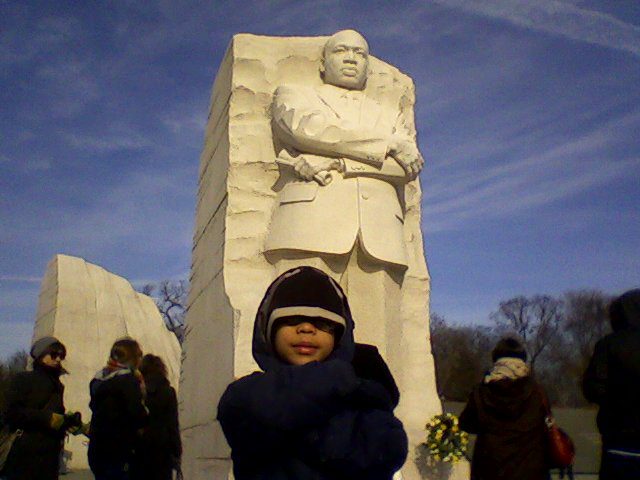
JaiMichael channeling Dr. King.
But we could not celebrate King’s dream without remembering how the Unspeakable identified King as an enemy of the state, marking him for death when he refused to accept the trinity of militarism, racism, and poverty in this country. We could not forget how the same country that celebrates his nonviolent struggle with a national holiday and monument also perpetuates the myth of redemptive violence by overtly executing its “disposable citizens.” So on Tuesday morning we went to the Supreme Court to stand with and pray for 14 activists who were arrested for asking SCOTUS to stop executions 35 years after it reinstated the death penalty in our country. An AP photographer caught the spirit of our group in 4 year-old Naomi’s expression.
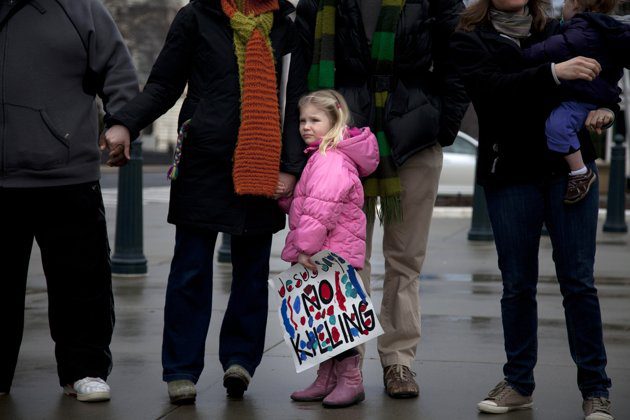
Rutba House prays at Supreme Court
How do we keep hope alive in the face of the powers of death?
A young man from Ohio stopped by my office today to chat about faith and community. As he was leaving, he paused. “I know this is unrelated,” he said, “but I want to thank you for what you’ve said about the death penalty. It’s really touched a lot of Christians where I live. And we’ve changed our minds. We know we can’t support it any more.”
Hope is knowing that our prayers are heard, even when we’re not sure how. I think my brother was referring to this piece, originally published on the Huffington Post.
In December of 2001, after observing a series of executions nearly every week in North Carolina, a group of faith-based activists came together to ask what we should do. We knew there were victims’ rights activists, many of them also people of faith, who supported the death penalty as a just punishment for violent criminals. We also knew death penalty protestors who argued against the death penalty because it disproportionately targets poor and black criminals and is an embarrassment to Western democracy. What we were most struck by, however, was the way the execution rite mimicks Christ’s passion in this Bible-belt state, almost as if the salvation of the people depends on human sacrifice. The problem with the death penalty, we started saying, was that it forced us as citizens to participate in idolatry. We wanted people to know that Jesus died once and for all so that no one else would have to. More than anything, we didn’t want to participate in the idolatry any longer.
So on the night when the state was scheduled to execute Kenneth Lee Boyd, the 1,000th person to be executed in the United States since the death penalty was reinstated in 1976, 15 of us went in sack cloth and ashes, knelt before the prison and blocked the entrance to prevent the witnesses from entering the building. Without witnesses, we knew, the execution could not go forward. In a matter of minutes we were arrested, and the execution continued. The next time an execution was scheduled the police put up barricades to prevent us from entering the prison from a sidewalk. So we processed through the intersection in front of the prison singing, “Were you there when they crucified my Lord?” and held a worship service honoring our Savior, who laid down his life as a ransom for many. Again, we were arrested and held in jail until the execution was completed. After we had done this a couple of times, the magistrate in Wake County assigned us each $5,000 bail. I spent the night in jail, waiting for a bench judge to let me out the next afternoon on a promise to appear for my court date.
After more than six months and a total of 65 arrests at four different executions, we finally had our day in court. The state presented its case, establishing that we had indeed trespassed on prison property by presenting aerial photographs and testimony from our arresting officers and the commander on duty. We agreed that all the facts were true, but told the judge that we wanted to offer in our defense an argument for the necessity of our actions. He invited me to take the stand and asked me to summarize our case. I told the judge that we were Christians, and that we could not support state-sponsored executions that expressly mimic Christ’s passion. I told him our Christian convictions compel us to take direct action to prevent any murder. We had trespassed at the prison to prevent a murder that we believed to be unjust and idolatrous.
“Before we proceed,” the judge asked, “could you tell me how you read Romans 13?” I knew there was hope if the judge wanted to talk about the Bible. So I quoted for him Paul’s injunction in Romans 13 to “submit to earthly authority” and said that we had learned from Martin Luther King that when a law is unjust in this country, it is the Christian’s responsibility to break it and thereby bring it before a court that can evaluate its justice. “We are here today, your honor, to submit to your authority and ask for a decision about the justice of the death penalty.” The judge nodded and asked us to present our case.
On the stand we talked about our relationships with people on death row and their family members. We explained that we had exhausted every legal means to try to stop the execution of the four men whose executions we had ultimately tried to prevent by trespassing. But more than anything, we talked about Jesus and the good news that all human sacrifice had been brought to an end at the cross. The prosecutor asked if we had shared our faith with the prisoners before they were executed, and we said we had. As a matter of fact, all four of the men had been fellow Christians. “Doesn’t Paul say, ‘To be absent from the body is to be present with the Lord?'” he asked. I was on the stand at the time and gladly took the opportunity to explain that neither Jesus nor Paul preached a salvation of the soul apart from the body. The Romans crucified Jesus’ body, but God raised his soul and his body from the dead. I said I knew I was just a preacher in a public courtroom, but I’d come to preach salvation of the whole person.
After my testimony as to our convictions and intentions, we asked the judge if we could call theologian Stanley Hauerwas as an expert witness. The judge hesitated, but we said we thought the court should hear from an expert on church doctrine whether there was any merit to our case. “Well, since he has come and waited so patiently, I’ll let him take the stand,” the judge said. Dr. Hauerwas explained to the judge the strong position against capital punishment that Pope John Paul II held, together with most of the major teachers of the church. “After all, the State executed our Lord,” Hauerwas said. “The church has always had a problem with capital punishment.” He went on to recount for the judge a history of Christian civil resistance to slavery, Jim Crow laws, foreign war and nuclear armament. “This is what Christians do when their convictions run up against the systems of this world,” he said. “They get in the way.”
With that, we rested our case and waited for the judge’s verdict. He began by saying that one of his early mentors had advised him that it was not wise to speak at any length from the bench. Generally, he followed that advice. But he wanted to diverge in this case to say both that he admired our courage and that he was honored to hear this case in his courtroom. It was not in his power, however, to decide on the justice of the death penalty. He said that his job was simply to rule as to whether we were guilty of trespassing, which we had agreed that we were. So he found us guilty, but suspended any sentence. We walked out of the courtroom knowing that the judge had done all he could — if he wanted to keep his job, that is.
A lawyer who had been following the death penalty in North Carolina for years congratulated us and said he didn’t think executions would last another year. Less than six months later, the North Carolina Medical Board issued a statement saying that it would be a breach of medical ethics for any physician to participate in an execution. The state’s protocol, however, mandates that a physician be present for an execution to take place. This created a legal tangle, the result of which has been a de facto moratorium on the death penalty in North Carolina.
Previous Post

January 19, 2012
Testimony: Where Hope Is Real, Gratitude Abounds
Next Post
January 23, 2012 From D.C.'s Christ House, A Word and a Witness
Browse Our Archives
Select a Category Features Front Porch Nurturing Communities Testimonies
Select a Month April 2015 March 2015 February 2015 January 2015 December 2014 September 2014 August 2014 July 2014 June 2014 May 2014 April 2014 March 2014 February 2014 January 2014 December 2013 November 2013 October 2013 September 2013 August 2013 July 2013 June 2013 May 2013 April 2013 March 2013 February 2013 January 2013 December 2012 November 2012 October 2012 September 2012 August 2012 July 2012 June 2012 May 2012 April 2012 March 2012 February 2012 January 2012
Follow Us!
TAKE THE
Religious Wisdom Quiz
What happened when the Israelites saved the with leftover manna?
Select your answer to see how you score.
It turned to gold It fed animals It bred worms and stank It melted
Related posts from Jonathan Wilson-Hartgrove
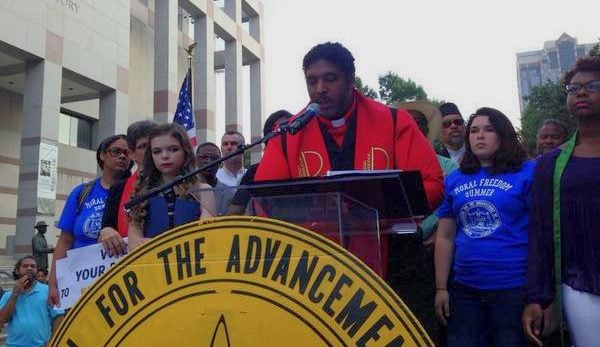
Arrests Resume As Moral Movement Continues
A Palm Sunday Invitation to Holy Ground

A White Southerner in the Freedom Movement
If Past Is Prologue, Pay Attention to the...
TRENDING AT PATHEOS Progressive Christian

Why Christians Have a Sacred Duty to Vote:...
The Bible offers strong support for the sacred duty to vote. Here...

What Being a Modern-Day Apostle Means to Me
In my last column, I discussed the ins and outs of modern-day...

Did Ancient China Once Worship the God of...
Across human history, a common thread weaves through the origins of the...

Love Your Neighbor – Including Earth-Kin: Lev. 19,...
God’s command to love your neighbor means acting in an ethical and...

Lead a Church Study of “Jesus and Lao...
Guest writer Jack Thomas (The Irreverent Reverend) reflects on leading his church...

Principles for Understanding the Apostolic Ministry Today
Whenever people discover that my formal ministry title is "apostle," as in...
view all Progressive Christian blogs
Ad-Free & Subscriber Log-In Subscription Support
- About Us
- 2026 Calendar
- Videos
- Podcasts
- Library of World Religions
- Faith In Media Tracker
- Advertise With Us
- Write for Us
- Privacy Policy
- Terms of Service
- Do Not Sell My Data
- Contact Us
- Radiant Digital
- Manage Newsletter Subscriptions
- Unsubscribe From Notifications
- Sitemap
Copyright 2008-2026, Patheos. All rights reserved.
Subscription Support Ad-Free & Subscriber Log-In
Follow Patheos