
BuddhistCatholicContemplativeEvangelicalGeneral ChristianHinduJewishLatter-day SaintMuslimNew VisionsProgressive Christian
Beliefs
- Buddhist
- Catholic
- Contemplative
- Evangelical
- General Christian
- Hindu
- Jewish
- Latter-day Saint
- More Voices
- Muslim
- New Visions
- Pagan
- Progressive Christian
Topics
- Religion News
- Food and Religion
- Sports and Religion
- Religious Art
- Religious Music and Entertainment
- Religious Events
- History and Religion
- Style and Religion
- Politics and Religion
- Women in Religion
- Recreation Outdoors and Religion
- Business Finance and Religion
- Careers Workplace and Religion
- Education and Religion
- Family Parenting and Religion
- Health Fitness and Religion
- Home and Religion
- Relationships and Religion
- Technology and Religion
- Travel and Religion
Columnists
- Buddhist Columnists
- Business Finance and Religion Columnists
- Careers Workplace and Religion Columnists
- Catholic Columnists
- Contemplative Columnists
- Education and Religion Columnists
- Evangelists Columnists
- Family Parenting and Religion Columnists
- General Christian Columnists
- Health Fitness and Religion Columnists
- Hindu Columnists
- History and Religion Columnists
- Home and Religion Columnists
- Jewish Columnists
- More Voices Columnists
- Latter Day Columnists
- Muslim Columnists
- New Visions Columnists
- Nonreligious Columnists
- Pagan Columnists
- Politics and Religion Columnists
- Progressive Columnists
- Recreation Outdoors and Religion Columnists
- Relationships and Religion Columnists
- Religion News Columnists
- Religious Art Columnists
- Religious Events Columnists
- Religious Music and Entertainment Columnists
- Sports and Religion Columnists
- Style and Religion Columnists
- Technology and Religion Columnists
- Travel and Religion Columnists
- Women in Religion Columnists
Resource Library
- 2026 Calendar
- Library of World Religions
- The 100 Most Holy Places on Earth
- Patheos Answers
- Podcasts
- Videos
- Faith Leaders Database
- Anglican Episcopalian
- Bahai
- Baptist
- Buddhism
- Christianity
- Confucianism
- Eastern Orthodoxy
- Hinduism
- Holiness and Pentecostal
- ISKCON
- Islam
- Judaism
- Lutheran
- Methodist
- The Church of Jesus Christ of Latter-day Saints
- New Age
- Paganism
- Presbytarian and Reformed
- Protestantism
- Religion Behind the Scenes
- Roman Catholic
- Scientology
- Shia Islam
- Sikhism
- Sufism
- Sunni Islam
- Taoism
- Zen
- See all religions
Research Tools
 Ad-Free & Subscriber Log-In Subscription Support
Ad-Free & Subscriber Log-In Subscription Support
Follow Patheos 

- Trending:
- Forgiveness
- |
- Marriage
- |
- Consciousness
- |
- Death Penalty
- |
- Election
- |
- Halloween
 Jonathan Storment
- Home
- Evangelical
- Left To Our Own Devices: Think Different
Left To Our Own Devices: Think Different
Last updated on: April 17, 2018 at 5:01 am by Jonathan Storment
Left To Our Own Devices: Think Different 2018-04-16T21:40:15-05:00 Jonathan Storment
Patheos Explore the world's faith through different perspectives on religion and spirituality! Patheos has the views of the prevalent religions and spiritualities of the world.
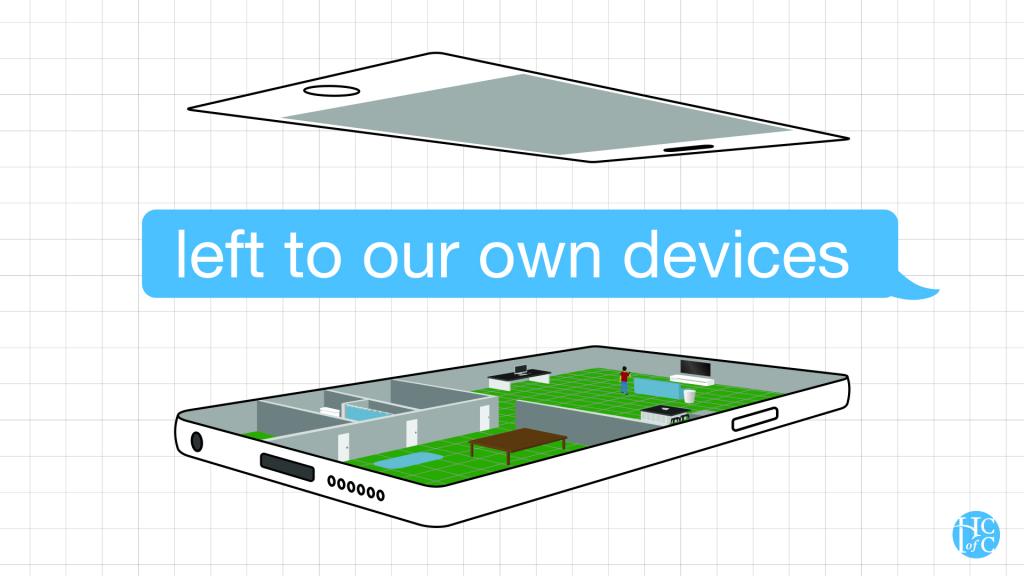 For the first few weeks after 9-11, there was a resurgence of all things religious.Maybe you remember, but for the first few Sundays after that national tragedy, churches were packed, prayer meetings were called and Americans seem to reinvest in their religious commitments.
But…
While all that was happening, a Neuroscientist named Sam Harris sat down and began to write a scathing critique of…not just Islam, but against all things religious. Later to be joined by Richard Dawkins, Christopher Hitchens and others, these New Atheists became Rock Stars.
They appeared on The Colbert Report, The Tonight Show, and college campuses across the country. And their central argument made in a hundred intelligent and memorable ways was that Religion…all religion…was bad for the world.
And they were by all accounts, very effective. Not so much in leading a large group of people to convert to Atheism, but in helping people drift away from religion in general.
If you’ve been paying attention, than you’ve probably heard about the Rise of the Nones (or those not affiliated with any religion) and you’re seeing the tremendous success of these influential men.
Now the most growing religious demographic in America is those who claim to have no religion.
Or so it seems.
A few months ago I read a book by Baylor Press called Appletopia: Media, Technology and The Religious Imagination of Steve Jobs. And it was fascinating. Especially in regards to the way that while traditional religious commitments have declined in the West, the commitments to the new religions have skyrocketed.
Especially in regards to our relationships with technology. Here’s an excerpt:
The sense that the world is charged with grandeur and mystery has largely faded in the wake of a dogmatic defense to rationalism in the modern world. As a result, the world has lost some of its primordial magic. Thus, an electrifying encounter with a technological wonder reinvests the world with a transcendent significance.
Life’s Too Short To Pretend You’re Not Religious
It’s interesting…something else happened just a few days after 9-11.
In late September 2001, Apple held a press conference, because of the recent national tragedy it was extremely subdued, unlike most Apple product roll-outs there wasn’t any rock music and no rounds of applause.
But that was when Steve Jobs told the world about how they could now fit a thousand songs in their pocket.
Just a couple of years later, Newsweek called it “a life-changing icon, and an object of devotion that has inspired a cult.”
It helped people feel cosmically connected and made their surroundings seem more spiritual and sacred, and this was the underlying message that the iPod ads were trying to convey, in both medium and message.
Maybe you remember the Ipod ads were all over the major urban centers, giant billboards painted on buildings (a medium that was used here for the first time) and they functioned like stained glass windows on the urban cathedral, with silhouetted icons dancing in ecstasy.
Right before the Iphone came out, the sitting Pope warned about the ways that technology could harm our souls, and in response a tech writer responded tongue in check to the Pope, saying “Steve Jobs is our shepherd now and he will save us by the Jesus phone, lifting the hunger and disease from the land and saving macboy fanatics like me.”
And if you think that’s too much of a stretch than maybe you’ve forgotten how Apple first advertised the iPhone. Below is one of the first ads that Apple ran for this device that has captured the world’s imagination and attention.
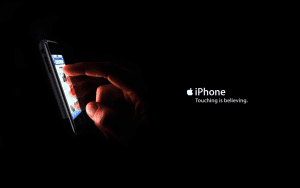
Ad for the first iPhone “Touching Is Believing”
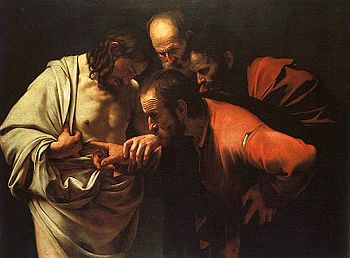
The Incredulity of Saint Thomas by Caravaggio
For those of you familiar with your Bible, you might recognize that this is derivative of another story, a story that happened right after Jesus had risen from the dead.
One of the Apostles, wasn’t there when the other apostles saw Jesus alive again, and when they told him about it he refused to believe it
He actually said he wouldn’t believe it until he had touched the risen Lord.
The picture is of a hand, with one finger extended to touch the glowing Iphone just like Michaelangelo’s picture of Creation of Adam.
Apple has tapped into our deepest longings and desires, selling wonder (with diminishing returns) using iconic religious images, stories and even religious heroes from Dr. King to Ghandhi. Apple promoters are even referred to as evangelists. As in telling the world “The Good News of Apple”
If you’re paying attention to this than you realize Apple’s aims are not just to get your money, but to capture your imagination…especially your religious imagination.
Some Trust in Chariots
Here’s a conversation that Jobs actually had with marketing department head “Murray” right before launching the Mac in 1984:
Jobs: We don’t stand a chance of advertising with features and benefits and with charts and comparisons. The only chance we have of communicating is with a feeling.
Murray: It’s got to be a cult product.
Jobs “Yeah, we say, it’s a cult, and then we say, hey drink this Kool-Aid. We want to create an image people will never forget. We’ve got to build it, and we’ve got to build it early.”
This is why some people believe the most photographed site in NYC is not Ground Zero or The Empire State Building, but the Apple store on 5th Avenue. It stands as a glowing otherworldly Temple that invites people into what is called (and rightly so) “The Cathedral of Consumption”
There’s an ancient Psalm that the people of God have sung for thousands of years. They would sing “Some trust in Chariots” Chariots: the greatest technology of their day at the time. And the people of God intentionally sang some trust in that new technology, but, “We trust in the name of the Lord our God.”
If we could get past the narrow definition of religion that we have, we’d probably be able to see that we, as a society, have not become less religious, but more so, and in different ways. And that these religious are competing for our minds, hearts and souls just as much as any other denomination in human history.
The Spanish Philosopher Jesus Martin-Barbero puts it this way:
Despite all the promise of modernity to make religion disappear, what has really happened is that religion has modernized itself. . . . What we are witnessing is not the conflict of religion and modernity, but the transformation of modernity into enchantment by linking new communication technologies to the logic of popular religiosity.
Now look, I own just about everything Apple has ever made. I’m an early adopter, and heavy tech user who really appreciates these devices, but I’m starting to realize some of my attachments to technology are unhealthy and might not have been so accidental after all.
A kind of thought experiment to try out is to re-consider that Steve Jobs wasn’t just a technological pioneer, he was also something like a L. Ron Hubbard. A Creator of a new and strange religion. Because until we come to terms with the cult of Apple and the significant amount of spinoffs sects we will be blind to the pull and power our devices have over us.
And before you tell yourself that you don’t drink the Kool-Aid that Steve Jobs was so intentional on creating and marketing I think we all owe ourself an honest self-assessment. Do we like what our new religions are doing to us?
One of the most basic words in the Christian Vocabulary is Repent. It’s a word that comes from the Greek word Metanoia. It means to turn around, to change directions.
It’s a call for people who are heading in a path that leads to their own self-destruction to wake up to the danger ahead of them and to make a course correction. But there is another meaning to the word Metanoia, it can be “A radical change of heart and mind.”
I think for most of us, especially those of you, who like me are tired of being addicted to your screen, to missing your life one moment at a time, to wake up. To Repent.
Or in the religious vocabulary of Apple.
Think Different.
Previous Post

April 10, 2018
Left to Our Own Devices: Consumers and Poor Communicators
Next Post
April 24, 2018 Left To Our Own Devices: Power Down
Browse Our Archives
Select a Category Uncategorized
Select a Month July 2018 June 2018 May 2018 April 2018 March 2018 February 2018 January 2018 December 2017 November 2017 October 2017 September 2017 August 2017 July 2017 June 2017 May 2017 April 2017 March 2017 February 2017 January 2017 December 2016 November 2016 October 2016 September 2016 August 2016 July 2016 June 2016 May 2016 April 2016
Follow Us!
TAKE THE
Religious Wisdom Quiz
Who said: "Now to him who is able to keep you from stumbling and to present you before his glorious presence without fault"?
Select your answer to see how you score.
Peter Paul John Jude
Related posts from Jonathan Storment

Christians Make the Best Atheists
Worshipping Aphrodite: You Will Marry the Wrong Person
Worshipping Aphrodite: Life in Ruins
Baptizing Justin Bieber #3: Beyond All Fame
TRENDING AT PATHEOS Evangelical

The REST of Your Life: A Creative Wrestles...
This week I had a conversation with a good friend from church....

How the author of the world's best hymn...
I've been working with John Newton for a while now. This makes...

Long before this Lectio Divina, Psalm 130 - the song - started...

What About the Trees? Another Living Parable
After I finished writing the last article about falling leaves as a...

Why Classical Education Is a Conversation, Not a...
Come and Read: Joy in Classical Education When I was a little...

Cornell University has received a great deal of negative publicity and intense...
view all Evangelical blogs
Ad-Free & Subscriber Log-In Subscription Support
- About Us
- 2026 Calendar
- Videos
- Podcasts
- Library of World Religions
- Faith In Media Tracker
- Advertise With Us
- Write for Us
- Privacy Policy
- Terms of Service
- Do Not Sell My Data
- Contact Us
- Radiant Digital
- Manage Newsletter Subscriptions
- Unsubscribe From Notifications
- Sitemap
Copyright 2008-2026, Patheos. All rights reserved.
Subscription Support Ad-Free & Subscriber Log-In
Follow Patheos