
BuddhistCatholicContemplativeEvangelicalGeneral ChristianHinduJewishLatter-day SaintMuslimNew VisionsProgressive Christian
Beliefs
- Buddhist
- Catholic
- Contemplative
- Evangelical
- General Christian
- Hindu
- Jewish
- Latter-day Saint
- More Voices
- Muslim
- New Visions
- Pagan
- Progressive Christian
Topics
- Religion News
- Food and Religion
- Sports and Religion
- Religious Art
- Religious Music and Entertainment
- Religious Events
- History and Religion
- Style and Religion
- Politics and Religion
- Women in Religion
- Recreation Outdoors and Religion
- Business Finance and Religion
- Careers Workplace and Religion
- Education and Religion
- Family Parenting and Religion
- Health Fitness and Religion
- Home and Religion
- Relationships and Religion
- Technology and Religion
- Travel and Religion
Columnists
- Buddhist Columnists
- Business Finance and Religion Columnists
- Careers Workplace and Religion Columnists
- Catholic Columnists
- Contemplative Columnists
- Education and Religion Columnists
- Evangelists Columnists
- Family Parenting and Religion Columnists
- General Christian Columnists
- Health Fitness and Religion Columnists
- Hindu Columnists
- History and Religion Columnists
- Home and Religion Columnists
- Jewish Columnists
- More Voices Columnists
- Latter Day Columnists
- Muslim Columnists
- New Visions Columnists
- Nonreligious Columnists
- Pagan Columnists
- Politics and Religion Columnists
- Progressive Columnists
- Recreation Outdoors and Religion Columnists
- Relationships and Religion Columnists
- Religion News Columnists
- Religious Art Columnists
- Religious Events Columnists
- Religious Music and Entertainment Columnists
- Sports and Religion Columnists
- Style and Religion Columnists
- Technology and Religion Columnists
- Travel and Religion Columnists
- Women in Religion Columnists
Resource Library
- 2026 Calendar
- Library of World Religions
- The 100 Most Holy Places on Earth
- Patheos Answers
- Podcasts
- Videos
- Faith Leaders Database
- Anglican Episcopalian
- Bahai
- Baptist
- Buddhism
- Christianity
- Confucianism
- Eastern Orthodoxy
- Hinduism
- Holiness and Pentecostal
- ISKCON
- Islam
- Judaism
- Lutheran
- Methodist
- The Church of Jesus Christ of Latter-day Saints
- New Age
- Paganism
- Presbytarian and Reformed
- Protestantism
- Religion Behind the Scenes
- Roman Catholic
- Scientology
- Shia Islam
- Sikhism
- Sufism
- Sunni Islam
- Taoism
- Zen
- See all religions
Research Tools
 Ad-Free & Subscriber Log-In Subscription Support
Ad-Free & Subscriber Log-In Subscription Support
Follow Patheos 

- Trending:
- Forgiveness
- |
- Marriage
- |
- Consciousness
- |
- Death Penalty
- |
- Election
- |
- Halloween
 Jonathan Storment
- Home
- Evangelical
- Charlottesville, the Church, and Our Self-Deceit
Charlottesville, the Church, and Our Self-Deceit
Last updated on: August 15, 2017 at 5:01 am by Jonathan Storment
Charlottesville, the Church, and Our Self-Deceit 2017-08-14T22:36:15-05:00 Jonathan Storment
Patheos Explore the world's faith through different perspectives on religion and spirituality! Patheos has the views of the prevalent religions and spiritualities of the world.
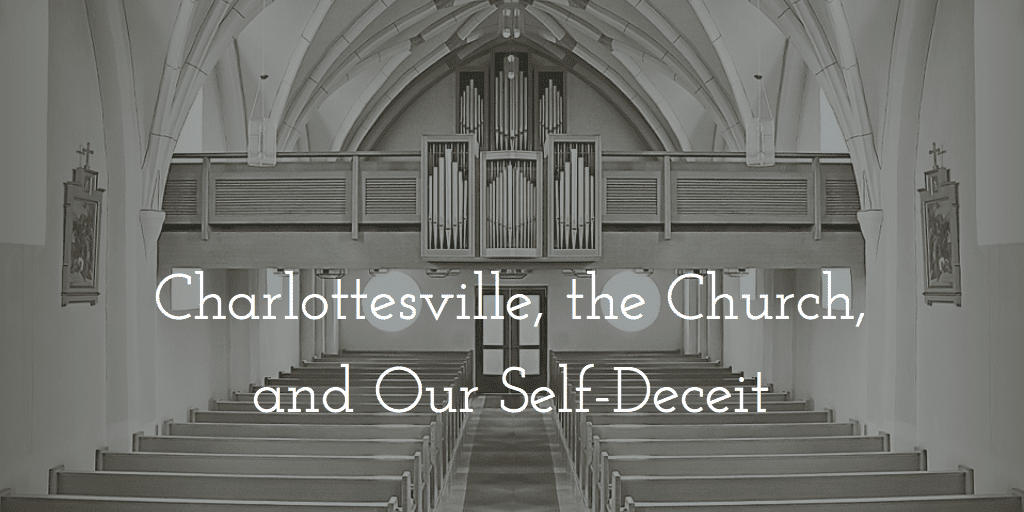 Nobody thinks they’re a racist.
Have you ever noticed that? In the social media bubbles of our own making, the echo chambers of our design we can safely assume that we are able to love everyone.
Even some of the people who marched under Nazi flags chanting “You will not replace us” this weekend, when their identity was outed online wanted to make sure the world knew “I’m not the angry racist I appear to be in those pictures.”
And while that kind of deceit is easy to see at a distance, I believe we are all engaged in a level of self-deceit…especially when it comes to this.
It’s only when you have to spend time around the people you would just as assume avoid that you discover the more nasty bits of truth about yourself, and it’s only when you discover those truths that you’re able to truly act on and resist them.
Over the weekend, as I watched the images of the angry white men marching with Tiki torches in Charlottsville one thought kept going through my head.
I have way more in common with them them than I’d like to admit.
When I saw that mugshot of James Fields (the driver who drove into the group of protestors) I knew that I was just a few opportunities away from being that guy.
I grew up in rural Arkansas in the 80s, in a world that was integrated in theory and yet segregated in every meaningful way I experienced the world…except one place…at church.
A Community of Resistance
I grew up in a church of ten people. Most people would call that a small group, but it was my entire church, and I love the people from that church.
When I went to college, I would come back a few times a year to preach, and I would try to bring some friends with me to encourage my church family. One of those Sundays we had brought about forty people with us, and right before it was time for me to preach, Brother Foy, the patriarch of the church, stood up to introduce me.
This is funny in itself, because I was the only person there who knew everyone. This was the church I grew up in, and these were my friends who came home with me. But tradition is tradition, and if someone other than Foy was preaching, he was going to say something.
So Foy stood up and the first words out of his mouth were, “I can’t help but notice that all of our guests are white.” Immediately I was worried about where this was going, because Foy was crazy. He was crazy for Jesus, but still… crazy. If he felt like something was true, he would say it without regard for how you felt about it, and I could tell this was about to be one of those occasions.
“We have forty extra people with us this morning, and every one of them is a white person.” Then Foy pointed at the African-American teenage boy sitting on the second row and said, “I brought an African-American this morning. Why didn’t you?” (Obviously, political correctness was not Foy’s strong suit.)
“Now Brother Jonathan, come preach the word to us.”
Then I had to stand up and preach to a group of people who were just made to feel as if they were they had just stumbled out of a Klan rally.
But to be honest, looking back, I’m glad Brother Foy asked that question. I wish all our churches had someone asking questions like that
Whenever I get frustrated with church, this is the story that brings me back. It is a story that reminds me of why I need the church, even when I don’t want her…maybe especially when I don’t want her.
If you’ve read this blog for any length of time at all, you know that I believe in what God is doing all over the world through the local church. At her best, one of the ways the Church does this is by keeping us honest about ourselves before moments like this weekend happen.
When most of our lives our mediated through glowing screens and homogenous friend groups or social media it’s much easier to not have confront the more unpleasant realities that go on inside of ourselves.
What We Can’t See in the Mirror
In his great little book, I Told Me So Gregg A. Ten Elshof talks about the pervasive nature of self-deception. This book is about how intelligent, self-reflective people often lie to themselves, oblivious that they are doing so.
Then Elshof says this:
We assume that each person is the unquestionable authority on the question of which beliefs he or she has.
In other words, none of us really knows clearly what we believe.
That is the nature of self-deceit. We need each other to help us see the blind spots we have. I think this is the reason that we Christians aren’t able to move very well on issues of race.
We have made this into the unforgivable, and therefore an un-confessable sin, and when the topic rears its ugly head we rush to prove how innocent we are, we scapegoat public figures andd doxx the anonymous ones, we point out our own “squeaky clean” record instead of asking the dangerous but Gospel-bringing question…”Where is this in me?”
I think one of the greatest challenges facing America today, is not those white men marching with Tiki torches, it’s what an article in the Atlantic a few years ago called, “Elegant Racism” It’s the kind of racism that has learned to be polite about its indifference. It would never organize a march to demand things stay the same.
Instead it would quietly place it’s vote in the board room.
The more insidious kind of racism is done every day by those of us…people like me…who find ourselves incredibly offended by the images we saw this weekend.
But the Gospel can help us here. Because when we are aware of the love of God we are able to be suspicious of our own virtues.
In his book, Elshof gives us an example of a dear Christian senior saint “Lucille” If you were to ask Lucille a series of True/False questions, and one of them happened to be: “People of all ethnicities are equally valuable, equally loved by God, and equally to be respected.”
She would obviously answer “true” without hesitation. It would strike her as something you would have to be a moral wretch to disagree with. Of course she believes this! She might well be offended by the mere suggestion that it should be treated as an open question. But if you spent any time with Lucille you would see that she believes no such thing at all. Her language and behavior might show a clear and habitual disdain for people of different races. She does not believe them to be equally valuable, equally loved by God, and equally to be respected. It’s not quite that she’s being hypocritical or dishonest. She sincerely thinks that she believes this.
How would she know otherwise?
It turns out we all need “Brother Foys” to help us see ourselves.
We talk about the verse “Do not judge” often. But Jesus’ point isn’t that Christians shouldn’t call each other out, the point is that we call each other out cautiously…confront others the way you would like to be confronted, and make sure that you have dealt with the beam in your own eye first.
Around thirty years before that Sunday morning in Benton Arkansas, after Brother Foy had already been a Christian for a decade or two, the Holy Spirit convicted him that he was a racist. And so Foy knew he had to do something. So he moved to a predominately African-American town and spent the rest of his career teaching at a predominately African-American school.
He lived out the word repentance, and now he could call others to it as well.
He often took me and other young people to African-American churches, just so we could rub shoulders with people we weren’t familiar with, and help us to see how much we had in common.
From the time when I met Foy, he had African-Americans (and people from several different nations) living in his house with him. He was Shane Claiborne before it was cool. And from the time I was a kid we were a racially integrated church in a racially segregated world.
I have a hunch that if we really want to know ourselves…If we really want to be a part of healing our growing national divide, we could use a few more of those.
Previous Post

August 8, 2017
FAQs: "How Do You Do It? (I Never Could...)"
Next Post

August 22, 2017 Christians Make the Best Atheists
Browse Our Archives
Select a Category Uncategorized
Select a Month July 2018 June 2018 May 2018 April 2018 March 2018 February 2018 January 2018 December 2017 November 2017 October 2017 September 2017 August 2017 July 2017 June 2017 May 2017 April 2017 March 2017 February 2017 January 2017 December 2016 November 2016 October 2016 September 2016 August 2016 July 2016 June 2016 May 2016 April 2016
Follow Us!
TAKE THE
Religious Wisdom Quiz
What did Job's wife suggest he do during his suffering?
Select your answer to see how you score.
Rebuke his friends Curse God and die Burn offerings Flee to Egypt
Related posts from Jonathan Storment

Leaving Highland: Generationally Generous

Stranger God: To Whom Honor is Due
Christians Make the Best Atheists
Why You Need to Volunteer At Church
TRENDING AT PATHEOS Evangelical

The REST of Your Life: A Creative Wrestles...
This week I had a conversation with a good friend from church....

How the author of the world's best hymn...
I've been working with John Newton for a while now. This makes...

Long before this Lectio Divina, Psalm 130 - the song - started...

What About the Trees? Another Living Parable
After I finished writing the last article about falling leaves as a...

Why Classical Education Is a Conversation, Not a...
Come and Read: Joy in Classical Education When I was a little...

Cornell University has received a great deal of negative publicity and intense...
view all Evangelical blogs
Ad-Free & Subscriber Log-In Subscription Support
- About Us
- 2026 Calendar
- Videos
- Podcasts
- Library of World Religions
- Faith In Media Tracker
- Advertise With Us
- Write for Us
- Privacy Policy
- Terms of Service
- Do Not Sell My Data
- Contact Us
- Radiant Digital
- Manage Newsletter Subscriptions
- Unsubscribe From Notifications
- Sitemap
Copyright 2008-2026, Patheos. All rights reserved.
Subscription Support Ad-Free & Subscriber Log-In
Follow Patheos