
BuddhistCatholicContemplativeEvangelicalGeneral ChristianHinduJewishLatter-day SaintMuslimNew VisionsProgressive Christian
Beliefs
- Buddhist
- Catholic
- Contemplative
- Evangelical
- General Christian
- Hindu
- Jewish
- Latter-day Saint
- More Voices
- Muslim
- New Visions
- Pagan
- Progressive Christian
Topics
- Religion News
- Food and Religion
- Sports and Religion
- Religious Art
- Religious Music and Entertainment
- Religious Events
- History and Religion
- Style and Religion
- Politics and Religion
- Women in Religion
- Recreation Outdoors and Religion
- Business Finance and Religion
- Careers Workplace and Religion
- Education and Religion
- Family Parenting and Religion
- Health Fitness and Religion
- Home and Religion
- Relationships and Religion
- Technology and Religion
- Travel and Religion
Columnists
- Buddhist Columnists
- Business Finance and Religion Columnists
- Careers Workplace and Religion Columnists
- Catholic Columnists
- Contemplative Columnists
- Education and Religion Columnists
- Evangelists Columnists
- Family Parenting and Religion Columnists
- General Christian Columnists
- Health Fitness and Religion Columnists
- Hindu Columnists
- History and Religion Columnists
- Home and Religion Columnists
- Jewish Columnists
- More Voices Columnists
- Latter Day Columnists
- Muslim Columnists
- New Visions Columnists
- Nonreligious Columnists
- Pagan Columnists
- Politics and Religion Columnists
- Progressive Columnists
- Recreation Outdoors and Religion Columnists
- Relationships and Religion Columnists
- Religion News Columnists
- Religious Art Columnists
- Religious Events Columnists
- Religious Music and Entertainment Columnists
- Sports and Religion Columnists
- Style and Religion Columnists
- Technology and Religion Columnists
- Travel and Religion Columnists
- Women in Religion Columnists
Resource Library
- 2026 Calendar
- Library of World Religions
- The 100 Most Holy Places on Earth
- Patheos Answers
- Podcasts
- Videos
- Faith Leaders Database
- Anglican Episcopalian
- Bahai
- Baptist
- Buddhism
- Christianity
- Confucianism
- Eastern Orthodoxy
- Hinduism
- Holiness and Pentecostal
- ISKCON
- Islam
- Judaism
- Lutheran
- Methodist
- The Church of Jesus Christ of Latter-day Saints
- New Age
- Paganism
- Presbytarian and Reformed
- Protestantism
- Religion Behind the Scenes
- Roman Catholic
- Scientology
- Shia Islam
- Sikhism
- Sufism
- Sunni Islam
- Taoism
- Zen
- See all religions
Research Tools
 Ad-Free & Subscriber Log-In Subscription Support
Ad-Free & Subscriber Log-In Subscription Support
Follow Patheos 

- Trending:
- Forgiveness
- |
- Marriage
- |
- Consciousness
- |
- Death Penalty
- |
- Election
- |
- Halloween
 Jonathan Storment
- Home
- Evangelical
- FAQs: “So Are You Teaching Them English?”
FAQs: “So Are You Teaching Them English?”
Last updated on: July 25, 2017 at 5:00 am by Eva Petross
FAQs: “So Are You Teaching Them English?” 2017-07-24T20:28:01-05:00 Eva Petross
Patheos Explore the world's faith through different perspectives on religion and spirituality! Patheos has the views of the prevalent religions and spiritualities of the world.

“So are you teaching them all English?”
Maybe people ask this from time to time because the whole Bible-translation-for-people-who-speak-unwritten-languages gig can be a bit confusing. Why not teach people English so they can read the Bible in a language that already has scripture translated? Surely that’s simpler than developing a whole orthography for a language that has never been written down, a full blown literacy program to teach people to read the language they speak, and then translating the entire canon into said language…right?
Let me tell you about my friend Aisha. She was one of the first people I met when I moved to North Africa. I was a clueless American woman trying to survive living in a big green Safari tent and figure out how in the heck you are supposed to cook lentils. She was a single mom and neighbor who knew how to hand wash clothes with a half-bucket of brackish water. For several months we spent most mornings together on my back porch, me furiously scribbling into a notebook and fumbling over uvular fricatives, her up to her elbows in soap suds and laughing at my horrible pronunciations of Arabic. She was one of my first Arabic teachers, and she was a good one.
But Arabic is not Aisha’s mother tongue. Aisha is a member of the Mapa* tribe, an indigenous people group that has lived in North Africa for something close to forever. They have a vibrant language and culture, traditional stories, musical instruments and favorite foods. The Mapa have their own heritage and identity. And for the past several decades, they have been paying for it with their lives.
The government of this country is controlled by a group of Arab elites who believe in extreme forms of Arabization. Minority peoples have been subjected to all manner of abuse, violence, and marginalization. And one of the most effective forms this has taken is through language. Because everyone knows if you want to pray to God, that must be done in Arabic. If you want to worship in song or read holy scripture, that must be done in Arabic. The only way to access God is through Arabic. God doesn’t hear anything else. Aisha’s language (and the languages of dozens of other tribes in the region) aren’t even regarded as real, much less worthy of being used for worship. I have met people who have heard these languages derided as mere “monkey talk”.
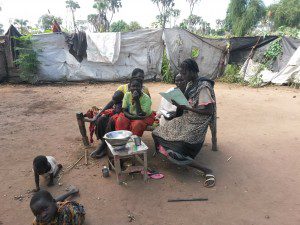
In 2011 war broke out in the area where we were living and Aisha and I both fled with our families – me on a little airplane with a single suitcase, her on foot through the bush with three kids and whatever water she could carry. We were reunited a year later in a refugee camp. It was during this season of adjusting to life in a refugee context that our team began developing the Mapa language and writing it down for the first time. We matched symbols to sounds, transliterated some simple stories, and developed some basic mother tongue literacy materials. And I have to confess, of all the things I have been able to witness and participate in in the past several years, few have been as meaningful to me as sitting in the patchy shade of an enormous baobab tree, shoulder to shoulder on a sagging rope bed with Aisha, both of our fingers tracing the words of a simple story about a hyena and a guinea fowl, and hearing the excitement in her voice as she realizes that she is reading. Not Arabic or English or any one of the pushy languages of the planet. But the bright-green, faintly nasal, ancient-sounding, reverberating language of her childhood. Written down and printed in a book for the first time ever.
What’s more, as one of the first readers in her community, Aisha has now also been helping us with community checking the first drafts of scripture portions as we translate them into her language. And despite the fact that in the world’s economy she is about as close to the bottom of the heap as you can get, this refugee mother with a first grade education who is married to an alcoholic, is one of the first people in the history of the world to read the Gospel in her language.
I think that is pretty cool.
In Acts chapter 2, we are given a picture of the heart of God. The Holy Spirit that had been promised was poured out on the disciples in the upper room. It felt like a rushing wind and it looked like tongues of fire.
And it sounded like languages.
Lots of different languages. Suddenly these small town fisher-folk from back-water Galilee were speaking in a plethora of languages from around the known-world. God’s great miracle was not that the diverse crowd of thousands could suddenly all understand a common language – Peter’s solitary voice shouting out the Gospel in resounding Aramaic or Greek or Hebrew echoing through the streets of Jerusalem. Rather, God’s story was radiating out in every direction in dozens of different languages, striking hearts with all the beauty and nuance and flavor like only hearing the truth in your own language can. It was like the redemption of the Tower of Babel – not an arrogant hoard disoriented by diversity, but a multiplicity of people unified in humility and worship.
Because at the end of the day, you can’t claim to love people and hate their language. You can’t claim to value them as human beings and write off how they speak as illegitimate. You can’t claim to be pointing them to God while demanding that they climb a craggy mountain to try and reach him. God has always been more interested in the margins and peripheries, the weaker and less influential, the oppressed and threatened. He has always been more interested in going than in asking people to come.
And in order to be like him, we have to be interested in those things too. Sometimes that’s what language you choose to speak (or not speak) with people. Trying to speak Mapa with Aisha makes me look like a fool. I sound like a three year old at my very best. I do much better to hang with her in Arabic, or better yet, English, where the power differential shifts completely to my advantage. But on my good days I swallow my pride and choose to sound like a child. Because that is the Gospel.
For most of us it might have more to do with other systems of power. The little ways we communicate to people on the margins that in order to be somehow real there are things that they will have to change. We like to root our faith in things that put us a little more in control, or at very least, a little more comfortable, don’t we? Even if that creates enormous barriers for other people. Because, of course, Arab Islamist governments of the world are not the only ones guilty of this. As it turns out, they have good company.
I have seen members of Aisha’s community overwhelmed at the thought that God not only understands their language, but he created it and loves to hear them speak it to him in prayer and song. What’s more, he speaks it fluently, and has something to say to them as well. He’s hungry for a long conversation. And they are eager to have it.
We’d all do well to set down our lists of expectations, however subtle they may be, and venture out to the edges. To open our ears and listen. The languages spoken out there on the margins are beautiful. And with a little humility, we can join the conversation.
(*name changed for security reasons)
Previous Post

July 18, 2017
FAQs: But Are You Safe?
Next Post
August 1, 2017 FAQs "Why are Muslims Killing Christians Over There?"
Browse Our Archives
Select a Category Uncategorized
Select a Month July 2018 June 2018 May 2018 April 2018 March 2018 February 2018 January 2018 December 2017 November 2017 October 2017 September 2017 August 2017 July 2017 June 2017 May 2017 April 2017 March 2017 February 2017 January 2017 December 2016 November 2016 October 2016 September 2016 August 2016 July 2016 June 2016 May 2016 April 2016
Follow Us!
TAKE THE
Religious Wisdom Quiz
What city’s walls fell after the Israelites marched around them?
Select your answer to see how you score.
Nineveh Babylon Jerusalem Jericho
Related posts from Jonathan Storment

Leaving Highland: Goodbye Abilene

Leaving Highland: Generationally Generous
Leaving Highland: Sunday Morning Public Nudity
TRENDING AT PATHEOS Evangelical

The REST of Your Life: A Creative Wrestles...
This week I had a conversation with a good friend from church....

How the author of the world's best hymn...
I've been working with John Newton for a while now. This makes...

Long before this Lectio Divina, Psalm 130 - the song - started...

What About the Trees? Another Living Parable
After I finished writing the last article about falling leaves as a...

Why Classical Education Is a Conversation, Not a...
Come and Read: Joy in Classical Education When I was a little...

Cornell University has received a great deal of negative publicity and intense...
view all Evangelical blogs
Ad-Free & Subscriber Log-In Subscription Support
- About Us
- 2026 Calendar
- Videos
- Podcasts
- Library of World Religions
- Faith In Media Tracker
- Advertise With Us
- Write for Us
- Privacy Policy
- Terms of Service
- Do Not Sell My Data
- Contact Us
- Radiant Digital
- Manage Newsletter Subscriptions
- Unsubscribe From Notifications
- Sitemap
Copyright 2008-2026, Patheos. All rights reserved.
Subscription Support Ad-Free & Subscriber Log-In
Follow Patheos