
BuddhistCatholicContemplativeEvangelicalGeneral ChristianHinduJewishLatter-day SaintMuslimNew VisionsProgressive Christian
Beliefs
- Buddhist
- Catholic
- Contemplative
- Evangelical
- General Christian
- Hindu
- Jewish
- Latter-day Saint
- More Voices
- Muslim
- New Visions
- Pagan
- Progressive Christian
Topics
- Religion News
- Food and Religion
- Sports and Religion
- Religious Art
- Religious Music and Entertainment
- Religious Events
- History and Religion
- Style and Religion
- Politics and Religion
- Women in Religion
- Recreation Outdoors and Religion
- Business Finance and Religion
- Careers Workplace and Religion
- Education and Religion
- Family Parenting and Religion
- Health Fitness and Religion
- Home and Religion
- Relationships and Religion
- Technology and Religion
- Travel and Religion
Columnists
- Buddhist Columnists
- Business Finance and Religion Columnists
- Careers Workplace and Religion Columnists
- Catholic Columnists
- Contemplative Columnists
- Education and Religion Columnists
- Evangelists Columnists
- Family Parenting and Religion Columnists
- General Christian Columnists
- Health Fitness and Religion Columnists
- Hindu Columnists
- History and Religion Columnists
- Home and Religion Columnists
- Jewish Columnists
- More Voices Columnists
- Latter Day Columnists
- Muslim Columnists
- New Visions Columnists
- Nonreligious Columnists
- Pagan Columnists
- Politics and Religion Columnists
- Progressive Columnists
- Recreation Outdoors and Religion Columnists
- Relationships and Religion Columnists
- Religion News Columnists
- Religious Art Columnists
- Religious Events Columnists
- Religious Music and Entertainment Columnists
- Sports and Religion Columnists
- Style and Religion Columnists
- Technology and Religion Columnists
- Travel and Religion Columnists
- Women in Religion Columnists
Resource Library
- 2026 Calendar
- Library of World Religions
- The 100 Most Holy Places on Earth
- Patheos Answers
- Podcasts
- Videos
- Faith Leaders Database
- Anglican Episcopalian
- Bahai
- Baptist
- Buddhism
- Christianity
- Confucianism
- Eastern Orthodoxy
- Hinduism
- Holiness and Pentecostal
- ISKCON
- Islam
- Judaism
- Lutheran
- Methodist
- The Church of Jesus Christ of Latter-day Saints
- New Age
- Paganism
- Presbytarian and Reformed
- Protestantism
- Religion Behind the Scenes
- Roman Catholic
- Scientology
- Shia Islam
- Sikhism
- Sufism
- Sunni Islam
- Taoism
- Zen
- See all religions
Research Tools
 Ad-Free & Subscriber Log-In Subscription Support
Ad-Free & Subscriber Log-In Subscription Support
Follow Patheos 

- Trending:
- Forgiveness
- |
- Marriage
- |
- Consciousness
- |
- Death Penalty
- |
- Election
- |
- Halloween
 Jonathan Storment
- Home
- Evangelical
- Shame on You: Trending Downward
Shame on You: Trending Downward
Last updated on: April 11, 2017 at 5:01 am by Jonathan Storment
Shame on You: Trending Downward 2017-04-10T15:21:55-05:00 Jonathan Storment
Patheos Explore the world's faith through different perspectives on religion and spirituality! Patheos has the views of the prevalent religions and spiritualities of the world.
“Honor is the good opinion of good people.” -Seneca a Roman 1st Century Poet
A couple of years ago, Ira Glass, the Host of This American Life, began his show by interviewing 3 High School freshman students.
 Specifically interviewing them while they were posting a selfie on Instagram.
In a year with stiff competition, I can’t think of much that made me sadder than listening to this conversation.
These young women were describing the cloud of shame that they feel hovering over them constantly, and the ever shifting need for image management to respond to it.
Here’s an excerpt of the conversation:
Ira Glass: Another thing you don’t see if you don’t know this language of comments and commenting back– let’s say that you comment on somebody’s photo. When they comment back, do they comment to you individually? Or do they group you in with 20 or 30 other people and send just one big group comment back to all of you? That tells you where you stand with the person.
Then there are all those situations where somebody choosing not to comment is a really big deal. Like for example, if you post a picture of yourself with a friend and then the friend does not comment on that picture, that’s just cold…
Ella:
You definitely feel insecure. Because, like, you expect them to comment, and they don’t, and you’re like, why?
Jane:
Like, what if they’ve seen it and they’re just not liking it on purpose, or like, what if everybody who’s seeing it thinks that we’re not actually friends because they’re not commenting on it. They haven’t commented yet. It’s been X amount of time and they still haven’t liked it.
Julia:
It’s this kind of shallow– like, why are you not responding to something that I never said you had to respond to in the first place?
Jane:
There’s definitely a weird psychology to it.
The next time you post a Tweet, or a status update, or a picture on Instagram or Snapchat, consider asking yourself, “Why am I really doing this?”
Finding The Self in the Selfie
Nothing has made me slow down my embrace of social media as much as realizing how much of what I was doing was just to develop a public persona that had only a casual relationship with reality.
In truth, I was only posting (and enhancing) the highlights of my life, carefully curated from a variety of experiences for making people think a certain way about me.
And what’s worse, I was good at it. So good that I was starting to confuse the Facebook/Instagram “me” with the real one. I was more and more connected to the crowd, and finding myself more and more lonely with my real self.
Did you ever wonder why we do we do this?
Last year in the New York Times, the Columnist David Brooks wrote about what he called “The Shame Culture” that has developed with the advent of Social Media.
Interestingly enough, Brooks said that social media has been, not so much, a revolution as a rediscovery of what the ancient and developing world already knows.
Tribalism and group loyalty are powerful forces that can be used for both good and evil.
Here’s the way Brooks described it:
“The omnipresence of social media has created a new sort of shame culture. The world of Facebook, Instagram and the rest is a world of constant display and observation. The desire to be embraced and praised by the community is intense. People dread being exiled and condemned. Moral life is not built on the continuum of right and wrong; it’s built on the continuum of inclusion and exclusion.
This creates a set of common behavior patterns. First, members of a group lavish one another with praise so that they themselves might be accepted and praised in turn.
Second, there are nonetheless enforcers within the group who build their personal power and reputation by policing the group and condemning those who break the group code. Social media can be vicious to those who don’t fit in. Twitter can erupt in instant ridicule for anyone who stumbles.
Third, people are extremely anxious that their group might be condemned or denigrated. They demand instant respect and recognition for their group. They feel some moral wrong has been perpetrated when their group has been disrespected, and react with the most violent intensity.
Shame Parades
Back in the days immediately following World War II, one of the more tragically interesting things that happened were these things called “Shame parades.”
As the dust was settling in Europe, people begin to look back over what others had done during the German occupation of their country, and they began to call them to account for their behavior.
And so they reached for shame.
The most common example we have of this was women who were seen with Nazi Soldiers. Many of them were wrongly branded as prostitutes, and many of them had been forced toward prostitution by the lack of food to feed their family, but all of them were treated with the same vile contempt.
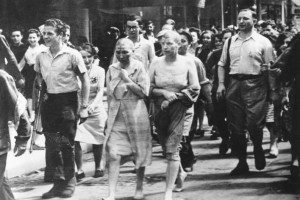
Image from Wikipedia
They had their head shaved, they were stripped down to their underwear and they were marched barefoot through the village where they lived as a sign, “This is what happens when you step out of line.”
What I find particularly interesting is who was doing the shaming, and why.
The people who were the most likely to do the shaming were the people who the ones who had joined the resistance at the last moments of the war.
They were the ones who were the most likely to be accused of some form of collaboration with the Nazi’s as well.
It’s also interesting, because before this moment, head shaving and public shaming was a tool used by the right-wing conservative party, but now it was being used primarily by the left, in progressive post-war Europe.
I want to point this out, because shame isn’t partisan, from the right to the left, we shame and exclude as a way of solidifying group cohesion and identifying boundaries.
The greatest shamers were the ones who were worried they were about to be exposed themselves. So to protect their reputations as honorable patriots they threw fellow citizens under the bus as sacrificial lambs to keep the spotlight on someone else.
In this scenario, and in my own experience, the people who tend to be most likely to reach for shame, are those who have some inner shame themselves.
I have a hunch, that shame these days, is used like an attempt to get clean for some kind of inner guilt, it’s motivated often by a worry that our own shame will be discovered, and if that happened we will be on the outside of whatever tribe we hope to belong to.
The Triumph of Shame
So this past Sunday was Palm Sunday. It’s the time when Christians all around the world remember Jesus riding into Jerusalem on a donkey. On the first Palm Sunday, the religious people surrounding Jesus cheered him on as he made his way into the hub of Israel.
But Jesus saw things differently. He wept, He warned, He knew what was coming.
And a few days later, Jesus made a similar trip. This time, not riding on a donkey, but naked and carrying his own Cross in a shame parade of His own.
This was a typical tactic of Rome, it was what they did after they had defeated a nation. They would take the Royalty and the higher-ups of the defeated nation and march them through the streets of Rome as a way of shaming “them” and glorifying “us.”
Just a couple of decades after Jesus died, Paul writes to the Roman colony in Colossi and says that when Rome was leading Jesus in that parade of shame, they weren’t doing what they thought.
Instead, what was really happening was this: “Jesus, having disarmed the powers and authorities, he made a public spectacle of them, triumphing over them by the cross.”
Paul knows what both a Roman Crucifixion and a Roman Shame parade looks like, and yet he sees things completely differently.
Jesus wasn’t being shamed, Jesus was victoriously winning the day.
So Paul immediately says, “Don’t let anyone look down on you for the way you live differently. Don’t let anyone Jesus-juke you with their false humility and supposedly superior way of being Christian, because Paul seems to be saying, whenever a fellow believer is reaching for shame to keep you in line, they are forgetting just what kind of community Jesus died to create.
Jesus isn’t interested in creating a community that is just another one-upping competitive beauty pageant. Those types of communities are everywhere and the way of Jesus isn’t for you.
Instead Jesus is creating a community where we honor one another precisely in our shame, because that shame was what drew us to this kind of God in the first place.
Previous Post
April 4, 2017
Shame On You: A Community of the Shamed
Next Post
April 15, 2017 Holy Saturday
Browse Our Archives
Select a Category Uncategorized
Select a Month July 2018 June 2018 May 2018 April 2018 March 2018 February 2018 January 2018 December 2017 November 2017 October 2017 September 2017 August 2017 July 2017 June 2017 May 2017 April 2017 March 2017 February 2017 January 2017 December 2016 November 2016 October 2016 September 2016 August 2016 July 2016 June 2016 May 2016 April 2016
Follow Us!
TAKE THE
Religious Wisdom Quiz
Who was Jeremiah's faithful secretary and scribe?
Select your answer to see how you score.
Baruch Zephaniah Eliakim Micah
Related posts from Jonathan Storment

Stranger God: To Whom Honor is Due

Stranger God: Wearing Evil and Touching Lepers


The Butterfly Effect: The Legacy of Hugh Hefner
TRENDING AT PATHEOS Evangelical

The REST of Your Life: A Creative Wrestles...
This week I had a conversation with a good friend from church....

How the author of the world's best hymn...
I've been working with John Newton for a while now. This makes...

Long before this Lectio Divina, Psalm 130 - the song - started...

What About the Trees? Another Living Parable
After I finished writing the last article about falling leaves as a...

Why Classical Education Is a Conversation, Not a...
Come and Read: Joy in Classical Education When I was a little...

Cornell University has received a great deal of negative publicity and intense...
view all Evangelical blogs
Ad-Free & Subscriber Log-In Subscription Support
- About Us
- 2026 Calendar
- Videos
- Podcasts
- Library of World Religions
- Faith In Media Tracker
- Advertise With Us
- Write for Us
- Privacy Policy
- Terms of Service
- Do Not Sell My Data
- Contact Us
- Radiant Digital
- Manage Newsletter Subscriptions
- Unsubscribe From Notifications
- Sitemap
Copyright 2008-2026, Patheos. All rights reserved.
Subscription Support Ad-Free & Subscriber Log-In
Follow Patheos