
BuddhistCatholicContemplativeEvangelicalGeneral ChristianHinduJewishLatter-day SaintMuslimNew VisionsProgressive Christian
Beliefs
- Buddhist
- Catholic
- Contemplative
- Evangelical
- General Christian
- Hindu
- Jewish
- Latter-day Saint
- More Voices
- Muslim
- New Visions
- Pagan
- Progressive Christian
Topics
- Religion News
- Food and Religion
- Sports and Religion
- Religious Art
- Religious Music and Entertainment
- Religious Events
- History and Religion
- Style and Religion
- Politics and Religion
- Women in Religion
- Recreation Outdoors and Religion
- Business Finance and Religion
- Careers Workplace and Religion
- Education and Religion
- Family Parenting and Religion
- Health Fitness and Religion
- Home and Religion
- Relationships and Religion
- Technology and Religion
- Travel and Religion
Columnists
- Buddhist Columnists
- Business Finance and Religion Columnists
- Careers Workplace and Religion Columnists
- Catholic Columnists
- Contemplative Columnists
- Education and Religion Columnists
- Evangelists Columnists
- Family Parenting and Religion Columnists
- General Christian Columnists
- Health Fitness and Religion Columnists
- Hindu Columnists
- History and Religion Columnists
- Home and Religion Columnists
- Jewish Columnists
- More Voices Columnists
- Latter Day Columnists
- Muslim Columnists
- New Visions Columnists
- Nonreligious Columnists
- Pagan Columnists
- Politics and Religion Columnists
- Progressive Columnists
- Recreation Outdoors and Religion Columnists
- Relationships and Religion Columnists
- Religion News Columnists
- Religious Art Columnists
- Religious Events Columnists
- Religious Music and Entertainment Columnists
- Sports and Religion Columnists
- Style and Religion Columnists
- Technology and Religion Columnists
- Travel and Religion Columnists
- Women in Religion Columnists
Resource Library
- 2026 Calendar
- Library of World Religions
- The 100 Most Holy Places on Earth
- Patheos Answers
- Podcasts
- Videos
- Faith Leaders Database
- Anglican Episcopalian
- Bahai
- Baptist
- Buddhism
- Christianity
- Confucianism
- Eastern Orthodoxy
- Hinduism
- Holiness and Pentecostal
- ISKCON
- Islam
- Judaism
- Lutheran
- Methodist
- The Church of Jesus Christ of Latter-day Saints
- New Age
- Paganism
- Presbytarian and Reformed
- Protestantism
- Religion Behind the Scenes
- Roman Catholic
- Scientology
- Shia Islam
- Sikhism
- Sufism
- Sunni Islam
- Taoism
- Zen
- See all religions
Research Tools
 Ad-Free & Subscriber Log-In Subscription Support
Ad-Free & Subscriber Log-In Subscription Support
Follow Patheos 

- Trending:
- Forgiveness
- |
- Marriage
- |
- Consciousness
- |
- Death Penalty
- |
- Election
- |
- Halloween
 Jonathan Storment
- Home
- Evangelical
- A Beautiful Gospel: Proving God
A Beautiful Gospel: Proving God
Last updated on: September 8, 2016 at 5:03 am by Jonathan Storment
A Beautiful Gospel: Proving God 2016-09-07T13:07:25-05:00 Jonathan Storment
Patheos Explore the world's faith through different perspectives on religion and spirituality! Patheos has the views of the prevalent religions and spiritualities of the world.
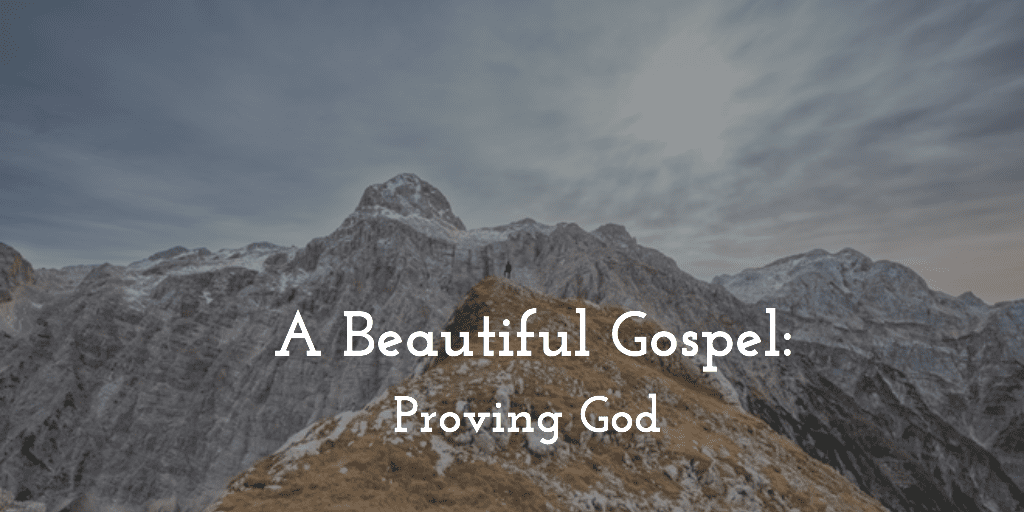 There may or may not be a God.
I’m saying this up front, because after a title like “Proving God” it’s important not to bury the lede.
Worked into being a person of faith is an awareness that we could be wrong about something which we are staking much on. That’s why we use the word Faith…it’s a loaded synonym for other words like risk or chance.
Because what if there isn’t a God? What if it is all just one big human construct, a projection of wish fulfillment started not long after human beings developed the capacity for language and started asking questions about what happened to those family members who stopped breathing?
What if?
For a lot of us, even opening up that as a possibility makes us uncomfortable, it sounds like a slippery slope that leads to reading books by Sam Harris or Richard Dawkins and writing angry rambling Facebook rants by people who are just as certain that there isn’t a God as we are certain that there is One.
So for the past century or two what people in the West have done with this uncomfortableness is to use a certain kind of logic to prove that God exists. We call it apologetics and often it’s clumsy and sometimes even false (ends justify means right?) and we argue/yell with the certain atheists about why we are right and why they are wrong using the same categories of reasoning but with very different outcomes.
Each side trots out their intellectual giants who support their position articulately and we talk about watchmakers and monkeys on typewriters and then put that Jesus fish on our car that shows our fish eating their fish (apparently the one Darwin invented has legs on it).
And we make a fundamental error in how we talk and think and dream about God.
Rob Bell pointed out a few years ago that when we argue about God we often use Math Talk, but when the Bible talks about God it uses Poetry. Since the Enlightenment, we’ve increasingly started talking about God with data and charts and stats and….evidence.
But the Bible never tries to prove God, it assumes God, and not just any God, but a certain kind of God, and to that end the Bible speaks in poetry and prophecy and story…and psalms.
The Bible starts off with a poem that is a song, it ends in Revelation with a lot of singing, and the longest book of the Bible is the Psalms. In the face of hostility in the New Testament, the people of God would argue and debate, but mostly they sang.
What an odd response.
Steve Jobs once told YoYo Ma that hearing him play the Cello was the best evidence that he knew of that there was a God.
Think about that.
Steve Jobs had been to church, he had given Christianity (and several world religions a try), and this creative genius had mostly walked away from all of it. There was no evidence that demanded a verdict for him. Until he heard YoYo Ma play.
For the longest time, when people who were struggling with their faith asked me for a book recommendation I would give them Tim Keller’s Reason for God, which is still a great and fine resource for people whose struggle with God is mostly intellectual.
But I don’t think that’s most of my friends struggle these days. So instead, the book I recommend the most, is Unapologetic by Francis Spufford.
It’s laced with profanity, spends little to no time on apologetics and is the most moving book I’ve read in 5 years.
And the reason I recommend this book to so many people because it’s beautiful.
Spufford is not your typical Christian author, he’s not a pastor (but he is married to an Anglican priest) he’s a novelist whose love of literature and writing has made him a word surgeon who deftly describes why he (as a Christian turned Atheist turned Christian again) thinks Christianity still makes surprising emotional sense.
If your struggling with your belief in God there’s a chance Spufford’s work will help, but it will certainly restore your faith in the English language.
I’m serious about this, I’ve told a lot of my older pastor friends about this because I think the Spufford vs. Keller line of talking about God to a generation of agnostics going on atheist has real merit.
Beauty is not a sidebar apologetic for us to use when we want to counter the questions about suffering in the world.
Beauty is the apologetic.
It is God’s way of getting us outside of ourselves and outside of our heads.
At least it was for Spufford.
Back in 1997 when Spufford was still in his atheist phase, he said that he was sitting in a cafe working on a book when Mozart’s Clarinet Concerto began to play. He was in a dark place in his life, “I couldn’t see any way out of the sorrow without some obvious self-deception”
When Mozart’s song began to play he said it was exactly what mercy would sound like.
Here’s his words:
It does not sound as if Mozart is doing something he can only just manage, and it does not sound as if the music is struggling to lift a weight it can only just manage. Yet at the same time, it is not music that denies anything. It offers a strong, absolutely calm rejoicing, but it does not pretend there is no sorrow. On the contrary, it sounds as if it comes from a world where sorrow is perfectly ordinary, but still there is more to be said. I had heard it lots of times, but this time it felt to me like news. It said: everything you fear is true. And yet. And yet. Everything you have done wrong, you have really done wrong. And yet. And yet. The world is wider than you fear it is, wider than the repeating rigmaroles in your mind, and it has this in it, as truly as it contains your unhappiness. Shut up and listen, and let yourself count, just a little bit, on a calm that you do not have to be able to make for yourself, because here it is, freely offered. You are still deceiving yourself, said the music, if you don’t allow for the possibility of this. There is more going on here than what you deserve, or don’t deserve. There is this, as well. And it played the tune again, with all the cares in the world.
What broke through Spufford’s heart that day was not a proposition, it was a melody. And to be clear, he believes the propositions…here’s how he says it just a few paragraphs later:
I am a fairly orthodox Christian. Every Sunday I say and do my best to mean the whole of the Creed, which is a series of propositions. No dancing about; no moving target, I promise. But it is still a mistake to suppose that it is assent to the propositions that makes you a believer…What I felt listening to Mozart in 1997 is not some wishy-washy metaphor for an idea I believe in, and it’s not a front behind which the real business of belief is going on: it’s the thing itself…I think that Mozart, two centuries earlier, had succeeded in creating a beautiful and accurate report of an aspect of reality. I think that the reason reality is that way, is in some ultimate sense merciful as well as being a set of physical processes all running along on their own without hope of appeal, all the way up from quantum mechanics to the relative velocity of galaxies by way of “blundering, low and horridly cruel” biology (Darwin), is that the universe is sustained by a continual and infinitely patient act of love.
I think that love keeps it in being. I think that Dante’s cosmology was crap, but that he was right to say that it’s “love that moves the sun and all the other stars.”
I believe this in my bones, I think it’s truer than anything else in the world, but I can’t prove it.
I can at best learn how to play it.
Previous Post

September 7, 2016
The Road Back to You: Politics, Faith and Having Compassion
Next Post
September 9, 2016 Church Work: Last Words
Browse Our Archives
Select a Category Uncategorized
Select a Month July 2018 June 2018 May 2018 April 2018 March 2018 February 2018 January 2018 December 2017 November 2017 October 2017 September 2017 August 2017 July 2017 June 2017 May 2017 April 2017 March 2017 February 2017 January 2017 December 2016 November 2016 October 2016 September 2016 August 2016 July 2016 June 2016 May 2016 April 2016
Follow Us!
TAKE THE
Religious Wisdom Quiz
Which Christian movement is known for "speaking in tongues" and lively worship?
Select your answer to see how you score.
Pentecostalism Presbyterianism Catholicism Quakerism
Related posts from Jonathan Storment

Stranger God: To Whom Honor is Due

Stranger God: Wearing Evil and Touching Lepers

The Butterfly Effect: The Legacy of Hugh Hefner
TRENDING AT PATHEOS Evangelical

The REST of Your Life: A Creative Wrestles...
This week I had a conversation with a good friend from church....

How the author of the world's best hymn...
I've been working with John Newton for a while now. This makes...

Long before this Lectio Divina, Psalm 130 - the song - started...

What About the Trees? Another Living Parable
After I finished writing the last article about falling leaves as a...

Why Classical Education Is a Conversation, Not a...
Come and Read: Joy in Classical Education When I was a little...

Cornell University has received a great deal of negative publicity and intense...
view all Evangelical blogs
Ad-Free & Subscriber Log-In Subscription Support
- About Us
- 2026 Calendar
- Videos
- Podcasts
- Library of World Religions
- Faith In Media Tracker
- Advertise With Us
- Write for Us
- Privacy Policy
- Terms of Service
- Do Not Sell My Data
- Contact Us
- Radiant Digital
- Manage Newsletter Subscriptions
- Unsubscribe From Notifications
- Sitemap
Copyright 2008-2026, Patheos. All rights reserved.
Subscription Support Ad-Free & Subscriber Log-In
Follow Patheos