
BuddhistCatholicContemplativeEvangelicalGeneral ChristianHinduJewishLatter-day SaintMuslimNew VisionsProgressive Christian
Beliefs
- Buddhist
- Catholic
- Contemplative
- Evangelical
- General Christian
- Hindu
- Jewish
- Latter-day Saint
- More Voices
- Muslim
- New Visions
- Pagan
- Progressive Christian
Topics
- Religion News
- Food and Religion
- Sports and Religion
- Religious Art
- Religious Music and Entertainment
- Religious Events
- History and Religion
- Style and Religion
- Politics and Religion
- Women in Religion
- Recreation Outdoors and Religion
- Business Finance and Religion
- Careers Workplace and Religion
- Education and Religion
- Family Parenting and Religion
- Health Fitness and Religion
- Home and Religion
- Relationships and Religion
- Technology and Religion
- Travel and Religion
Columnists
- Buddhist Columnists
- Business Finance and Religion Columnists
- Careers Workplace and Religion Columnists
- Catholic Columnists
- Contemplative Columnists
- Education and Religion Columnists
- Evangelists Columnists
- Family Parenting and Religion Columnists
- General Christian Columnists
- Health Fitness and Religion Columnists
- Hindu Columnists
- History and Religion Columnists
- Home and Religion Columnists
- Jewish Columnists
- More Voices Columnists
- Latter Day Columnists
- Muslim Columnists
- New Visions Columnists
- Nonreligious Columnists
- Pagan Columnists
- Politics and Religion Columnists
- Progressive Columnists
- Recreation Outdoors and Religion Columnists
- Relationships and Religion Columnists
- Religion News Columnists
- Religious Art Columnists
- Religious Events Columnists
- Religious Music and Entertainment Columnists
- Sports and Religion Columnists
- Style and Religion Columnists
- Technology and Religion Columnists
- Travel and Religion Columnists
- Women in Religion Columnists
Resource Library
- 2026 Calendar
- Library of World Religions
- The 100 Most Holy Places on Earth
- Patheos Answers
- Podcasts
- Videos
- Faith Leaders Database
- Anglican Episcopalian
- Bahai
- Baptist
- Buddhism
- Christianity
- Confucianism
- Eastern Orthodoxy
- Hinduism
- Holiness and Pentecostal
- ISKCON
- Islam
- Judaism
- Lutheran
- Methodist
- The Church of Jesus Christ of Latter-day Saints
- New Age
- Paganism
- Presbytarian and Reformed
- Protestantism
- Religion Behind the Scenes
- Roman Catholic
- Scientology
- Shia Islam
- Sikhism
- Sufism
- Sunni Islam
- Taoism
- Zen
- See all religions
Research Tools
 Ad-Free & Subscriber Log-In Subscription Support
Ad-Free & Subscriber Log-In Subscription Support
Follow Patheos 

- Trending:
- Forgiveness
- |
- Marriage
- |
- Consciousness
- |
- Death Penalty
- |
- Election
- |
- Halloween

- Home
- Progressive Christian
- An Angel Learns to Judge
An Angel Learns to Judge
Last updated on: April 8, 2013 at 1:35 pm by John Shore
An Angel Learns to Judge 2013-04-08T13:35:24-08:00 John Shore
Patheos Explore the world's faith through different perspectives on religion and spirituality! Patheos has the views of the prevalent religions and spiritualities of the world.
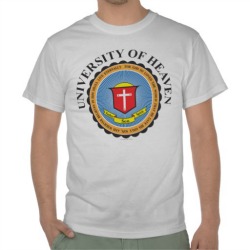
Professor Malachi, Dean of Discernment and Judgment at The University of Heaven, tapped a file resting on the middle of his desk. “Let’s consider this candidate for heaven right here,” he said. “The man is homosexual. Do we allow him into heaven?”
The student angel Arthur shifted uncomfortably in his chair. Finally he said, “No, we don’t.”
“We don’t? Are you sure?”
Arthur paused in case he wasn’t. He almost desperately wanted to impress Professor Malachi, who had unexpectedly invited him into his office for this chat. “Well, the Bible clearly states that homosexuality is a sin.”
“Does it? What’s the first thing we teach here about sin, Arthur?”
Arthur remembered his Introduction to Judgment class. “That it’s contextual.”
“Exactly. When is it not a sin to kill?”
“When it’s done in the service of a greater good. In defense of the weak. In self-defense. Or even if it’s an accident.”
“Very good. So despite the fact that the Bible says, Thou shalt not kill … ?”
“We consider the context in which any killing has occurred before determining whether or not that killing was a sin.”
“Right. And if a woman tells her best friend that the Christmas cookies she made for her were so delicious that she ate them all, even though she really threw them in the garbage because they tasted like dead cat?”
Arthur laughed. “No sin.” He recalled his time back on earth, when he told his Grandma how much he loved the bulky purple and green sweater she’d knit him.
“Even though the Bible says very clearly Thou shalt not lie?”
“Even though. Because the larger good was served by her showing affection to her friend.”
“And the poor man who steals a loaf of bread from the kitchen of a rich man to feed his starving children?”
“No sin.”
“Despite the very clear words of the Bible’s Eighth Commandment, Thou shalt not steal” ?
“Still no sin. Because there is no judging of sin without first judging that sin’s context.”
The professor smiled. “We’ll make a master angel of you yet, Arthur.”
“Thank you, sir.” Arthur took a moment to look at the vast shimmering empyrean everywhere around the two of them.
“Quite a sight, isn’t it?” said Malachi.
“Even when I dreamed of it on earth, I never imagined anything like it.”
“Speaking of those not yet here amongst us. Right off the bat, Arthur, do you vote thumbs up or thumbs down for our gay applicant?”
“Well, I know that as a Christian on earth I definitely believed that homosexuality was a sin. That’s all I was ever taught.”
“You died in your mid-twenties, Arthur. Had you continued to hold that same belief up until the time of your accident?”
“No, I didn’t. I mean, not exactly. By then the whole issue had grown more complicated. All I ever heard growing up was that being gay was extremely sinful. I learned that basically there was no such thing as a homosexual: that gay people were really just straight people who needed to get right with God.”
“You believed it was possible to, as they say, ‘pray away the gay.'”
“I did believe that, yes.”
“As did most Christians. Did you continue to believe that?”
“Well, over time it became pretty obvious how wrong that was. It became clear that nobody could just pray away their gay—that some people really were just born gay, the same as some people are born left-handed or red-headed.”
“Ah. And what was the general Christian teaching after that became the common Christian understanding?”
“Then we were taught that while it might not have been possible for a gay person to stop being gay, it was possible for any gay person to resist the temptation to give in to their homosexual tendencies.”
“And what exactly does that mean, you think, to ‘give into one’s homosexual tendencies’?”
“I guess it means to engage in homosexual sex. To actually, physically, be gay. I mean, what else could it mean?”
“Nothing that I can see. So the new Christian idea became that gay people could, and should, will themselves to resist being at least physically intimate with others of their kind—to never, in short, have life partners in the way that straight people do. To never marry, for instance.”
“Yes. Just like everyone else, they were supposed to resist the sins that they personally were tempted to commit.”
“So by that reasoning—the reasoning that all people are sinful and need to resist whatever urges they have to sin—gay people were deemed to be no different from anyone else. Now it was inherently no more of a sin to be gay than it was to be straight. All were then understood to start out on the same moral footing. All were then innocent, in other words, until proven guilty.”
Arthur thought for a moment. “That’s right. That’s how it was.”
“So tell me, where has all this left you on the gay issue?”
“Still a bit confused. I honestly don’t know what to make of the whole question of the sinfulness of homosexuality.”
“Then let’s reason it out, shall we? If I correctly understood you, you no longer hold to the idea that it’s a sin just to be gay, any more than it’s automatically a sin to be, as you said, left-handed, or red-haired—which is to say, any more than it is to be straight. Yes?”
“Yes.”
“So a person’s sinfulness is no longer determined by what they are, but rather solely and exclusively by what they do. No manifest sin exists, in other words, before a sinful action is actually committed. Correct?”
“Correct.”
“So—and forgive my redundancy; I just want to be absolutely certain we’re on the same page—virtually the only way to judge if anyone, gay, straight, or otherwise, has done something sinful, is by evaluating what they actually did. There is simply no other way to determine sinfulness.”
“Yes. That does make sense.”
“And what do we know to be the indispensable tool for judging the morality of any given action?”
“Context.”
“Context. Sometimes killing, lying, and stealing is a sin; sometimes it’s not. It depends on the context. And when we look to context to determine morality, what two qualities do we look for?”
“Harmful intent and harmful action,” said Arthur. “At the motives behind the action, and the harm that resulted from the action. Or, as you put it in one of your lectures, To find the sin, look within.”
Professor Malachi brought his hand to his heart. “How it touches me to learn that one of my students has listened during class. So, what does our beloved Bible say about the context of homosexual sex?”
Arthur thought for a long moment. “The Bible says virtually nothing about any sort of contextual situation relative to homosexuality. It just lists homosexuality as a sin. It refers to no context at all.”
“Which means that the Bible can, in no way, tell us whether or not any given act of homosexuality is a sin, yes?”
“Yes. It doesn’t do that. It can’t do that.”
“But we do know that being a homosexual, in and of itself, is not sinful. We know that we can only judge acts, not God-given states of being. And we know that devoid of context, we have nothing upon which to base those judgements, do we?”
“No, we don’t.”
“Which brings us back to the question of our gay applicant. Do we accept him into heaven, or do we reject his application?”
“Well, I guess I couldn’t say. Not at this point, anyway. In order for me to make that call I would first have to know the man—really know him—as a person.”
“Yes!” cried the professor. “That is exactly right, Arthur! Exactly right. You have reasoned through to the very heart and truth of the matter. And so you will leave this office a wiser and kinder angel than when you entered it, simply because you were willing to do that reasoning. And God bless you for that willingness, son.”
Previous Post

April 4, 2013
Belief in Jesus brings her mainly self-condemnation and stress
Next Post
April 9, 2013 One Man. Two fiancees. One prenup-nup?
Browse Our Archives
Select a Category Christian Issues Christian Spirituality Dear John En Espanol Everywhere She's Not Humor Look See Pastor Bob's Corner Personal Portuguese Relationships Russian Short-short story Smith Family Chronicles Uncategorized
Select a Month March 2024 August 2022 August 2020 July 2020 June 2020 February 2020 December 2019 June 2019 December 2018 May 2018 May 2017 January 2017 December 2015 November 2015 October 2015 September 2015 August 2015 July 2015 June 2015 May 2015 April 2015 January 2015 December 2014 November 2014 October 2014 September 2014 August 2014 July 2014 June 2014 May 2014 April 2014 March 2014 February 2014 January 2014 December 2013 November 2013 October 2013 September 2013 August 2013 July 2013 June 2013 May 2013 April 2013 March 2013 February 2013 January 2013 December 2012 November 2012 October 2012 September 2012 August 2012 July 2012 June 2012 May 2012 April 2012 March 2012 February 2012 January 2012 December 2011 November 2011 October 2011 September 2011 August 2011 July 2011 June 2011 May 2011 April 2011 March 2011 February 2011 January 2011 December 2010 November 2010 October 2010 September 2010 August 2010 July 2010 June 2010 May 2010 April 2010 March 2010 February 2010 January 2010 December 2009 November 2009 October 2009 September 2009 August 2009 July 2009 June 2009 May 2009 April 2009 March 2009 February 2009 January 2009 December 2008 November 2008 October 2008 September 2008 August 2008 July 2008 June 2008 May 2008 April 2008 March 2008 February 2008 January 2008 December 2007 November 2007 October 2007 September 2007 August 2007 July 2007 June 2007 May 2007 April 2007
TAKE THE
Religious Wisdom Quiz
What king of Israel was famous for his chariot and for fighting Ahab?
Select your answer to see how you score.
Omri Jehu Jeroboam Joash
Books by This Author Books by John Shore
Related posts from John Shore

Christians shouldn't get depressed? What BS.

Can this born-again gay Christian woman find happiness?

Why don't more Christians act like Christ?

I'm in an open marriage. Can I still...
TRENDING AT PATHEOS Progressive Christian

Why Christians Have a Sacred Duty to Vote:...
The Bible offers strong support for the sacred duty to vote. Here...

What Being a Modern-Day Apostle Means to Me
In my last column, I discussed the ins and outs of modern-day...

Did Ancient China Once Worship the God of...
Across human history, a common thread weaves through the origins of the...

Love Your Neighbor – Including Earth-Kin: Lev. 19,...
God’s command to love your neighbor means acting in an ethical and...

Lead a Church Study of “Jesus and Lao...
Guest writer Jack Thomas (The Irreverent Reverend) reflects on leading his church...

Principles for Understanding the Apostolic Ministry Today
Whenever people discover that my formal ministry title is "apostle," as in...
view all Progressive Christian blogs
Ad-Free & Subscriber Log-In Subscription Support
- About Us
- 2026 Calendar
- Videos
- Podcasts
- Library of World Religions
- Faith In Media Tracker
- Advertise With Us
- Write for Us
- Privacy Policy
- Terms of Service
- Do Not Sell My Data
- Contact Us
- Radiant Digital
- Manage Newsletter Subscriptions
- Unsubscribe From Notifications
- Sitemap
Copyright 2008-2026, Patheos. All rights reserved.
Subscription Support Ad-Free & Subscriber Log-In
Follow Patheos