
BuddhistCatholicContemplativeEvangelicalGeneral ChristianHinduJewishLatter-day SaintMuslimNew VisionsProgressive Christian
Beliefs
- Buddhist
- Catholic
- Contemplative
- Evangelical
- General Christian
- Hindu
- Jewish
- Latter-day Saint
- More Voices
- Muslim
- New Visions
- Pagan
- Progressive Christian
Topics
- Religion News
- Food and Religion
- Sports and Religion
- Religious Art
- Religious Music and Entertainment
- Religious Events
- History and Religion
- Style and Religion
- Politics and Religion
- Women in Religion
- Recreation Outdoors and Religion
- Business Finance and Religion
- Careers Workplace and Religion
- Education and Religion
- Family Parenting and Religion
- Health Fitness and Religion
- Home and Religion
- Relationships and Religion
- Technology and Religion
- Travel and Religion
Columnists
- Buddhist Columnists
- Business Finance and Religion Columnists
- Careers Workplace and Religion Columnists
- Catholic Columnists
- Contemplative Columnists
- Education and Religion Columnists
- Evangelists Columnists
- Family Parenting and Religion Columnists
- General Christian Columnists
- Health Fitness and Religion Columnists
- Hindu Columnists
- History and Religion Columnists
- Home and Religion Columnists
- Jewish Columnists
- More Voices Columnists
- Latter Day Columnists
- Muslim Columnists
- New Visions Columnists
- Nonreligious Columnists
- Pagan Columnists
- Politics and Religion Columnists
- Progressive Columnists
- Recreation Outdoors and Religion Columnists
- Relationships and Religion Columnists
- Religion News Columnists
- Religious Art Columnists
- Religious Events Columnists
- Religious Music and Entertainment Columnists
- Sports and Religion Columnists
- Style and Religion Columnists
- Technology and Religion Columnists
- Travel and Religion Columnists
- Women in Religion Columnists
Resource Library
- 2026 Calendar
- Library of World Religions
- The 100 Most Holy Places on Earth
- Patheos Answers
- Podcasts
- Videos
- Faith Leaders Database
- Anglican Episcopalian
- Bahai
- Baptist
- Buddhism
- Christianity
- Confucianism
- Eastern Orthodoxy
- Hinduism
- Holiness and Pentecostal
- ISKCON
- Islam
- Judaism
- Lutheran
- Methodist
- The Church of Jesus Christ of Latter-day Saints
- New Age
- Paganism
- Presbytarian and Reformed
- Protestantism
- Religion Behind the Scenes
- Roman Catholic
- Scientology
- Shia Islam
- Sikhism
- Sufism
- Sunni Islam
- Taoism
- Zen
- See all religions
Research Tools
 Ad-Free & Subscriber Log-In Subscription Support
Ad-Free & Subscriber Log-In Subscription Support
Follow Patheos 

- Trending:
- Forgiveness
- |
- Marriage
- |
- Consciousness
- |
- Death Penalty
- |
- Election
- |
- Halloween

- Home
- Progressive Christian
- Twelve Years of Rejected Short Stories, And Then This!
Twelve Years of Rejected Short Stories, And Then This!
Last updated on: July 21, 2010 at 11:31 am by John Shore
Twelve Years of Rejected Short Stories, And Then This! 2010-07-21T11:31:52-08:00 John Shore
Patheos Explore the world's faith through different perspectives on religion and spirituality! Patheos has the views of the prevalent religions and spiritualities of the world.


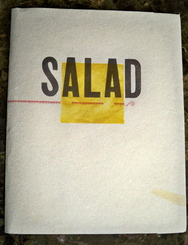
The outside cover. If that yellow isn't hand-painted water color, it sure looks and feels like it.
The other day I found on my Facebook page a brief supportive note from a woman whose name, Elaine Liner, I failed to place. Later that day it popped into my head: she was the woman who, in 1991, had published one of my short stories.
I have no idea what the state is today of what used to called little literary magazines, but back when I was first trying to publish my short stories, “little literaries” were just about the only place in which any writer could publish work of that sort. Such magazines tended to fall into one of two categories. In the first were the more famous ones, which tended to come out of the writing programs of colleges and universities–Ploughshares, The Iowa Review, Agni, The Missouri Review, New England Review, and such publications. My chances of getting published in one of these prestigious journals (which were the ones read by book agents looking for new clients–but whatever) were roughly equal to Columbia University suddenly awarding me an honorary doctorate in English literature.
The other kind of little little literary magazines were those published by everyday people whose love of short stories compelled them to put out a call for short stories, don an editor’s cap, reach into their purses, and make of themselves a publisher. Privately funded and lovingly produced, these publications ran the gamut from five photocopied pages folded and stapled together to polished, well-received periodicals that could hold their own against any literary journal in the country.
I spent a full twelve years sending out and having my short stories rejected by both kinds of little literaries. I collected so many rejection letters it’s a wonder I ever managed to climb out of bed at all.
Finally, out of a despair so deep just thinking about it now makes me want to run out and jump down a well, I gave up trying to write short stories that I thought were how short stories were supposed to be written, and instead, in the throes of what amounted to a kind of creative trance, started writing these insane little stories, of the sort I’ve shared here on my blog via The Smiling Bird, Oscy Gets a Life, and The Story of My Life.
In one week nine of my new stories were accepted for publication, each by one of the better privately-funded little literaries.
Every day, for six days in a row, I found in my mailbox another notification that a story of mine had been accepted for publication–and on three of those days, I found two such notices. That was a week I’ll never forget.
One of the publications from which I received such a notice was SALAD, from LaLaLa Press, out of Dallas. The editor of SALAD was Elaine Liner. The publication was 5.5 x 7.75 inches, and gorgeously done. Its cover was of thick, handmade paper, folded and glued just so; its pages, I saw, were designed by Caryl Herfort, clearly a top-rate artist. (I’m sad to say that just now my Google search for Caryl, with whom I’ve never had any contact; turned up this Facebook memorial to her). This was no regular little literary magazine. Clearly, this was an act of love.
To give you a sense of the thing, let me show you a bit more of it–or at least that part of it that certainly thrilled me:
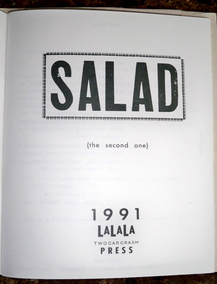
The inner title page.
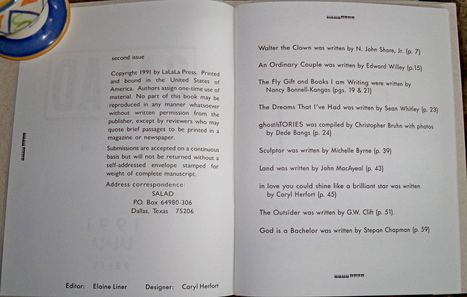
Copyright page and Table of Contents.

I should have taken more/better pictures of the SALAD’s internal pages–but you get the idea. Each story or poem in the publication had accompanying it a piece of design or artwork like you see here on the opposing page of my story: some little stand-alone graphic that just … nails it.
You know, this is the dream, really. This is how you long to see your stuff presented. And when you’re just starting out–and you know you’re doing work that’s not like anything out there?
Man, then something like this–someone who cares enough to treat you stuff like this–makes all the difference in the world.
Thank you, Elaine Liner. It was good to hear from you again.
(Elaine is now theater critic for The Dallas Observer [scroll down the page to see her review of “Flaming Guns of the Purple Sage”]; she is also co-founder of Theater Jones–which, unsurprisingly, is a public service to Dallas’ arts scene.)
Here is the story of mine that Elaine published, lo these many years now gone by:
Walter the Clown
Once upon a time there lived a little boy named Walter Hobnob. Walter was eight years old. His mom and dad were named, appropriately enough, Mom and Dad. They’d had their regular names—Spiff and Windy—changed just as soon as they’d had their little bouncing baby boy.
Those Hobnobs. They sure took life seriously.
Their son didn’t, though. Why, that boy was just a regular clown.
“Hey,” says Walter, “anybody seen my big red floppy rubber shoes?”
“Now, come on, Walt,” said his dad, Dad. “I want you to take off that silly fright wig and that ridiculous red nose right this very instant. I’m serious. I want you to start acting normal, young man—and I mean right now.”
“I’ll sure try, Dad,” said Walter sincerely. Almost immediately, though, he turned into a clown again. “But first, how about a nice big sniff of this flower I have buttoned to my lapel?”
No matter what his parents did, or how they threatened and cajoled, for the life of them they couldn’t get their little Walter to stop behaving—and dressing—like a circus clown.
“Where does he get it?” moaned his dad.
“Maybe one of us has clowns in our family tree,” suggested Mom. “You know: maybe Walter inherited the clown gene.”
“Hmmm,” said Dad. “Any clowns in your family that you know of?” Mom thought about it for a minute, and then said, “No. Yours?”
“No,” said Dad resolutely. “Never.”
So, that wasn’t it.
Walter’s acting like a clown all the time wore pretty thin pretty quickly on the powers-that-be at Walter’s public school, the Play Along Elementary Drill House.
The principal of the school called up his parents.
“He hit another boy in the face today with a cream pie!”
His teacher called, too.
“He pulled on his big polka-dot tie today, and his pants flew up and down his suspenders like a window blind! And that underwear!”
“Sorry,” said Dad.
“Sorry,” said Mom.
They went to Walter.
“Son,” they said, “what’s the matter with you? Don’t you know how you hurt and disappoint us when you insist on wearing that orange wig and those huge red shoes? I mean, look at us. We’re normal people. Normal people have normal children. But what happened to you?”
Walter made the saddest face imaginable, with his red painted frown, and slowly blinked his big, heavily mascaraed eyes a few times.
“Sorry,” he said, looking up at them.
And he was sorry, too, when about a year later his parents finally kicked him out of the house. He had just come home from school, and when his mom and dad saw that he was wearing a brand new bright blue fright wig, apparently the same thing in both of them snapped.
“All right!” they said, throwing him out the door. “That’s it!” Hurling behind him his favorite red and white checkered pants and his big red shoes and his spare round nose, they said, “We just can’t take being Bozo’s parents another day! Bye! Write us when you get normal!”
“But, Mom!” cried Walter. “Dad! You can’t kick me out this way! How will I survive?”
“You’ll do fine,” they said. “Everybody loves a clown. But remember, Walter: Nobody wants to live with one!”
They slammed the door; and that was that.
Walter was so crestfallen that he plopped down onto the lawn, right there in front of his ex-house. Pretty soon a little dog came by, a mutt. When it saw Walter, it ran right over to him and started jumping around and trying to lick his face, the way some dogs do.
“Hey, big fella,” said Walter. “Sit.”
The dog sat.
“Speak,” said Walter.
The dog arfed.
“Roll over,” said Walter. The dog flipped onto his back and happily pawed the air.
“Close enough,” said Walter. “You’re a good dog. Mind if I call you Spot, since you have that big spot on you? Want me to do some tricks for you, Spot? Watch this.” He pulled three colored balls out of his coat pocket and started juggling them. “Pretty cool, ‘eh?” he said. “Can you believe I got kicked out of my house?”
Right down the block from Walter’s house was a school bus stop. As Walter was juggling, a bunch of kids were just piling off the bus after a hard day spent adding numbers and spelling and trying to figure out maps and so on.
“Hey, look!” yelled one of the kids. “It’s Walter! He’s juggling! And who’s that ugly little kid with him? C’mon, you guys!” They all came over to see Walter and the kid who turned out to be a dog.
All the kids loved Walter. They always had. Walter was their kind of guy.
“Hey, Walt!” they said. “What’re all yer clothes doin’ outside?”
Walter stood up and pantomimed the whole story of how his parents had thrown him out of the house.
Once the kids understood what happened, they were outraged.
“That’s ridiculous!” said one particularly hearty kid, chubby Andy Watkins.
“Sure is!” everyone agreed. Then somebody said, “C’mon! Let’s go build our pal Walter his own circus, so that he can have a place where he’ll always belong!”
All the kids roared their approval—and in about a week, way on the outskirts of town in the middle of a big empty field, those industrious little dreamers had finished building “Walter’s Circus,” complete with a big-top, and sawdust rings, and wooden bleachers and everything.
Almost immediately, people started pouring in from miles around to see the new circus.
And all of the kids in the neighborhood moved out of their houses and came to work in the circus with Walter.
There was Mikey, The Boy Who Does About a Million Summersaults And Then Walks Like He’s Drunk!
There was Sharon, The Girl Who Can Spit A Watermelon Seed Practically 15 Feet!
There was Ruthie and Angela Ronzo, Twins Who Can Dress So Alike You Can Barely Tell Them Apart!
There was Andy, The Kid Who Can Eat Almost A Whole Pie If It’s Cherry!
Admission to the circus, all acts included, was fifty cents—except for all the parents in Walter’s town. They had to pay a thousand dollars a piece to get in. And even then, they were only allowed to see the permanent, boring displays, like the papier-mache animals and the lame wax sculptures. And they had to look at those through a small, low, narrow window, which the kids encouraged Spot to keep nice and smudgy.
***************************************************************************************************************

Don't click if you don't like me


Previous Post

July 21, 2010
#Shakespalin
Browse Our Archives
Select a Category Christian Issues Christian Spirituality Dear John En Espanol Everywhere She's Not Humor Look See Pastor Bob's Corner Personal Portuguese Relationships Russian Short-short story Smith Family Chronicles Uncategorized
Select a Month March 2024 August 2022 August 2020 July 2020 June 2020 February 2020 December 2019 June 2019 December 2018 May 2018 May 2017 January 2017 December 2015 November 2015 October 2015 September 2015 August 2015 July 2015 June 2015 May 2015 April 2015 January 2015 December 2014 November 2014 October 2014 September 2014 August 2014 July 2014 June 2014 May 2014 April 2014 March 2014 February 2014 January 2014 December 2013 November 2013 October 2013 September 2013 August 2013 July 2013 June 2013 May 2013 April 2013 March 2013 February 2013 January 2013 December 2012 November 2012 October 2012 September 2012 August 2012 July 2012 June 2012 May 2012 April 2012 March 2012 February 2012 January 2012 December 2011 November 2011 October 2011 September 2011 August 2011 July 2011 June 2011 May 2011 April 2011 March 2011 February 2011 January 2011 December 2010 November 2010 October 2010 September 2010 August 2010 July 2010 June 2010 May 2010 April 2010 March 2010 February 2010 January 2010 December 2009 November 2009 October 2009 September 2009 August 2009 July 2009 June 2009 May 2009 April 2009 March 2009 February 2009 January 2009 December 2008 November 2008 October 2008 September 2008 August 2008 July 2008 June 2008 May 2008 April 2008 March 2008 February 2008 January 2008 December 2007 November 2007 October 2007 September 2007 August 2007 July 2007 June 2007 May 2007 April 2007
TAKE THE
Religious Wisdom Quiz
Who asked Jesus, "What is truth?"
Select your answer to see how you score.
Peter Judas Caiaphas Pilate
Books by This Author Books by John Shore
Related posts from John Shore

What Book Publishers Want Most, But Can't Have

My New Book Has Taken Over My Head
An interview about my book "I'm OK --...

TRENDING AT PATHEOS Progressive Christian

Why Christians Have a Sacred Duty to Vote:...
The Bible offers strong support for the sacred duty to vote. Here...

What Being a Modern-Day Apostle Means to Me
In my last column, I discussed the ins and outs of modern-day...

Did Ancient China Once Worship the God of...
Across human history, a common thread weaves through the origins of the...

Love Your Neighbor – Including Earth-Kin: Lev. 19,...
God’s command to love your neighbor means acting in an ethical and...

Lead a Church Study of “Jesus and Lao...
Guest writer Jack Thomas (The Irreverent Reverend) reflects on leading his church...

Principles for Understanding the Apostolic Ministry Today
Whenever people discover that my formal ministry title is "apostle," as in...
view all Progressive Christian blogs
Ad-Free & Subscriber Log-In Subscription Support
- About Us
- 2026 Calendar
- Videos
- Podcasts
- Library of World Religions
- Faith In Media Tracker
- Advertise With Us
- Write for Us
- Privacy Policy
- Terms of Service
- Do Not Sell My Data
- Contact Us
- Radiant Digital
- Manage Newsletter Subscriptions
- Unsubscribe From Notifications
- Sitemap
Copyright 2008-2026, Patheos. All rights reserved.
Subscription Support Ad-Free & Subscriber Log-In
Follow Patheos