
BuddhistCatholicContemplativeEvangelicalGeneral ChristianHinduJewishLatter-day SaintMuslimNew VisionsProgressive Christian
Beliefs
- Buddhist
- Catholic
- Contemplative
- Evangelical
- General Christian
- Hindu
- Jewish
- Latter-day Saint
- More Voices
- Muslim
- New Visions
- Pagan
- Progressive Christian
Topics
- Religion News
- Food and Religion
- Sports and Religion
- Religious Art
- Religious Music and Entertainment
- Religious Events
- History and Religion
- Style and Religion
- Politics and Religion
- Women in Religion
- Recreation Outdoors and Religion
- Business Finance and Religion
- Careers Workplace and Religion
- Education and Religion
- Family Parenting and Religion
- Health Fitness and Religion
- Home and Religion
- Relationships and Religion
- Technology and Religion
- Travel and Religion
Columnists
- Buddhist Columnists
- Business Finance and Religion Columnists
- Careers Workplace and Religion Columnists
- Catholic Columnists
- Contemplative Columnists
- Education and Religion Columnists
- Evangelists Columnists
- Family Parenting and Religion Columnists
- General Christian Columnists
- Health Fitness and Religion Columnists
- Hindu Columnists
- History and Religion Columnists
- Home and Religion Columnists
- Jewish Columnists
- More Voices Columnists
- Latter Day Columnists
- Muslim Columnists
- New Visions Columnists
- Nonreligious Columnists
- Pagan Columnists
- Politics and Religion Columnists
- Progressive Columnists
- Recreation Outdoors and Religion Columnists
- Relationships and Religion Columnists
- Religion News Columnists
- Religious Art Columnists
- Religious Events Columnists
- Religious Music and Entertainment Columnists
- Sports and Religion Columnists
- Style and Religion Columnists
- Technology and Religion Columnists
- Travel and Religion Columnists
- Women in Religion Columnists
Resource Library
- 2026 Calendar
- Library of World Religions
- The 100 Most Holy Places on Earth
- Patheos Answers
- Podcasts
- Videos
- Faith Leaders Database
- Anglican Episcopalian
- Bahai
- Baptist
- Buddhism
- Christianity
- Confucianism
- Eastern Orthodoxy
- Hinduism
- Holiness and Pentecostal
- ISKCON
- Islam
- Judaism
- Lutheran
- Methodist
- The Church of Jesus Christ of Latter-day Saints
- New Age
- Paganism
- Presbytarian and Reformed
- Protestantism
- Religion Behind the Scenes
- Roman Catholic
- Scientology
- Shia Islam
- Sikhism
- Sufism
- Sunni Islam
- Taoism
- Zen
- See all religions
Research Tools
 Ad-Free & Subscriber Log-In Subscription Support
Ad-Free & Subscriber Log-In Subscription Support
Follow Patheos 

- Trending:
- Forgiveness
- |
- Marriage
- |
- Consciousness
- |
- Death Penalty
- |
- Election
- |
- Halloween

- Home
- Progressive Christian
- Original Sin: Thanks, Mom and Dad!
Original Sin: Thanks, Mom and Dad!
Last updated on: March 16, 2010 at 5:23 am by John Shore
Original Sin: Thanks, Mom and Dad! 2010-03-16T05:23:50-08:00 John Shore
Patheos Explore the world's faith through different perspectives on religion and spirituality! Patheos has the views of the prevalent religions and spiritualities of the world.
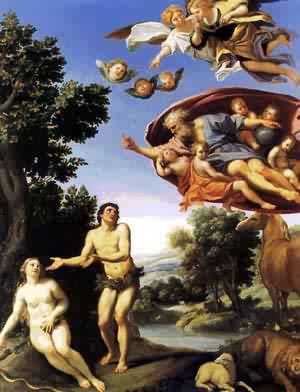
A young man wrote me yesterday to ask me what exactly the phrase “original sin” means. So:
Dear polite kid who wrote to ask me that:
Original sin is when you sin in a way that’s so unique no one’s ever sinned that way before. Hence its originality.
Har! Kid, if you don’t know my work, you might not have expected that kind of top-notch Comedy Insertion. But that’s the sort of thing you can expect here at JohnShore.com.
Wait! Come back!
No, but seriously: Do not—repeat, do not—endeavor to find a new, original way to sin. I’ve tried that, and believe me, someone always ends up having to call the police and/or an ambulance. Besides, there are no new ways to sin. Without question, every way that it’s possible for anyone to sin is a way that people have been sinning since time began.
And why have people always sinned? Why is it virtually impossible to be a human being and not sin about as often as you inhale?
Because of the real—and truly unfunny—meaning of original sin.
The term “original sin” usually refers to one of two things. The first is the original original sin—ground zero, as it were, for the whole idea of original sin. This is the actual event, recorded in the first book of the Bible (which is “The Book of Genesis”), when Adam and Eve, then blissfully living and gamboling about in the paradisiacal Garden of Eden, ruined everything by shamelessly noshing on the one fruit that God had very specifically told them to never, ever eat.
“Eat anything in the garden you want!” God (in effect) told the world’s first couple. “Anything! The only thing I’m telling you not to eat is the fruit off this one tree, right here. Everything will remain perfectly great for you guys, if you just do not eat the fruit off this tree right here.”
So, of course, that’s the fruit Adam and Eve just had to gobble down the moment they thought God wasn’t looking.
And that is when everything, for them and everybody who would ever come after them, started going straight to You Know Where.
Curse that Satan! (As you probably know, it was the silver-tongued Satan who sweet-talked Eve into taking that terrible first bite of that forbidden fruit (which is where that term comes from, by the way). We read in Genesis 3 that the Evil One was “more crafty than any of the wild animals.” Which brings up the question of how crafty animals used to be, anyway. Which makes me think of Yogi Bear. Which means it’s time to move on.)
So when people talk about “original sin” they’re often referring to what, in Christian terms, is the actual first sin ever committed by any human being, ever.
The eating of the forbidden fruit by Adam and Eve in the Garden of Eden is the original sin.
Boom. Easy.
Usually, though, when people talk about “original sin,” they’re referring to something a lot bigger and broader than that. They’re usually referring to the effect of Adam and Eve’s first transgression against the will of God, to the indelible stain of shame and sinfulness that Christians (sometimes literally; sometimes metaphorically) believe that Adam and Eve’s original sin made the legacy of all humanity after them.
Adam and Eve’s first transgression against God precipitated this great and tragic Fall of Man. The idea there is that when, through their willful disobedience of God, Adam and Eve fell out of God’s grace, we all fell out of God’s grace. When those two got kicked out of the Garden of Eden, it meant that none of us would ever be able to return to the state of blissful, constant communion with God that our Original Parents ruined by insisting that they knew better than God about what was good for them.
And so to this day, we all struggle with the results—with the shame, greed, selfishness, meanness, nastiness, inclination to do evil, etc.—that come from those inevitable times when we, too, imagine that we know what’s better for us than God does.
Wanna see how angry God was at the audacity of Adam and Eve’s disobedience of him, at the way they so clearly demonstrated to him that, in their opinion, the endless, free bounty he’d granted them just wasn’t quite good enough?
Here, from Genesis 3, is part of His response:
Then the LORD God said to the woman, “What is this you have done?”
The woman said, “The serpent [being Satan] deceived me, and I ate.”
So the LORD God said to the serpent, “Because you have done this,
“Cursed are you above all the livestock
and all the wild animals!
You will crawl on your belly
and you will eat dust
all the days of your life. …
To the woman he said,
“I will greatly increase your pains in childbearing;
with pain you will give birth to children.
Your desire will be for your husband,
and he will rule over you.”
To Adam he said, ” … “Cursed is the ground because of you;
through painful toil you will eat of it
all the days of your life.
It will produce thorns and thistles for you,
and you will eat the plants of the field.
By the sweat of your brow
you will eat your food
until you return to the ground,
since from it you were taken;
for dust you are
and to dust you will return.”
So the LORD God banished him from the Garden of Eden to work the ground from which he had been taken. After he drove the man out, he placed on the east side of the Garden of Eden cherubim and a flaming sword flashing back and forth to guard the way to the tree of life.
See? That is one righteously ticked-off landlord, executing the eviction to end all evictions.
You know how people have to go to work every single morning, just so they can eat? We have Adam and Eve to thank for that.
You know how people are inclined to often feel alienated, and lonely, and inferior, and afraid, and ashamed, and in Every Way negative about themselves and everything else in the world? We have Adam and Eve to thank for that.
You know how life can be so hard sometimes? How desperately people want to be loved? How selfish and gnarly people can so quickly become? How easily people corrupt themselves? How frail people’s resolve to do and be good usually is?
You know how the whole human race just can’t seem to ever get enough of war?
Thanks, (original) Mom and Dad!
Anyway, that’s the idea behind original sin. As I say, some Christians think the story of Adam and Eve actually happened; others understand it as a metaphor. But pretty much every Christian believes that the whole point of the figure known to history as Jesus Christ was that he sacrificed himself as a way of “delivering us from our sins”—that is, of undoing the lasting effects of the ravaging results of Adam and Eve’s original sin.
Here’s the passage of Genesis (3:1-6), which in most Bibles is titled “The Fall of Man”:
Now the serpent was more crafty than any of the wild animals the LORD God had made. He said to the woman, “Did God really say, ‘You must not eat from any tree in the garden’?”
The woman said to the serpent, “We may eat fruit from the trees in the garden, but God did say, ‘You must not eat fruit from the tree that is in the middle of the garden, and you must not touch it, or you will die.’ ”
“You will not surely die,” the serpent said to the woman. “For God knows that when you eat of it your eyes will be opened, and you will be like God, knowing good and evil.”
When the woman saw that the fruit of the tree was good for food and pleasing to the eye, and also desirable for gaining wisdom, she took some and ate it. She also gave some to her husband, who was with her, and he ate it.
Thanks. Lemme know if I can be of any more help to you.
Previous Post

March 15, 2010
One Novel Thought
Next Post
March 17, 2010 What Angry Leprechauns Do
Browse Our Archives
Select a Category Christian Issues Christian Spirituality Dear John En Espanol Everywhere She's Not Humor Look See Pastor Bob's Corner Personal Portuguese Relationships Russian Short-short story Smith Family Chronicles Uncategorized
Select a Month March 2024 August 2022 August 2020 July 2020 June 2020 February 2020 December 2019 June 2019 December 2018 May 2018 May 2017 January 2017 December 2015 November 2015 October 2015 September 2015 August 2015 July 2015 June 2015 May 2015 April 2015 January 2015 December 2014 November 2014 October 2014 September 2014 August 2014 July 2014 June 2014 May 2014 April 2014 March 2014 February 2014 January 2014 December 2013 November 2013 October 2013 September 2013 August 2013 July 2013 June 2013 May 2013 April 2013 March 2013 February 2013 January 2013 December 2012 November 2012 October 2012 September 2012 August 2012 July 2012 June 2012 May 2012 April 2012 March 2012 February 2012 January 2012 December 2011 November 2011 October 2011 September 2011 August 2011 July 2011 June 2011 May 2011 April 2011 March 2011 February 2011 January 2011 December 2010 November 2010 October 2010 September 2010 August 2010 July 2010 June 2010 May 2010 April 2010 March 2010 February 2010 January 2010 December 2009 November 2009 October 2009 September 2009 August 2009 July 2009 June 2009 May 2009 April 2009 March 2009 February 2009 January 2009 December 2008 November 2008 October 2008 September 2008 August 2008 July 2008 June 2008 May 2008 April 2008 March 2008 February 2008 January 2008 December 2007 November 2007 October 2007 September 2007 August 2007 July 2007 June 2007 May 2007 April 2007
TAKE THE
Religious Wisdom Quiz
What was the first miracle performed by Elisha?
Select your answer to see how you score.
Raising a boy from the dead Healing Naaman’s leprosy Parting the Jordan River Multiplying oil
Books by This Author Books by John Shore
Related posts from John Shore

Christians shouldn't get depressed? What BS.

Can this born-again gay Christian woman find happiness?

Why don't more Christians act like Christ?

I'm in an open marriage. Can I still...
TRENDING AT PATHEOS Progressive Christian

Why Christians Have a Sacred Duty to Vote:...
The Bible offers strong support for the sacred duty to vote. Here...

What Being a Modern-Day Apostle Means to Me
In my last column, I discussed the ins and outs of modern-day...

Did Ancient China Once Worship the God of...
Across human history, a common thread weaves through the origins of the...

Love Your Neighbor – Including Earth-Kin: Lev. 19,...
God’s command to love your neighbor means acting in an ethical and...

Lead a Church Study of “Jesus and Lao...
Guest writer Jack Thomas (The Irreverent Reverend) reflects on leading his church...

Principles for Understanding the Apostolic Ministry Today
Whenever people discover that my formal ministry title is "apostle," as in...
view all Progressive Christian blogs
Ad-Free & Subscriber Log-In Subscription Support
- About Us
- 2026 Calendar
- Videos
- Podcasts
- Library of World Religions
- Faith In Media Tracker
- Advertise With Us
- Write for Us
- Privacy Policy
- Terms of Service
- Do Not Sell My Data
- Contact Us
- Radiant Digital
- Manage Newsletter Subscriptions
- Unsubscribe From Notifications
- Sitemap
Copyright 2008-2026, Patheos. All rights reserved.
Subscription Support Ad-Free & Subscriber Log-In
Follow Patheos