
BuddhistCatholicContemplativeEvangelicalGeneral ChristianHinduJewishLatter-day SaintMuslimNew VisionsProgressive Christian
Beliefs
- Buddhist
- Catholic
- Contemplative
- Evangelical
- General Christian
- Hindu
- Jewish
- Latter-day Saint
- More Voices
- Muslim
- New Visions
- Pagan
- Progressive Christian
Topics
- Religion News
- Food and Religion
- Sports and Religion
- Religious Art
- Religious Music and Entertainment
- Religious Events
- History and Religion
- Style and Religion
- Politics and Religion
- Women in Religion
- Recreation Outdoors and Religion
- Business Finance and Religion
- Careers Workplace and Religion
- Education and Religion
- Family Parenting and Religion
- Health Fitness and Religion
- Home and Religion
- Relationships and Religion
- Technology and Religion
- Travel and Religion
Columnists
- Buddhist Columnists
- Business Finance and Religion Columnists
- Careers Workplace and Religion Columnists
- Catholic Columnists
- Contemplative Columnists
- Education and Religion Columnists
- Evangelists Columnists
- Family Parenting and Religion Columnists
- General Christian Columnists
- Health Fitness and Religion Columnists
- Hindu Columnists
- History and Religion Columnists
- Home and Religion Columnists
- Jewish Columnists
- More Voices Columnists
- Latter Day Columnists
- Muslim Columnists
- New Visions Columnists
- Nonreligious Columnists
- Pagan Columnists
- Politics and Religion Columnists
- Progressive Columnists
- Recreation Outdoors and Religion Columnists
- Relationships and Religion Columnists
- Religion News Columnists
- Religious Art Columnists
- Religious Events Columnists
- Religious Music and Entertainment Columnists
- Sports and Religion Columnists
- Style and Religion Columnists
- Technology and Religion Columnists
- Travel and Religion Columnists
- Women in Religion Columnists
Resource Library
- 2026 Calendar
- Library of World Religions
- The 100 Most Holy Places on Earth
- Patheos Answers
- Podcasts
- Videos
- Faith Leaders Database
- Anglican Episcopalian
- Bahai
- Baptist
- Buddhism
- Christianity
- Confucianism
- Eastern Orthodoxy
- Hinduism
- Holiness and Pentecostal
- ISKCON
- Islam
- Judaism
- Lutheran
- Methodist
- The Church of Jesus Christ of Latter-day Saints
- New Age
- Paganism
- Presbytarian and Reformed
- Protestantism
- Religion Behind the Scenes
- Roman Catholic
- Scientology
- Shia Islam
- Sikhism
- Sufism
- Sunni Islam
- Taoism
- Zen
- See all religions
Research Tools
 Ad-Free & Subscriber Log-In Subscription Support
Ad-Free & Subscriber Log-In Subscription Support
Follow Patheos 

- Trending:
- Forgiveness
- |
- Marriage
- |
- Consciousness
- |
- Death Penalty
- |
- Election
- |
- Halloween

- Home
- Pagan
- Religious Music and Entertainment
- The Vampire Films of Jean Rollin
The Vampire Films of Jean Rollin
Last updated on: October 1, 2026 at 3:00 am by John Beckett
The Vampire Films of Jean Rollin 2026-09-19T07:10:42-06:00 John Beckett
Patheos Explore the world's faith through different perspectives on religion and spirituality! Patheos has the views of the prevalent religions and spiritualities of the world.
For this year’s Halloween movie feature I’d like to introduce you to nine vampire movies by French director Jean Rollin (1938 – 2010). His movies have been called surrealist and fantastique. They’ve also been called bizarre and sleazy. I find them fascinating, even though I generally prefer a more straightforward and story-driven style of movie making.
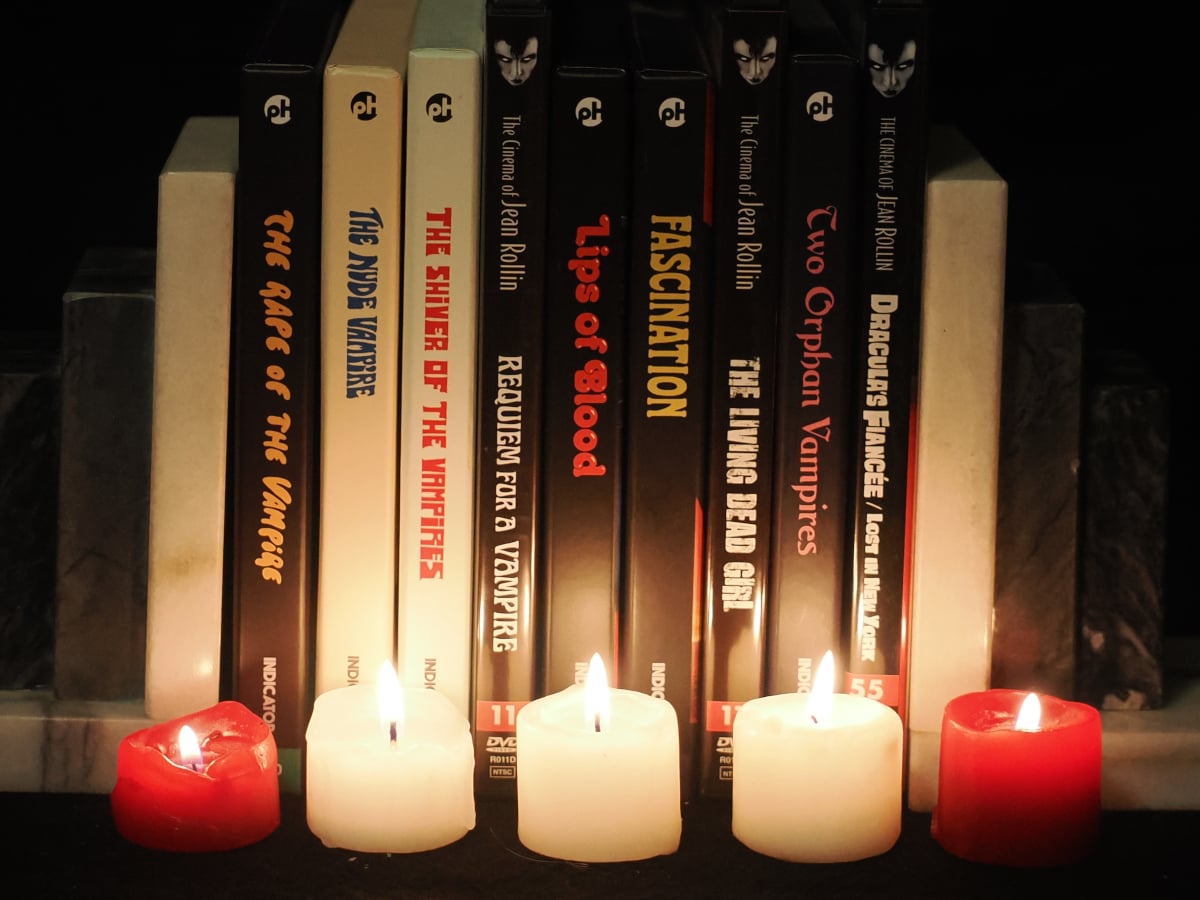
I watched the first seven over a two week period in the summer of 2023. It took me a while to find the last two. As you can see from the picture, I bought them all – something I usually do only if I’m sure I’ll want to watch a movie multiple times. Which I have – and I watched them again on consecutive nights in preparation for this feature. As I write this, seven of the nine are available to stream on either Amazon Prime or Tubi.
Rollin’s vampires are neither the monsters of the early Dracula movies nor the sexy anti-heroes of Anne Rice and beyond. While different movies have different vampire metaphysics, they are always outsiders. Even when the storylines are difficult to follow, I still find myself identifying with the vampires. And that as much as the fantastique imagery is why I enjoy them so much.
The Rape of the Vampire
(Le viol du vampire – 1968 – subtitled)
Four vampire sisters – one of them blind from the titular attack – live in seclusion. Then a young doctor decides (uninvited, of course) to cure them of their delusions, because vampires obviously don’t exist. He removes the crosses keeping them on their property, but succeeds only in convincing the local peasants that they’re now a threat. Tragedy ensues.
The first part of this movie was a short film created by Rollin for a chain of theaters in France. He later added a second, longer segment to turn it into a feature-length film. The first segment is quite good – the second segment is not. The script is incoherent even by fantastique standards, the actors were amateurs, and the story is almost impossible to follow.
Still, this is where Rollin’s vampire movies began, and it’s worth watching if only for that. It’s the only one of the nine in black and white. It’s also the first time he filmed on the rocky beach at Dieppe. Rollin enjoyed his time there as a child and he went back to it over and over again.
Vampires are: diseased.
Rollin tropes: candelabras, beach at Dieppe.
The Nude Vampire
(La vampire nue – 1970 – dubbed and subtitled)
A man finds that his rich father is keeping a young woman prisoner and subjecting her to medical experiments, trying to find out why she’s indestructible, and never letting her see the faces of other people. When he tries to rescue her, he discovers that his father will go to any extreme to protect his investment. He also discovers that the girl is not as unique as everyone assumes.
The Nude Vampire is less about vampires and more a commentary on the inhumanity of the rich, and how our current socio-economic arrangement need not last forever… though 56 years later, it’s as entrenched as ever.
Rollin never had much of a budget to work with, but he did manage to find some excellent locations, which help make his movies visually fascinating. Most of the second half of The Nude Vampire takes place at Château de Rochefort, a mansion with 91 bedrooms built around 1900 that’s now a high-end conference center.
This was the first appearance of twins Marie-Pierre and Catherine Castel (credited as Pony and Cathy Tricot), who play servant girls who are playthings of their rich employer… until circumstances change.
Interestingly given the title, while there is nudity in this movie, there is less than in most of Rollin’s films.
Vampires are: mutants. Stan Lee started his X-Men comics in 1963 and while there’s no evidence Rollin read them, there are similarities.
Rollin tropes: candelabras, beach at Dieppe, sheer gowns, two young women.
The Shiver of the Vampires
(Le frisson des vampires – 1971 – dubbed and subtitled)
A newlywed couple begin their honeymoon by visiting the bride’s cousins, who she hasn’t seen since she was a child. When they get to their castle they’re told the cousins are dead. But after sunset they appear… and they’re not alone.
This is my favorite of all Jean Rollin’s movies. The vampires are vampires, the colors look like something out of an Argento giallo, and the 70s rock soundtrack is a perfect fit with the atmosphere. Septmonts Castle (built in the 13th century) is someplace you’d expect to find vampires (and it’s open to tourists). There are long stretches with no dialogue – this is a movie you have to watch.
Is this film intended to be a commentary on relationships? Isle and Antoine never consummate their marriage. Antoine isn’t a bad guy (especially by 1970s standards) but once Isle meets the female vampire Isolde, it’s all over. Isabelle mourns the cousins and says she would have married both of them, but they don’t seem too upset when she’s killed, and they behave like an old married couple. In an interview for the 4K restoration, assistant director Natalie Perrey said it was an attempt to capitalize on the lesbian vampire trend of the early 70s (The Vampire Lovers, Daughters of Darkness, The Velvet Vampire, etc.).
You can think deep thoughts, or you can just enjoy the movie. Or both. I like both.
Vampires are: the undead.
Rollin tropes: candelabras, beach at Dieppe, sheer gowns, two young women, vampire in a clock.
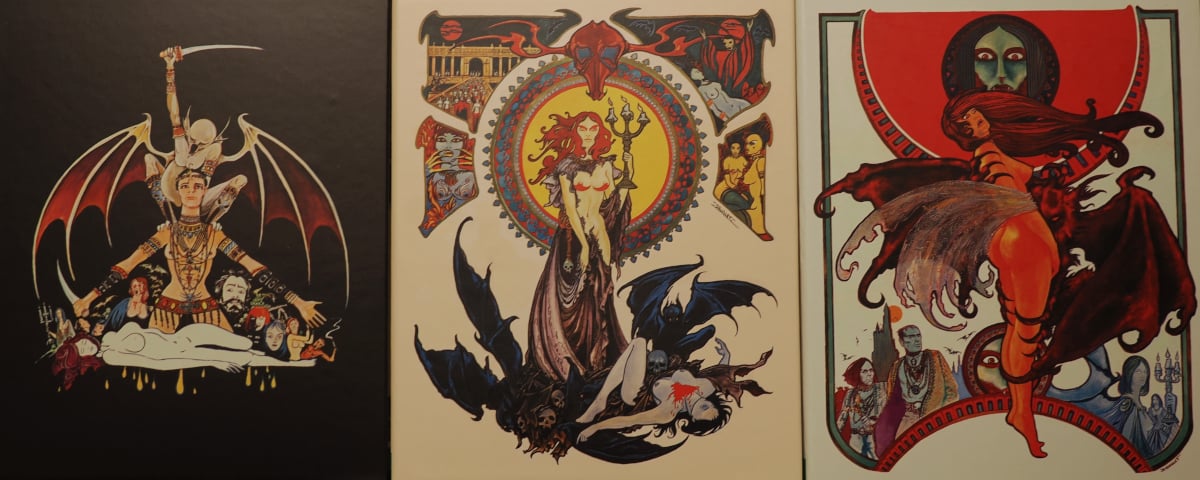
The art nouveau movie posters for Rollin’s first three vampire films were done by French artist Philippe Druillet, who was also one of the original contributors to Heavy Metal magazine
Requiem for a Vampire
(Requiem pour un vampire – 1972 – dubbed and subtitled)
Two young women dressed as clowns are pursued in a car chase and gun battle [yes, you read that right]. When their driver is killed, they burn the car and his body and escape on foot. Following several misadventures, they stumble upon a castle (Château de La Roche-Guyon) only to find it full of vampires. But not healthy vampires – the master vampire is old and weak. He would turn the two young adventurers, but he no longer has the strength. He is the last of his kind. He will go to his grave and will not arise again – thus the title.
The fantastique elements that worked so well in The Shiver of the Vampires don’t work nearly as well here. There is virtually no dialogue in the first hour of Requiem and not much in the final 27 minutes. Scenes are thrown together haphazardly whether they work or not.
Censorship laws were reduced or eliminated in both Europe and the U.S. in the late 1960s. By the early 70s, producers were adding more and more sex to sell tickets – it would take ten years or so to settle the boundary between erotic cinema and pornography. Rollin – who directed some hard core porn when he needed money – included an eight minute dungeon scene shot in red light that’s little more than soft porn… and for my tastes, not very good soft porn.
Rollin said he put the script together in one sitting. If he had given it a week – and then let someone edit it – this could have been a good movie. The core concept is solid and some of the locations are excellent. But as it is, it’s one of his weaker films.
Vampires are: the undead.
Rollin tropes: two young women.
Lips of Blood
(Lèvres de sang – 1975 – subtitled)
A small boy gets lost at night. He encounters a beautiful woman in white who watches over him while he sleeps. Just before dawn, she sends him back to his mother. And then he forgets about her for twenty years until he sees a photo of the castle where it all occurred (Château Gaillard) in a perfume ad and sets out to find it, and her. He soon discovers that his mother has been keeping secrets from him.
Lips of Blood is the quintessential Jean Rollin vampire movie. Much of it was shot in locations either in ruin or in decay (Rollin had to shoot quickly to finish at one urban site before it was torn down). Night shots are beautifully lit. The Castel twins are back together. They must have cashed in some favors: on what was clearly a cold night, they were wrapped in capes while the other pair of young female vampires were wearing sheer gowns that sometimes blew over their heads.
Mainly, vampires are outsiders. They may drink blood to live, but the real monsters are the humans who keep them sealed in coffins for decades and kill others to keep their secret.
Vampires are: the undead.
Rollin tropes: beach at Dieppe, sheer gowns, two young women (times two in this movie).
Fascination
(Fascination – 1979 – subtitled)
A bandit double-crosses his gang and runs off with their stolen gold. He takes refuge in a château (Château de la Motte in Château Renard) where he finds two beautiful women who will do anything to get him to stay till midnight, when something mysterious is coming.
Is Fascination a vampire movie? It’s unlike the others on this list, but it has more blood-drinking than any of them. It’s set in 1905 and begins with several stylish women in a slaughterhouse, drinking ox blood as therapy for anemia (an actual medical practice of the time), a scene loosely based on the short story “The Glass of Blood” by Jean Lorrain (1892).
And then things get darker.
Rollin discovered Brigitte Lahaie in his porn work and found she could act. He gave her a small part in The Grapes of Death (1978), then cast her in the leading role in Fascination and in The Night of the Hunted (1980 – it’s good but it’s missing the visuals of Rollin’s vampire movies). The image of Lahaie walking across the stone bridge wearing a flowing cape and carrying a scythe – that she clearly intends to use – is perhaps the most iconic scene in all of Rollin’s movies.
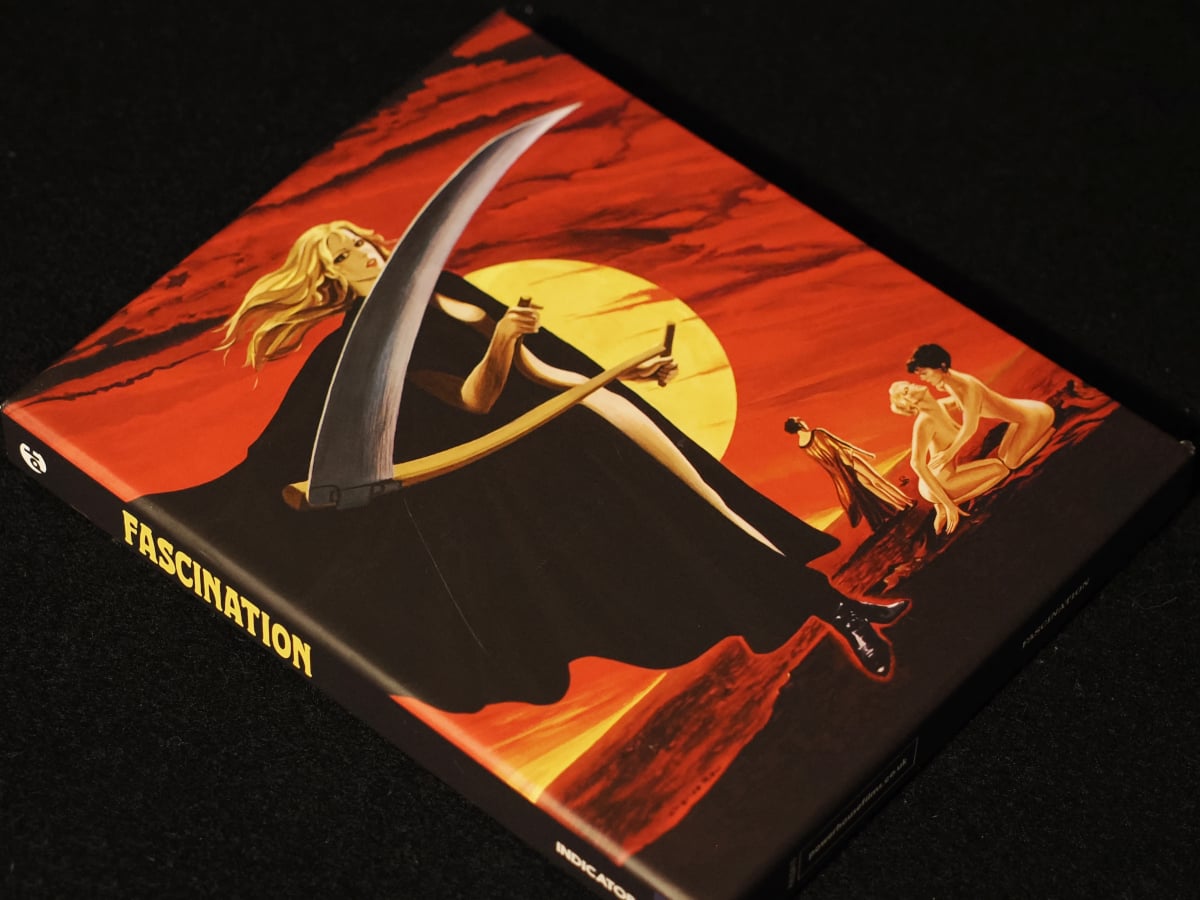
The Fascination movie poster by Charles Rau presents the iconic scene of Brigitte Lahaie with her cape and scythe
Shiver is my favorite, but when I put on my amateur film critic’s hat there’s no question: Fascination is Rollin’s best vampire movie, and maybe his best movie overall. It received unusually good reviews (critics mostly hated Rollin’s work) but because of a dispute with a French film distributor it only played on a few screens. It wasn’t widely seen until it was released on DVD in 1999.
Vampires are: rich women who drink blood.
Rollin tropes: candelabras, sheer gowns, two young women. Is it fair to compare Brigitte Lahaie and Franca Maï – and their leading roles – to the Castel twins and others with small supporting parts? Probably not, but it fits the trope, so I’m doing it.
The Living Dead Girl
(La morte vivante – 1982 – subtitled, no dubbing but some American characters speak English)
Catherine Valmont has been dead for two years. But when graverobbers open her coffin and an earthquake spills chemical waste in her tomb, she returns to life. As she gradually remembers who she was, she realizes she’s now also something else – something deadly.
This is Rollin’s most polarizing film. Much of it takes place at a huge château, but it’s shot almost entirely in the day, which doesn’t create the same atmosphere as the other movies (though the final scene is a dramatic exception). It has less gratuitous sex and nudity than most of his films (though there’s some), but unusually for Rollin, it has a lot of gore. And it has plot holes big enough to drive a Talbot-Matra Rancho through, starting with how Catherine has been dead for two years but her body hasn’t decayed a bit.
What I found personally disturbing was how closely it matched dreams I’ve had of interacting with people I used to know only to suddenly realize “you’re supposed to be dead.” Those dreams usually end after that. But not in this movie. When Helene discovers that her childhood best friend is alive, she can’t believe she was ever dead. But when she realizes what has happened, she’ll do anything to keep her alive – even the unthinkable.
And to add a bit of real spirituality to this blog post of fantasy, The Living Dead Girl is a reminder that when you make an oath – especially a blood oath – you may be required to fulfill it in ways you could never have imagined.
Vampires are: a chemically resuscitated zombie.
Rollin tropes: two young women. Rollin also used the chemical zombie trope in The Grapes of Death (1978). Many consider Grapes one of his best, but I prefer his vampire movies.
Two Orphan Vampires
(Les deux orphelines vampires – 1997 – dubbed and subtitled)
Two blind girls of mysterious origin live in an orphanage and the nuns who run it love them. But at night, they can see (in shades of blue) and they leave the orphanage to explore the world, and to quench their thirst for blood. As they do, they wonder what they are, and they remember who they used to be.
Jean Rollin was best known for making visually spectacular films often with little dialogue. But in Two Orphan Vampires he commits the cardinal sin of movie making: telling the story instead of showing the story. And so we’re subjected to long closeups of the orphans as they talk about previous lives, including one as Aztec priestesses presiding over blood sacrifices.
If you don’t have the budget to film the scene, then write a different scene.
The Rape of the Vampire and Requiem for a Vampire may have been incoherent, but at least they were interesting to look at. Two Orphan Vampires was well written, but the finished product was boring. And to make matters worse, it was Rollin’s longest film at an hour and 47 minutes.
Vampires are: day walkers who are repeatedly killed and reborn.
Rollin tropes: two young women.
Dracula’s Fiancée
(La fiancée de Dracula – 2002 – dubbed and subtitled)
A Van Helsing clone and his assistant try to find Dracula’s location from “parallels” – humans who serve vampires, and who are driven mad by proximity to them. They learn he has claimed Isabelle as his fiancée – she’s being guarded by a group of nuns who are also being driven mad. They try to use her to find Dracula and also save her from him. Meanwhile, no one asks Isabelle what she wants.
Dracula’s Fiancée was Rollin’s attempt to return to the fantastique formula that worked so well in the 70s. He was only partially successful. The opening scene in the cemetery is good, as is the final scene on the beach. But the silliness of the insane nuns (and the fact that they’re nuns) and the confusion around “parallels” keep it from creating the sense of fascination that was so good in his early 70s films.
Brigitte Lahaie has a small part, but her dress looks like something she pulled out of her closet for a business meeting, not a costume suitable for her character. And Catherine Castel has a cameo as a rope-skipping nun – she’s unrecognizable in the habit.
Vampires are: the undead.
Rollin tropes: beach at Dieppe, sheer gowns, vampire in a clock.
Recommended viewing order
You can watch these movies in any order. While themes, tropes, and actors often repeat, there are no repeating characters or continuing storylines. That said, I do not recommend watching them in chronological order.
Begin with Lips of Blood – it’s the most stereotypical Jean Rollin vampire movie. If you finish it thinking “that was a waste of an hour and 28 minutes” then stop there. But if you find it fascinating, keep going. Watch The Nude Vampire and The Shiver of the Vampires next.
With those under your belt, you’ll have enough context to appreciate The Rape of the Vampire as Rollin’s first effort (though it’s currently unavailable on streaming) and Requiem for a Vampire as a flawed but visually interesting movie.
Now enjoy Fascination for the unique and excellent film it is – it really is Rollin’s best. I didn’t like The Living Dead Girl nearly as much, but many do.
I watched Two Orphan Vampires and Dracula’s Fiancée in that order, but as I write this Orphan isn’t available on streaming. I can’t recommend you buy it unless you turn into a Rollin completist like me, so watch Dracula’s Fiancée and pick up Orphan when you find it.
Religious Music and Entertainment
Previous Post

September 29, 2026
I Think I’ve Been Hexed
Next Post

October 18, 2026 The Pillar of the Boatmen: the Ancient Monument to Cernunnos
Recent Comments
"Concern about the attitude of Islam toward Pagans is not limited to the Trump Administration. ..."
"Thank you for your much needed review of the Lucas Miles polemic. A key point ..."
I Read Pagan Threat So You ..."
"A number of these are also available streaming through the Kanopy digital service, carried by ..."
The Vampire Films of Jean Rollin
"Happy October!"
The Vampire Films of Jean Rollin
Browse Our Archives
Select a Category Books Community CUUPS Druidry Foundations and Context Gods and Goddesses Magic Myth Nature Ritual Spiritual Practice Theology Travel Uncategorized Videos
Select a Month October 2026 September 2026 August 2026 July 2026 June 2026 May 2026 April 2026 March 2026 February 2026 January 2026 December 2025 November 2025 October 2025 September 2025 August 2025 July 2025 June 2025 May 2025 April 2025 March 2025 February 2025 January 2025 December 2024 November 2024 October 2024 September 2024 August 2024 July 2024 June 2024 May 2024 April 2024 March 2024 February 2024 January 2024 December 2023 November 2023 October 2023 September 2023 August 2023 July 2023 June 2023 May 2023 April 2023 March 2023 February 2023 January 2023 December 2022 November 2022 October 2022 September 2022 August 2022 July 2022 June 2022 May 2022 April 2022 March 2022 February 2022 January 2022 December 2021 November 2021 October 2021 September 2021 August 2021 July 2021 June 2021 May 2021 April 2021 March 2021 February 2021 January 2021 December 2020 November 2020 October 2020 September 2020 August 2020 July 2020 June 2020 May 2020 April 2020 March 2020 February 2020 January 2020 December 2019 November 2019 October 2019 September 2019 August 2019 July 2019 June 2019 May 2019 April 2019 March 2019 February 2019 January 2019 December 2018 November 2018 October 2018 September 2018 August 2018 July 2018 June 2018 May 2018 April 2018 March 2018 February 2018 January 2018 December 2017 November 2017 October 2017 September 2017 August 2017 July 2017 June 2017 May 2017 April 2017 March 2017 February 2017 January 2017 December 2016 November 2016 October 2016 September 2016 August 2016 July 2016 June 2016 May 2016 April 2016 March 2016 February 2016 January 2016 December 2015 November 2015 October 2015 September 2015 August 2015 July 2015 June 2015 May 2015 April 2015 March 2015 February 2015 January 2015 December 2014 November 2014 October 2014 September 2014 August 2014 July 2014 June 2014 May 2014 April 2014 March 2014 February 2014 January 2014 December 2013 November 2013 October 2013 September 2013 August 2013 July 2013 June 2013 May 2013 April 2013 March 2013 February 2013 January 2013 December 2012 November 2012 October 2012 September 2012 August 2012 July 2012 June 2012 May 2012 April 2012 March 2012 February 2012 January 2012 December 2011 November 2011 October 2011 September 2011 August 2011 July 2011 June 2011 May 2011 April 2011 March 2011 February 2011 January 2011 December 2010 November 2010 October 2010 September 2010 August 2010 July 2010 June 2010 May 2010 April 2010 March 2010 February 2010 January 2010 December 2009 November 2009 October 2009 September 2009 August 2009 July 2009 June 2009 May 2009 April 2009 March 2009 February 2009 January 2009 December 2008 November 2008 October 2008 September 2008 August 2008 July 2008 June 2008
Follow Us!
TAKE THE
Religious Wisdom Quiz
Who said, "You intended to harm me, but God intended it for good"?
Select your answer to see how you score.
Joseph David Solomon Job
Related posts from John Beckett


Bo French Doesn’t Understand Texas

What We Lose When “Ask AI” Becomes A...
The Bloody Road to Castle Dracula
TRENDING AT PATHEOS Pagan

Emotion in Early Christianity by Andrew Crislip
Andrew Crislip’s Emotion in Early Christianity examines an often overlooked dimension of...

16 Spiritual Touchstones for a More Grounded Life
After decades of spiritual study, here are 16 principles I try...

Catholic Evangelization: Sharing Your Faith Every Day
Welcome back to the Graceful Awakening mini-series called, “From Faith to Mission.” ...
The Pillar of the Boatmen: the Ancient Monument...
The Pillar of the Boatmen is a Romano-Gaulish sculpture that dates from...

In one sense walking into Westminster Abbey is like walking down the...

'Super Scam Me' Exposes AI Jon Bon Jovi...
Leslie Pickett believed she was in a relationship with Jon Bon Jovi....
view all Pagan blogs
What Are Your Thoughts?leave a comment
Ad-Free & Subscriber Log-In Subscription Support
- About Us
- 2026 Calendar
- Videos
- Podcasts
- Library of World Religions
- Faith In Media Tracker
- Advertise With Us
- Write for Us
- Privacy Policy
- Terms of Service
- Do Not Sell My Data
- Contact Us
- Radiant Digital
- Manage Newsletter Subscriptions
- Unsubscribe From Notifications
- Sitemap
Copyright 2008-2026, Patheos. All rights reserved.
Subscription Support Ad-Free & Subscriber Log-In
Follow Patheos