
BuddhistCatholicContemplativeEvangelicalGeneral ChristianHinduJewishLatter-day SaintMuslimNew VisionsProgressive Christian
Beliefs
- Buddhist
- Catholic
- Contemplative
- Evangelical
- General Christian
- Hindu
- Jewish
- Latter-day Saint
- More Voices
- Muslim
- New Visions
- Pagan
- Progressive Christian
Topics
- Religion News
- Food and Religion
- Sports and Religion
- Religious Art
- Religious Music and Entertainment
- Religious Events
- History and Religion
- Style and Religion
- Politics and Religion
- Women in Religion
- Recreation Outdoors and Religion
- Business Finance and Religion
- Careers Workplace and Religion
- Education and Religion
- Family Parenting and Religion
- Health Fitness and Religion
- Home and Religion
- Relationships and Religion
- Technology and Religion
- Travel and Religion
Columnists
- Buddhist Columnists
- Business Finance and Religion Columnists
- Careers Workplace and Religion Columnists
- Catholic Columnists
- Contemplative Columnists
- Education and Religion Columnists
- Evangelists Columnists
- Family Parenting and Religion Columnists
- General Christian Columnists
- Health Fitness and Religion Columnists
- Hindu Columnists
- History and Religion Columnists
- Home and Religion Columnists
- Jewish Columnists
- More Voices Columnists
- Latter Day Columnists
- Muslim Columnists
- New Visions Columnists
- Nonreligious Columnists
- Pagan Columnists
- Politics and Religion Columnists
- Progressive Columnists
- Recreation Outdoors and Religion Columnists
- Relationships and Religion Columnists
- Religion News Columnists
- Religious Art Columnists
- Religious Events Columnists
- Religious Music and Entertainment Columnists
- Sports and Religion Columnists
- Style and Religion Columnists
- Technology and Religion Columnists
- Travel and Religion Columnists
- Women in Religion Columnists
Resource Library
- 2026 Calendar
- Library of World Religions
- The 100 Most Holy Places on Earth
- Patheos Answers
- Podcasts
- Videos
- Faith Leaders Database
- Anglican Episcopalian
- Bahai
- Baptist
- Buddhism
- Christianity
- Confucianism
- Eastern Orthodoxy
- Hinduism
- Holiness and Pentecostal
- ISKCON
- Islam
- Judaism
- Lutheran
- Methodist
- The Church of Jesus Christ of Latter-day Saints
- New Age
- Paganism
- Presbytarian and Reformed
- Protestantism
- Religion Behind the Scenes
- Roman Catholic
- Scientology
- Shia Islam
- Sikhism
- Sufism
- Sunni Islam
- Taoism
- Zen
- See all religions
Research Tools
 Ad-Free & Subscriber Log-In Subscription Support
Ad-Free & Subscriber Log-In Subscription Support
Follow Patheos 

- Trending:
- Forgiveness
- |
- Marriage
- |
- Consciousness
- |
- Death Penalty
- |
- Election
- |
- Halloween

- Home
- Pagan
- The Case For Polytheism
The Case For Polytheism
Last updated on: September 28, 2025 at 3:00 am by John Beckett
The Case For Polytheism 2025-09-26T20:06:03-06:00 John Beckett
Patheos Explore the world's faith through different perspectives on religion and spirituality! Patheos has the views of the prevalent religions and spiritualities of the world.
We do not need anyone’s approval to be Pagan. We do not proselytize, so we have no need to craft brilliant arguments to convince others of the reality of the many Gods. Those of us who are polytheists simply need to acknowledge the Gods and choose to worship, work with, and work for one or more of them.
But we live in a society where the loudest voices scream that there is only one God and the second loudest voices scream there are no Gods. It can be hard to hear the Gods over all that screaming, hard to not passively conform to our family, friends, and neighbors who are sure they have the truth, even though they’ve never seriously considered the question.
Are the Gods many, one, or none? We owe it to ourselves to contemplate this question and to choose the answer that seems most likely to us, rather than simply accepting what we were told as children – or acquiescing to the loudest voices in the public square.
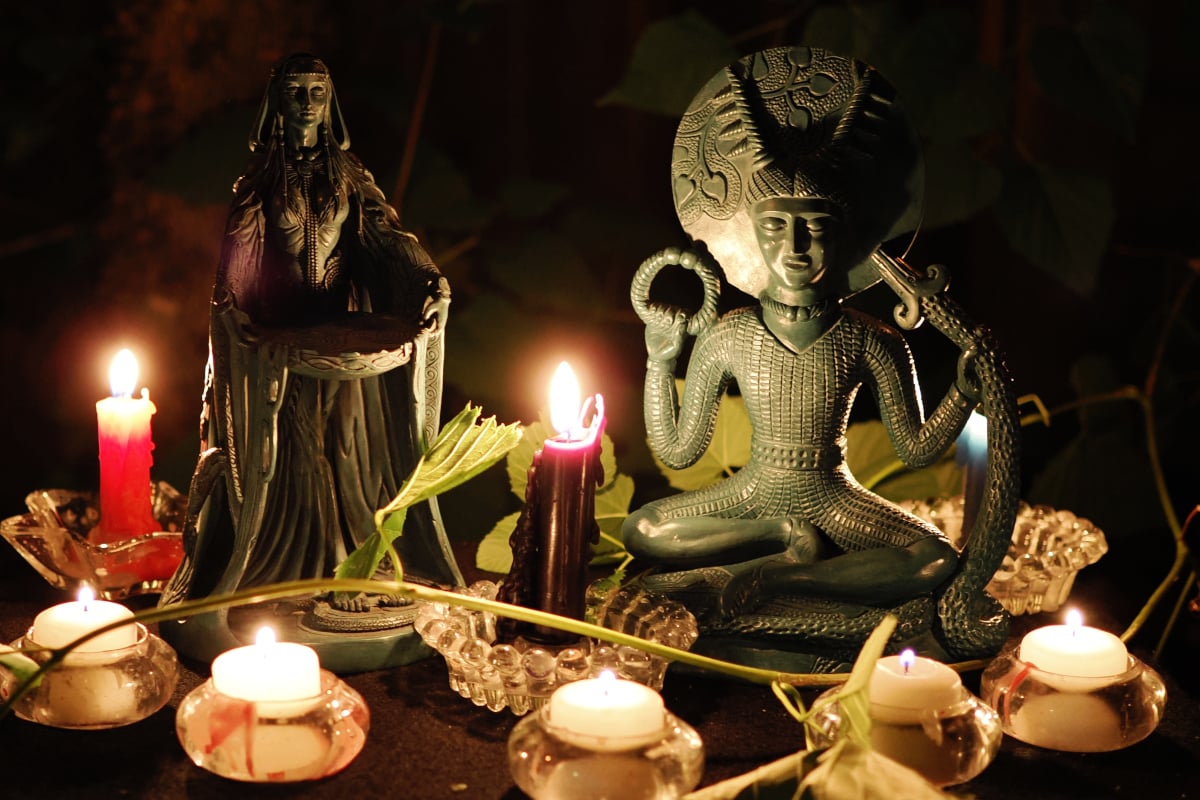
Danu and Cernunnos
Religious questions are inherently uncertain
If we’re going to explore foundational questions of religion and metaphysics, we have to begin with an admission: these questions are inherently uncertain. We cannot prove the existence – or the non-existence – of the Gods in the way we can prove or disprove various concepts and phenomena in science and mathematics.
How did the universe begin? Where did we come from? What happens after we die? How should we live while we’re here? People have been arguing about this for at least as long as we’ve been human and they’re not going to stop any time soon.
Metaphysics is the branch of philosophy that deals with these questions, with our foundational assumptions about the world and the way it works. Everyone has a metaphysics, but for most people, they’re “what everybody knows” and “common sense” and “just the way things are.” They’re what they were taught as small children. They never consider that perhaps their fundamental assumptions are wrong, or that another explanation might be better, or that another approach might be more in line with their values.
We need to do our best to explore these questions while still accepting that our answers will always be tentative and uncertain.
And we also need to remember that just because something is uncertain doesn’t mean any answer is a good answer. Some answers are more likely than others – and some answers are either demonstrably false or so unlikely they can be safely dismissed.
Knowing the Gods through tradition
Most people start here, and that’s fine. The problem is that too many people never move beyond here.
Whether we’re exploring religion, art, science, or anything else, we need not – and I argue, we should not – start from zero. Technology has advanced to unbelievable levels because each generation has built on the discoveries and innovations of previous generations. We can do the same in religion.
We have some of the sacred stories our ancestors told. We have some of their beliefs, some of their liturgies, some of their “spiritual technology” – if we’re fortunate, if those things weren’t either lost to time or deliberately destroyed by conquering religions.
Tradition need not be ancient. There is no ancient lore about Cernunnos. But there is modern lore, and that’s a good thing.
Tradition is a place to start. But it’s not everything.
Knowing the Gods through reason
Most of the classic “proofs for the existence of God” are based on inference. Given that we know certain things, other things are likely to also be true. This goes all the way back to Aristotle’s “prime mover” which said that since everything has a cause, there must be a first cause that itself is uncaused.
The main problem with this is that many monotheists take that a step further and argue that the prime mover must be their God, when it might be a different God. Or it might be someone or something that is beyond our capacity to comprehend.
Still, our inferences point us in the direction of Gods, in one form or another.
Knowing the Gods through experience
Before humans thought rationally about the Gods, they experienced the Gods.
I’m reluctant to call first-hand experience of the Gods a human universal because many people have trouble with this. The dominant religion tells us such experience is impossible (except through their approved methods, which don’t work every time for every person) and popular culture leaves us expecting a spectacle out of a comic book movie.
Most religious experiences are far more subtle. Some aren’t, but most are.
Some of these experiences are a connection to a greater whole. This leads us to pantheism, the idea that the Divine is everywhere in everything.
Other experiences connect us to an individual person. This leads us to classic theism, either polytheism (many Gods) or monotheism (one God).
My own polytheism is grounded in a framework of pantheism. We are all part of a greater Whole, even though we cannot relate to the Whole as we relate to ourselves and to other parts.
Multiple differing experiences imply multiple individual deities
I struggled with polytheism in my early Pagan days. I had grown up and spent my whole life as a monotheist and I had internalized monotheist concepts.
And then before Denton CUUPS’ first Egyptian Summer Solstice ritual in 2004, those of us who were presenting the ritual decided to spend nine nights in meditation, one night on each deity of the Ennead. As I progressed through the meditations, I realized that my experience of Isis was different from my experience of Osiris, and both were different from my experience of Set and of Nephthys.
And then it hit me: if I experienced the Gods as individuals, then I should understand them as individuals and I should relate to them as individuals. That approach works very well for me, and for others.
Areas of responsibility and interest, and more
Many deities are known as the Goddess of This or the God of That. Some of that is an inference, as we discussed above: we look for a cause or a controller behind a natural phenomenon and infer that’s a God.
And so we have the God of the Sun and the Goddess of the Moon and the God of This Mountain and the Goddess of This River and so on. When we see the Gods in their functions, it follows that the God of the Sun and the Goddess of the River are not the same. They have different areas of interest, different names, different personalities. Our experiences of this functionality tells us the Gods are many, not one.
But even where our ancestors understood that deities have functions, they also told stories about the Goddess of This or the God of That doing things that had nothing to do with This or That. In other words, they were behaving like whole persons.
The Gods are many, and the Gods are individuals, not simply functions.
We have relationships with persons
I get annoyed when people say things like “the universe is looking after you.” The universe is a collective noun for all that is. The universe doesn’t care about you because the universe isn’t a person who’s capable of caring about you or anything else. Pantheism may be true (I tend to think it is) but we cannot form relationships with the God of pantheism.
We can form relationships with the many Gods.
I have a priestly relationship with Cernunnos and with Danu. I have a sworn relationship with the Morrigan that is not priesthood, but that often functions like it.
I have informal but regular relationships with Lugh, Brighid, Isis, Thoth, and Cerridwen. I have made no promises to them, but we seem to find ourselves working toward similar goals in similar ways, so I have their statues on my altars and I pray to them every night.
I pray, meditate, and make offerings. I listen for their calls and their instructions. Mainly, I try to incorporate their virtues and values into my life – I try to be more like them, even though I know I can’t come close to their level of wisdom and virtue.
The English word “religion” comes to us in part from the Latin word religare, meaning “to bind together.” It has the same linguistic roots as the English word “ligament.” Religion is a set of protocols for forming and maintaining relationships, especially relationships with the Gods.
Does it work?
How do we evaluate metaphysical propositions that cannot be either proven or disproven? We can’t determine if it’s true or false, or even if it’s mostly true or mostly false.
We can evaluate the results of accepting or rejecting those propositions.
Does it make your life better? Not easier – good things often make your life anything but easy – but more meaningful. Does it help you deal with the challenges of life? Does it help you find your place in the world? Does it help you deal with the knowledge that you are alive but someday you will die?
For me, that answer is an unqualified yes.
Cernunnos has been with me since before I knew who he was. He helps me remember that I’m a part of Nature – neither its head nor its center, but one part among many.
Danu has been with me since early in my Pagan journey. She doesn’t say much, but what she does say is filled with wisdom.
I seem to work for the Morrigan more than for anyone else, and that’s fine. I strongly support her mission of sovereignty, and while I am not a warrior, I find great meaning in doing my part in these difficult times. The Morrigan holds my death, and I take comfort in that… particularly as I get older.
Other deities are a part of my life. Some are part of my regular practice. Some I hear from or speak to occasionally, and some manage to draft me into their service unexpectedly.
My life is better with the Gods in it, and I am thankful for them.
Polytheism is humanity’s default religious position
Religious scholar Jordan Paper said that left to themselves, people simply acknowledge and worship their Gods. “Without monotheism … polytheists would have no more reason to call themselves such than they would to call themselves ‘air breathers’ or ‘bipedal’.” Monotheism has succeeded because it demands domination and actively seeks it.
And now it’s fading.
Christianity is still the most popular religion in the West, especially in the United States. But it does not have the cultural dominance – or the sheer numbers – it had 10 years ago, much less 60 years ago (church attendance peaked around 1960). Now people are free to follow the path that calls to them, that seems right to them.
For many of us, that means acknowledging, honoring, and worshipping many Gods.
For further reading
Paganism In Depth – A Polytheist Approach (2019)
Deity Work (2025)
An Epistemology of the Many Gods (2023)
Our Gods Are Not Jealous Gods (2020)
Why I Believe in the Gods (2019)
When You Hear The Call of The Morrigan (2017)
Previous Post

September 24, 2025
I Read Pagan Threat So You Don’t Have To
Next Post

October 1, 2025 10 Great Movies For Halloween You Probably Haven’t Seen
Recent Comments
"Concern about the attitude of Islam toward Pagans is not limited to the Trump Administration. ..."
"Thank you for your much needed review of the Lucas Miles polemic. A key point ..."
I Read Pagan Threat So You ..."
"A number of these are also available streaming through the Kanopy digital service, carried by ..."
The Vampire Films of Jean Rollin
"Happy October!"
The Vampire Films of Jean Rollin
Browse Our Archives
Select a Category Books Community CUUPS Druidry Foundations and Context Gods and Goddesses Magic Myth Nature Ritual Spiritual Practice Theology Travel Uncategorized Videos
Select a Month October 2026 September 2026 August 2026 July 2026 June 2026 May 2026 April 2026 March 2026 February 2026 January 2026 December 2025 November 2025 October 2025 September 2025 August 2025 July 2025 June 2025 May 2025 April 2025 March 2025 February 2025 January 2025 December 2024 November 2024 October 2024 September 2024 August 2024 July 2024 June 2024 May 2024 April 2024 March 2024 February 2024 January 2024 December 2023 November 2023 October 2023 September 2023 August 2023 July 2023 June 2023 May 2023 April 2023 March 2023 February 2023 January 2023 December 2022 November 2022 October 2022 September 2022 August 2022 July 2022 June 2022 May 2022 April 2022 March 2022 February 2022 January 2022 December 2021 November 2021 October 2021 September 2021 August 2021 July 2021 June 2021 May 2021 April 2021 March 2021 February 2021 January 2021 December 2020 November 2020 October 2020 September 2020 August 2020 July 2020 June 2020 May 2020 April 2020 March 2020 February 2020 January 2020 December 2019 November 2019 October 2019 September 2019 August 2019 July 2019 June 2019 May 2019 April 2019 March 2019 February 2019 January 2019 December 2018 November 2018 October 2018 September 2018 August 2018 July 2018 June 2018 May 2018 April 2018 March 2018 February 2018 January 2018 December 2017 November 2017 October 2017 September 2017 August 2017 July 2017 June 2017 May 2017 April 2017 March 2017 February 2017 January 2017 December 2016 November 2016 October 2016 September 2016 August 2016 July 2016 June 2016 May 2016 April 2016 March 2016 February 2016 January 2016 December 2015 November 2015 October 2015 September 2015 August 2015 July 2015 June 2015 May 2015 April 2015 March 2015 February 2015 January 2015 December 2014 November 2014 October 2014 September 2014 August 2014 July 2014 June 2014 May 2014 April 2014 March 2014 February 2014 January 2014 December 2013 November 2013 October 2013 September 2013 August 2013 July 2013 June 2013 May 2013 April 2013 March 2013 February 2013 January 2013 December 2012 November 2012 October 2012 September 2012 August 2012 July 2012 June 2012 May 2012 April 2012 March 2012 February 2012 January 2012 December 2011 November 2011 October 2011 September 2011 August 2011 July 2011 June 2011 May 2011 April 2011 March 2011 February 2011 January 2011 December 2010 November 2010 October 2010 September 2010 August 2010 July 2010 June 2010 May 2010 April 2010 March 2010 February 2010 January 2010 December 2009 November 2009 October 2009 September 2009 August 2009 July 2009 June 2009 May 2009 April 2009 March 2009 February 2009 January 2009 December 2008 November 2008 October 2008 September 2008 August 2008 July 2008 June 2008
Follow Us!
TAKE THE
Religious Wisdom Quiz
What was the name of the Jewish ruling council in Jesus’ time?
Select your answer to see how you score.
Essenes Sanhedrin Sadducees Pharisees
Related posts from John Beckett




What We Lose When “Ask AI” Becomes A...
TRENDING AT PATHEOS Pagan

How to Make a Decision When You Can't...
Main point: It’s much more valuable to stay close to God so...

Archdiocese Hosts Military Marriage Retreat in Germany
RASTATT, Germany — The transient military lifestyle, with its frequent deployments and...

Nearly every morning, I make the drive to Detroit with my high-school-age...

The Real AI Story Is Adoption Without Trust
Artificial intelligence has crossed a political threshold. It is no longer a...

A new article, written by Jeff Lindsay and Gale L. Pooley,...

Swimfan: Forgotten Aughts Pleasures
This is a recovery effort. In 2002, My Big Fat Greek Wedding...
view all Pagan blogs
What Are Your Thoughts?leave a comment
Ad-Free & Subscriber Log-In Subscription Support
- About Us
- 2026 Calendar
- Videos
- Podcasts
- Library of World Religions
- Faith In Media Tracker
- Advertise With Us
- Write for Us
- Privacy Policy
- Terms of Service
- Do Not Sell My Data
- Contact Us
- Radiant Digital
- Manage Newsletter Subscriptions
- Unsubscribe From Notifications
- Sitemap
Copyright 2008-2026, Patheos. All rights reserved.
Subscription Support Ad-Free & Subscriber Log-In
Follow Patheos